
AI in Financial Services: Key Use Cases, Benefits, and Future Trends
AI in financial services is rapidly becoming a core driver of innovation, enabling institutions to automate operations, enhance decision-making, and deliver highly personalized customer experiences. From fraud detection to predictive analytics and generative AI, the technology unlocks significant efficiency and growth opportunities. However, success depends on addressing challenges around data security, compliance, and talent while partnering with experienced providers like HomeNest Software to build scalable, future-ready solutions.
Scope of Work
Artificial intelligence (AI) is systematically optimizing operational efficiency, reducing compliance costs, and enabling data-driven revenue generation without disrupting existing architectures. In this article, HomeNest Software explores real-world AI use cases in financial services and the core technologies driving these advancements.
What Is AI in Financial Services?
AI in financial services refers to the use of artificial intelligence to enhance financial processes, systems, and customer experiences. Unlike traditional rule-based automation, AI-driven solutions can learn from data, identify patterns, and make real-time decisions enabling more accurate predictions and smarter operations across the financial ecosystem.
Core Technologies Behind AI in Financial Services
- Machine Learning & Deep Learning: These technologies allow systems to analyze historical data and continuously improve over time. They are widely used for risk prediction, fraud detection, credit scoring, and portfolio optimization.
- Natural Language Processing (NLP): NLP enables AI systems to understand and process human language, powering applications such as chatbots, virtual assistants, and automated customer support.
- Computer Vision: This technology extracts and digitizes information from documents like invoices, contracts, and identity records. It plays a key role in automating KYC (Know Your Customer) processes and accelerating loan approvals.
- Generative AI (e.g., GPT, GANs): Generative AI serves as a scalable infrastructure for generating aggregated data, automated reporting, and dynamic risk simulation. It is used to create synthetic data, automate content generation, simulate risk scenarios, and build intelligent virtual assistants that enhance customer engagement.
By combining these technologies, AI is transforming financial services into a more intelligent, efficient, and data-driven industry.
Benefits of AI in Financial Services
The adoption of AI in financial services delivers tangible advantages across operations, decision-making, and customer engagement. These benefits not only streamline internal processes but also help organizations strengthen their competitive position in an increasingly digital market.
Automation and Speed
Speed is a critical differentiator in modern finance. AI enables institutions to automate repetitive tasks and process large volumes of data almost instantly.
Activities that once required hours such as report generation, document verification, or transaction processing can now be completed in seconds. This allows businesses to respond faster to customer needs, execute transactions efficiently, and capitalize on market opportunities in real-time.
Precision and Accuracy
AI significantly improves accuracy by minimizing human error and eliminating bias in data analysis. In financial environments, where even small mistakes can have major consequences, this level of precision is essential.
AI systems can continuously analyze vast datasets with consistent reliability, delivering more accurate forecasts, risk assessments, and decision-making insights without fatigue or inconsistency.
Efficiency and Scalability
Beyond speed, AI enhances long-term operational efficiency. It allows financial systems to handle fluctuations in transaction volume without manual intervention.
For example, during peak periods such as salary payment cycles AI-driven systems can automatically scale infrastructure resources to maintain performance. This reduces operational strain and ensures seamless service delivery even under heavy demand.
Innovation and Competitive Advantage
AI transforms data into actionable intelligence, enabling financial institutions to innovate and stay ahead of competitors. By analyzing customer behavior, market trends, and risk patterns, businesses can develop new products, improve services, and optimize strategies.
Organizations that adopt AI early gain a significant advantage unlocking new revenue streams, improving profitability, and building more adaptive, future-ready financial ecosystems.
By leveraging AI, financial institutions can move beyond traditional limitations and create faster, smarter, and more resilient systems that drive sustainable growth.
Key Stakeholders of AI in Financial Services

Implementing AI in financial services is not solely a technological initiative; it requires strong alignment across leadership, technical teams, and governance functions. Understanding the role of each stakeholder ensures a cohesive strategy and maximizes the value AI can deliver.
Executives and Financial Leadership
Senior leaders such as CEOs and CFOs define the strategic direction for AI adoption. They determine investment priorities, evaluate long-term business impact, and ensure AI initiatives align with overall growth objectives.
For AI especially generative AI to deliver real value, it must be integrated into the organization’s core strategy rather than treated as a standalone experiment. Leadership plays a critical role in driving this alignment.
CIOs, CTOs, and Technology Teams
While executives set the vision, CIOs, CTOs, and engineering teams are responsible for execution. They evaluate technologies, oversee system architecture, and ensure secure integration of AI into existing platforms.
Their role also includes maintaining system performance, scalability, and adaptability ensuring AI solutions can evolve alongside changing business and market demands.
Risk Management and Legal Teams
In a highly regulated industry, risk and legal teams are essential to responsible AI deployment. They ensure that AI systems comply with financial regulations, assess potential legal risks, and maintain adherence to industry standards.
Their involvement helps organizations avoid compliance issues while building trustworthy and secure AI-driven systems.
Ethics, Compliance, and Audit Functions
As AI adoption grows, ethical considerations become increasingly important. Teams focused on ethics, diversity, and auditing ensure that AI systems operate fairly, transparently, and without bias.
They work closely with compliance and cybersecurity teams to protect data privacy, enforce responsible AI usage, and maintain accountability across all financial processes.
Customers
Customers are the ultimate beneficiaries of AI in financial services. They experience faster transactions, more accurate services, and highly personalized interactions powered by AI technologies.
At the same time, customer behavior and feedback play a crucial role in refining AI models. By understanding user needs, financial institutions can continuously improve their systems, building trust, satisfaction, and long-term loyalty.
A successful AI strategy in financial services depends on the collaboration of all stakeholders combining strategic vision, technical execution, regulatory oversight, and customer-centric thinking to drive sustainable innovation.
Governance of AI in Financial Services
Effective AI governance in financial services requires a structured approach that combines regulatory alignment, risk control, and continuous oversight. To ensure AI systems remain transparent, fair, and compliant, organizations must focus on the following core components:
Regulatory Frameworks
A strong governance foundation begins with compliance. Financial institutions must align with key regulations such as the EU AI Act, Singapore’s FEAT Principles, and global standards like GDPR, AML, and Basel III. These frameworks guide the responsible use of AI, particularly for high-risk applications, and ensure that systems meet legal and ethical requirements.
Algorithmic Risk Controls
Robust model governance is essential to manage risks associated with AI-driven decisions. This includes regular model validation, algorithm audits, version control, and lifecycle management.
Such controls are especially critical in sensitive areas like credit scoring, fraud detection, and underwriting, where errors or biases can lead to significant financial and operational consequences.
Transparency and Fairness
Transparency is a key principle in AI governance. Explainable AI (XAI) helps make algorithmic decisions understandable to regulators, auditors, and end users.
At the same time, organizations must actively address data bias to ensure fair outcomes. Promoting fairness not only reduces ethical risks but also strengthens trust in AI-driven financial services.
Continuous Monitoring and Evaluation
AI systems require ongoing supervision even after deployment. Financial institutions should implement real-time performance monitoring, conduct regular testing, and establish feedback loops to refine models over time.
This continuous evaluation ensures that AI solutions remain accurate, reliable, and compliant as business conditions and regulatory environments evolve.
By establishing strong governance practices, organizations can confidently deploy AI in financial services balancing innovation with accountability, and performance with compliance.
AI Use Cases in Financial Services
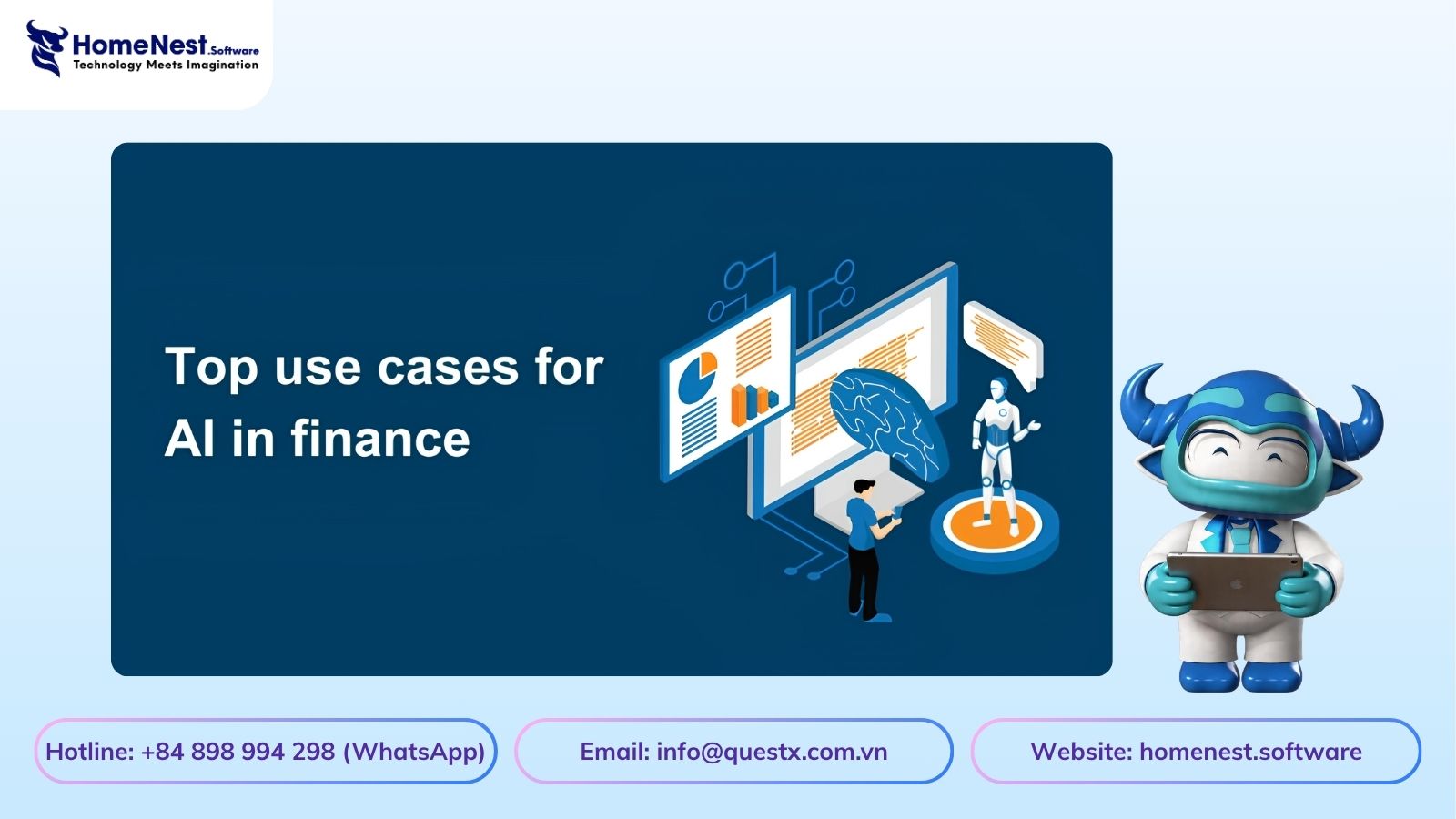
Artificial Intelligence is fundamentally reshaping the financial services industry, moving from experimental adoption to large-scale, production-grade deployment. Today, AI is embedded across trading, risk management, customer experience, and operational efficiency delivering measurable impact in speed, accuracy, and decision making.
Below is a detailed breakdown of the most impactful AI use cases across the financial ecosystem.
1. Market and Investment Intelligence
AI plays a critical role in financial markets by enabling faster, data-driven investment decisions and automating complex trading strategies.
Algorithmic Trading
Algorithmic trading is one of the most mature AI applications in finance. It allows institutions to execute thousands of trades within milliseconds based on real-time signals and predefined strategies.
For example, asset managers deploy AI systems that monitor thousands of stocks simultaneously. When technical indicators (such as moving averages) align with positive market sentiment from news or social media, the system can trigger buy or sell orders instantly.
Core technologies include:
- Reinforcement Learning (RL) to continuously optimize trading strategies
- High-frequency trading (HFT) systems for ultra-fast data processing
- Real-time data pipelines analyzing price, volume, and sentiment signals
This enables firms to react faster than human traders and capture short-lived market opportunities.
Portfolio Management
AI enhances portfolio management by dynamically optimizing asset allocation based on market conditions and individual risk profiles.
A typical use case involves robo-advisory platforms that automatically rebalance portfolios when volatility increases shifting capital from high-risk assets to safer investments in real time.
Key technologies:
- Time series forecasting models (LSTM, ARIMA)
- Predictive analytics for asset performance
- Robo-advisors using customer financial profiles
This results in better risk-adjusted returns and more personalized investment strategies.
Predictive Analytics and Sentiment Analysis
AI combines historical data with real-time sentiment analysis to predict market movements.
For instance, AI systems analyze news articles, social media, and financial reports to detect shifts in sentiment. A spike in negative sentiment around a financial asset can trigger early warnings of potential price drops.
Technologies used:
- NLP pipelines for sentiment classification
- Forecasting models like Prophet and ARIMA
- Real-time alert systems for traders
This approach provides a competitive edge in volatile markets.
Competitive Intelligence
AI also supports strategic decision making by monitoring competitor activities and market trends.
Banks use AI systems to track competitor pricing, product launches, and public announcements. This allows them to adjust strategies quickly and maintain market competitiveness.
Technologies involved:
- Web scraping tools
- NLP for document analysis
- Business intelligence dashboards
2. Risk Management and Compliance
AI is revolutionizing how financial institutions detect risks, prevent fraud, and maintain regulatory compliance.
Fraud Detection and Anomaly Detection
AI systems can monitor millions of transactions in real-time and detect suspicious behavior instantly.
For example, if a transaction occurs from an unusual location or device, the system can automatically flag or block it within seconds.
Technologies:
- Isolation Forest for anomaly detection
- Autoencoders for behavioral modeling
- Streaming systems like Kafka or Spark
Credit Scoring
AI-driven credit scoring goes beyond traditional financial data by incorporating alternative data sources such as mobile usage or transaction history.
This allows institutions to evaluate borrowers more accurately even those without formal credit histories.
Technologies:
- XGBoost and Random Forest models
- Advanced feature engineering
- Behavioral data analytics
Automated Loan Processing
AI automates the entire loan lifecycle from document verification to approval decisions.
For example, digital banks can approve loans within minutes by extracting and validating applicant data automatically.
Technologies:
- OCR for document digitization
- NLP for data validation
- RPA for workflow automation
Cybersecurity and Compliance Monitoring
AI strengthens security by continuously monitoring system activity and detecting unusual behavior.
For instance, if an internal account accesses sensitive data outside normal patterns, AI systems can immediately revoke access.
Technologies:
- AI-powered SIEM systems (e.g., Splunk, QRadar)
- UEBA (User Behavior Analytics)
- Rule-based compliance engines
3. Customer-Centric Services
AI enhances customer experience by delivering faster, more personalized financial services.
Customer Service Automation
Conversational AI (chatbots and voicebots) enables 24/7 customer support, handling thousands of requests simultaneously.
For example, users can block lost cards, check balances, or initiate services without human assistance.
Technologies:
- NLP platforms (Dialogflow, Rasa)
- Speech-to-text and text-to-speech systems
- Multichannel integration
Personal Finance Management
AI-powered applications analyze spending habits and provide personalized recommendations for budgeting and saving.
These systems can automatically suggest financial plans based on user behavior and goals.
Technologies:
- Recommendation engines
- Predictive cash flow models
- Behavioral analytics
AI-Driven Virtual Financial Advisors
With the rise of generative AI, virtual advisors can provide highly personalized financial guidance.
For example, users can ask complex questions about retirement planning, and AI systems generate tailored strategies instantly.
Technologies:
- Large Language Models (LLMs)
- Fine-tuned AI models for financial compliance
- Context-aware recommendation systems
4. Operations and Efficiency
AI significantly improves back-office operations, reducing costs and increasing productivity.
Data Analysis and Document Processing
AI can extract and analyze information from large volumes of unstructured documents such as contracts, financial reports, and pitch decks.
Technologies:
- OCR and NLP pipelines
- Named Entity Recognition (NER)
- BI dashboards (Tableau, Looker)
Cost Reduction and Process Automation
AI automates repetitive tasks such as reconciliation, auditing, and reporting, reducing operational costs and human error.
For example, processes that once required entire teams can now be handled by a single analyst supported by AI.
Technologies:
- RPA tools like UiPath
- Anomaly detection models
- NLP-based classification engines
Scenario Simulation and Synthetic Data
Generative AI enables institutions to simulate complex financial scenarios and generate synthetic datasets for training models.
This is especially useful when real-world data is limited or sensitive.
Technologies:
- GANs and diffusion models
- Scenario simulation engines
- Synthetic data generation frameworks
Voice and Image AI for KYC
AI improves onboarding by handling low-quality documents and diverse user conditions.
For example, fintech companies use synthetic data to train systems to recognize blurred IDs or varied voice inputs.
Technologies:
- Diffusion models for image generation
- Voice synthesis systems
- Adversarial training for robustness
AI in financial services is no longer limited to isolated use cases; it is becoming a foundational layer across the entire financial ecosystem. Organizations that successfully integrate AI across trading, risk, customer experience, and operations will gain a significant competitive advantage in speed, intelligence, and scalability.
Trends and Future of AI in Financial Services
The financial services industry has moved beyond the experimental phase of artificial intelligence; it is now a mandatory infrastructure for survival. However, practical implementation reveals a harsh truth: the main bottleneck for financial institutions is rarely the AI algorithm itself, but rather the integration of these models into outdated, cumbersome core banking systems. In the future, the real competitive advantage will belong to organizations that can design seamless, event-driven data paths, transitioning from individual AI experiments to high-frequency, real-time data processing without compromising architectural stability.
Accelerating Adoption and Business Impact
Financial institutions are increasingly viewing AI as a core business capability rather than a supporting tool. From predictive analytics to generative AI, organizations are leveraging intelligent systems to optimize operations, enhance decision making, and create new digital products.
Many firms anticipate that AI will contribute directly to revenue generation whether through automated investment strategies, personalized financial services, or AI-powered platforms.
Challenges: Security, Privacy, and Talent Gaps
Despite its potential, AI adoption comes with significant challenges. Data security and vendor dependence remain serious concerns. In tightly regulated environments, relying on third-party “black box” AI models poses significant compliance risks. We mitigate this by ensuring 100% source code and model architecture transfer, guaranteeing your internal teams maintain absolute control over sensitive financial data and algorithm governance.
Another major challenge is the talent gap. There is a growing shortage of professionals with expertise in AI, data science, and financial systems. At the same time, workforce disruption is inevitable, as AI reshapes traditional roles and workflows.
Workforce Transformation and Emerging Roles
AI is not simply replacing jobs; it is redefining them. Routine and repetitive tasks are increasingly automated, allowing employees to focus on higher-value responsibilities such as data analysis, strategic planning, and AI oversight.
New hybrid roles are emerging that combine technical knowledge with business and ethical understanding. These roles are critical for ensuring that AI systems are used responsibly and effectively.
The Shift Toward Reskilling and Adaptation
To keep pace with these changes, many organizations are investing heavily in reskilling and upskilling initiatives. Training programs focused on AI literacy, data analysis, and digital competencies are becoming essential.
This transition represents not just a technological shift, but a broader organizational transformation where human expertise and AI capabilities work together to drive innovation and long-term growth.
AI is set to become a foundational pillar of the financial industry. Organizations that embrace this shift strategically while addressing challenges around security, talent, and governance will be best positioned to lead in the next era of financial services.
Conclusion
AI in financial services has evolved from a supporting capability into a strategic foundation for long-term growth in the digital economy. Financial institutions that act early can unlock new revenue opportunities, enhance operational efficiency, and strengthen risk management.
To stay competitive, businesses must adopt the right AI solutions, align them with their strategic goals, and ensure strong governance and security practices. The sooner organizations move from experimentation to implementation, the greater their advantage in an increasingly AI-driven financial landscape.
If you’re ready to transform your financial operations with AI, connect with HomeNest Software to explore tailored solutions that deliver real business impact.

FAQs About AI in Financial Services
What is AI in financial services?
AI in financial services refers to the use of artificial intelligence technologies such as machine learning, NLP, and predictive analytics to automate processes, improve decision making, and enhance customer experiences across banking, fintech, and insurance.
How is AI used in financial services today?
AI is applied in areas like fraud detection, credit scoring, algorithmic trading, customer support (chatbots), risk management, and personalized financial recommendations.
What are the main benefits of AI in financial services?
Key benefits include:
- Faster and automated processes
- Improved accuracy and reduced human error
- Enhanced fraud detection and security
- Personalized customer experiences
- Better data-driven decision making
What are the risks of AI in financial services?
The main risks include data privacy concerns, cybersecurity threats, regulatory compliance challenges, and potential bias in AI models if not properly managed.
How does generative AI impact financial services?
Generative AI enables advanced applications such as virtual financial advisors, automated content generation, synthetic data creation, and scenario simulation for risk analysis.
Is AI replacing jobs in the financial sector?
AI is transforming jobs rather than fully replacing them. While it automates repetitive tasks, it also creates new roles in AI management, data analysis, and ethical governance.
What technologies power AI in financial services?
Core technologies include:
- Machine Learning and Deep Learning
- Natural Language Processing (NLP)
- Computer Vision
- Generative AI (LLMs, GANs)
How can businesses start implementing AI in financial services?
Businesses should:
- Identify key use cases (fraud detection, automation, analytics)
- Choose the right technology stack
- Ensure compliance and data security
- Partner with experienced development providers
Does HomeNest Software provide 100% source code and model ownership?
Yes. Unlike proprietary SaaS vendors that lock you into subscription fees and closed architectures, HomeNest Software provides 100% ownership of the developed source code and model configurations. This enables your internal teams to conduct independent security audits, refine algorithms, and scale the infrastructure without vendor restrictions.
Why choose HomeNest Software?
HomeNest Software provides end-to-end AI and fintech development solutions, combining expertise in AI, cloud, and system integration to deliver secure, scalable, and business-driven applications tailored to your needs.
Latest Articles
View All
Criteria For Choosing The Right App Design Agency
UI/UX design is the logical foundation of a system, not merely a visual element. Choosing the wrong partner will directly lead to technical debt, budget overruns, and disruptions in the development process. This article provides a 6-step evaluation framework and a list of operational risks, helping businesses eliminate subjective design advice and accurately assess agency capabilities based on developer handoff standards and practical business performance.
How Does AI in Banking Industry Impact the Future?
Artificial intelligence (AI) has transitioned from a supplementary tool to a core infrastructure of financial data management, optimizing profitability through real-time fraud detection, natural language processing (NLP), and high-speed credit scoring models. “Deploying AI in the financial sector requires more than just algorithmic accuracy, it demands a highly secure cloud architecture and rigorous data governance,” commented Nguyen Tien, co-founder of HomeNest Software. Why read this guide? We skip the theoretical jargon to focus entirely on technical implementation. Whether you’re evaluating a vendor or planning a system overhaul, this article will detail: Operational Efficiency: Automating unstructured data workflows at scale. Risk Architecture: Implementing real-time threat detection and AML compliance. Data ownership: The essential need for 100% ownership of the source code to ensure full algorithm auditability.

How to Make a Banking App like Bank of America?
Developing a mobile banking application like Bank of America extends far beyond basic UI design; it requires engineering a fault-tolerant backend capable of real-time ledger synchronization, biometric authentication, and high-volume data processing under strict regulatory frameworks. Drawing from HomeNest Software’s deep experience in architecting enterprise-grade fintech solutions, this guide strips away theoretical jargon to focus entirely on operational and technical execution. What you will find in this guide: We break down the precise development roadmap, from mapping out microservices and ensuring PCI-DSS compliance to estimating MVP development costs and securing absolute data sovereignty through 100% source code ownership. If you are preparing to build, scale, or audit a financial platform, this blueprint provides the exact framework you need.

Banking App Development Cost
Building a banking application is rarely a simple process; it’s a complex technical challenge requiring a balance between complying with stringent financial regulations, handling large transaction volumes, and a scalable cloud architecture. Miscalculating these technical requirements from the outset often leads to significant technical debt and budget overruns. Based on HomeNest Software’s practical experience in designing enterprise-grade fintech solutions, this guide bypasses generic estimates to provide a realistic analysis of banking application development costs. What you’ll find in this guide: We analyze the true cost factors, from technology selection and API integration to the hidden costs of regulatory compliance and security infrastructure. Whether you’re launching a minimum viable product or expanding an existing financial platform, this analysis provides the precise operational data you need to plan your budget effectively.

How to Build a Mobile Banking App Like Chime?
Building a mobile banking app like Chime is not just about features, it is about delivering a secure, scalable, and user-centric financial experience. From planning the right architecture to optimizing mobile banking app development cost, every decision directly impacts your product’s success. Leveraging Fintech app development services, starting with MVP app development, and scaling through on-demand app development solutions allows businesses to reduce risk and accelerate time to market. To stay competitive, combining Android app development services and iOS app development solutions ensures wider reach, while continuous updates through maintenance software development services keep your app secure and future-ready.

How to Build a Banking App Like Barclays: A Complete Entrepreneur’s Guide
Building a banking app like Barclays requires more than just development. It demands a strong product vision, secure architecture, and a clear monetization strategy. From optimizing cost and selecting the right tech stack to ensuring compliance and scalability, every decision impacts long-term success. Partnering with an experienced team like HomeNest Software helps accelerate development, reduce risks, and deliver a high-quality fintech product that can compete in today’s fast-evolving digital banking landscape.