
Criteria For Choosing The Right App Design Agency
UI/UX design is the logical foundation of a system, not merely a visual element. Choosing the wrong partner will directly lead to technical debt, budget overruns, and disruptions in the development process. This article provides a 6-step evaluation framework and a list of operational risks, helping businesses eliminate subjective design advice and accurately assess agency capabilities based on developer handoff standards and practical business performance.
Scope of Work

The quality of user interface design directly impacts customer retention rates and the operational efficiency of a digital platform. During digital transformation, partnering with a substandard app design agency can lead to serious risks such as exceeding budgets, delays in launch, and creating technical debt for the system.
This article provides a standard 6-step process for businesses to evaluate, screen, and select app design partners that meet their technical and business requirements.
6 Criteria for Evaluating App Design Agencies
1. Clearly Define Your Company’s Internal Needs and Problems
Before searching for a partner, you need to agree on internal requirements to create a precise “brief” for the agency:
- Application Goal: What specific problem will this app solve for the client?
- Scope of Work: Do you need a completely new app design or an upgrade of an existing one? Do you only need the interface design or do you need the agency to handle the software programming as well?
- Project Limits: Clearly define the maximum budget your company can afford and the mandatory deadline for product completion.
2. Filter Agency Lists from Reliable Data Sources
Don’t just search generally on Google, rely on platforms that can verify data:
- Check overall credibility: Look up agency information on platforms like Clutch or GoodFirms. These are places where you can read verified reviews from previous business clients.
- Assessing Design Capabilities: Directly view their project portfolio on professional networks like Behance or Dribbble to assess the standards of interface design they can achieve.
3. Evaluating Capabilities Through Case Studies
A beautiful interface isn’t enough, the agency’s capabilities must be demonstrated through practical usability.
- Problem-Solving Structure: When reviewing their past projects, ask them to present a logical sequence: Initial problem -> Design solution -> Achieved results.
- Industry Experience: Prioritize agencies that have previously developed applications in your industry, such as Finance, Healthcare, or E-commerce. They will understand user workflows in that industry better.
- Ease of Use: Download and test real-world applications they have designed. A good product should allow users to operate quickly and navigate clearly.

4. Reviewing the Workflow and Design Delivery Standards
A transparent process will control the quality of the output and ensure the project doesn’t fall behind schedule:
- Standard Process: The agency needs to adhere to clear work steps: User research -> Framework creation -> Prototyping -> Practical usability testing.
- Delivery Standards: Require the agency to provide a complete design system and instructions on specialized tools like Figma. This ensures your programming team can accurately apply the design to the coding process.
5. Evaluating Communication Skills and Independent Consulting Capabilities
App development requires continuous communication to resolve emerging issues:
- Response Speed: Assess professionalism through the time it takes them to respond to emails/messages and the project management tools they use.
- Consulting and Critical Thinking Ability: A highly professional agency will not passively follow every request. They must be able to analyze business processes, identify inconsistencies in the initial idea, and propose more optimal solutions for the business.

6. Agree on legal terms and cost model
Before starting the project, all elements related to rights must be confirmed in writing:
- Confidentiality agreement: Require a signed Non-Disclosure Agreement (NDA) before you share your business idea and core company data.
- Ownership: The contract must clearly state that your business owns 100% of the commercial copyright and will receive all original design files after payment.
- Cost model: Assess whether your project is suitable for a lump-sum pricing method or a cost-based pricing method based on resources and actual time.
Real Risks to Avoid When Hiring a Design Agency
The core value of choosing the right agency lies not only in a beautiful interface but also in protecting your budget and ensuring the application is practically functional. Misjudging a partner can lead to the following six direct risks:
- Unexpected Costs: Many agencies offer very low initial quotes to secure contracts, but fail to detail the scope of work. As a result, businesses end up paying numerous additional fees for even basic modifications.
- Unprogrammable Designs (Poor Technical Feasibility): Agencies focus only on creating visually appealing user interfaces while neglecting the system logic and limitations of iOS/Android. Consequently, the development team cannot write code according to the design, or the resulting app will constantly report errors due to illogical data structures.
- Customer abandonment (Poor UX): Skipping real-world testing makes operations like registration, purchasing, and payment complicated and multi-step. Users encountering difficulties will immediately uninstall the application.
- Delays in business plans: The agency’s poor project management capabilities lead to repeated delays in project delivery. This slows down the application launch schedule and directly impacts the business’s revenue plan.
- Actual product differs from the final design: When delivering, the agency only provides static images without a set of design specifications. Without standardised specifications, programmers will code incorrectly for colour and spacing, resulting in an unprofessional-looking application that doesn’t match the approved design.
- Dependence when upgrades are needed: If the contract doesn’t clearly define ownership rights, the agency may refuse to return the original design files. In that case, the business does not hold the original resources and is entirely dependent on this entity for future changes or feature upgrades.

Are you ready to standardize your business’s application system?
Contact HomeNest Software’s team of experts today for technical advice and the best UI/UX design solutions for your project.
Some Representative Apps
Information on the user interface and technical workflow in two projects implemented by HomeNest Software:
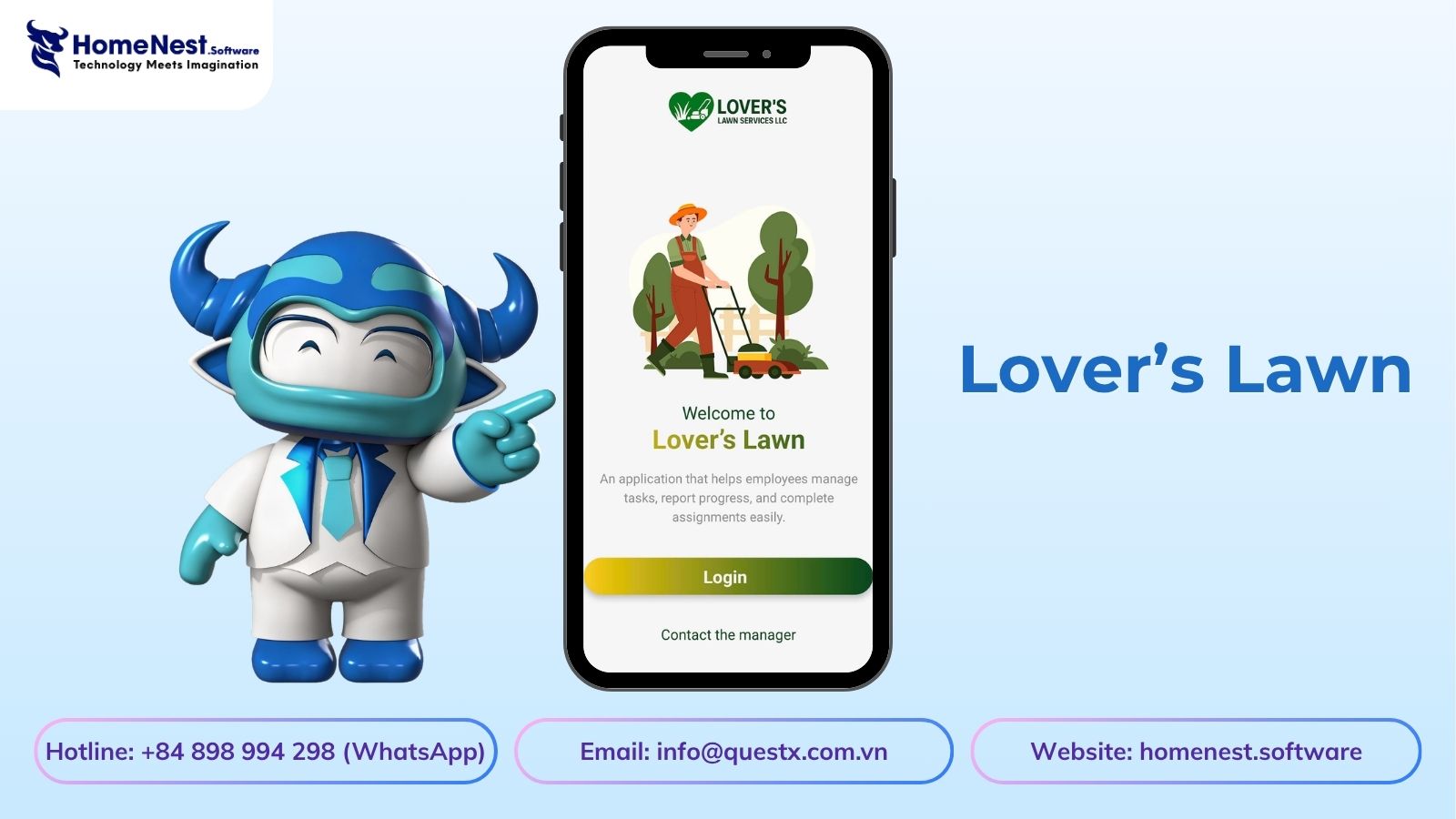
1. Lover’s Lawn Mobile Application Project
- System Requirement: Manage scheduling and delivery of on-site maintenance services.
- Problem: Long user flow increases customer bounce rates at the service booking step and hinders employee operation on mobile devices.
- Implementation: Eliminate intermediate steps in the scheduling flow. Restructure the information layout for three features: location map, service schedule, and payment gateway.
- Output: Design and technical specifications document exported from Figma. This data provides the screen flow for the programming team to write code. (See Lover’s Lawn Case Study).
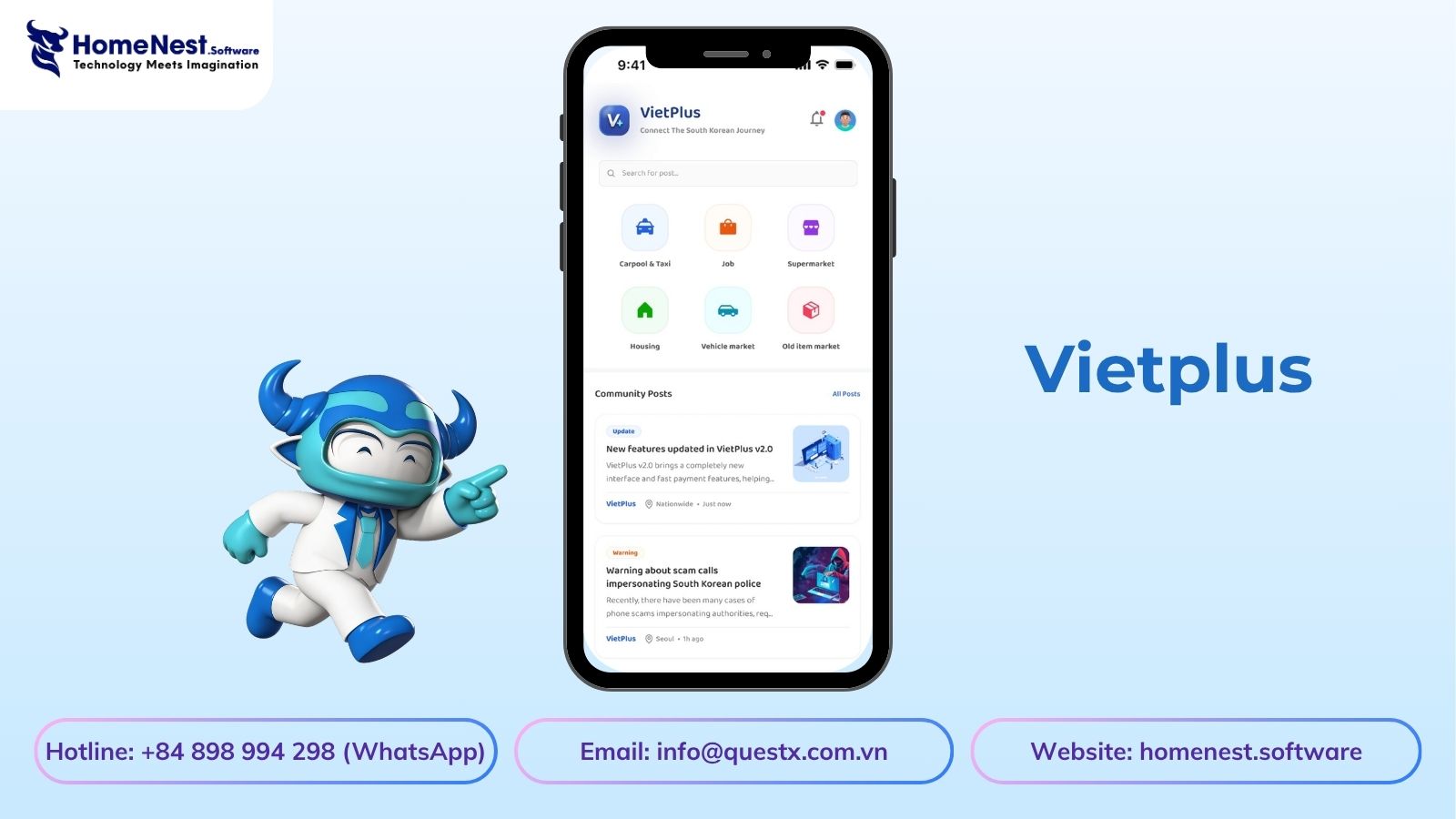
2. VietPlus Application Project
- System Requirement: Classify and display a large amount of content data.
- Problem: Continuous feature scaling requires a common interface structure to avoid display discrepancies across multiple screens.
- Implementation: Document the Design System. Define and package UI components, color codes, and fonts into a shared library.
- Output: A library of source files and guidelines. This data block is handed over to the front-end team for reuse when programming new features, reducing the time spent creating new interfaces. (See VietPlus Case Study).
Lesson learned: A reputable agency should be able to directly address system data logic through the interface, rather than just providing superficial concept drawings.
Looking for a UI/UX design and software development firm that adheres to EEAT standards?
HomeNest Software specializes in UI/UX design and software development services, focusing on directly integrating user interfaces with system data logic. We solve complex data problems (integrating IoT, AI, Blockchain) and produce standardized Developer Handoff documents, ensuring programmability and eliminating impractical designs.
To assess your current UX flow or request a system solution for your digital transformation project, please contact:
- Address: The Sun Avenue, 28 Mai Chi Tho Street, Binh Trung Ward, Ho Chi Minh City
- Hotline (WhatsApp): +84 898 994 298
- Email: info@questx.com.vn
Frequently Asked Questions about Choosing an App Design Agency
1. How is the UI/UX design cost for an enterprise application calculated?
The design cost is not fixed but depends on the project scope, the number of feature screens, and the complexity of the data flow (user flow). Professional agencies usually apply two models:
- Fixed Price: Suitable for projects with clear system requirements documentation from the outset.
- Time & Material: Suitable for large-scale projects requiring in-depth research and flexible feature expansion during implementation.
2. How long does the design process from start to finish take?
Standard implementation time ranges from 4 to 12 weeks, depending on the system size. A technical design process must go through the following sequential stages: User research -> Wireframe creation -> Prototype design -> Usability testing. Agencies committing to excessively short completion times often risk skipping testing, leading to a poor user experience.
3. Does the business retain full ownership of the copyright and source files after the project is completed?
Yes. According to software contract standards, after fulfilling payment obligations, the business will hold 100% of the commercial copyright and receive all original design files. This clause is mandatory in the contract to ensure the business controls system resources and is not dependent on the agency for future application upgrades and maintenance.
4. How to assess the agency’s capabilities without technical programming expertise?
Businesses can assess the partner’s execution capabilities through the following three factors:
- Validity testing: Directly download and use the actual applications they have designed to see if the workflow is intuitive.
- Case Study Structure: Requires the Agency to present past projects logically: Business Problem -> Design Solution -> Achieved Performance Data.
- Critical Analysis Skills: Evaluates the ability to analyze and identify inconsistencies in the company’s initial requirements, thereby proposing a more optimal technical solution.
5. Why require the Agency to deliver the Design System instead of just static screen design files?
Static image files do not provide sufficient technical specifications for the front-end development team. Requiring the delivery of a detailed Design System and Guidelines (using tools like Figma) provides a precise set of standards for structure, spacing, and interface components. This ensures accurate source code deployment, prevents technical debt, and minimizes coding time.
6. How do you know if a business needs to build a completely new application (from scratch) or just redesign it?
This decision depends on the current state of the system.
- If the old application has an outdated database structure, overly complex user flow, and many core operational errors, building a completely new application is necessary.
- If the data system (back-end) is still stable but conversion rates are low due to a difficult-to-use interface, redesigning the UI/UX to optimize the workflow is a more cost-effective and time-efficient solution.
A reputable agency should conduct a system audit before providing advice.
Latest Articles
View All
How Much Does It Cost to Build a Shopping App Like Temu?
Temu’s meteoric rise to over 900 million global downloads proves the power of combining AI, gamification, and social commerce, but building a similar viral shopping platform requires careful financial and technical planning. Developing an app like Temu typically costs anywhere from $40,000 for a basic Minimum Viable Product (MVP) to over $300,000 for a fully-featured platform. This guide breaks down every cost category, analyzes the core features driving Temu’s success, highlights the best technology stacks, and offers practical strategies to optimize your development budget without compromising on quality.
How Does AI in Banking Industry Impact the Future?
Artificial intelligence (AI) has transitioned from a supplementary tool to a core infrastructure of financial data management, optimizing profitability through real-time fraud detection, natural language processing (NLP), and high-speed credit scoring models. “Deploying AI in the financial sector requires more than just algorithmic accuracy, it demands a highly secure cloud architecture and rigorous data governance,” commented Nguyen Tien, co-founder of HomeNest Software. Why read this guide? We skip the theoretical jargon to focus entirely on technical implementation. Whether you’re evaluating a vendor or planning a system overhaul, this article will detail: Operational Efficiency: Automating unstructured data workflows at scale. Risk Architecture: Implementing real-time threat detection and AML compliance. Data ownership: The essential need for 100% ownership of the source code to ensure full algorithm auditability.
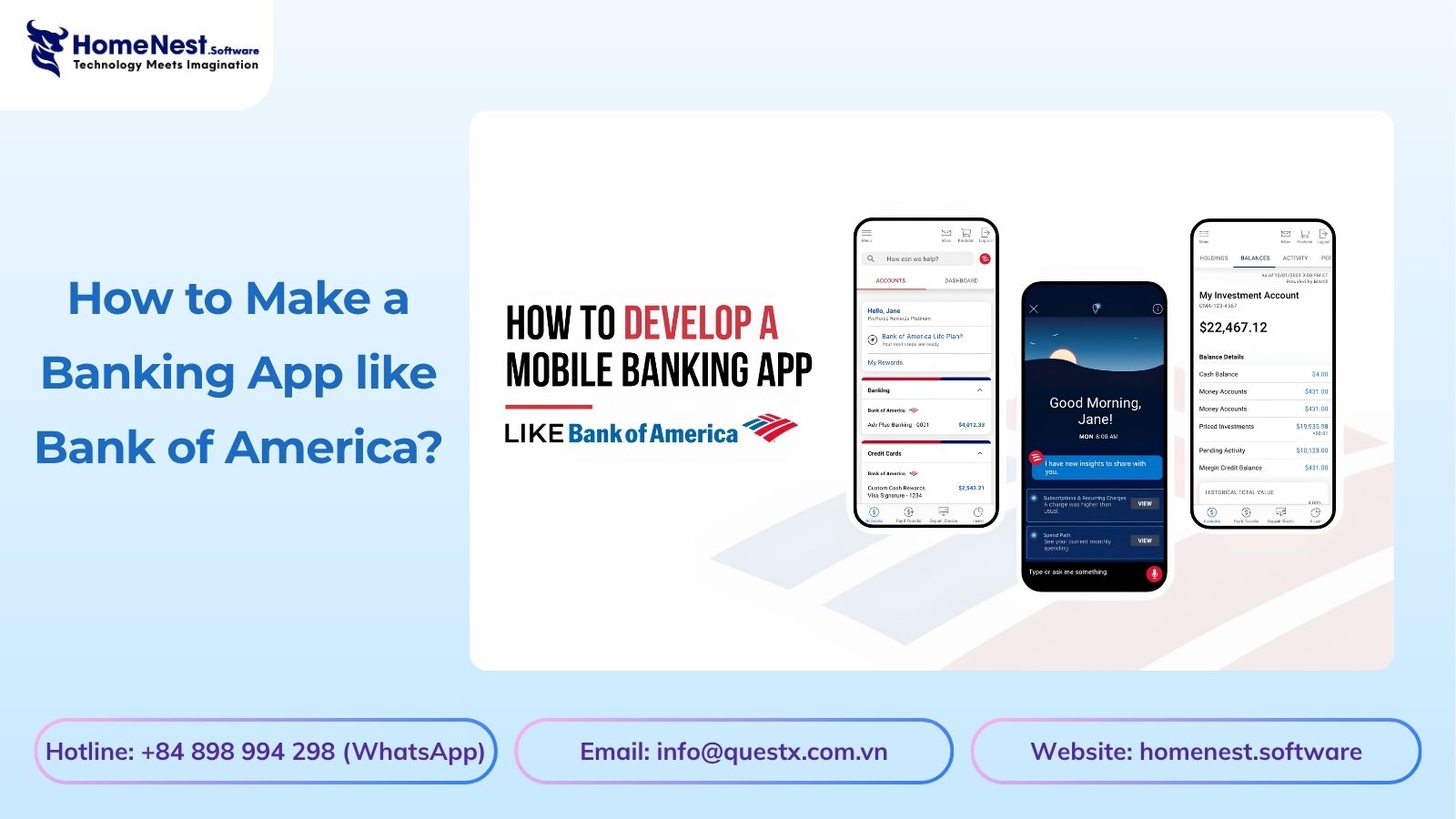
How to Make a Banking App like Bank of America?
Developing a mobile banking application like Bank of America extends far beyond basic UI design; it requires engineering a fault-tolerant backend capable of real-time ledger synchronization, biometric authentication, and high-volume data processing under strict regulatory frameworks. Drawing from HomeNest Software’s deep experience in architecting enterprise-grade fintech solutions, this guide strips away theoretical jargon to focus entirely on operational and technical execution. What you will find in this guide: We break down the precise development roadmap, from mapping out microservices and ensuring PCI-DSS compliance to estimating MVP development costs and securing absolute data sovereignty through 100% source code ownership. If you are preparing to build, scale, or audit a financial platform, this blueprint provides the exact framework you need.
Banking App Development Cost
Building a banking application is rarely a simple process; it’s a complex technical challenge requiring a balance between complying with stringent financial regulations, handling large transaction volumes, and a scalable cloud architecture. Miscalculating these technical requirements from the outset often leads to significant technical debt and budget overruns. Based on HomeNest Software’s practical experience in designing enterprise-grade fintech solutions, this guide bypasses generic estimates to provide a realistic analysis of banking application development costs. What you’ll find in this guide: We analyze the true cost factors, from technology selection and API integration to the hidden costs of regulatory compliance and security infrastructure. Whether you’re launching a minimum viable product or expanding an existing financial platform, this analysis provides the precise operational data you need to plan your budget effectively.
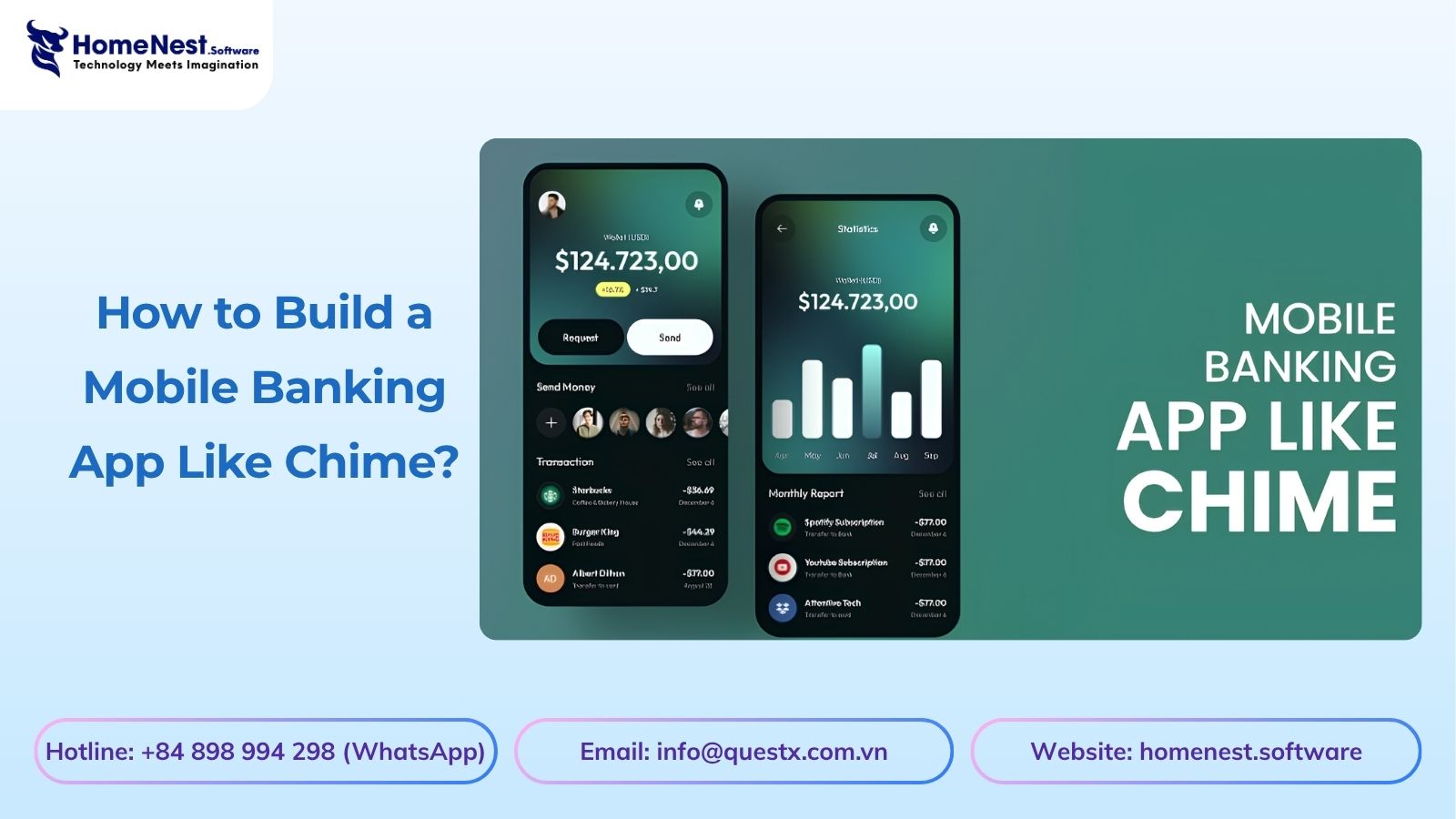
How to Build a Mobile Banking App Like Chime?
Building a mobile banking app like Chime is not just about features, it is about delivering a secure, scalable, and user-centric financial experience. From planning the right architecture to optimizing mobile banking app development cost, every decision directly impacts your product’s success. Leveraging Fintech app development services, starting with MVP app development, and scaling through on-demand app development solutions allows businesses to reduce risk and accelerate time to market. To stay competitive, combining Android app development services and iOS app development solutions ensures wider reach, while continuous updates through maintenance software development services keep your app secure and future-ready.
How to Build a Banking App Like Barclays: A Complete Entrepreneur’s Guide
Building a banking app like Barclays requires more than just development. It demands a strong product vision, secure architecture, and a clear monetization strategy. From optimizing cost and selecting the right tech stack to ensuring compliance and scalability, every decision impacts long-term success. Partnering with an experienced team like HomeNest Software helps accelerate development, reduce risks, and deliver a high-quality fintech product that can compete in today’s fast-evolving digital banking landscape.