
Top 10 Financial CRM Software Solutions for the Finance Industry
Financial CRM software is a critical tool for modern financial institutions to centralize client data, enhance personalization, and ensure regulatory compliance. The right solution not only improves sales efficiency and customer engagement but also enables smarter, data-driven decision-making through AI and automation. To maximize value, businesses should choose a scalable, secure platform that integrates seamlessly with existing systems and consider working with experienced partners like HomeNest Software to build a tailored, future-ready CRM solution.
Scope of Work
Many financial institutions face challenges in managing client data, maintaining compliance, and delivering personalized services at scale. Financial CRM software provides the tools needed to address these issues while supporting sustainable growth. In this guide, HomeNest Software explores the best CRM software for financial advisors in 2026, helping you select the right solution for your business.
What Is Financial CRM Software?
Financial CRM software is a specialized platform designed to help financial institutions manage client relationships, track leads accurately, and deliver highly personalized services.
By creating a single, unified view of each customer, this software enables banks, wealth managers, insurance providers, and credit unions to better understand client behavior and needs. With this level of insight, organizations can offer the right products at the right time improving both customer satisfaction and long term loyalty.
Research shows that effective personalization can increase revenue by 5–15%, highlighting the importance of having a centralized customer data system.
A strong example is Salesforce Financial Services Cloud, which consolidates key customer data such as contact details, transaction history, and multi-channel interactions into a single platform. This unified data layer supports better decision making across marketing, sales, customer service, and compliance functions.
In addition, many modern financial CRM platforms now integrate artificial intelligence to automate repetitive tasks, prioritize high-value opportunities, and enhance overall operational efficiency giving businesses a competitive edge in the evolving financial services landscape.
If you’re exploring CRM solutions further, it’s also worth evaluating leading Salesforce development partners and understanding what to look for when choosing a reliable consulting provider.
Key Benefits of Using Financial CRM Software
Adopting financial CRM software provides significant advantages for financial institutions seeking to improve efficiency, strengthen client relationships, and scale personalized services. These platforms enable organizations to act faster, stay organized, and unlock new revenue opportunities.
Smarter Lead Management and Revenue Growth
With modern CRM solutions, financial institutions can track every lead throughout the sales lifecycle, ensuring no opportunity is missed. By analyzing customer behavior and identifying cross-sell potential, teams can refine their strategies and increase revenue.
For example, a bank may identify customers frequently making international transfers. Based on this insight, it can recommend premium packages with lower fees and added benefits creating value for both the customer and the business.
Stronger Client Engagement
Financial CRM platforms allow advisors to deliver highly personalized experiences by leveraging centralized customer data. This enables institutions to align services with individual financial goals and life stages.
For instance, when a client approaches retirement, the system can prompt advisors to review and adjust financial plans enhancing trust, satisfaction, and long-term loyalty.
Improved Collaboration Across Teams
By storing all customer data in a single system, financial CRM software improves coordination between sales, support, and compliance teams. Updates made by one department are instantly visible to others, ensuring everyone works with accurate, real-time information.
This unified approach reduces errors, eliminates data silos, and enhances overall operational efficiency.
Secure Management of Sensitive Data
Security is a critical priority in the financial sector. Financial CRM platforms include advanced protection measures such as encryption, multi-factor authentication, and regular security audits.
These features help safeguard sensitive client data, reduce the risk of breaches, and ensure compliance with industry regulations strengthening both trust and reputation.
Real-Time Performance Insights
Modern CRM systems provide real-time visibility into sales performance, including lead conversion rates, deal values, and sales cycles.
Interactive dashboards allow managers to identify gaps, optimize strategies, and improve team productivity. With data-driven insights readily available, organizations can make faster and more informed decisions.
Anywhere, Anytime Access
Cloud-based financial CRM solutions enable teams to access customer data and manage tasks from any device whether in the office or on the go.
For example, field agents can update client information instantly and share insights with their teams in real-time. This flexibility improves workflow efficiency and ensures timely, responsive customer service.
By leveraging these capabilities, financial institutions can enhance customer experience, improve operational performance, and build a strong competitive advantage in the evolving financial services landscape.
Top 10 Best Financial CRM Software Solutions in 2026
The CRM market is crowded, but only a subset of platforms are purpose-built for financial services. Below is a refined and detailed look at the top financial CRM software solutions in 2026, highlighting their capabilities, strengths, and ideal use cases.
1. Salesforce Financial Services Cloud
Overview
A market leading CRM tailored for banks, insurers, and wealth managers, built on the Salesforce ecosystem. It focuses heavily on client lifecycle management, compliance, and advisory workflows.
Key Strengths
- 360° client view (accounts, transactions, life events)
- Built-in compliance and regulatory controls
- Financial planning and advisory tools
- Workflow automation and AI-driven insights
- Advanced analytics and reporting dashboards
Why It Stands Out
Salesforce sets the benchmark for enterprise-grade financial CRM combining flexibility, scalability, and deep ecosystem integration.
2. Microsoft Dynamics 365 Finance and Operations
Overview
A hybrid ERP + CRM platform that connects financial operations with customer relationship management, ideal for organizations needing unified data across departments.
Key Strengths
- Unified financial and customer data
- Built-in compliance and financial reporting
- Process automation for billing and workflows
- AI-powered analytics and forecasting
Why It Stands Out
Strong integration capabilities make it ideal for firms that need both operational control and CRM intelligence in one platform.
3. Zoho CRM (Finance Edition)
Overview
A cost-effective, highly customizable CRM solution designed for small and mid-sized financial institutions.
Key Strengths
- Centralized client and transaction management
- Lead and deal pipeline tracking
- Workflow automation
- Flexible reporting and dashboards
- Strong third-party integrations
Why It Stands Out
Affordable yet powerful ideal for growing firms that need flexibility without enterprise-level costs.
4. HubSpot CRM (Financial Services)
Overview
Known for ease of use and marketing automation, HubSpot CRM helps financial firms improve engagement and client communication.
Key Strengths
- Contact and interaction tracking
- Marketing and sales automation
- Real-time dashboards and analytics
- Seamless integrations
Why It Stands Out
Best suited for firms focused on inbound marketing, client acquisition, and engagement.
5. Pega CRM
Overview
An enterprise-level CRM with strong AI and automation capabilities, designed for large financial institutions.
Key Strengths
- AI-driven decisioning and workflow automation
- Advanced case management
- Personalized client engagement
- Compliance and risk management tools
Why It Stands Out
Ideal for organizations seeking automation at scale with deep AI integration.
6. Oracle CRM (Financial Services)
Overview
A robust CRM solution for large enterprises requiring advanced analytics, security, and scalability.
Key Strengths
- Centralized client and account management
- Predictive analytics and machine learning
- Enterprise-grade security and compliance
- Omnichannel communication
Why It Stands Out
Best for complex financial ecosystems requiring high reliability and deep data insights.
7. Wealthbox CRM
Overview
A lightweight, user-friendly CRM built specifically for financial advisors and wealth management firms.
Key Strengths
- Clean and intuitive interface
- Task and workflow management
- Collaboration tools (shared calendars, notes)
- Integration with financial planning tools
Why It Stands Out
Combines simplicity with strong advisory-focused features ideal for smaller advisory teams.
8. Creatio
Overview
A no-code CRM platform that enables financial firms to automate workflows and customize processes without heavy development.
Key Strengths
- No-code customization
- Predictive scoring and analytics
- Unified sales, service, and marketing platform
- Document and workflow automation
Why It Stands Out
Highly flexible and adaptable perfect for organizations prioritizing speed and customization.
9. AdvisorEngine CRM
Overview
A CRM built for data-driven wealth management, focusing on visualization and portfolio insights.
Key Strengths
- Advanced dashboards and reporting
- Portfolio management and rebalancing
- Workflow automation
- Custom forms and compliance tools
Why It Stands Out
Excellent for firms that rely heavily on analytics and portfolio transparency.
10. UGRU CRM
Overview
A specialized CRM designed for financial planning and advisory businesses.
Key Strengths
- Financial planning dashboards and forecasting
- Marketing automation and campaign tracking
- Secure client portal
- Workflow and compliance management
Why It Stands Out
Tailored for advisors who need a balance between planning, marketing, and compliance.
The best financial CRM software is not just about managing contacts it’s about building a unified, intelligent system that connects data, automates workflows, and delivers personalized financial services at scale.
Whether you are a startup advisor or a global financial institution, selecting the right platform depends on your scale, compliance needs, integration requirements, and long-term growth strategy.
Key Features to Look for in Financial CRM Software

Choosing the right financial CRM software requires a clear understanding of the features that truly drive performance across sales, customer service, and compliance. The most effective platforms go beyond basic contact management to deliver intelligence, automation, and personalization at scale.
Customer Service Capabilities
Modern CRM systems for financial services include service portals and AI-powered chatbots that enable faster response times. These tools help institutions handle inquiries, account updates, and transaction requests efficiently improving overall client satisfaction and support quality.
Integrating LLM APIs & Automated Workflows
Artificial intelligence in modern financial CRM systems goes beyond basic scheduling. Integrating the Large Language Model (LLM) via API enables the system to process unstructured financial data, automate complex compliance checks, and provide personalized real-time advisory insights, ensuring high operational efficiency and robust data governance.
Centralized Contact Management
A strong CRM system consolidates all client data into a single platform. This includes transaction history, communication records, and personal preferences ensuring that every team has access to accurate, up-to-date information for better decision making.
Digital Client Onboarding
Digital onboarding features streamline the client acquisition process by eliminating manual paperwork. With secure e-signatures and automated workflows, clients can complete applications and compliance forms quickly and conveniently.
Advanced Analytics and Reporting
Data-driven insights are essential for growth. Financial CRM platforms provide dashboards and reporting tools that help organizations track performance, forecast trends, and analyze customer behavior enabling smarter, faster decisions.
Personalization for Financial Services
Personalization is a key differentiator in the financial sector. CRM systems use client data to deliver tailored recommendations in areas such as financial planning, banking services, and wealth management strengthening relationships and increasing customer loyalty.
Sales Intelligence and Pipeline Visibility
Effective CRM solutions offer deep visibility into sales pipelines, team performance, and revenue forecasts. These insights help leaders refine strategies, identify opportunities, and improve overall sales efficiency within the financial services environment.
By focusing on these core features, financial institutions can select a CRM platform that not only improves operations but also enhances client experience and drives long-term business growth.
Who Can Use Financial CRM Software?
Financial CRM software is designed for a broad range of professionals across the financial ecosystem, helping each role manage relationships more effectively and streamline day-to-day operations.
Financial Advisors and Wealth Managers
Advisors use CRM platforms to maintain comprehensive client profiles, including investment history, risk tolerance, and long-term financial goals. This enables them to deliver personalized advice, optimize portfolios, and build stronger, trust-based relationships with clients.
Bank Officers
Banking professionals rely on CRM systems to track customer interactions across multiple products such as loans, credit cards, and investments. With a complete view of each client, they can identify cross-selling opportunities and provide more consistent, high-quality service.
Insurance Agents
Insurance agents use CRM tools to manage the full policy lifecycle from onboarding and renewals to claims handling. These systems help track customer needs, streamline workflows, and uncover opportunities to introduce new or upgraded insurance products.
Customer Service Representatives
Support teams benefit from centralized client data, allowing them to resolve issues quickly and accurately. With every interaction recorded in one place, service representatives can deliver consistent experiences while ensuring compliance and maintaining service quality.
By supporting multiple roles within financial organizations, CRM software becomes a central system that enhances collaboration, improves efficiency, and delivers a more seamless customer experience.
How to Choose the Right Financial CRM Software for Your Business

Selecting the right financial CRM software requires a structured evaluation to ensure the platform aligns with your business strategy, operational needs, and long-term growth plans. Below are the key factors to consider when making your decision.
Firm Size and Scalability
Choose a CRM that can grow with your business. As your client base expands and data volume increases, the system should maintain performance and support additional users, accounts, and workflows without disruption.
Features and Business Requirements
Clearly define your priorities whether it’s compliance management, financial planning tools, automation, or advanced analytics. The ideal solution should either include these features out of the box or offer flexibility for customization.
Integration Capabilities
A strong CRM should integrate seamlessly with your existing ecosystem, including accounting systems, financial planning tools, and third-party applications. Smooth integration ensures consistent workflows and accurate, real-time data across platforms.
User Experience and Adoption
Ease of use is critical for successful implementation. An intuitive interface helps teams adopt the system quickly, reduces training time, and ensures the platform is used effectively across the organization.
Compliance and Security
Given the sensitivity of financial data, prioritize platforms with robust security measures such as encryption, access controls, and compliance with industry regulations. Audit-ready reporting is also essential for maintaining transparency and trust.
Cost and Budget Considerations
Evaluate the total cost of ownership, including licensing, implementation, training, and ongoing maintenance. The goal is to select a solution that delivers strong value without exceeding your budget.
Support and Training
Reliable vendor support and comprehensive training resources are crucial for a smooth rollout and long-term success. Look for providers that offer onboarding assistance, documentation, and ongoing technical support.
By carefully considering these factors, financial institutions can choose a CRM solution that not only meets immediate operational needs but also supports future growth and enhances client relationships over time.
How HomeNest Software Can Help
HomeNest Software specializes in building custom financial CRM software tailored to the unique workflows of banks, insurance providers, and wealth management firms. Instead of forcing businesses into rigid, off-the-shelf systems, we design solutions aligned with your compliance requirements, reporting standards, and client engagement strategies.

Tailored CRM Solutions for Financial Services
Our approach focuses on delivering CRM platforms that fit seamlessly into your existing ecosystem. We ensure that every solution is:
- Built around your operational processes
- Designed to meet regulatory and security requirements
- Optimized for client relationship management and long-term growth
Technical Expertise and Integration Capabilities
With deep experience in Salesforce development, mobile applications, and offshore web development, we create CRM systems that integrate smoothly with your current financial tools and platforms.
Key capabilities include:
- AI-driven lead scoring and opportunity prioritization
- Workflow automation to reduce manual effort
- Secure, multi-device access for flexible operations
- Seamless integration with legacy systems and third-party applications
Unrestricted by Vendors and 100% Owned Source Code
We understand that financial institutions cannot compromise on data sovereignty. Unlike SaaS platforms that bind you to recurring licenses and closed architectures, HomeNest Software operates on a model of absolute transparency: delivering 100% of the source code upon project completion. This ensures your internal engineering teams retain full intellectual property rights, allowing them to independently test security protocols, customize workflows, and scale the platform without vendor restrictions.
Agile Delivery and Enterprise-Grade Security
We follow Agile methodologies to ensure transparency, flexibility, and continuous improvement throughout the development lifecycle. Combined with ISO-aligned security practices, our solutions protect sensitive financial data while remaining scalable and future-ready.
If you’re looking to modernize client management, improve compliance, and unlock the full potential of financial CRM, HomeNest Software provides the expertise and dedicated teams to make it happen.
Conclusion
Selecting the right financial CRM software can fundamentally improve how financial institutions manage client relationships, ensure compliance, and scale their operations. From AI-driven insights to secure data handling, the right platform enables teams to work smarter, deliver personalized services, and make better strategic decisions.
At HomeNest Software, we specialize in developing custom CRM solutions for financial services that integrate seamlessly with your existing systems and workflows. If you’re ready to modernize your operations and elevate client experience, connect with HomeNest Software today to start building a solution tailored to your business.
FAQs About Financial CRM Software
What is financial CRM software?
Financial CRM software is a specialized system designed for banks, insurers, and financial advisors to manage client relationships, track interactions, and deliver personalized financial services while ensuring compliance.
How is financial CRM different from regular CRM?
Unlike general CRM systems, financial CRM software includes features tailored to the finance industry, such as compliance tracking, financial planning tools, transaction history management, and secure data handling.
Who should use financial CRM software?
It is ideal for financial advisors, wealth managers, banks, insurance agents, and customer service teams who need to manage client data, improve engagement, and streamline workflows.
What are the key security standards for financial CRM?
Financial CRM systems must meet strict security and data protection standards, including SOC 2 Type II certification, PCI-DSS compliance (for payment data), AES-256 data encryption at rest and in transit, multi-factor authentication (MFA), role-based access controls, and compliance with regional privacy laws like GDPR and CCPA.
Can financial CRM software integrate with our existing core banking systems?
Yes, modern financial CRMs are designed to integrate with core banking platforms, wealth management tools, portfolio trackers, and communication channels. Using secure REST or GraphQL APIs ensures seamless, real-time data sync across all your systems.
Latest Articles
View All
Criteria For Choosing The Right App Design Agency
UI/UX design is the logical foundation of a system, not merely a visual element. Choosing the wrong partner will directly lead to technical debt, budget overruns, and disruptions in the development process. This article provides a 6-step evaluation framework and a list of operational risks, helping businesses eliminate subjective design advice and accurately assess agency capabilities based on developer handoff standards and practical business performance.

How Does AI in Banking Industry Impact the Future?
Artificial intelligence (AI) has transitioned from a supplementary tool to a core infrastructure of financial data management, optimizing profitability through real-time fraud detection, natural language processing (NLP), and high-speed credit scoring models. “Deploying AI in the financial sector requires more than just algorithmic accuracy, it demands a highly secure cloud architecture and rigorous data governance,” commented Nguyen Tien, co-founder of HomeNest Software. Why read this guide? We skip the theoretical jargon to focus entirely on technical implementation. Whether you’re evaluating a vendor or planning a system overhaul, this article will detail: Operational Efficiency: Automating unstructured data workflows at scale. Risk Architecture: Implementing real-time threat detection and AML compliance. Data ownership: The essential need for 100% ownership of the source code to ensure full algorithm auditability.
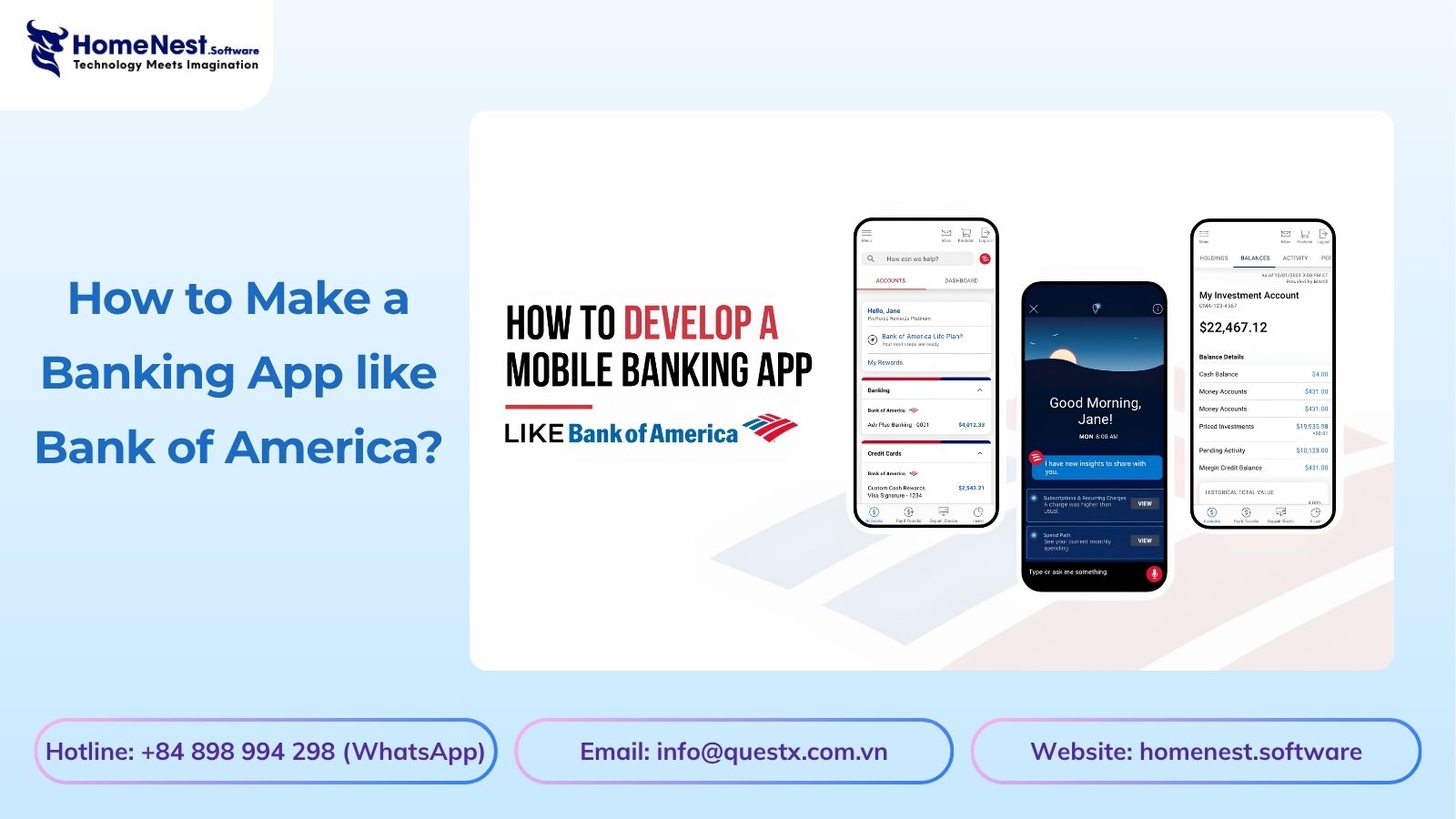
How to Make a Banking App like Bank of America?
Developing a mobile banking application like Bank of America extends far beyond basic UI design; it requires engineering a fault-tolerant backend capable of real-time ledger synchronization, biometric authentication, and high-volume data processing under strict regulatory frameworks. Drawing from HomeNest Software’s deep experience in architecting enterprise-grade fintech solutions, this guide strips away theoretical jargon to focus entirely on operational and technical execution. What you will find in this guide: We break down the precise development roadmap, from mapping out microservices and ensuring PCI-DSS compliance to estimating MVP development costs and securing absolute data sovereignty through 100% source code ownership. If you are preparing to build, scale, or audit a financial platform, this blueprint provides the exact framework you need.
Banking App Development Cost
Building a banking application is rarely a simple process; it’s a complex technical challenge requiring a balance between complying with stringent financial regulations, handling large transaction volumes, and a scalable cloud architecture. Miscalculating these technical requirements from the outset often leads to significant technical debt and budget overruns. Based on HomeNest Software’s practical experience in designing enterprise-grade fintech solutions, this guide bypasses generic estimates to provide a realistic analysis of banking application development costs. What you’ll find in this guide: We analyze the true cost factors, from technology selection and API integration to the hidden costs of regulatory compliance and security infrastructure. Whether you’re launching a minimum viable product or expanding an existing financial platform, this analysis provides the precise operational data you need to plan your budget effectively.

How to Build a Mobile Banking App Like Chime?
Building a mobile banking app like Chime is not just about features, it is about delivering a secure, scalable, and user-centric financial experience. From planning the right architecture to optimizing mobile banking app development cost, every decision directly impacts your product’s success. Leveraging Fintech app development services, starting with MVP app development, and scaling through on-demand app development solutions allows businesses to reduce risk and accelerate time to market. To stay competitive, combining Android app development services and iOS app development solutions ensures wider reach, while continuous updates through maintenance software development services keep your app secure and future-ready.

How to Build a Banking App Like Barclays: A Complete Entrepreneur’s Guide
Building a banking app like Barclays requires more than just development. It demands a strong product vision, secure architecture, and a clear monetization strategy. From optimizing cost and selecting the right tech stack to ensuring compliance and scalability, every decision impacts long-term success. Partnering with an experienced team like HomeNest Software helps accelerate development, reduce risks, and deliver a high-quality fintech product that can compete in today’s fast-evolving digital banking landscape.