
GitHub vs GitLab – Architecture and Selection Guide
Managing source code requires stable infrastructure. Automating software releases requires reliable pipelines. Tool sprawl creates operational complexity. Engineering teams face friction when using fragmented DevOps tools. Selecting between GitHub and GitLab shapes long term development efficiency.
Scope of Work
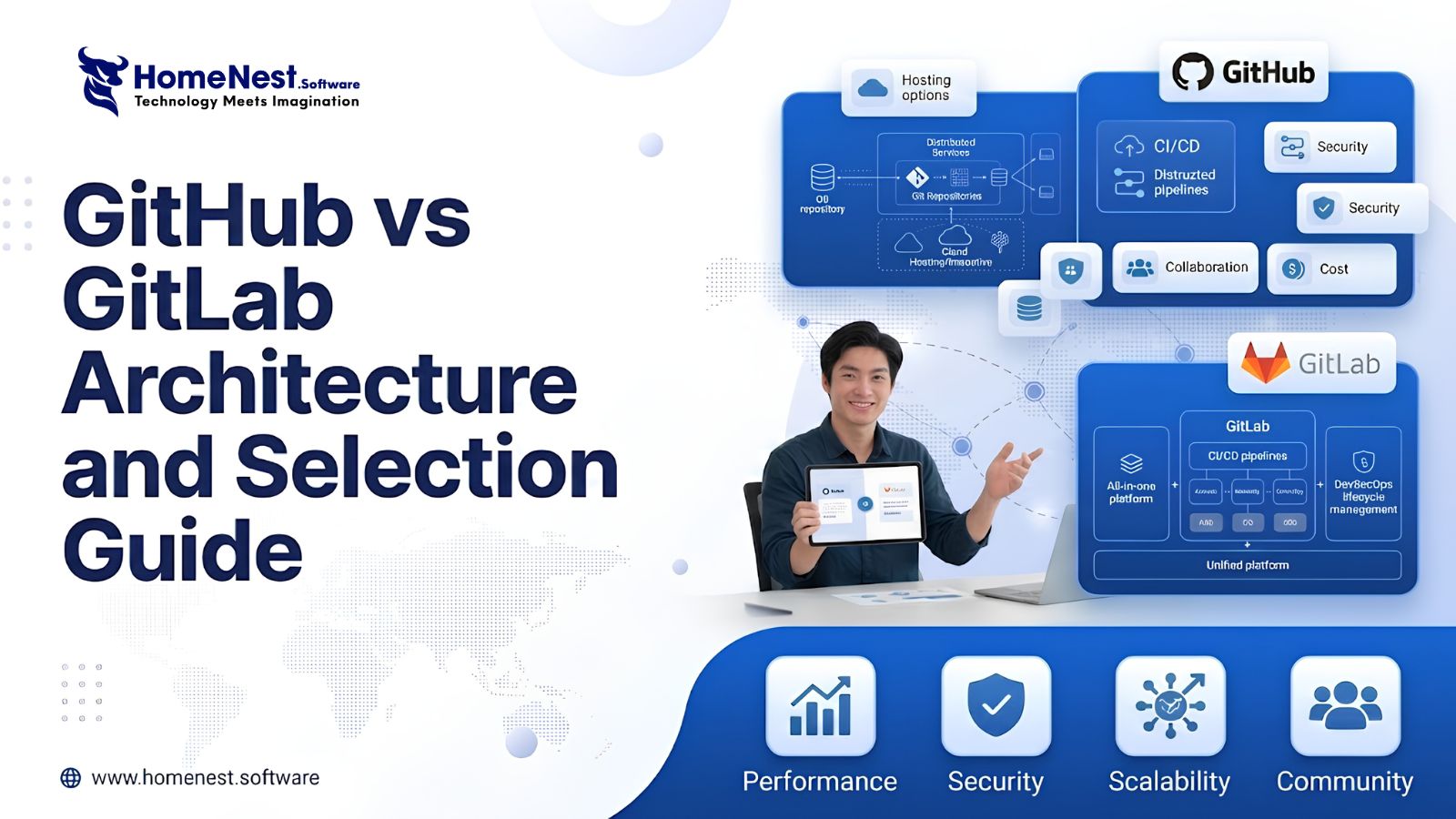
Managing source code requires stable infrastructure. Automating software releases requires reliable pipelines. Tool sprawl creates operational complexity. Engineering teams face friction when using fragmented DevOps tools. Selecting between GitHub and GitLab shapes long term development efficiency.
The DevOps market in 2026 prioritizes platform engineering and AI integration. Both platforms serve modern software development. However their architectural philosophies target different operational goals.
Overview of both GitHub and GitLab platforms
GitHub Overview
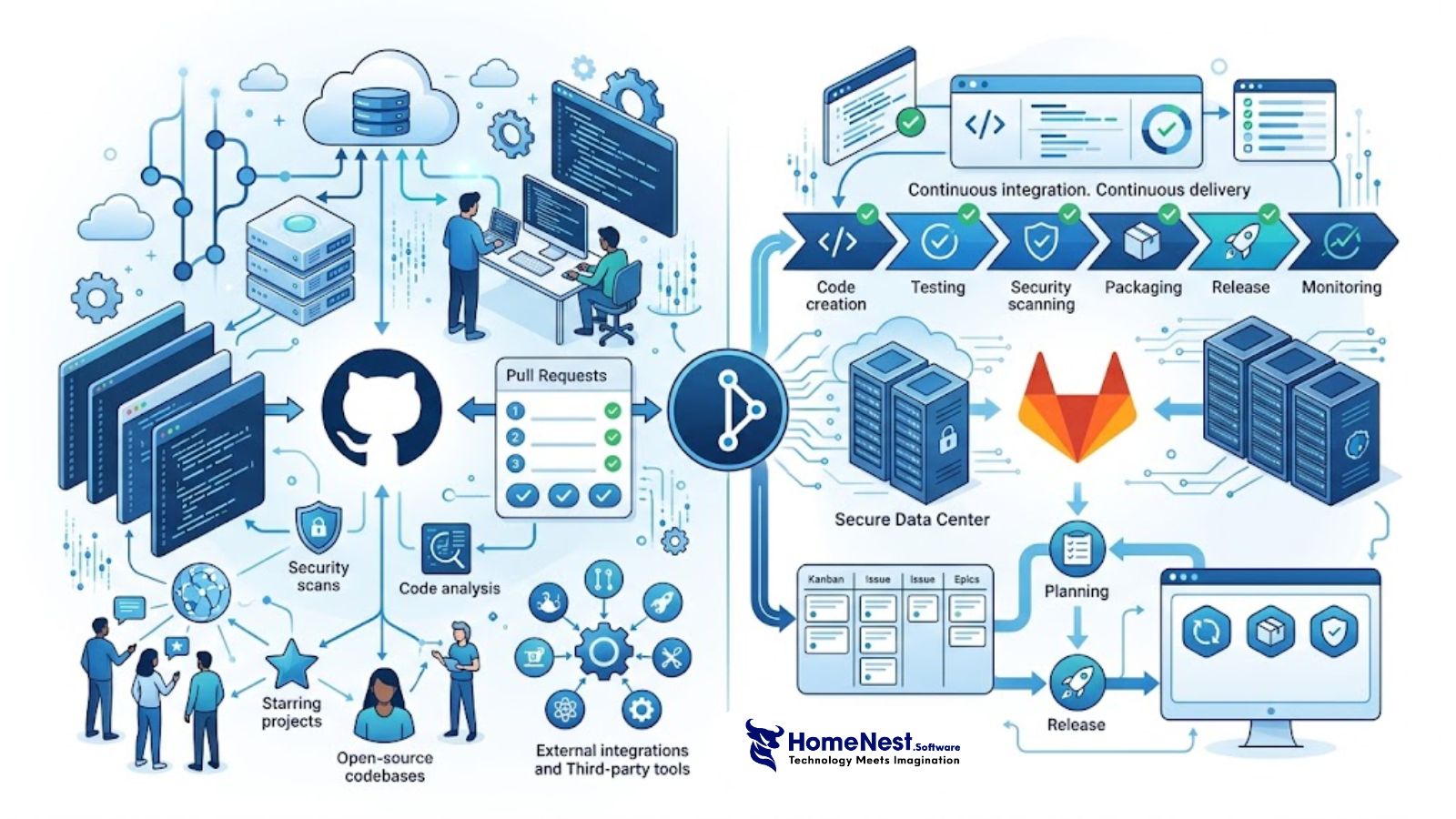
GitHub operates as a cloud platform for software development and version control built on Git. Microsoft acquired the platform in 2018. It serves over 100 million developers worldwide. The ecosystem emphasizes open source collaboration source code hosting and pull request workflows. Organizations leverage GitHub Actions for continuous integration and deploy third party integrations through GitHub Marketplace.
GitLab Overview
GitLab operates as an open core DevSecOps platform built on Git. GitLab Incorporated founded the service in 2014. It combines the entire software development lifecycle into a single native application. The system covers nine development stages from project planning and source code management to security auditing and continuous deployment. Organizations choose GitLab to eliminate tool sprawl and enforce centralized compliance across private or self hosted environments.
Key Features of Both Platforms
Source Code Management and Code Review
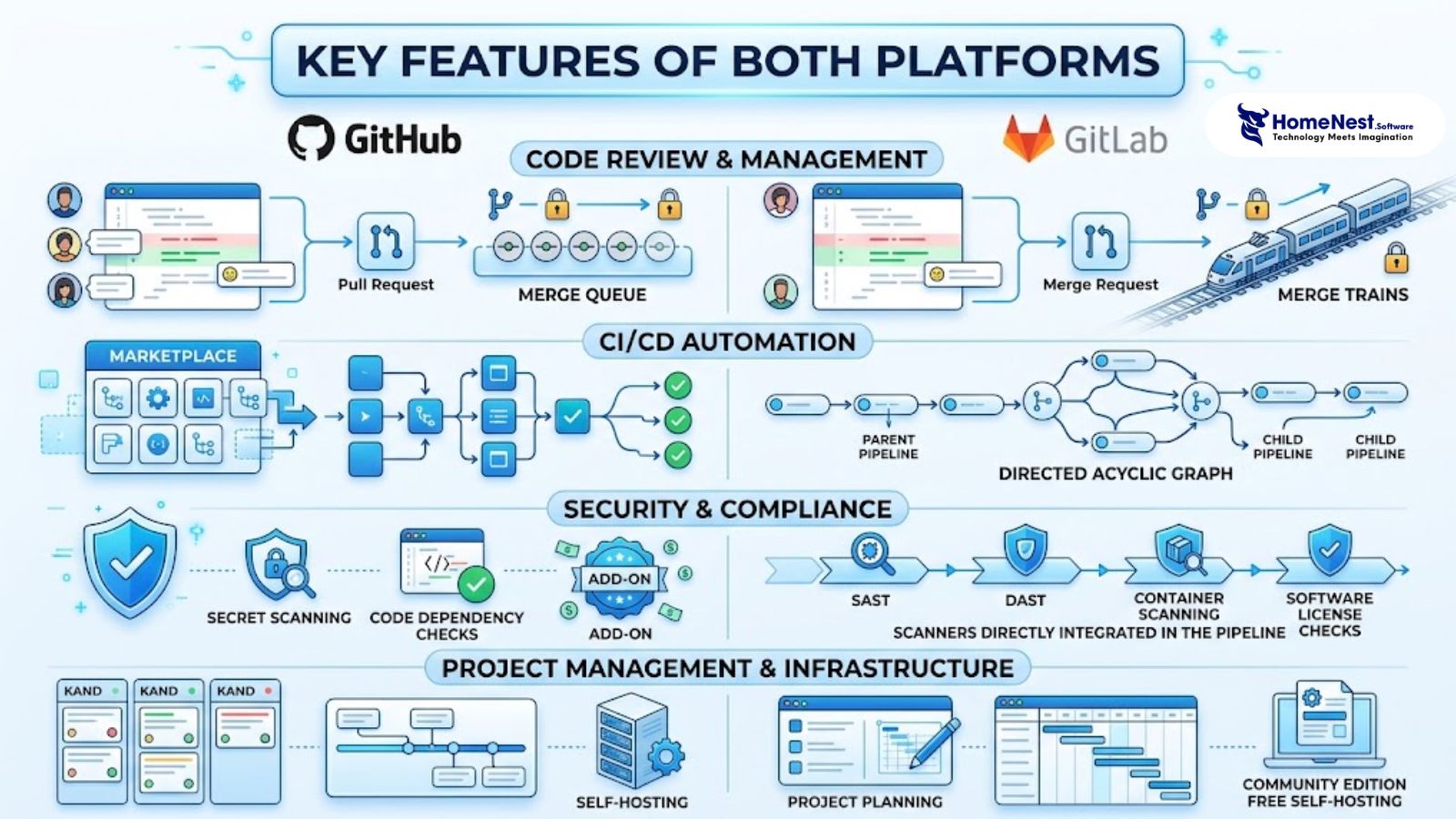
GitHub utilizes Pull Requests. GitLab utilizes Merge Requests. Both mechanisms offer code review tools inline commenting and branch protections.
Code control technologies differ. GitLab Merge Trains serialize merge branches to prevent conflict errors. GitHub Merge Queues manage branch queues for high volume repositories to streamline integration.
CI CD Automation: GitHub Actions vs GitLab CI CD
GitHub Actions uses a modular structure. Teams leverage over 25000 actions from Marketplace. Workflows use YAML definitions to trigger automated jobs across various environments.
GitLab CI CD offers native pipeline capabilities. It supports Directed Acyclic Graphs to optimize execution order. It provides Parent Child pipelines for monorepo projects.
Security and Compliance
GitHub Advanced Security is an add on package. It includes Secret Protection and Code Security. CodeQL and Dependabot remain free for public repositories.
GitLab Ultimate integrates security scanning into the pipeline natively. It includes SAST DAST container scanning and software license checks.
Read more: Application Security
Project Management and Infrastructure
GitHub Projects v2 offers lightweight management with Kanban boards and roadmaps. GitHub Enterprise Server provides self hosting as a paid virtual appliance.
GitLab provides deep project management capabilities replacing standalone tools. GitLab Community Edition offers free self hosting on private infrastructure.
AI Coding Assistants Comparison
GitHub Copilot
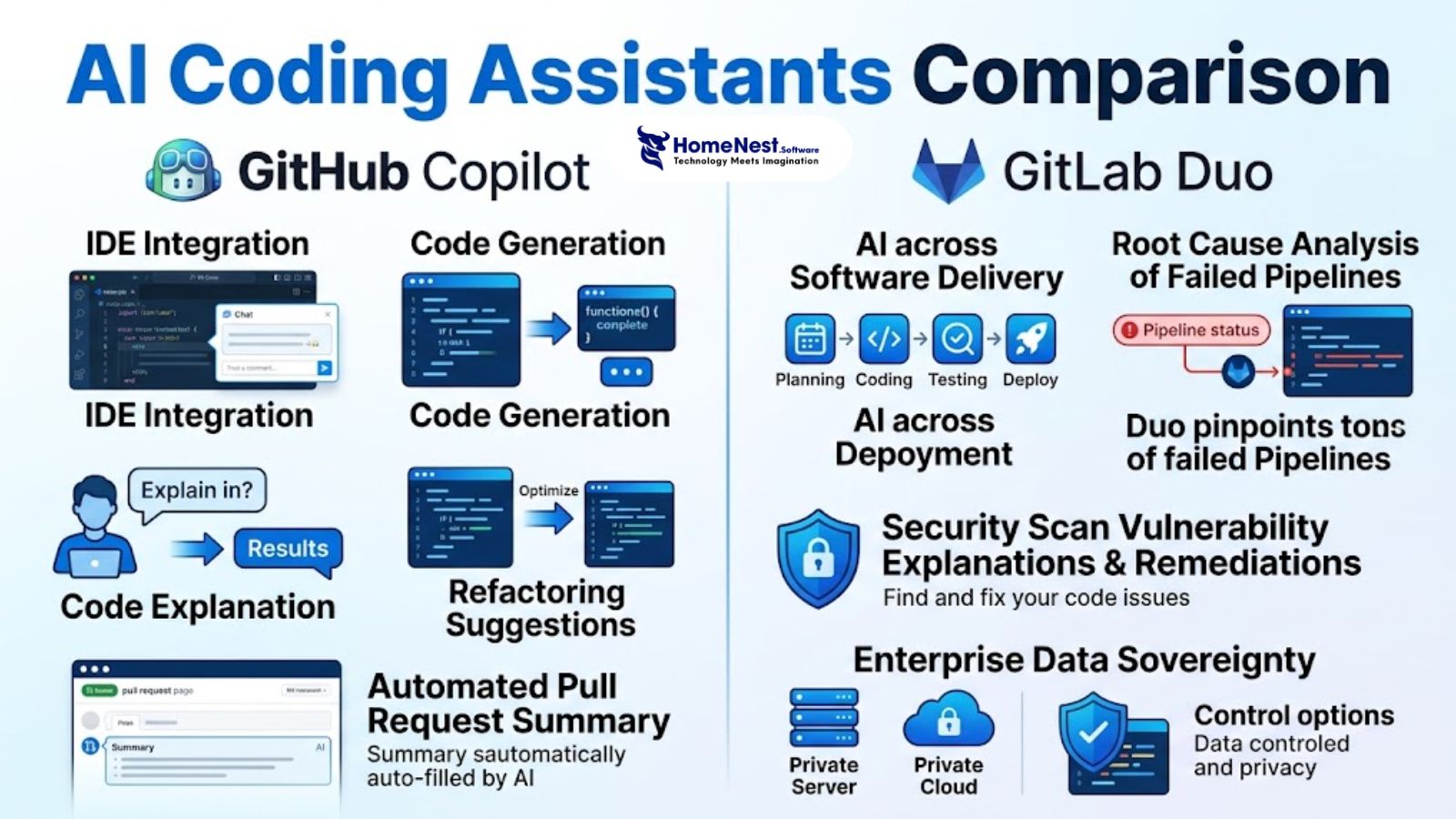
GitHub Copilot powered by OpenAI models dominates market adoption among developers. The platform operates directly inside integrated development environments like VS Code and JetBrains. GitHub Copilot Chat provides inline context aware code explanations and refactoring suggestions. Copilot Workspace expands this capability by translating repository issues into complete technical plans and functional code updates. Developers gain rapid code generation autocomplete functions and automated pull request summary creation.
GitLab Duo
GitLab Duo embeds artificial intelligence across every stage of software delivery. Duo Enterprise focuses on contextual automation beyond simple code autocompletion. The assistant performs root cause analysis on failed continuous integration pipelines to identify broken code immediately. It explains vulnerability findings detected during automated security scans and proposes direct code remediations. GitLab Duo enables enterprise privacy controls through self hosted large language models or private cloud deployments. Organizations maintain full data sovereignty without exposing internal codebases to third party AI vendors.
Feature Comparison Table
| Comparison Criteria | GitHub | GitLab |
| Core Architecture | Flexible modular ecosystem focused on third-party integrations | Unified DevSecOps platform built on a single application |
| Code Review Mechanism | Pull Requests combined with Merge Queues for large repositories | Merge Requests combined with Merge Trains to automatically prevent code conflicts |
| CI/CD Automation | GitHub Actions powered by Marketplace modules | Built-in GitLab CI/CD supporting Directed Acyclic Graphs (DAG) |
| Free Runner Limits | 2,000 minutes/month for free accounts | 400 minutes/month for free accounts |
| AI Coding Assistant | GitHub Copilot and Copilot Workspace powered by OpenAI models | GitLab Duo supporting self-hosted/local AI model deployment |
| Native Security Features | Dependabot plus the optional GitHub Advanced Security add-on | Built-in SAST, DAST, container scanning, and license compliance auditing |
| Project Management | Kanban boards and lean roadmaps via GitHub Projects v2 | Comprehensive enterprise project management suite as a Jira alternative |
| Self-Hosting Capability | Paid Enterprise Server virtual machine instance | Free Community Edition or paid self-hosted tiers |
DevOps Benefits Analysis
GitHub DevOps Benefits
GitHub delivers distinct operational advantages for modern engineering teams. High global platform adoption minimizes developer onboarding time. Engineering teams leverage a vast ecosystem of third party tools through GitHub Marketplace. This modular flexibility allows organizations to integrate specialized solutions for monitoring code analysis and deployment without vendor lock in. GitHub Actions offers cloud native integration capabilities that accelerate automated software release pipelines across multi cloud environments.
GitLab DevOps Benefits
GitLab provides structural advantages for enterprises seeking operational efficiency. Consolidation of nine software development lifecycle stages into one application eliminates tool sprawl. Organizations reduce administrative overhead by managing code repositories security policies and deployment pipelines within a single database. Built in DevSecOps capabilities embed security testing directly into continuous integration workflows. This native integration enables continuous compliance monitoring while enforcing audit controls across all enterprise projects.
Read more: 8 Proven Ways to Reduce Costs with Agile and DevOps
When should you choose GitHub and GitLab?
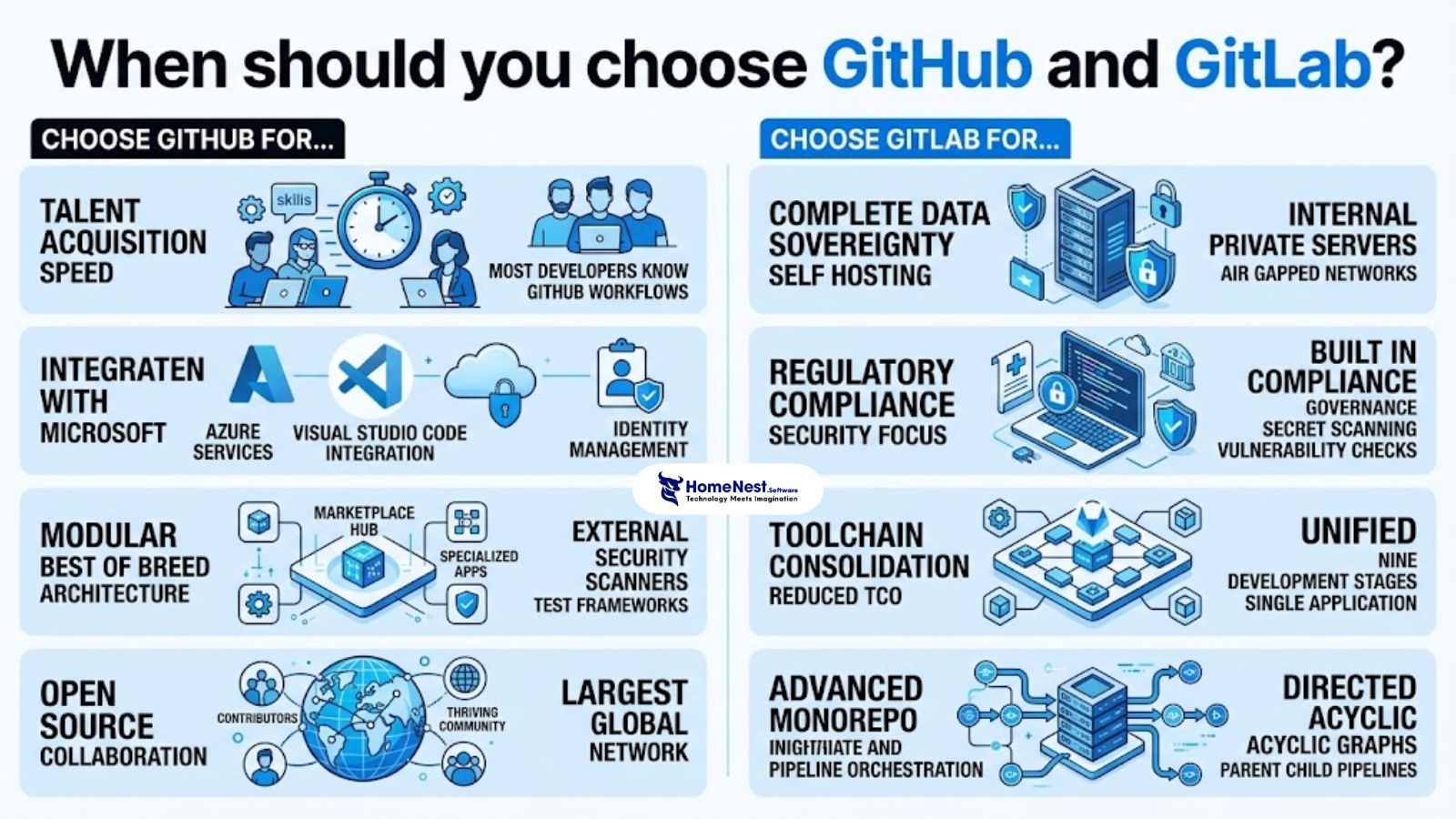
Choose GitHub When
1. Talent Acquisition Speed Matters
Your organization needs to recruit developers quickly. Most software engineers already know GitHub workflows. Using GitHub eliminates onboarding friction and accelerates developer productivity.
2. Your Tech Stack Relies on Microsoft Ecosystem
Your infrastructure integrates heavily with Azure services and Microsoft tools. GitHub offers native integration with Azure Active Directory as well as Visual Studio Code. This connection streamlines enterprise identity management and deployment automation.
3. You Prefer Modular Best of Breed Architecture
Your engineering team wants total flexibility to choose specialized third party applications. GitHub Marketplace enables seamless connections with external security scanners test frameworks and deployment tools.
4. Open Source Collaboration is Core to Your Strategy
Your company maintains open source projects or relies on public community contributions. GitHub provides the largest open source network globally to drive ecosystem engagement.
Choose GitLab When
1. Complete Data Sovereignty and Self Hosting are Mandatory
Your organization requires source code hosting on internal private servers or air gapped networks. GitLab Community Edition and self hosted tiers grant complete operational control without cloud dependencies.
2. Regulatory Compliance and Security Drive Decisions
Your enterprise operates in strictly regulated sectors such as Finance Healthcare or Defense. GitLab Ultimate delivers built in compliance governance secret scanning and container vulnerability checks natively.
3. Management Demands Toolchain Consolidation
Your leadership aims to eliminate fragmented software licenses and reduce total cost of ownership. GitLab unifies nine development stages into a single application and single database to streamline operations.
4. Advanced Monorepo and Pipeline Orchestration is Required
Your projects utilize large monorepo structures that demand complex pipeline relationships. GitLab CI CD supports Directed Acyclic Graphs along with Parent Child pipelines for optimal execution speed.
Conclusion: Accelerating Your DevOps Transformation with HomeNest Software
Choosing between GitHub and GitLab shapes your engineering workflow platform costs and security architecture. GitHub offers flexible modularity and rapid developer adoption. GitLab delivers unified DevSecOps governance and end to end toolchain consolidation. Both platforms drive high efficiency when aligned with clear business objectives.
Building a modern software delivery pipeline requires expert execution beyond selecting a repository platform. HomeNest Software delivers enterprise software development custom platform engineering and DevOps optimization services. The team helps organizations evaluate infrastructure needs streamline continuous integration pipelines and enforce security standards across GitHub and GitLab environments.
Partner with HomeNest Software to build scalable software solutions and elevate engineering productivity. Contact HomeNest Software today to discover how our in-depth engineering services can transform your business’s software development lifecycle.
Contact information:
- Phone / WhatsApp: (+84) 898 994 298
- Email: info@questx.com.vn
- Headquarters: SAV5 Tower, The Sun Avenue, 28 Mai Chi Tho Street, Binh Trung Ward, Ho Chi Minh City, Vietnam
- Branch Office: SAV4 Tower, The Sun Avenue, 28 Mai Chi Tho Street, Binh Trung Ward, Ho Chi Minh City, Vietnam
Frequently Asked Questions (FAQ) about Github and Gitlab
Can an enterprise run GitHub Actions on a fully self hosted private network without cloud connectivity?
GitHub Enterprise Server supports self hosted runners on private networks. However some GitHub Actions features require connections to external GitHub services or license validation servers. GitLab Community Edition or self hosted GitLab Ultimate provides better native support for completely air gapped private environments.
Is GitLab Duo better than GitHub Copilot for corporate security compliance?
GitHub Copilot leads in code generation speed and developer adoption. GitLab Duo excels in compliance workflows by analyzing pipeline failures explaining security vulnerabilities directly inside merge requests and supporting self hosted large language models for absolute data privacy.
How does total cost of ownership change when an organization scales past 100 developers?
GitHub Team costs less per user initially. However large enterprises needing deep security scanning must purchase GitHub Advanced Security as a separate add on. GitLab Ultimate includes native SAST DAST and compliance tools which often results in lower overall TCO for large enterprises requiring unified security.
What is the main technical challenge when migrating pipelines between GitHub and GitLab?
Pipeline syntax non compatibility creates the biggest migration obstacle. GitHub Actions uses modular workflow syntax with reusable actions. GitLab CI CD uses nested YAML configurations with features like Directed Acyclic Graphs. Engineering teams must rewrite pipeline scripts completely rather than converting configurations automatically.
Which platform handles massive monorepos better for large engineering teams?
Both platforms support large monorepos through specialized features. GitHub uses Merge Queues and Sparse Checkout to maintain repository performance. GitLab leverages Parent Child pipelines and Directed Acyclic Graphs to prevent unnecessary job execution across large codebase structures.
Latest Articles
View All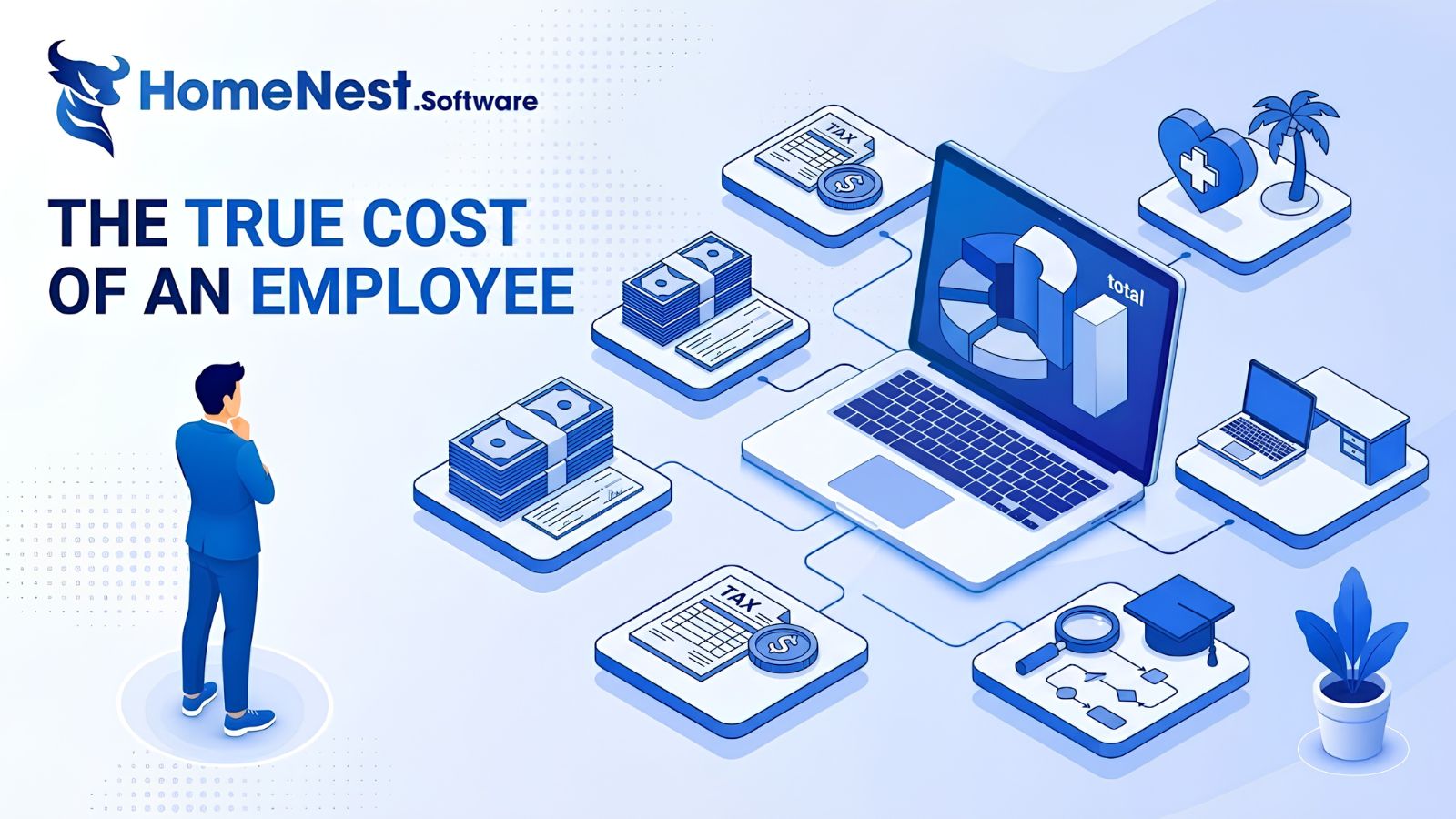
The True Cost of an Employee: A Complete Breakdown for Employers
This article reveals that the true cost of an employee is typically 25% to 40% higher than their base salary due to hidden expenses like taxes, benefits, workspace, and recruiting. To address this, the guide provides a detailed 7-step framework to accurately calculate total employer costs, alongside actionable strategies to optimize budgets and improve retention without reducing pay.
Essential Tips To Develop A Music Streaming App
Discover expert tips to develop a successful music streaming app with HomeNest Software. This guide covers essential features, legal licensing, and scalable technology stacks. Learn how to build a robust, cross-platform application with AI personalization to stand out in the 2026 competitive audio market.

How to Build a Language Learning App Like Cake
Discover how to build a successful language learning app like Cake with this comprehensive guide from HomeNest Software. We explore market research, essential MVP features, advanced AI integrations, tech stack selection, and estimated development costs. Partner with HomeNest Software to create a scalable, gamified, and highly engaging educational platform tailored to your business goals. Start your app development journey with us today.
How to Build an App Like TaskRabbit: Features, Cost, Tech Stack – Business Model
Building an app like TaskRabbit is more than replicating existing features—it’s about creating a trusted marketplace that seamlessly connects customers with skilled service providers. By combining an intuitive user experience, secure payment systems, scalable architecture, and the right business model, you can launch a competitive on-demand platform. Partnering with an experienced app development company like HomeNest Software ensures your product is built with the technology, flexibility, and long-term scalability needed to succeed in the rapidly growing gig economy.
How to Build a Meal Planning App: A Complete Step-by-Step Guide
Building a successful meal planning app goes beyond creating an attractive interface it requires a clear business strategy, personalized user experiences, and scalable technology. By combining essential features like AI-powered meal recommendations, nutrition tracking, grocery list automation, and wearable integration, businesses can deliver lasting value to users while capitalizing on the growing digital health market. Partnering with an experienced mobile app development company ensures your solution is secure, future-ready, and designed to succeed in an increasingly competitive health-tech industry.

How Much Does It Cost to Build a Shopping App Like Temu?
Temu’s meteoric rise to over 900 million global downloads proves the power of combining AI, gamification, and social commerce, but building a similar viral shopping platform requires careful financial and technical planning. Developing an app like Temu typically costs anywhere from $40,000 for a basic Minimum Viable Product (MVP) to over $300,000 for a fully-featured platform. This guide breaks down every cost category, analyzes the core features driving Temu’s success, highlights the best technology stacks, and offers practical strategies to optimize your development budget without compromising on quality.