
How to Build an App Like TaskRabbit: Features, Cost, Tech Stack – Business Model
Building an app like TaskRabbit is more than replicating existing features—it’s about creating a trusted marketplace that seamlessly connects customers with skilled service providers. By combining an intuitive user experience, secure payment systems, scalable architecture, and the right business model, you can launch a competitive on-demand platform. Partnering with an experienced app development company like HomeNest Software ensures your product is built with the technology, flexibility, and long-term scalability needed to succeed in the rapidly growing gig economy.
Scope of Work
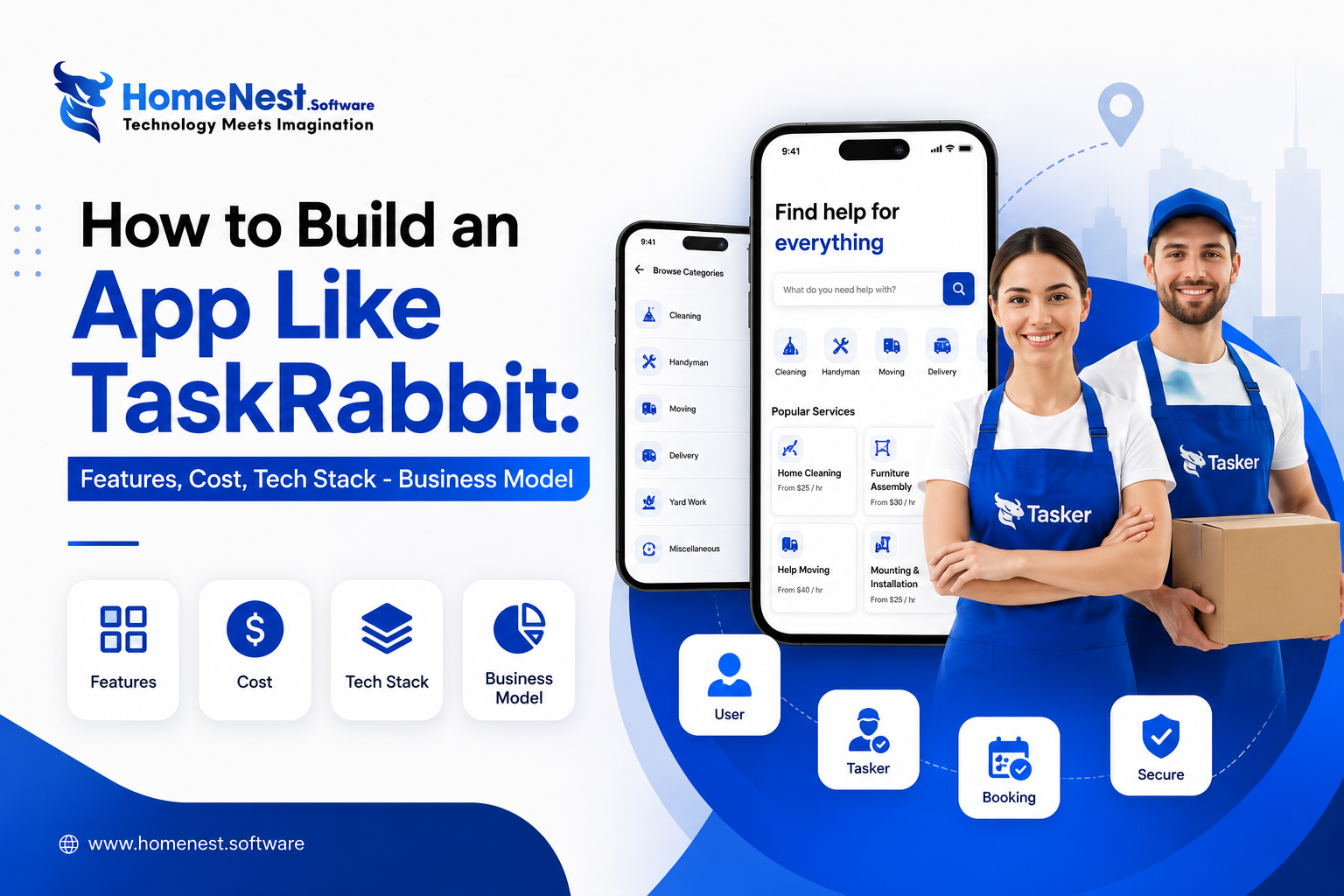
Remember Rancho’s iconic line from 3 Idiots: “Become capable, and success will follow.” TaskRabbit turned that philosophy into a powerful global marketplace built around everyday skills.
We are living in the age of the gig economy, where practical expertise can become a source of income almost instantly. A retired carpenter, a university student, or an experienced cleaner can now connect with customers, accept local jobs, and earn on their own terms.
TaskRabbit’s success comes from more than technology. It created a trusted ecosystem where convenience, verified talent, transparent pricing, and seamless booking work together in one experience.
Think of it as a ride-hailing platform for everyday services. Instead of booking a car, users can hire trusted professionals to assemble furniture, clean a home, complete repairs, manage deliveries, or handle other time-consuming tasks.
For startups and enterprises, this model represents a compelling opportunity to enter the growing on-demand services market. The next step is understanding how the platform works and how to build a scalable app that customers and service providers will continue to use.
What Is TaskRabbit?
TaskRabbit is an on-demand service marketplace that connects customers with skilled local professionals, known as Taskers, who can complete a wide range of everyday tasks. Founded in 2008 and acquired by IKEA in 2017, the platform has become one of the world’s leading marketplaces for home and personal services.
Through the TaskRabbit app, users can quickly find trusted Taskers for services such as furniture assembly, home cleaning, moving assistance, handyman work, mounting and installation, delivery, and many other household tasks. Customers can compare profiles, hourly rates, reviews, and availability before booking the right professional for their needs.
The platform also offers secure payment processing, in-app messaging, real-time scheduling, and customer support, creating a seamless experience for both clients and service providers. Today, TaskRabbit operates across multiple countries, giving freelancers flexible earning opportunities while providing users with fast, reliable, and convenient access to local services whenever they need them.
How Does the TaskRabbit App Work?
TaskRabbit simplifies the process of finding and hiring trusted local professionals through a few straightforward steps. From creating an account to completing a job and making a secure payment, the platform is designed to provide a seamless experience for both customers and Taskers.
1. Create an Account
Download the TaskRabbit app from the App Store or Google Play and sign up using your email address or a social media account. After registration, you can set up your profile and start browsing available services.
2. Select the Service You Need
Browse a wide range of on-demand services, including furniture assembly, home cleaning, moving assistance, handyman work, mounting, delivery, and more. Choose the category that best matches your needs.
3. Compare Local Taskers
The app displays a list of available Taskers in your area. You can compare their hourly rates, customer ratings, reviews, skills, and availability to find the professional who best fits your requirements.
4. Book Your Preferred Tasker
Once you’ve selected a Tasker, choose your preferred date and time, add any special instructions, and confirm your booking. The Tasker receives your request and prepares for the job.
5. Complete the Task
At the scheduled time, the Tasker arrives at your location and completes the requested service. Throughout the process, you can communicate directly through the app if additional details are needed.
6. Pay Securely and Leave a Review
After the task is completed, payment is processed securely through the app. You can then rate your experience and leave a review, helping future users make informed decisions while maintaining the platform’s trust and quality standards.
Steps to Build an App Like TaskRabbit
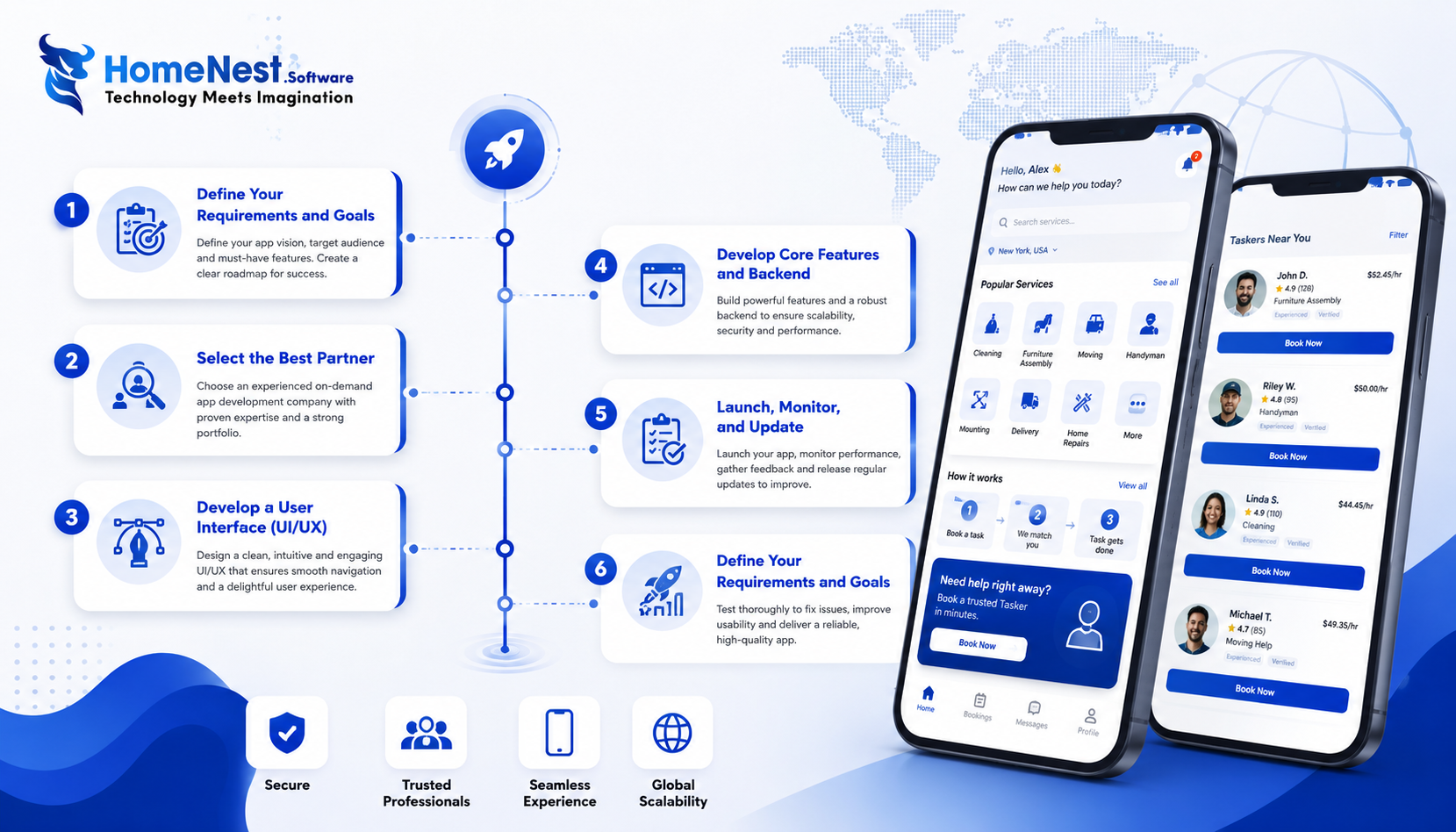
Building an app like TaskRabbit requires more than just coding. It involves validating your business idea, designing an intuitive user experience, selecting the right technology stack, and continuously improving the platform after launch. Here’s a step-by-step roadmap to help you create a scalable on-demand service marketplace.
1. Define Your Business Goals and Requirements
Start by identifying your target audience, service categories, revenue model, and long-term business objectives. Determine the core features your platform needs and prioritize them for an MVP (Minimum Viable Product). A well-defined project scope helps reduce development risks, control costs, and establish a realistic timeline.
2. Choose the Right App Development Partner
Partner with an experienced on-demand app development company that has a proven track record of building marketplace applications. Review their portfolio, technical expertise, client testimonials, and development process. The right partner will help you choose the best technologies, recommend scalable architecture, and ensure your product is built for long-term growth.
Read more: Enterprise Software Development: What It Is and How to Choose the Right Partner
3. Design an Intuitive UI/UX
A seamless user experience is one of the biggest factors behind the success of marketplace apps. Design separate yet consistent interfaces for customers, service providers, and administrators. Focus on simple navigation, fast booking, secure payments, and clear communication throughout the user journey to maximize engagement and retention.
4. Build the Core Features and Backend Infrastructure
Develop the essential functionality that powers your marketplace, including:
- User registration and authentication
- Service listings and task posting
- Tasker profiles and ratings
- Booking and scheduling
- Real-time chat and notifications
- GPS location and live tracking
- Secure payment integration
- Admin dashboard and analytics
At the same time, build a robust backend capable of handling user management, service requests, payment processing, notifications, and future scalability.
5. Test the Application Thoroughly
Before launching, conduct comprehensive testing across multiple devices and operating systems. Validate every workflow, including registration, booking, payments, messaging, and notifications. Beta testing with real users can also uncover usability issues and provide valuable insights for improving the overall experience.
6. Launch, Monitor, and Continuously Improve
Once your app is ready, publish it on the App Store and Google Play. After launch, closely monitor performance metrics, user behavior, crash reports, and customer feedback. Regularly release updates, introduce new features, optimize performance, and strengthen security to keep your TaskRabbit-like platform competitive as your business grows.
How Much Does It Cost to Build an App Like TaskRabbit?
The cost of developing an app like TaskRabbit depends on its feature set, platform, design complexity, technology stack, and the development team’s expertise. While a basic MVP can be launched with a relatively modest budget, a fully featured, scalable marketplace requires a significantly larger investment.
On average, the cost to build a TaskRabbit-like app ranges from $5,000 to $15,000+, depending on your business requirements and the level of customization. Enterprise-grade solutions with advanced functionality, AI capabilities, and large-scale infrastructure may require a higher budget.
App Complexity and Features
The scope of features is the biggest factor affecting development costs. A simple MVP with user registration, service listings, booking, and payments requires fewer development hours than a platform with advanced capabilities such as:
- Real-time location tracking
- In-app messaging
- Push notifications
- AI-powered service recommendations
- Dynamic pricing
- Multi-language support
- Ratings and review system
- Admin analytics dashboard
The more sophisticated the functionality, the higher the development time and overall project cost.
Platform Selection
Your choice of platform also influences the budget.
- Single-platform development (iOS or Android) is generally the most cost-effective option.
- Cross-platform frameworks such as Flutter or React Native reduce development time by sharing a single codebase across both platforms.
- Native development delivers the best performance and user experience but usually requires a larger investment because separate applications are built for iOS and Android.
UI/UX Design
An intuitive, visually appealing interface plays a critical role in user acquisition and retention. Custom UI/UX design, interactive animations, personalized user flows, and premium branding require more design and development effort than template-based interfaces.
Investing in high-quality user experience often leads to better customer satisfaction and long-term business growth.
Development Team and Location
Development costs vary significantly based on the experience and geographic location of your development partner.
Experienced software companies deliver higher-quality architecture, stronger security, and more reliable maintenance, while lower-cost providers may reduce upfront expenses but increase long-term technical debt. Choosing a team with proven experience in on-demand marketplace development often provides the best balance between cost and quality.
Read more: Software Development Outsourcing
Backend Infrastructure and Ongoing Maintenance
A TaskRabbit-like marketplace relies on a powerful backend to support thousands of simultaneous users, real-time bookings, secure payments, notifications, and cloud data storage.
Beyond the initial development budget, you should also plan for ongoing expenses, including:
- Cloud hosting and infrastructure
- Database management
- Third-party API integrations
- Security monitoring
- Performance optimization
- Bug fixes and feature enhancements
- Regular operating system compatibility updates
These recurring investments help ensure your application remains secure, scalable, and competitive over time.
Estimating the cost of a TaskRabbit-like app requires evaluating your business goals, feature requirements, target platforms, and expected user growth. Starting with an MVP allows you to validate your idea, reduce initial investment, and expand the platform based on real user feedback. Partnering with an experienced on-demand app development company can also help optimize both your development budget and time to market.
Key Features Every TaskRabbit-Like App Should Include
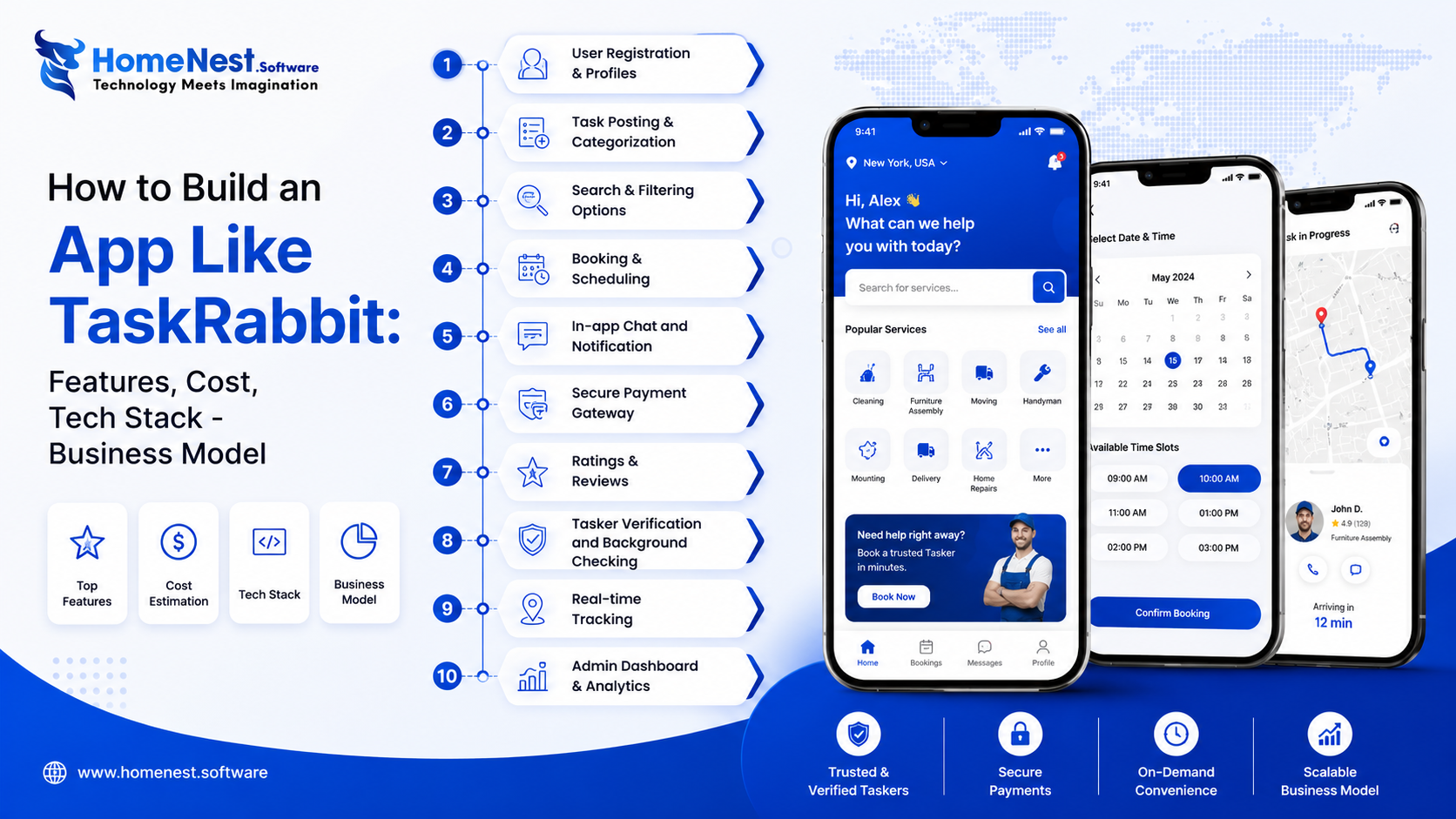
The success of a TaskRabbit-like marketplace depends on delivering a seamless experience for both customers and service providers. Below are the essential features that every on-demand service app should include to improve usability, build trust, and support long-term business growth.
User Registration and Profile Management
Allow customers and service providers to create secure accounts using email, phone numbers, or social login. User profiles should include personal information, service history, skills, certifications, ratings, and completed jobs to establish credibility and improve trust across the platform.
Task Posting and Service Categories
Enable customers to post service requests with detailed descriptions, preferred schedules, locations, and budgets. Organize services into categories such as home cleaning, furniture assembly, handyman services, moving assistance, plumbing, electrical work, and delivery to simplify job discovery.
Smart Search and Advanced Filters
Help users quickly find the right professional through advanced search and filtering options. Customers should be able to filter Taskers based on location, hourly rate, availability, ratings, completed jobs, experience, and service categories.
Booking and Scheduling System
Provide an intuitive booking experience that allows users to select a preferred Tasker, choose available dates and time slots, manage appointments, and easily reschedule or cancel bookings when necessary.
Real-Time Chat and Push Notifications
Built-in messaging enables customers and Taskers to communicate directly before, during, and after a job. Push notifications keep both parties informed about booking confirmations, schedule changes, payment updates, and task completion.
Secure Payment Gateway
Integrate reliable payment solutions that support credit cards, digital wallets, bank transfers, and other popular payment methods. Escrow payment functionality can further enhance trust by releasing funds only after the service has been successfully completed.
Ratings and Reviews
A transparent review system encourages accountability and helps maintain service quality. After each completed task, customers can rate Taskers and leave detailed feedback, while service providers can also review customers to foster a trusted marketplace.
Tasker Verification and Background Checks
Strengthen platform credibility by verifying service providers through identity verification, document validation, certifications, and background checks where applicable. Verified badges increase customer confidence and improve booking conversions.
Real-Time Location Tracking
GPS tracking allows customers to monitor the Tasker’s arrival and track service progress in real time. This feature improves transparency, reduces uncertainty, and creates a more reliable on-demand service experience.
Admin Dashboard and Business Analytics
A comprehensive admin panel gives platform administrators full control over users, bookings, payments, commissions, disputes, and customer support. Integrated analytics provide valuable insights into user growth, revenue, booking trends, service performance, and overall platform health, enabling data-driven business decisions.
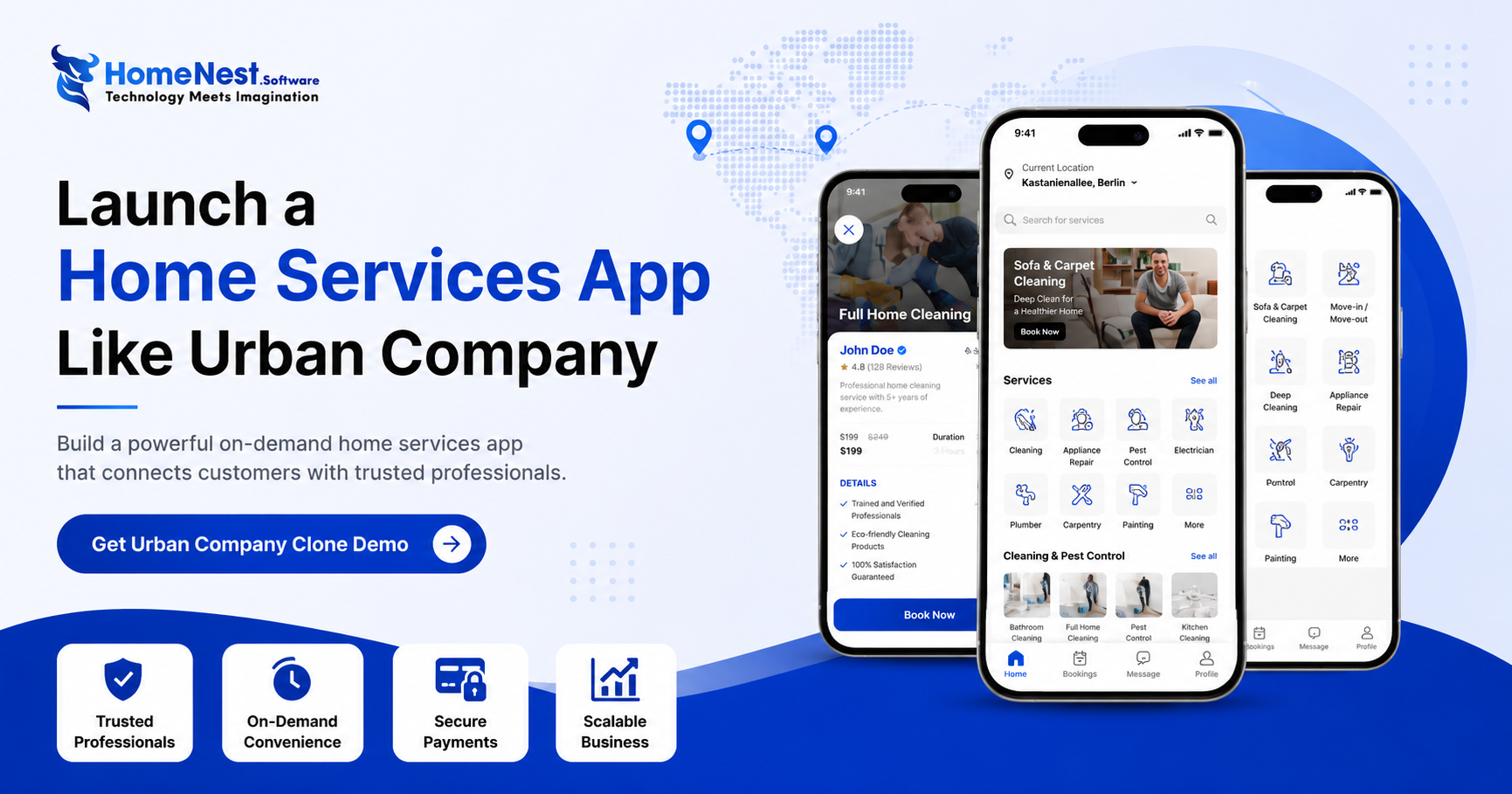
Build Your TaskRabbit-Like App with HomeNest Software
Looking to launch an on-demand services marketplace like TaskRabbit? HomeNest Software specializes in building scalable, secure, and feature-rich mobile applications tailored to your business goals. Whether you’re creating a platform for home services, handyman bookings, cleaning, moving assistance, or other local services, our experienced development team can bring your vision to life.
From product strategy and UI/UX design to backend architecture, mobile app development, cloud infrastructure, payment integration, and post-launch support, we provide end-to-end development services. Every solution is built with scalability, performance, and user experience in mind, ensuring your platform is ready to grow with your business.
Whether you’re launching an MVP or developing a full-scale marketplace, HomeNest Software helps you build a reliable TaskRabbit-like app that connects customers with trusted professionals through a seamless digital experience.
Case Study: How HomeNest Software Built an On-Demand Home Services App
A strong example of HomeNest Software’s expertise in on-demand marketplace development is the Lover’s Lawn App a platform that connects homeowners with professional lawn care and landscaping providers through a seamless mobile experience. Similar to TaskRabbit, the application focuses on simplifying service booking, improving operational efficiency, and building trust between customers and service professionals.
Business Challenge
The client wanted to replace fragmented manual booking and scheduling processes with a centralized digital platform. Their goals included:
- Simplifying service booking for homeowners
- Improving communication between customers and field technicians
- Providing real-time job tracking and transparent service updates
- Giving managers complete visibility into daily operations
- Building a scalable platform capable of supporting future business growth
HomeNest Software’s Solution
Our development team designed and delivered a complete on-demand marketplace in just 4 months with a dedicated team of 6 engineers. The platform was built around user experience, operational efficiency, and long-term scalability.
Key features included:
- Streamlined booking flow completed in just 3–5 steps
- Real-time service tracking
- Before-and-after photo verification
- Secure customer and service provider management
- Smart admin dashboard for centralized operations
- Recurring maintenance reminders
- Quick Rebook functionality to increase customer retention
- Transparent pricing and intuitive scheduling experience
Technology Stack
The solution was powered by a modern technology stack, including:
- Node.js
- TypeScript
- PostgreSQL
- Tailwind CSS
- Cloud-based backend architecture with API integrations for seamless data synchronization
Results
After launch, the platform achieved measurable business outcomes:
| Metric | Result |
|---|---|
| Development Timeline | 4 Months |
| Development Team | 6 Engineers |
| Monthly Traffic | 3,000+ Visitors |
| Customer Satisfaction | 99% |
| User Retention | 96% |
| Average Page Load Time | 0.4 Seconds |
Why This Matters for TaskRabbit-Like Apps
The Lover’s Lawn project demonstrates the same core marketplace principles behind successful platforms like TaskRabbit:
- Multi-sided marketplace architecture
- Real-time booking and scheduling
- GPS-enabled service workflows
- Secure payment-ready infrastructure
- Transparent communication between customers and service providers
- Scalable backend capable of supporting business growth
Whether you’re building a platform for home cleaning, handyman services, moving assistance, landscaping, or other local services, the architectural approach remains largely the same. Leveraging HomeNest Software’s real-world experience helps reduce development risks, accelerate time to market, and deliver a reliable on-demand marketplace that is ready to scale.
Final Thoughts
Building an app like TaskRabbit requires much more than developing a mobile application it involves creating a trusted marketplace where customers and service providers can connect efficiently. Success depends on choosing the right business model, implementing essential features, designing an intuitive user experience, and building a scalable technology infrastructure.
By partnering with an experienced on-demand app development company like HomeNest Software, you can reduce development risks, accelerate time to market, and create a platform that delivers long-term value. With the right strategy, technology stack, and continuous innovation, your TaskRabbit-like app can become a competitive marketplace that drives sustainable business growth in the expanding on-demand economy.
How to Build an App Like TaskRabbit: Features, Cost, Tech Stack – Business Model
Frequently Asked Questions (FAQs)
1. How long does it take to build an app like TaskRabbit?
The development timeline depends on the project’s complexity and feature requirements. A basic MVP typically takes 2–4 months, while a fully featured TaskRabbit-like marketplace with advanced functionality such as real-time tracking, in-app messaging, AI recommendations, and admin analytics may require 4–8 months or longer.
2. How much does it cost to develop a TaskRabbit-like app?
The cost varies based on the app’s features, platforms, UI/UX complexity, and development team. A basic solution generally starts from $5,000, while a more advanced, enterprise-grade platform can exceed $15,000, depending on customization and scalability requirements.
3. What are the must-have features of a TaskRabbit-like app?
Essential features include:
- User registration and profiles
- Service listings and task posting
- Smart search and filtering
- Booking and scheduling
- In-app chat
- Secure payment gateway
- Ratings and reviews
- Tasker verification
- GPS tracking
- Push notifications
- Admin dashboard and analytics
These features create a reliable marketplace for both customers and service providers.
4. Which technologies are best for developing a TaskRabbit-like app?
Popular technologies include:
- Frontend: Flutter, React Native, Swift, Kotlin
- Backend: Node.js, NestJS, Django, Laravel
- Database: PostgreSQL, MongoDB
- Cloud: AWS, Google Cloud, Microsoft Azure
- Real-time Services: Firebase, Socket.io
- Payments: Stripe, PayPal, Razorpay
The right technology stack depends on your scalability and business requirements.
5. Can I start with an MVP before building a full marketplace?
Yes. Launching an MVP (Minimum Viable Product) is the recommended approach. It allows you to validate your business idea, gather real user feedback, reduce development costs, and release new features based on market demand instead of assumptions.
6. How does a TaskRabbit-like app generate revenue?
Most on-demand service marketplaces use one or more of the following monetization models:
- Commission on each completed booking
- Service or platform fees
- Featured listings for service providers
- Subscription plans
- In-app advertising
- Premium business accounts
Many successful platforms combine multiple revenue streams to maximize profitability.
7. Is it better to build native apps or use cross-platform development?
It depends on your goals. Flutter and React Native offer faster development and lower costs by supporting both iOS and Android with a single codebase. Native development provides the highest performance and deeper platform integration but generally requires a larger budget.
8. Why should I choose HomeNest Software for TaskRabbit app development?
HomeNest Software specializes in building scalable on-demand marketplace applications with modern UI/UX, secure payment integration, cloud-native architecture, and enterprise-grade security. Our experienced team provides end-to-end development services from product strategy and design to deployment, maintenance, and future scaling helping businesses launch competitive TaskRabbit-like platforms faster and more efficiently.
Latest Articles
View All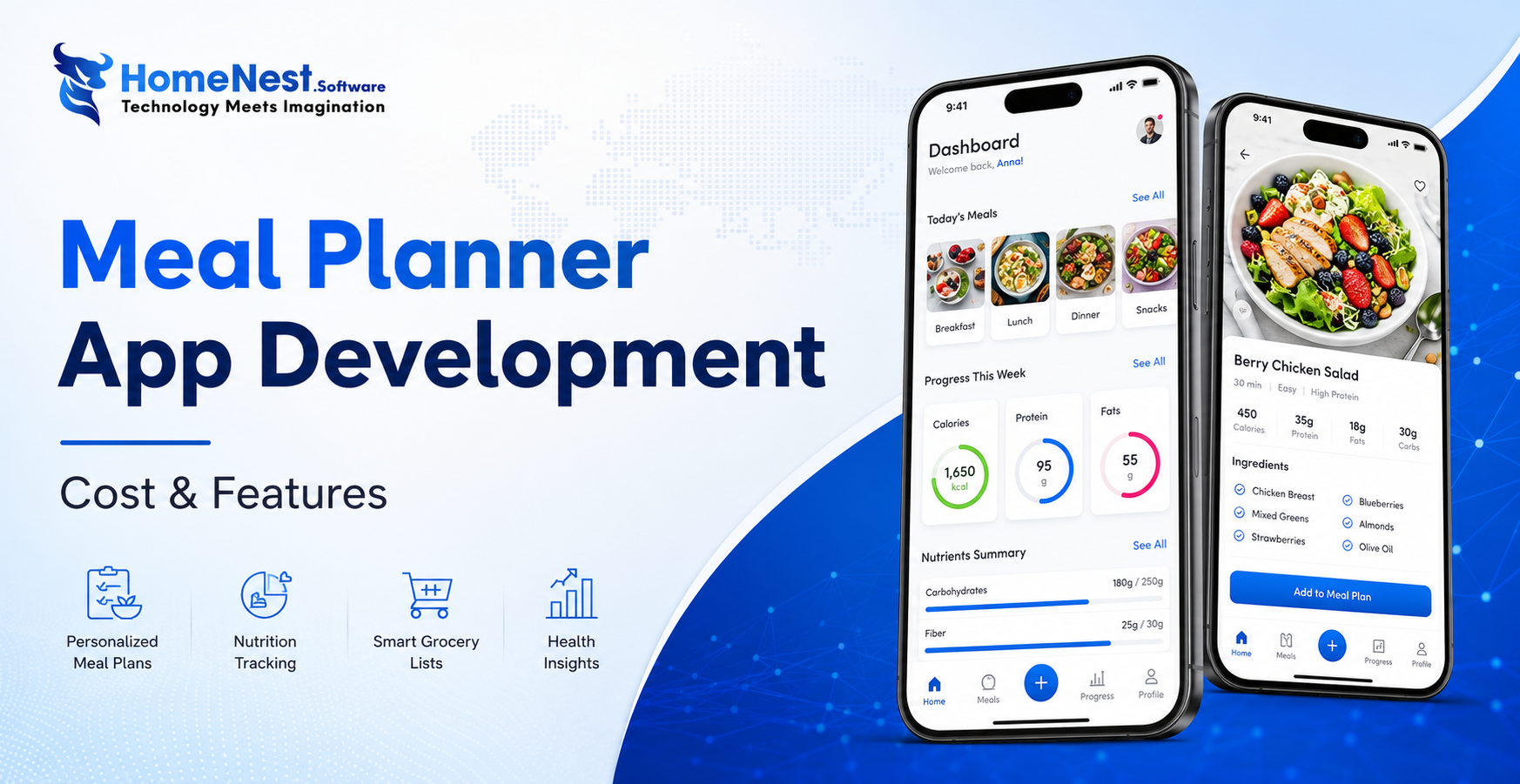
How to Build a Meal Planning App: A Complete Step-by-Step Guide
Building a successful meal planning app goes beyond creating an attractive interface it requires a clear business strategy, personalized user experiences, and scalable technology. By combining essential features like AI-powered meal recommendations, nutrition tracking, grocery list automation, and wearable integration, businesses can deliver lasting value to users while capitalizing on the growing digital health market. Partnering with an experienced mobile app development company ensures your solution is secure, future-ready, and designed to succeed in an increasingly competitive health-tech industry.
How Much Does It Cost to Build a Shopping App Like Temu?
Temu’s meteoric rise to over 900 million global downloads proves the power of combining AI, gamification, and social commerce, but building a similar viral shopping platform requires careful financial and technical planning. Developing an app like Temu typically costs anywhere from $40,000 for a basic Minimum Viable Product (MVP) to over $300,000 for a fully-featured platform. This guide breaks down every cost category, analyzes the core features driving Temu’s success, highlights the best technology stacks, and offers practical strategies to optimize your development budget without compromising on quality.

Criteria For Choosing The Right App Design Agency
UI/UX design is the logical foundation of a system, not merely a visual element. Choosing the wrong partner will directly lead to technical debt, budget overruns, and disruptions in the development process. This article provides a 6-step evaluation framework and a list of operational risks, helping businesses eliminate subjective design advice and accurately assess agency capabilities based on developer handoff standards and practical business performance.
How Does AI in Banking Industry Impact the Future?
Artificial intelligence (AI) has transitioned from a supplementary tool to a core infrastructure of financial data management, optimizing profitability through real-time fraud detection, natural language processing (NLP), and high-speed credit scoring models. “Deploying AI in the financial sector requires more than just algorithmic accuracy, it demands a highly secure cloud architecture and rigorous data governance,” commented Nguyen Tien, co-founder of HomeNest Software. Why read this guide? We skip the theoretical jargon to focus entirely on technical implementation. Whether you’re evaluating a vendor or planning a system overhaul, this article will detail: Operational Efficiency: Automating unstructured data workflows at scale. Risk Architecture: Implementing real-time threat detection and AML compliance. Data ownership: The essential need for 100% ownership of the source code to ensure full algorithm auditability.
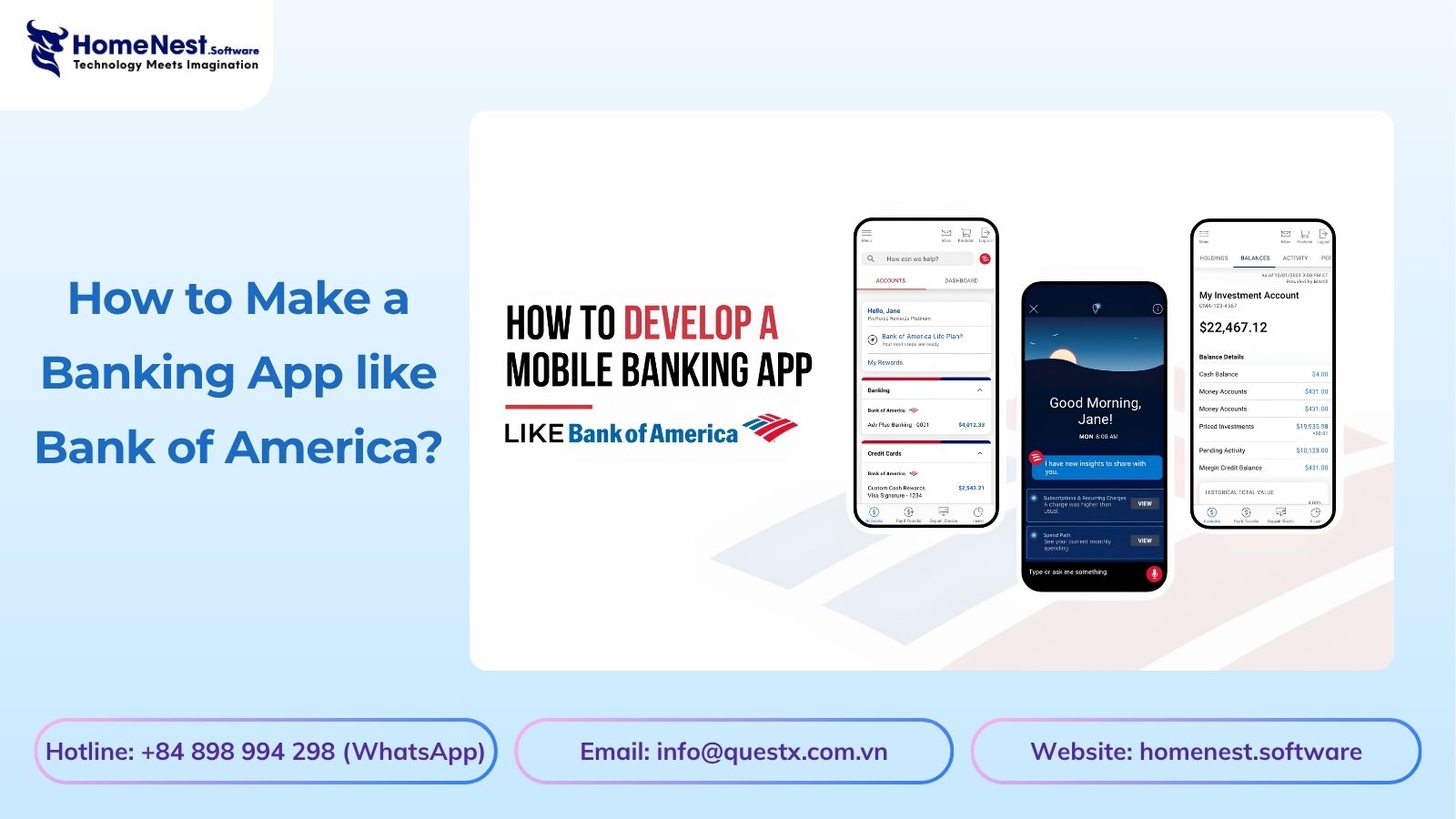
How to Make a Banking App like Bank of America?
Developing a mobile banking application like Bank of America extends far beyond basic UI design; it requires engineering a fault-tolerant backend capable of real-time ledger synchronization, biometric authentication, and high-volume data processing under strict regulatory frameworks. Drawing from HomeNest Software’s deep experience in architecting enterprise-grade fintech solutions, this guide strips away theoretical jargon to focus entirely on operational and technical execution. What you will find in this guide: We break down the precise development roadmap, from mapping out microservices and ensuring PCI-DSS compliance to estimating MVP development costs and securing absolute data sovereignty through 100% source code ownership. If you are preparing to build, scale, or audit a financial platform, this blueprint provides the exact framework you need.
Banking App Development Cost
Building a banking application is rarely a simple process; it’s a complex technical challenge requiring a balance between complying with stringent financial regulations, handling large transaction volumes, and a scalable cloud architecture. Miscalculating these technical requirements from the outset often leads to significant technical debt and budget overruns. Based on HomeNest Software’s practical experience in designing enterprise-grade fintech solutions, this guide bypasses generic estimates to provide a realistic analysis of banking application development costs. What you’ll find in this guide: We analyze the true cost factors, from technology selection and API integration to the hidden costs of regulatory compliance and security infrastructure. Whether you’re launching a minimum viable product or expanding an existing financial platform, this analysis provides the precise operational data you need to plan your budget effectively.