
How Much Does It Cost to Build a Shopping App Like Temu?
Temu’s meteoric rise to over 900 million global downloads proves the power of combining AI, gamification, and social commerce, but building a similar viral shopping platform requires careful financial and technical planning. Developing an app like Temu typically costs anywhere from $40,000 for a basic Minimum Viable Product (MVP) to over $300,000 for a fully-featured platform. This guide breaks down every cost category, analyzes the core features driving Temu’s success, highlights the best technology stacks, and offers practical strategies to optimize your development budget without compromising on quality.
Scope of Work
Building a shopping app like Temu costs between $40,000 and $300,000 or more, depending on the features you include, the platforms you target, and where your development team is located. A basic MVP (minimum viable product) with core shopping functions typically costs $40,000 to $80,000 and takes 4 to 6 months to build. A full platform with AI recommendations, gamification, multi-vendor support, and advanced analytics costs $150,000 to $300,000 and requires 8 to 14 months of development.
This guide breaks down every cost category, explains the factors that drive the price up or down, and provides the technology choices that have the most impact on your final budget.
What Is Temu and What Makes It Worth Studying?
Temu is an online marketplace owned by PDD Holdings, the same company behind Pinduoduo in China. It launched in the United States in September 2022 and reached 100 million downloads within six months. By 2024, Temu had over 900 million total downloads globally and was generating more than $50 billion in gross merchandise value annually, according to data from Business of Apps and Statista.
The reason Temu grew so fast comes down to a specific combination of business decisions:
Direct-from-manufacturer model. Temu connects buyers directly to factories, mostly in China, which removes multiple layers of markup. Products are priced significantly lower than on Amazon or eBay because there are no distributors or brand premiums in the chain.
Aggressive gamification. The app includes daily check-ins with rewards, spin-the-wheel discount games, group-buying discounts, and referral bonuses. These features increase session time and return visit rates. Temu’s average daily active user spends more than 20 minutes in the app, which is notably higher than most shopping apps.
Social commerce features. Users share deals, invite friends for discounts, and participate in group buying. This organic sharing reduces customer acquisition costs.
AI-driven personalization. The product feed is tailored to each user’s browsing and purchase history using machine learning models. New users see trending items in their country; returning users see items similar to what they have already viewed or bought.
These features are not unique to Temu individually, but the combination and the way they are executed explain why Temu became the most downloaded app in the United States for much of 2023.
If you want to build a platform with similar functionality, you need to understand what each of these features costs to develop and maintain.
Core Features You Need to Build an App Like Temu
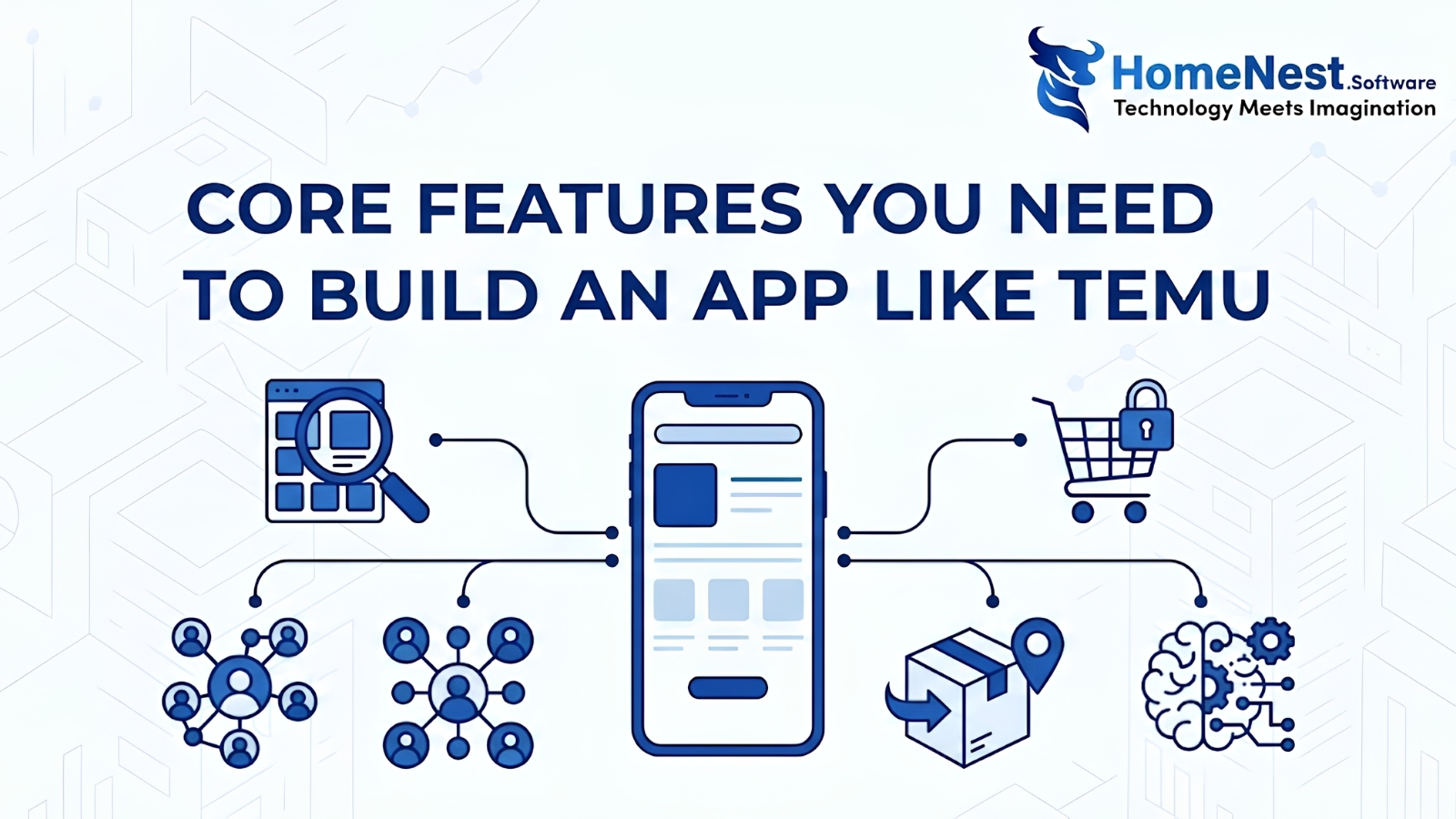
The cost of your app is directly tied to the features you build. Here is a breakdown of the three main panels any Temu-style marketplace needs.
Read more: A Complete Guide to Building a Marketplace App: 8 Steps & Cost Breakdown
Buyer App Features
The buyer-facing side is what users interact with most. These are the features that determine whether users stay, return, and spend money.
- User registration and login (email, phone, Google, Apple, Facebook OAuth)
- Product catalog with category browsing and subcategory filters
- Advanced search with filters (price range, rating, category, shipping time)
- Visual search (upload a photo to find similar products)
- AI-powered product recommendations on the home feed and product pages
- Shopping cart and saved wishlist
- Multiple payment methods (credit card, PayPal, Apple Pay, Google Pay, digital wallets)
- Real-time order tracking with push notifications at each stage
- Product reviews and ratings with photo uploads
- Gamification system (daily rewards, spin-to-win, referral credits, group discounts)
- In-app customer support with chatbot and live chat escalation
- Multi-language and multi-currency display
- Social sharing of products and deals
Seller and Vendor Panel Features
If you want a multi-vendor marketplace (where multiple sellers list products, like Temu rather than a single-brand store), you need a separate seller panel.
- Vendor account registration and profile setup
- Product listing with bulk upload via CSV or API
- Inventory management with low-stock alerts
- Order management and fulfillment tracking
- Payout dashboard with transaction history
- Basic analytics (views, clicks, conversion rate per product)
- Communication with buyers through the platform
Admin Panel Features
The admin panel is what your team uses to manage the entire marketplace.
- User management (buyers and sellers)
- Product approval and content moderation
- Commission and revenue tracking
- Promotions, coupons, and campaign management
- Fraud detection alerts and transaction review
- Platform analytics and reporting
- Support ticket management
Detailed Cost Breakdown for Building a Temu-Like App
The table below shows cost estimates based on typical market rates for a mid-size development team. These figures reflect real project data from e-commerce development work.
Read more: Ecommerce App Development Cost: A Full Breakdown
Cost by Feature Module
| Module | Estimated Cost (USD) | Development Time | Technologies Commonly Used |
|---|---|---|---|
| UI/UX Design | $5,000 to $15,000 | 4 to 8 weeks | Figma, Adobe XD |
| User Registration and Profiles | $3,000 to $8,000 | 2 to 4 weeks | Firebase Auth, OAuth 2.0 |
| Product Catalog and Search | $8,000 to $25,000 | 6 to 10 weeks | Elasticsearch, Algolia |
| AI Recommendation Engine | $10,000 to $30,000 | 8 to 12 weeks | Python, TensorFlow, AWS SageMaker |
| Payment Gateway Integration | $5,000 to $12,000 | 3 to 5 weeks | Stripe, PayPal, Razorpay |
| Order Management and Tracking | $6,000 to $15,000 | 4 to 6 weeks | Google Maps API, Firebase |
| Gamification System | $5,000 to $15,000 | 4 to 6 weeks | Custom backend logic, Redis |
| Admin Dashboard | $8,000 to $15,000 | 6 to 8 weeks | React.js, Node.js, PostgreSQL |
| Vendor and Seller Panel | $10,000 to $20,000 | 6 to 8 weeks | React.js, Node.js |
| Push Notifications | $2,000 to $5,000 | 2 to 3 weeks | Firebase Cloud Messaging, OneSignal |
| In-App Chat and Chatbot | $5,000 to $12,000 | 3 to 5 weeks | Socket.io, Dialogflow, OpenAI API |
| Testing and Quality Assurance | $5,000 to $15,000 | 4 to 8 weeks | Selenium, Appium, Jest |
| Deployment and Launch Setup | $2,000 to $5,000 | 1 to 2 weeks | AWS, Google Cloud, Docker |
| Total Range | $74,000 to $192,000 | 6 to 12 months | – |
Note: The higher end of each range applies when you add more complexity, such as supporting 10 languages, integrating multiple payment processors for different countries, or building a custom AI model instead of using an API.
Cost by App Complexity Level
| Complexity Level | What It Includes | Cost Range | Timeline |
|---|---|---|---|
| Basic MVP | Core catalog, cart, payment, order tracking, basic user accounts | $40,000 to $80,000 | 3 to 5 months |
| Mid-Level App | All MVP features plus vendor panel, basic AI recommendations, reviews, push notifications | $80,000 to $150,000 | 5 to 8 months |
| Full-Featured Platform | All of the above plus gamification, advanced AI, visual search, multi-currency, multi-vendor analytics, fraud detection | $150,000 to $300,000 or more | 8 to 14 months |
Cost by Development Team Location
Where your team is based affects the hourly rate and therefore the total project cost significantly.
| Region | Typical Hourly Rate (USD) | Estimated Total Cost for Full App |
|---|---|---|
| United States or Canada | $150 to $250 per hour | $250,000 to $500,000 or more |
| Western Europe | $100 to $180 per hour | $180,000 to $350,000 |
| Eastern Europe | $40 to $80 per hour | $80,000 to $180,000 |
| India | $25 to $60 per hour | $45,000 to $130,000 |
| Vietnam | $25 to $50 per hour | $40,000 to $110,000 |
| Southeast Asia (other) | $30 to $65 per hour | $50,000 to $140,000 |
Teams in Vietnam and India can deliver the same technical work as North American teams at a significantly lower cost. The difference is not quality but market labor rates. Many large technology companies, including Atlassian, Grab, and Bosch, run substantial development operations in Vietnam.
Technology Stack for a Temu-Like App
The technology choices you make during planning affect both development cost and long-term maintenance costs. Here is what a typical production-ready e-commerce platform uses.
Read more: How to Build an Online Marketplace Like Amazon
| Layer | Recommended Options | Notes |
|---|---|---|
| Mobile Frontend | Flutter, React Native | Cross-platform; one codebase for iOS and Android |
| Web Frontend | React.js, Next.js | Next.js adds server-side rendering for SEO |
| Backend | Node.js, Django, Laravel | Node.js handles high concurrent connections well |
| Database (primary) | PostgreSQL, MySQL | Relational; good for orders, users, transactions |
| Database (flexible) | MongoDB | Good for product catalog with variable attributes |
| Caching | Redis | Reduces load on main database for frequent queries |
| Search | Elasticsearch, Algolia | Handles large product catalogs with fast filtering |
| AI and Machine Learning | Python, TensorFlow, AWS SageMaker | For recommendation engine and dynamic pricing |
| Cloud Hosting | AWS, Google Cloud Platform, Microsoft Azure | AWS is most common for e-commerce at scale |
| Payment Processing | Stripe, PayPal, Razorpay, Braintree | Choose based on target markets |
| Push Notifications | Firebase Cloud Messaging, OneSignal | Firebase is free for most use cases |
| Analytics | Google Analytics 4, Mixpanel, Amplitude | Mixpanel and Amplitude are better for event tracking |
| DevOps and CI/CD | Docker, Kubernetes, GitHub Actions | Kubernetes for scaling at high traffic |
Why Flutter or React Native instead of native apps?
Building separate native apps for iOS (Swift) and Android (Kotlin) costs roughly 40 to 60 percent more than building a single cross-platform app using Flutter or React Native. For most businesses starting out, cross-platform development delivers performance that is good enough for production and reduces both initial cost and ongoing maintenance.
At HomeNest Software, we use Flutter for most new mobile projects because it produces a single codebase, supports iOS and Android, and offers near-native performance. We switch to native development only when the project has specific platform requirements that Flutter cannot meet, such as deep hardware integration.
The Development Process: Step by Step
Understanding the process helps you set realistic expectations for timelines and know what questions to ask during vendor selection.
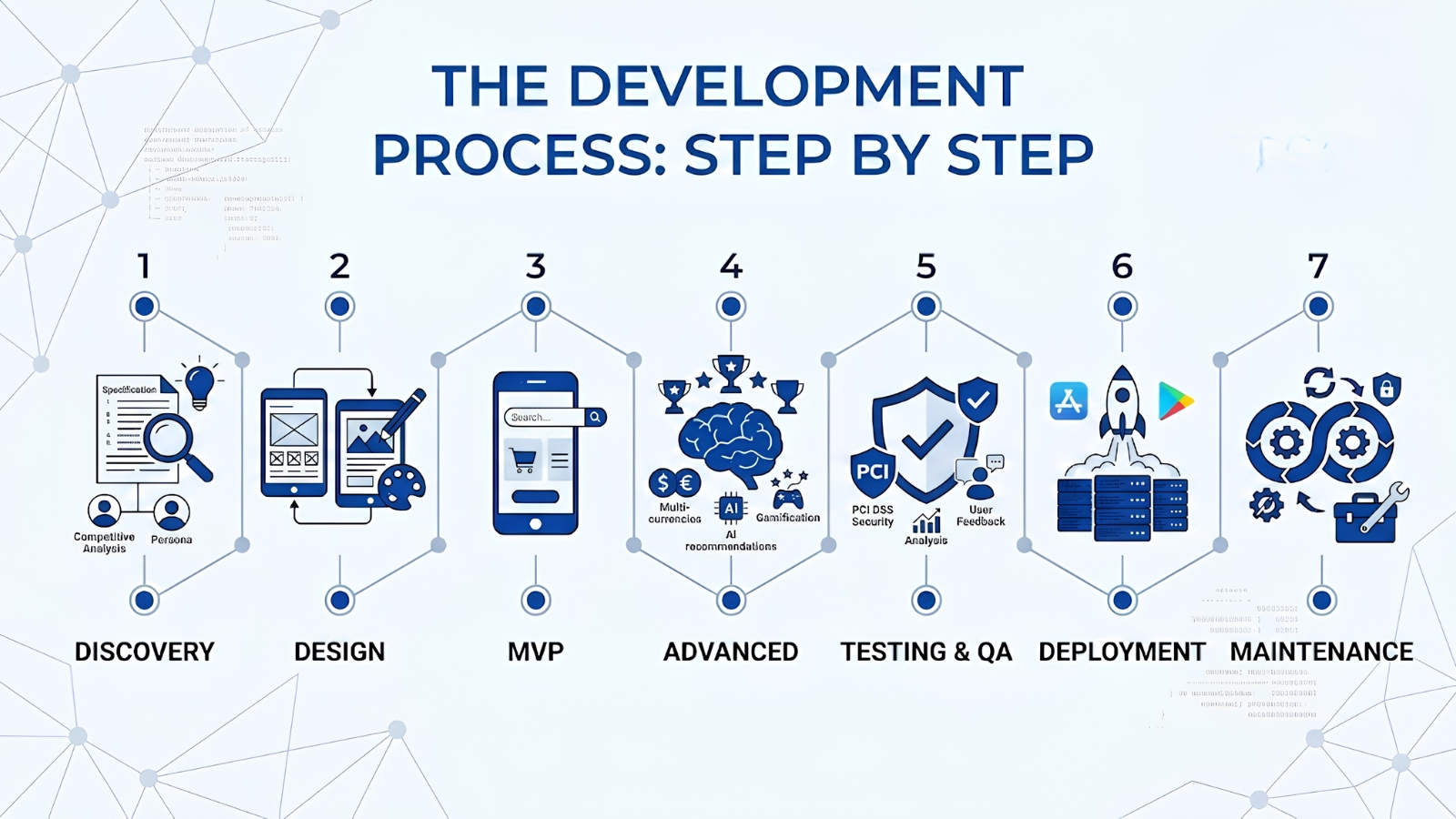
Step 1: Discovery and Requirements (2 to 3 weeks)
This phase covers competitive analysis, user persona definition, feature prioritization, and technical feasibility review. A good discovery phase produces a detailed product specification document and a feature roadmap. Skipping this step is a common reason projects run over budget.
Step 2: UI and UX Design (4 to 6 weeks)
The design phase produces wireframes, high-fidelity mockups, and a clickable prototype. Design decisions made here affect development speed later. A well-designed component library reduces implementation time for each screen.
Step 3: MVP Development (8 to 12 weeks)
The MVP includes the minimum set of features needed to put the app in front of real users. For a shopping app, this typically means product catalog, search, user accounts, cart, checkout, and basic order tracking. The goal is to validate the business concept before investing in advanced features.
Step 4: Advanced Feature Development (6 to 10 weeks)
This phase adds the features that differentiate your app: AI recommendations, gamification, vendor management, multi-currency support, and advanced analytics. The duration depends on how many of these you include.
Step 5: Testing and Quality Assurance (4 to 6 weeks)
Testing covers functional testing (does each feature work as specified), performance testing (does the app handle 10,000 simultaneous users), security testing (are payment flows and user data protected), and usability testing (do real users understand how to complete key actions). Security testing is particularly important for e-commerce because payment handling is subject to PCI DSS compliance requirements.
Step 6: Deployment and Launch (2 to 3 weeks)
This includes submitting to the Apple App Store and Google Play Store, setting up production servers, configuring monitoring tools, and running a final pre-launch checklist. App Store review typically takes 1 to 3 days for Apple and a few hours for Google.
Step 7: Post-Launch Maintenance (ongoing)
After launch, you will need ongoing work for bug fixes, security updates, operating system compatibility updates, and new feature development. Plan for a maintenance budget of 15 to 20 percent of the initial development cost per year.
| Maintenance Category | Annual Cost Estimate |
|---|---|
| Bug fixes and security patches | $5,000 to $15,000 |
| Server and infrastructure costs | $3,000 to $20,000 |
| Feature updates and improvements | $10,000 to $30,000 |
| Total annual estimate | $15,000 to $50,000 |
Factors That Change the Final Cost
These are the specific decisions that push your budget up or down the most.
Feature count and complexity. Each additional feature adds development time. A simple coupon system might take two weeks. A full gamification engine with streak tracking, leaderboards, referral attribution, and reward redemption could take eight to twelve weeks.
Platform targets. iOS only, Android only, both mobile platforms, or mobile plus a web version each require different amounts of work. A cross-platform mobile app plus a web platform typically costs 60 to 80 percent more than a single mobile platform.
AI and machine learning. Using a third-party AI API (such as OpenAI or AWS Personalize) to power recommendations costs less to implement than building a custom model. Custom models produce better results but require a data science team and training data.
Number of supported countries and currencies. Adding each new country means supporting its language, currency, payment methods, and sometimes local regulations. Supporting 20 countries costs significantly more than supporting one.
Compliance requirements. If you serve users in the European Union, you must comply with GDPR. If you handle credit card payments, you must meet PCI DSS requirements. These are not optional, and meeting them adds both development time and ongoing legal review costs.
Third-party integrations. Connecting to shipping carriers (FedEx, UPS, DHL), ERP systems, or loyalty program platforms each adds development time and API licensing costs.
Design quality. A standard component library with functional design costs less than a custom design system with micro-animations, custom illustrations, and branded interactions.
How to Reduce the Cost Without Compromising Quality
These are practical decisions that reduce total project cost without cutting features that matter to users.
Launch with an MVP first. Identify the five to seven features that users must have to complete a transaction, build those, and launch. Add other features based on what users actually request after launch. This approach prevents spending money on features nobody uses.
Use cross-platform development. Flutter or React Native reduces cost compared to building separate native iOS and Android apps. The performance difference is not noticeable to most users for e-commerce applications.
Use managed AI services instead of custom models. AWS Personalize, Google Recommendations AI, and similar services provide recommendation engine functionality without requiring you to build or train your own model. The results are good enough for most starting platforms and cost far less to implement.
Outsource to regions with lower labor rates. Vietnam and India offer development quality comparable to North America and Western Europe at 25 to 40 percent of the cost. At HomeNest Software, our rates start at $25 per hour for well-qualified developers who have worked on production e-commerce systems.
Use open-source tools where appropriate. PostgreSQL, MongoDB, Elasticsearch, and Redis are open source and free to use. Payment processing does have per-transaction costs, but there are no licensing fees for the core database and search infrastructure.
Adopt agile development. Working in two-week sprints with regular reviews keeps the project aligned with business priorities and prevents expensive rework caused by misunderstandings about requirements.
Temu vs Other Shopping Apps: Feature and Cost Comparison
| Feature | Temu | Shein | Amazon | Wish |
|---|---|---|---|---|
| Multi-vendor marketplace | Yes | No (own brand) | Yes | Yes |
| AI recommendations | Advanced | Advanced | Advanced | Basic |
| Gamification | Heavy | Moderate | Minimal | Moderate |
| Group buying | Yes | No | No | No |
| Social referral system | Yes | Yes | No | Yes |
| Visual search | Yes | Yes | Yes | No |
| Estimated cost | $150K to $300K | $120K to $250K | $500K or more | $80K to $150K |
This comparison shows that a full Temu-like platform is not the cheapest option to build, but it is also not as expensive as matching Amazon’s full feature set. A focused MVP that replicates Temu’s most effective features (AI recommendations, gamification, referral system) is achievable within a $100,000 to $150,000 budget.
How a Temu-Like App Makes Money
Building the app is the cost side of the equation. Here is the revenue side.
Commission on each transaction. The most common model is charging sellers a percentage of each sale, typically 10 to 25 percent depending on the product category. This is the primary revenue source for most marketplaces.
Seller subscription plans. Charge sellers a monthly fee for access to the platform. Higher-tier plans offer better analytics, priority support, or featured placement.
Promoted listings and advertising. Sellers pay to have their products appear at the top of search results or on the home feed. This is significant revenue for mature platforms.
Logistics and fulfillment fees. If you offer a managed shipping or warehousing service, you charge sellers for it.
Data and analytics packages. Selling market trend data and consumer behavior reports to sellers.
A marketplace that processes $10 million in annual gross merchandise value at a 15 percent commission rate generates $1.5 million in gross revenue before operating costs. At scale, the unit economics of a marketplace model are good, which is why it attracts significant investment.
Why HomeNest Software Is a Suitable Development Partner
HomeNest Software is a software development company based in Vietnam. We have delivered e-commerce and marketplace projects for clients in North America, Europe, and Southeast Asia since 2018.
Here is what we provide that is relevant to a Temu-like project:
- Direct e-commerce experience. We have built multi-vendor marketplaces, single-brand storefronts, B2B procurement platforms, and subscription commerce systems. We understand the technical decisions that determine whether a marketplace scales or breaks under load.
- Flutter and React Native expertise. Our mobile team works primarily with Flutter, which means we can build a cross-platform app at lower cost than a team that maintains separate iOS and Android codebases.
- AI integration work. We have integrated recommendation engines using AWS Personalize and custom Python models, connected OpenAI APIs for in-app chat and search, and built dynamic pricing systems.
- Transparent project management. We use milestone-based contracts. You pay for completed, reviewed, and approved work. Every project includes weekly progress reports and a shared project board where you can see task status in real time.
- Post-launch support. We offer retainer-based maintenance agreements starting at $1,500 per month, which covers bug fixes, dependency updates, and minor feature work.
- Competitive rates. Our development rates start at $25 per hour for developers and $35 per hour for senior developers and architects. Project-based quotes are available for fixed-scope work.
We are not the only development company that can build what you need. We recommend that you request quotes from three to five vendors, review their portfolios for relevant work, and speak with at least one of their past clients before making a decision.
Summary
The cost to build a shopping app like Temu falls into three broad ranges.
A basic MVP costs $40,000 to $80,000 and takes 3 to 5 months. It includes the features users need to browse products, add items to a cart, check out, and track their orders.
A mid-level app costs $80,000 to $150,000 and takes 5 to 8 months. It adds AI recommendations, a vendor panel, reviews, notifications, and basic gamification.
A full-featured platform costs $150,000 to $300,000 or more and takes 8 to 14 months. It includes everything in the mid-level app plus advanced gamification, visual search, multi-country support, fraud detection, and a mature analytics system.
The single most effective way to reduce cost is to start with an MVP and add features after launch. The second most effective way is to work with a development team in a lower-cost region such as Vietnam or India, where you can find qualified developers at $25 to $60 per hour.
If you want to discuss your specific requirements and get a project estimate, contact the HomeNest Software team. We will review your goals, recommend a scope for a first version, and provide a written quote within five business days.
Frequently Asked Questions
How much does it cost to build a shopping app like Temu?
The cost ranges from $40,000 for a basic MVP to $300,000 or more for a full platform with AI features, gamification, multi-vendor support, and advanced analytics. The exact amount depends on which features you include, which platforms you target (iOS, Android, web), and where your development team is based.
How long does it take to develop an app like Temu?
A basic MVP takes 3 to 5 months. A mid-level app with AI recommendations and a vendor panel takes 5 to 8 months. A full-featured marketplace with gamification, advanced AI, and multi-country support takes 8 to 14 months.
What features are the most important for a Temu-like shopping app?
Based on Temu’s growth data, the features with the highest impact on user retention and revenue are AI-powered recommendations, gamification (daily rewards and referral bonuses), real-time order tracking, fast and reliable payment processing, and a mobile-first UI. The multi-vendor model is critical if your goal is a marketplace rather than a single-brand store.
Can I build a Temu-like app on a $50,000 budget?
Yes, but you will need to prioritize carefully. A $50,000 budget is enough for a cross-platform mobile app with product catalog, search, cart, checkout, basic user accounts, and order tracking. AI recommendations, gamification, and a vendor panel would need to come in a later phase funded by early revenue.
What is the best technology stack for building this type of app?
We recommend Flutter for cross-platform mobile, Next.js for the web frontend, Node.js for the backend API, PostgreSQL for primary data storage, Redis for caching, and AWS for hosting. This is a well-supported, production-tested combination that most mid-size development teams know how to work with.
Is it better to build a native app or a cross-platform app?
For most e-commerce projects, cross-platform development with Flutter or React Native is the better choice. It costs 30 to 40 percent less than building separate native apps and delivers performance that is sufficient for shopping applications. Native development is appropriate when you need deep access to device hardware or when performance is a critical differentiator, which is rarely the case for e-commerce.
What does annual maintenance cost for an app like this?
Plan for 15 to 20 percent of your initial development cost per year. On a $100,000 project, that means $15,000 to $20,000 annually. This covers bug fixes, security updates, operating system compatibility updates, server costs, and minor feature improvements.
What is the biggest mistake businesses make when building an e-commerce app?
The most common mistake is trying to build too many features before launching. Building a full feature set before validating that real users want the product wastes money and delays feedback. A better approach is to launch with core shopping functionality, acquire your first 1,000 to 10,000 users, and then build additional features based on what those users actually request.
Latest Articles
View All
Criteria For Choosing The Right App Design Agency
UI/UX design is the logical foundation of a system, not merely a visual element. Choosing the wrong partner will directly lead to technical debt, budget overruns, and disruptions in the development process. This article provides a 6-step evaluation framework and a list of operational risks, helping businesses eliminate subjective design advice and accurately assess agency capabilities based on developer handoff standards and practical business performance.
How Does AI in Banking Industry Impact the Future?
Artificial intelligence (AI) has transitioned from a supplementary tool to a core infrastructure of financial data management, optimizing profitability through real-time fraud detection, natural language processing (NLP), and high-speed credit scoring models. “Deploying AI in the financial sector requires more than just algorithmic accuracy, it demands a highly secure cloud architecture and rigorous data governance,” commented Nguyen Tien, co-founder of HomeNest Software. Why read this guide? We skip the theoretical jargon to focus entirely on technical implementation. Whether you’re evaluating a vendor or planning a system overhaul, this article will detail: Operational Efficiency: Automating unstructured data workflows at scale. Risk Architecture: Implementing real-time threat detection and AML compliance. Data ownership: The essential need for 100% ownership of the source code to ensure full algorithm auditability.
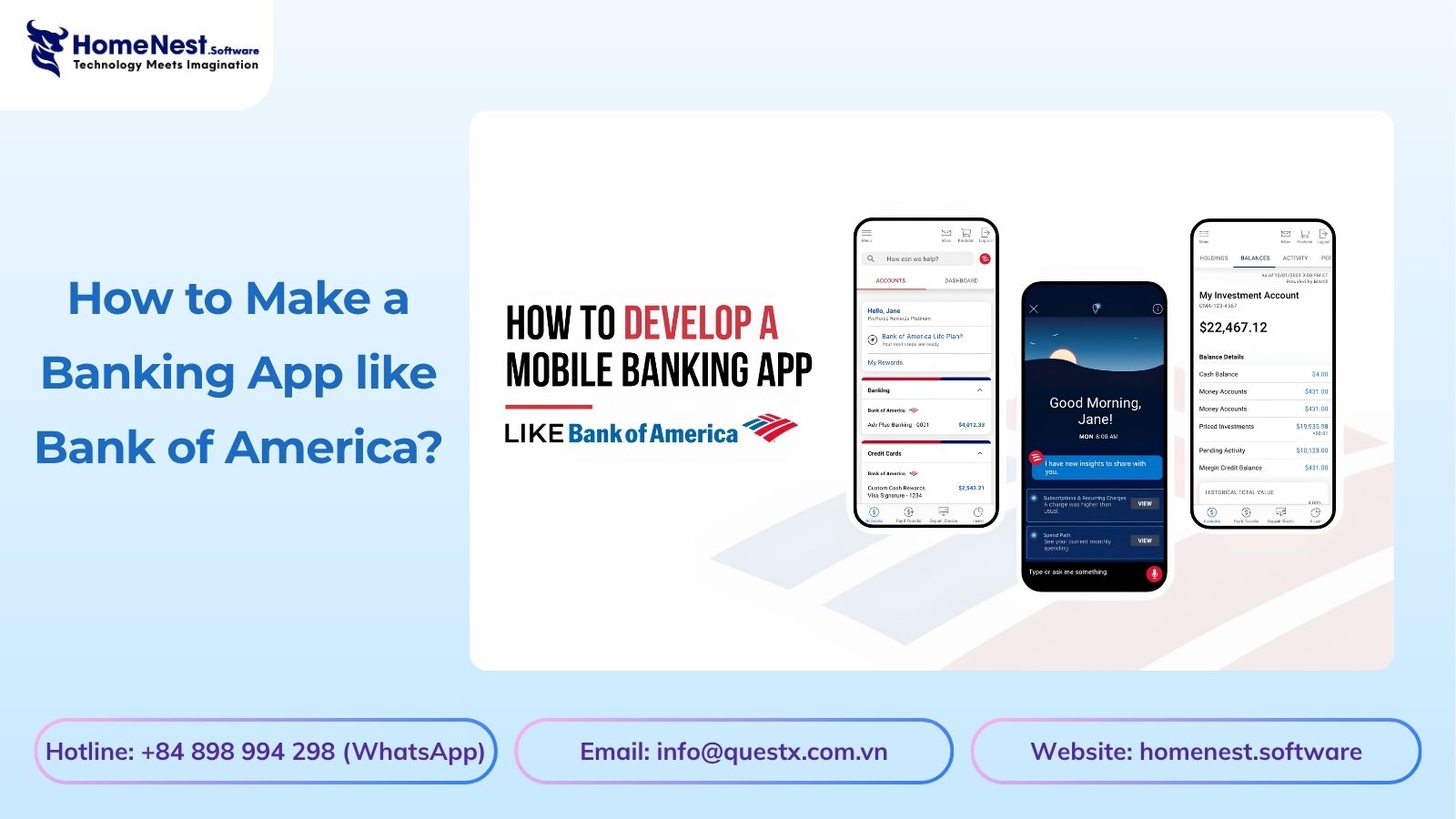
How to Make a Banking App like Bank of America?
Developing a mobile banking application like Bank of America extends far beyond basic UI design; it requires engineering a fault-tolerant backend capable of real-time ledger synchronization, biometric authentication, and high-volume data processing under strict regulatory frameworks. Drawing from HomeNest Software’s deep experience in architecting enterprise-grade fintech solutions, this guide strips away theoretical jargon to focus entirely on operational and technical execution. What you will find in this guide: We break down the precise development roadmap, from mapping out microservices and ensuring PCI-DSS compliance to estimating MVP development costs and securing absolute data sovereignty through 100% source code ownership. If you are preparing to build, scale, or audit a financial platform, this blueprint provides the exact framework you need.
Banking App Development Cost
Building a banking application is rarely a simple process; it’s a complex technical challenge requiring a balance between complying with stringent financial regulations, handling large transaction volumes, and a scalable cloud architecture. Miscalculating these technical requirements from the outset often leads to significant technical debt and budget overruns. Based on HomeNest Software’s practical experience in designing enterprise-grade fintech solutions, this guide bypasses generic estimates to provide a realistic analysis of banking application development costs. What you’ll find in this guide: We analyze the true cost factors, from technology selection and API integration to the hidden costs of regulatory compliance and security infrastructure. Whether you’re launching a minimum viable product or expanding an existing financial platform, this analysis provides the precise operational data you need to plan your budget effectively.
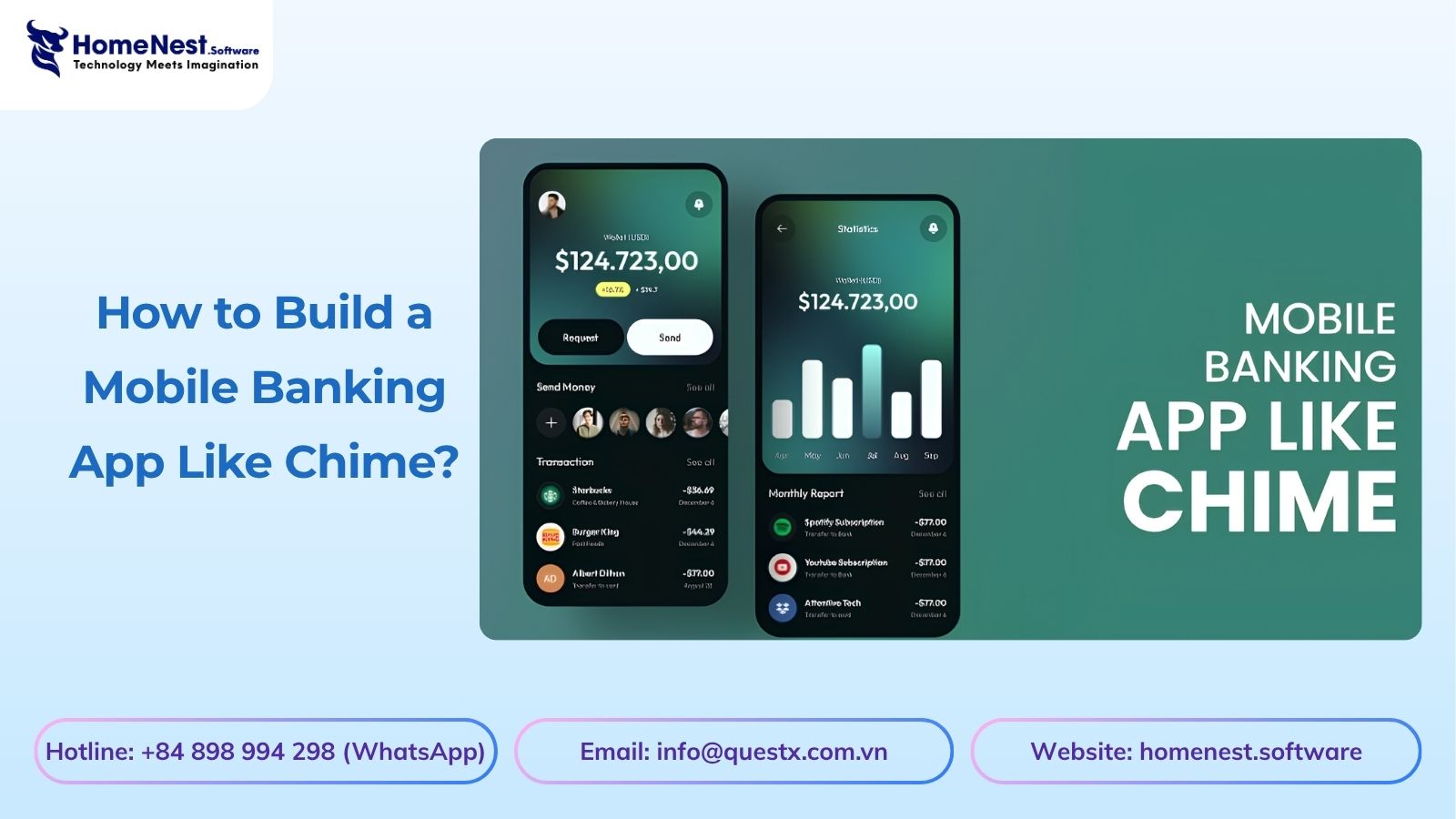
How to Build a Mobile Banking App Like Chime?
Building a mobile banking app like Chime is not just about features, it is about delivering a secure, scalable, and user-centric financial experience. From planning the right architecture to optimizing mobile banking app development cost, every decision directly impacts your product’s success. Leveraging Fintech app development services, starting with MVP app development, and scaling through on-demand app development solutions allows businesses to reduce risk and accelerate time to market. To stay competitive, combining Android app development services and iOS app development solutions ensures wider reach, while continuous updates through maintenance software development services keep your app secure and future-ready.
How to Build a Banking App Like Barclays: A Complete Entrepreneur’s Guide
Building a banking app like Barclays requires more than just development. It demands a strong product vision, secure architecture, and a clear monetization strategy. From optimizing cost and selecting the right tech stack to ensuring compliance and scalability, every decision impacts long-term success. Partnering with an experienced team like HomeNest Software helps accelerate development, reduce risks, and deliver a high-quality fintech product that can compete in today’s fast-evolving digital banking landscape.