
Adaptive AI vs. Generative AI: What’s the Difference?
Scope of Work
Today, most industries rely on artificial intelligence and for good reason. AI has evolved into a powerful, all purpose tool that enhances efficiency, scalability, and innovation across business operations. In earlier discussions, we explored how AI has progressed through different stages, including Adaptive AI and Generative AI two approaches that are reshaping how organizations build intelligent systems.
While both technologies offer flexibility and distinct capabilities, they serve different purposes. One focuses on learning and adapting to changing conditions, while the other emphasizes creativity, content generation, and user engagement. Understanding the differences between Adaptive AI and Generative AI is critical for businesses seeking reliable, impactful, and future ready AI solutions.
If you’re wondering which AI approach is better suited to your needs, you’re in the right place. In this blog, we’ll break down the key differences between Adaptive AI and Generative AI across multiple dimensions. We’ll also explore their definitions, use cases, and strategic considerations to help you choose the right AI technology to drive sustainable business growth.
What Is Adaptive AI?

Adaptive AI refers to artificial intelligence systems designed to continuously learn, adjust, and improve their performance based on interactions, feedback, and real world experiences. Unlike static AI models, adaptive AI evolves over time, enabling more accurate decisions as conditions and data patterns change.
These systems commonly leverage advanced machine learning techniques such as reinforcement learning, where the AI learns to take actions that maximize long term outcomes or cumulative rewards within a specific environment.
Below are the core capabilities that define Adaptive AI:
Active Learning
Adaptive AI continuously learns from multiple data sources and refines its behavior based on new inputs. As it processes additional interactions, the system becomes more efficient and accurate.
Example: In customer support applications, adaptive AI can analyze user interactions to reduce response times and improve the quality of answers over time.
Personalization and Customization
One of the key strengths of adaptive AI is its ability to personalize user experiences. By analyzing user behavior, preferences, and historical data, adaptive AI can tailor recommendations, services, and content to individual needs.
Example: Streaming platforms use adaptive AI to recommend movies and shows based on a user’s viewing history and engagement patterns.
Predictive Analytics
By learning from historical data and identifying trends, adaptive AI enables highly accurate predictions. This capability is widely used in demand forecasting, healthcare risk assessment, and consumer behavior analysis.
Example: Adaptive AI can forecast product demand in retail, predict disease outbreaks in healthcare, or anticipate customer churn in marketing.
Real Time Decision Making
Adaptive AI excels in environments that require immediate responses to changing data. It can analyze real time inputs and adjust decisions dynamically, making it ideal for fast paced and complex systems.
Example: In financial markets, adaptive AI evaluates live market data to support investment decisions based on current trends and risk factors.
What Is Generative AI?
Generative AI is a branch of artificial intelligence focused on creating original content. As the term “generative” implies, this type of AI can produce entirely new outputs from scratch ranging from text and images to music, designs, and digital layouts. It operates on advanced models that learn patterns, structures, and nuances from large datasets, then use that knowledge to generate high quality, novel content that closely resembles human creativity.
Below are the core capabilities that define Generative AI:
Content Creation
Generative AI can produce a wide variety of content, including written articles, music compositions, visual artwork, and marketing materials. In many cases, the output is so sophisticated that it becomes difficult to distinguish AI generated content from that created by humans.
Design and Creative Prototyping
Generative AI is widely used to create design concepts, layouts, and prototypes. In industries such as fashion, media, and product design, it analyzes historical styles, trends, and patterns to generate innovative and visually compelling designs.
Data Augmentation
Generative AI plays a critical role in enhancing datasets for machine learning models. When acquiring large volumes of training data is costly or time consuming, generative AI can synthesize new data based on existing datasets, improving model accuracy and robustness.
Personalization and Custom Experiences
By learning from user behavior and preferences, generative AI can produce personalized content tailored to individual needs. This capability enhances user engagement, improves customer retention, and supports more effective business communication across digital channels.
Read more: How Much Does It Cost to Build an AI Chatbot?
Differences Between Adaptive AI and Generative AI
To choose the right AI approach for your business, it is essential to understand how Adaptive AI and Generative AI differ across key dimensions. The table below highlights their fundamental distinctions in terms of purpose, capabilities, use cases, and limitations.
| Factor | Adaptive AI | Generative AI |
|---|---|---|
| Definition | Adaptive AI is an intelligence system that continuously learns from its environment and user interactions to improve performance over time. | Generative AI is designed to create new content or data such as text, images, or designs based on patterns learned from existing datasets. |
| Core Functionality | Adapts to changing conditions and new data to enhance personalization and decision making accuracy. | Generates original content, ideas, and synthetic data to support creativity, automation, and innovation. |
| Primary Use Cases | Predictive maintenance, fraud detection, financial modeling, manufacturing optimization, and recommendation systems in e commerce. | Content generation (e.g., articles using GPT), generative design, and drug discovery in healthcare and life sciences. |
| Key Challenges | Ensuring data quality, managing complex models, and maintaining privacy while learning from continuous data streams. | Controlling content quality, addressing data bias, and managing legal and ethical risks associated with generated outputs. |
| Applications | Real time personalization, predictive analytics, decision support systems, and resource optimization. | Creative content production, design automation, and immersive digital experiences such as virtual environments. |
| Limitations | High dependence on data quality, model complexity, limited transparency, and increased computational demands raising ethical concerns. | Similar reliance on data quality, potential lack of transparency, and ethical or legal issues related to generated content. |
| Other Key Characteristics | Highly responsive with continuous improvement, but requires careful monitoring to avoid unintended behaviors. | Strong driver of creativity and innovation, but must be governed to prevent misuse or inaccurate outputs. |
| Advantages | Real time flexibility, enhanced customization, improved decision making, and efficient resource utilization. | Increased creativity, faster content production, personalized user experiences, and reduced operational costs. |
| Training Approach | Uses techniques such as reinforcement learning to learn from interactions and feedback in dynamic environments. | Trained on large datasets to identify patterns and relationships, which are then used to generate new content. |
How to Choose the Right AI Approach for Your Business
Choosing between Adaptive AI and Generative AI is a critical decision that directly impacts business outcomes, scalability, and long term value. These two AI approaches serve fundamentally different purposes, so the choice should be driven by strategy not implementation cost alone. Below are the key factors to help you determine which AI model best aligns with your business goals.
Define Your Business Objectives
Start by clearly identifying what you want to achieve with AI.
If your primary goal is to generate high quality content quickly such as marketing copy, SEO articles, product descriptions, or creative assets Generative AI is the ideal choice, as it excels at producing original content at scale.
On the other hand, if your business needs real time insights, trend analysis, forecasting, or adaptive decision making, Adaptive AI is better suited. Its ability to continuously learn from new data enables more accurate predictions and smarter responses over time.
Evaluate Data Availability
Data is the foundation of any AI system, but each model has different requirements.
Adaptive AI depends on a continuous stream of real time or frequently updated data to refine its predictions and behavior. In contrast, Generative AI typically requires large, well structured datasets to learn patterns and generate meaningful content.
Assess the volume, quality, and structure of your available data before making a decision or work with experienced AI developers who can help prepare and optimize your data for the right AI approach.
Assess Resources and Infrastructure
Both Adaptive AI and Generative AI are resource intensive and require careful planning. Consider your technical infrastructure, cloud capabilities, data pipelines, and the expertise of your development partner.
A thorough evaluation of these resources helps ensure that the selected AI model can be implemented efficiently and scaled sustainably without disrupting existing systems.
Prioritize Accuracy vs. Creativity
While both AI models deliver value, they excel in different areas.
Generative AI is ideal when speed, creativity, and content volume are top priorities. Adaptive AI, however, is better suited for scenarios where accuracy, contextual awareness, and real time decision making are critical such as forecasting, personalization, or operational optimization.
Understanding which outcome matters most to your business will significantly narrow down the right choice.
Start Small and Scale Strategically
Regardless of the AI approach you choose, it’s best to begin with a Minimum Viable Product (MVP). A pilot implementation allows you to validate performance, measure business impact, and refine the solution before full scale deployment.
This phased approach reduces risk, controls costs, and ensures the final AI solution remains closely aligned with your business objectives.
Conclusion
In this blog, we explored the key differences between Adaptive AI and Generative AI through the lens of business needs, data requirements, and strategic goals. Each technology offers distinct advantages, and the right choice depends on how you plan to apply AI within your organization.
As a trusted AI development partner, HomeNest Software is equipped to help you evaluate, design, and implement AI solutions tailored to your business objectives. Whether you’re building intelligent web platforms, mobile applications, or enterprise grade AI systems, our team is ready to support you with future ready AI expertise.
If you’re looking to leverage AI for sustainable growth, HomeNest Software is here to guide you every step of the way.
HomeNest Software – Empowering Long Term Growth for Modern Businesses.

Contact Information:
- Address: The Sun Avenue, 28 Mai Chi Tho Street, Binh Trung Ward, Ho Chi Minh City
- Hotline: +84 898 994 298 ( WhatsApp )
- Website: homenest.software
HomeNest Services: Website Design – App Design – Software Development.
Frequently Asked Questions (FAQ)
1. Which is better for business: Adaptive AI or Generative AI?
There is no one size fits all answer. Adaptive AI is better for businesses that require real time learning, prediction, and decision making, such as finance, logistics, and personalization systems. Generative AI is more suitable for content creation, design, and customer engagement use cases where creativity and speed are priorities.
2. Can a business use both Adaptive AI and Generative AI together?
Yes. Many modern AI solutions combine both approaches. For example, Generative AI can create personalized content, while Adaptive AI continuously learns from user interactions to optimize recommendations and decision making over time.
3. Does Adaptive AI require real time data to work effectively?
Yes. Adaptive AI performs best when it has access to continuous or frequently updated data streams. This allows the system to learn from new inputs, adjust its behavior, and improve accuracy in dynamic environments.
4. Is Generative AI suitable for decision making systems?
Generative AI is not primarily designed for real time decision making. It excels at generating content and ideas but often requires human oversight when used in critical business decisions. For automated decision support, Adaptive AI is typically more reliable.
5. Which AI approach is more cost effective for startups?
For early stage startups, Generative AI is often more cost effective because it can deliver immediate value through content automation and customer engagement. Adaptive AI usually requires more data, longer training cycles, and continuous optimization, making it better suited for scaling businesses.
6. What are the main risks of using Generative AI in business?
Key risks include content inaccuracies, data bias, intellectual property concerns, and lack of transparency. These risks can be mitigated through human review, ethical AI guidelines, and controlled deployment strategies.
7. How do I decide which AI model aligns with my long term business strategy?
Start by defining your core objectives whether they focus on creativity, automation, prediction, or personalization. Evaluate your data availability, infrastructure, and scalability needs. Consulting with an experienced AI development partner can help you map the right AI approach to your long term goals.
8. Can HomeNest Software help evaluate and implement the right AI approach?
Absolutely. HomeNest Software provides end to end AI consulting, from strategy and feasibility analysis to development and deployment. We help businesses choose between Adaptive AI, Generative AI, or a hybrid approach based on real world use cases and measurable business outcomes.
Latest Articles
View All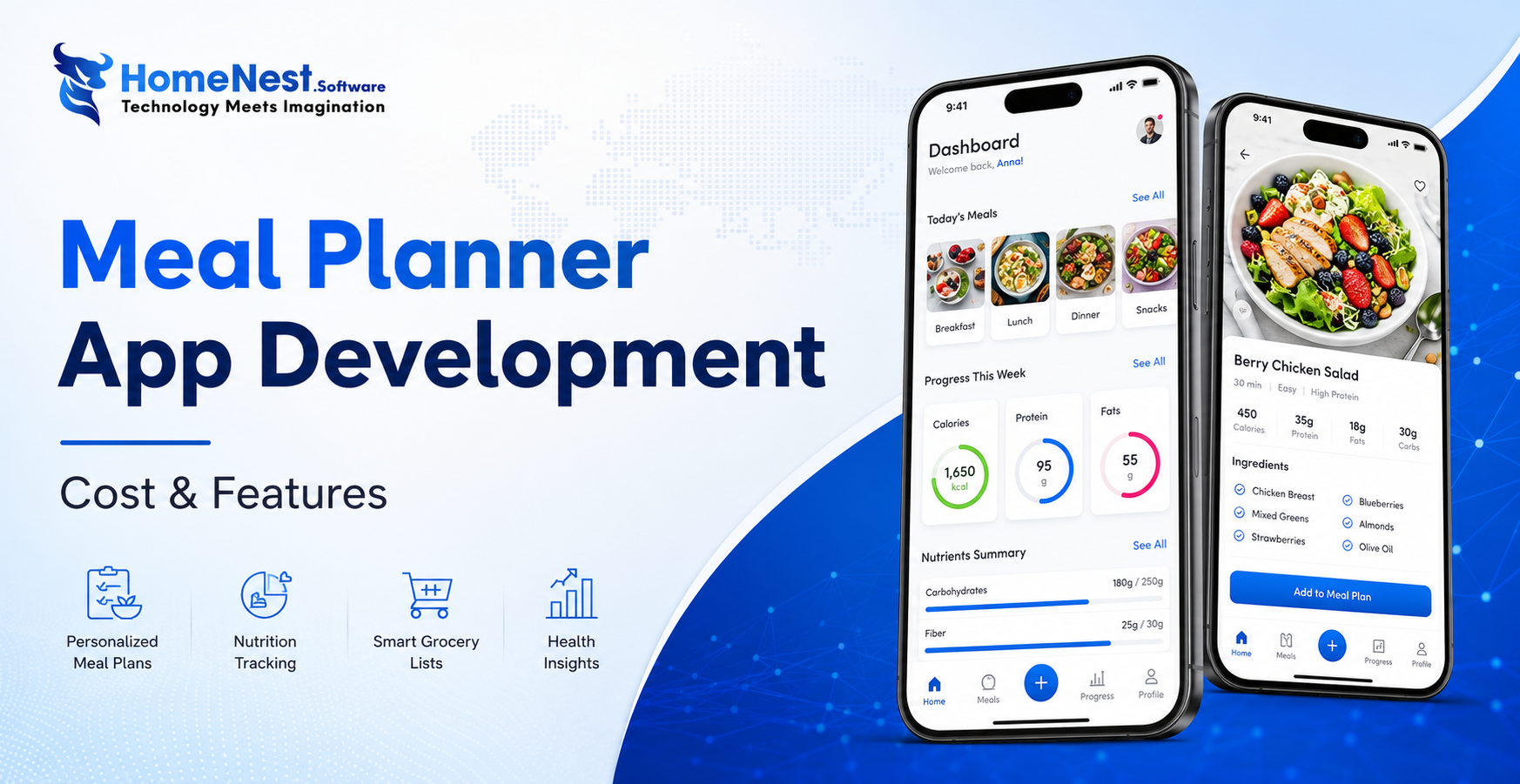
How to Build a Meal Planning App: A Complete Step-by-Step Guide
Building a successful meal planning app goes beyond creating an attractive interface it requires a clear business strategy, personalized user experiences, and scalable technology. By combining essential features like AI-powered meal recommendations, nutrition tracking, grocery list automation, and wearable integration, businesses can deliver lasting value to users while capitalizing on the growing digital health market. Partnering with an experienced mobile app development company ensures your solution is secure, future-ready, and designed to succeed in an increasingly competitive health-tech industry.
How Much Does It Cost to Build a Shopping App Like Temu?
Temu’s meteoric rise to over 900 million global downloads proves the power of combining AI, gamification, and social commerce, but building a similar viral shopping platform requires careful financial and technical planning. Developing an app like Temu typically costs anywhere from $40,000 for a basic Minimum Viable Product (MVP) to over $300,000 for a fully-featured platform. This guide breaks down every cost category, analyzes the core features driving Temu’s success, highlights the best technology stacks, and offers practical strategies to optimize your development budget without compromising on quality.

Criteria For Choosing The Right App Design Agency
UI/UX design is the logical foundation of a system, not merely a visual element. Choosing the wrong partner will directly lead to technical debt, budget overruns, and disruptions in the development process. This article provides a 6-step evaluation framework and a list of operational risks, helping businesses eliminate subjective design advice and accurately assess agency capabilities based on developer handoff standards and practical business performance.
How Does AI in Banking Industry Impact the Future?
Artificial intelligence (AI) has transitioned from a supplementary tool to a core infrastructure of financial data management, optimizing profitability through real-time fraud detection, natural language processing (NLP), and high-speed credit scoring models. “Deploying AI in the financial sector requires more than just algorithmic accuracy, it demands a highly secure cloud architecture and rigorous data governance,” commented Nguyen Tien, co-founder of HomeNest Software. Why read this guide? We skip the theoretical jargon to focus entirely on technical implementation. Whether you’re evaluating a vendor or planning a system overhaul, this article will detail: Operational Efficiency: Automating unstructured data workflows at scale. Risk Architecture: Implementing real-time threat detection and AML compliance. Data ownership: The essential need for 100% ownership of the source code to ensure full algorithm auditability.
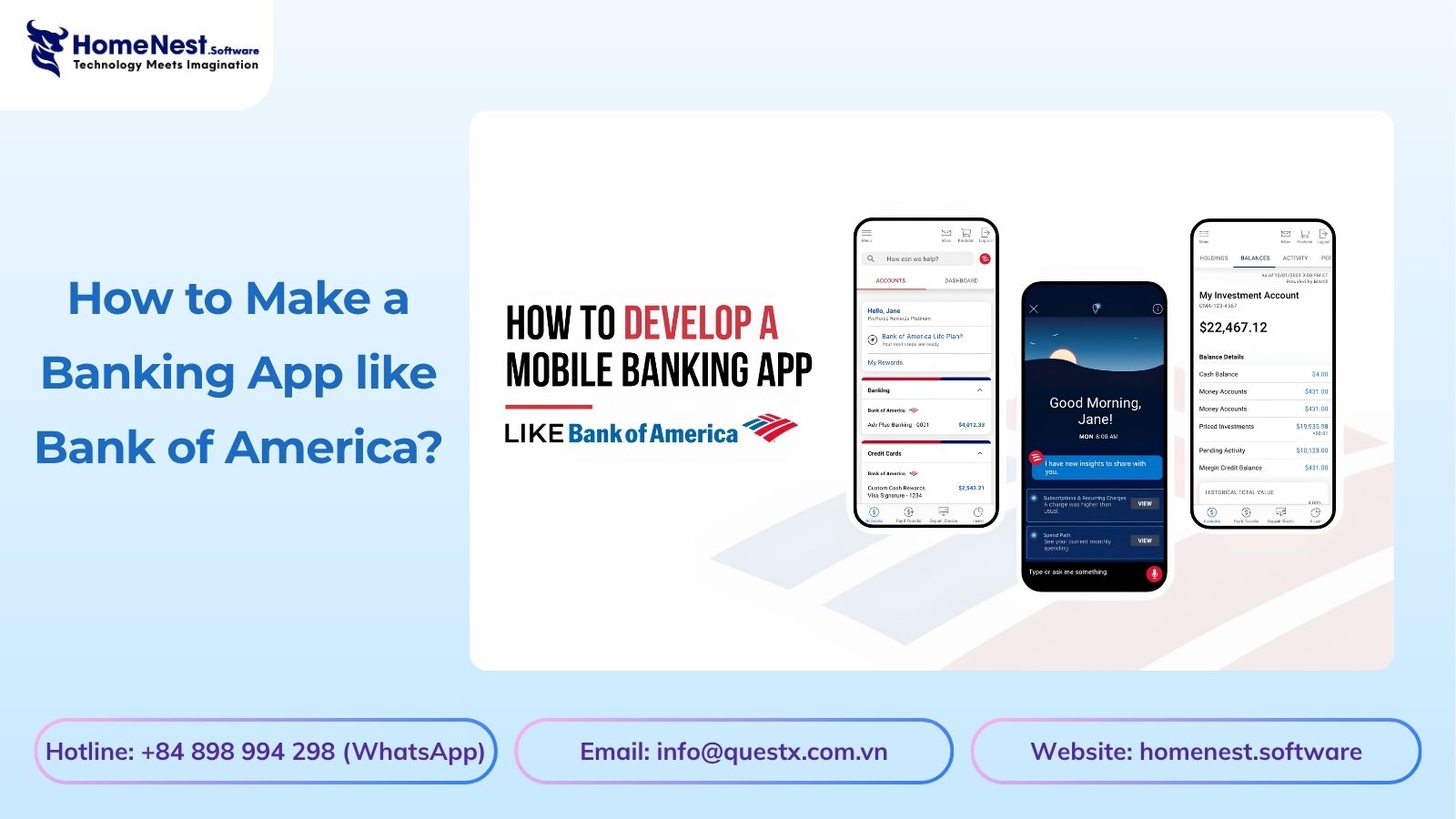
How to Make a Banking App like Bank of America?
Developing a mobile banking application like Bank of America extends far beyond basic UI design; it requires engineering a fault-tolerant backend capable of real-time ledger synchronization, biometric authentication, and high-volume data processing under strict regulatory frameworks. Drawing from HomeNest Software’s deep experience in architecting enterprise-grade fintech solutions, this guide strips away theoretical jargon to focus entirely on operational and technical execution. What you will find in this guide: We break down the precise development roadmap, from mapping out microservices and ensuring PCI-DSS compliance to estimating MVP development costs and securing absolute data sovereignty through 100% source code ownership. If you are preparing to build, scale, or audit a financial platform, this blueprint provides the exact framework you need.
Banking App Development Cost
Building a banking application is rarely a simple process; it’s a complex technical challenge requiring a balance between complying with stringent financial regulations, handling large transaction volumes, and a scalable cloud architecture. Miscalculating these technical requirements from the outset often leads to significant technical debt and budget overruns. Based on HomeNest Software’s practical experience in designing enterprise-grade fintech solutions, this guide bypasses generic estimates to provide a realistic analysis of banking application development costs. What you’ll find in this guide: We analyze the true cost factors, from technology selection and API integration to the hidden costs of regulatory compliance and security infrastructure. Whether you’re launching a minimum viable product or expanding an existing financial platform, this analysis provides the precise operational data you need to plan your budget effectively.