
Top 10 Real Estate App Development Companies in California, USA
Scope of Work

The California real estate market continues to grow at a rapid pace, and mobile applications have become an essential tool for both property professionals and home seekers. From property search and virtual tours to real time analytics and lead management, real estate apps are reshaping how transactions and interactions take place across the state. With the US real estate app market projected to surpass $10 billion within the next five years, this sector presents a significant opportunity for innovation and investment.
This blog is designed to help you identify and understand the top real estate app development companies in California, USA. These companies empower real estate businesses to adopt modern technologies, leverage data driven insights, and make smarter strategic decisions. We will explore emerging market trends, essential app features that drive success, and the development partners capable of helping you build competitive, high performing real estate applications.
Why Hire a Real Estate App Development Company?
Before exploring the top real estate app development companies in the USA, it’s important to understand why partnering with a specialized development firm is critical to the success of your project. Below are the key reasons businesses choose professional real estate app development companies:
1. Deep Industry Expertise and Market Knowledge
Established real estate app development companies especially those based in California bring strong domain knowledge of the real estate ecosystem. Their understanding of market dynamics, user behavior, and regulatory requirements enables them to design solutions that address real challenges while capitalizing on emerging opportunities.
2. Proven Track Record and Client Success
Reputable development companies have a history of delivering successful projects across residential, commercial, and proptech platforms. Reviewing their portfolios and client testimonials provides insight into their technical capabilities, reliability, and ability to deliver results reducing overall project risk.
3. Access to Modern and Emerging Technologies
Leading real estate app developers stay ahead of technology trends, integrating innovations such as AI, machine learning, blockchain, and IoT into their solutions. This ensures your app remains competitive, scalable, and aligned with the future of digital real estate.
4. Strong Focus on Quality and User Experience
Top development firms prioritize performance, security, and usability. Through rigorous testing and quality assurance processes, they deliver high quality applications with intuitive navigation and seamless user experiences driving higher adoption, engagement, and retention among agents and property seekers.
5. Transparent Communication and Collaborative Workflow
Successful app development relies on clear communication and collaboration. Professional real estate app development companies maintain open channels throughout the project lifecycle, keeping clients informed, aligned, and involved at every stage from planning to launch and beyond.
Read more: Best Countries to Outsource Software Development
List of Top 10 Real Estate App Development Companies in California, USA

1. HomeNest Software
Clutch Rating: 4.9
HomeNest Software is a leading real estate app development company in the USA, known for building robust, scalable solutions using modern technologies such as AI and blockchain. Their expertise spans property listing platforms, advanced search systems, CRM applications, and virtual tour solutions. With a strong focus on cost effective delivery and client satisfaction, HomeNest Software helps real estate businesses in California expand their digital presence and adopt next generation proptech solutions.
2. Hyperlink InfoSystem
Founded: 2011
Clutch Rating: 4.8
Hyperlink InfoSystem is a well established mobile app development company with strong capabilities in real estate solutions. Their user friendly apps address challenges such as property management, virtual tours, and agent–client communication. The company’s design driven approach ensures intuitive and reliable real estate applications.
3. OpenXcell
Founded: 2009
Clutch Rating: 4.7
OpenXcell brings extensive experience in delivering tailored mobile and web applications for real estate firms. Their solutions include property portals, custom search engines, CRM systems, and marketing automation tools. An agile development approach enables them to meet complex business requirements while delivering projects on time.
4. Attract Group
Founded: 2008
Clutch Rating: 4.6
Attract Group specializes in real estate focused mobile applications, web development, and digital marketing solutions. The company offers strong consulting expertise in UX, app marketing, and business strategy, helping real estate businesses scale their operations and increase market reach.
5. NMG Technologies
Founded: 2005
Clutch Rating: 4.5
NMG Technologies delivers customized enterprise grade web and mobile applications across multiple industries, including real estate. Their portfolio includes property portals, management apps, CRM platforms, and data analytics solutions. They work closely with clients to ensure business alignment and long term value.
6. Zazz
Founded: 2011
Clutch Rating: 4.8
Based in San Francisco, Zazz is known for sleek UI design and advanced software architecture. Their real estate solutions include virtual home tour apps, AI powered property matching systems, and real time location based listings making them a strong choice for innovative proptech products.
7. Naked Development
Founded: 2017
Clutch Rating: 5.0
Naked Development is a design first mobile app studio headquartered in Irvine, California. They specialize in crafting user centric real estate apps with a strong focus on aesthetics, usability, and performance ideal for platforms where customer experience is a key differentiator.
8. Dogtown Media
Founded: 2011
Clutch Rating: 4.9
Located in Venice Beach, Los Angeles, Dogtown Media develops smart, data driven real estate applications. Their offerings include geo location based listing apps, automated property alerts, and AI powered chatbots for real estate agents, buyers, and investors.
9. Cheesecake Labs
Founded: 2011
Clutch Rating: 4.1
Cheesecake Labs specializes in custom mobile app development and has delivered innovative solutions for real estate businesses. Their experience in solving industry specific challenges allows them to create scalable and forward thinking real estate applications.
10. Intellectsoft
Founded: 2007
Clutch Rating: 4.8
Headquartered in Palo Alto, California, Intellectsoft is a digital transformation consultancy offering enterprise grade real estate solutions. Their services include property management platforms, AR/VR based virtual tours, smart building IoT integrations, and secure CRM systems. Intellectsoft is particularly suited for large real estate enterprises seeking scalable, compliant, and innovation driven ecosystems.
Read more: USA App Development Costs: What You Need to Know
How to Choose the Best Real Estate App Development Firms
Choosing the right real estate app development company is a strategic decision that can significantly impact your product success and long term business growth. Beyond technical skills, the ideal partner must understand the real estate domain, deliver scalable solutions, and align with your business vision. Below is a structured, practical guide to help you make the right choice.
1. Clearly Define Your Requirements
Start by outlining your business goals and core app requirements. Identify essential features such as property listings, advanced search and filters, virtual tours, payment integrations, CRM tools, and analytics. Clear documentation helps eliminate ambiguity and ensures all stakeholders share the same expectations from the outset.
2. Prioritize Real Estate App Experience
Not every app development company has real estate expertise. Focus on firms with proven experience building property focused platforms. Reviewing their portfolio helps validate their understanding of real estate workflows, including listings, agent management, lead generation, and user engagement.
3. Assess Technical Capabilities
Modern real estate apps often leverage advanced technologies such as AI, AR/VR, cloud infrastructure, and geolocation services. Evaluate whether the company has hands on experience with these technologies to ensure your app remains future ready and competitive.
4. Review Client Feedback and Ratings
Client reviews and testimonials provide valuable insights into a company’s reliability and professionalism. Platforms like Clutch, GoodFirms, and LinkedIn can help you assess delivery timelines, communication quality, problem solving ability, and overall client satisfaction.
5. Request Case Studies and Product Demos
Case studies reveal how a company approaches real world challenges from problem definition to execution and results. Live demos or product walkthroughs further help you evaluate usability, performance, and feature depth.
6. Evaluate Communication and Project Management
Transparent communication and strong project management are critical to successful app development. Ensure the company uses structured workflows, regular reporting, and collaboration tools to keep you informed throughout the development lifecycle.
7. Ensure Data Security and Regulatory Compliance
Real estate apps handle sensitive user data, property details, and financial transactions. Confirm that the company follows best practices for data encryption, secure APIs, and compliance with regulations such as GDPR or CCPA, where applicable.
8. Compare Pricing and Value Offered
Request detailed cost estimates and compare them carefully. Avoid choosing solely based on the lowest price focus instead on value, quality, long term support, and scalability. Unrealistically low quotes may signal compromised quality or hidden costs.
9. Verify Post Launch Support and Maintenance
App development doesn’t end at launch. Ensure the company offers ongoing maintenance, bug fixes, performance optimization, and feature enhancements to keep your app reliable and up to date.
10. Conduct Final Interviews and Check Compatibility
Shortlist the most suitable companies and conduct final discussions to assess cultural fit, transparency, and commitment. A strong partnership is built on trust, aligned expectations, and shared business goals.
Conclusion
California is home to some of the world’s most innovative real estate app development companies, offering cutting edge solutions powered by advanced technologies and deep industry expertise. Whether you are a startup or an established real estate enterprise, partnering with the right development firm can enhance customer experience, streamline operations, and strengthen your market position.
By conducting thorough due diligence and selecting a development partner that aligns with your technical, strategic, and business objectives, you can ensure a smooth development process and long term success for your real estate app.
HomeNest Software – Empowering Long Term Growth for Modern Businesses.

Contact Information:
- Address: The Sun Avenue, 28 Mai Chi Tho Street, Binh Trung Ward, Ho Chi Minh City
- Hotline: +84 898 994 298 ( WhatsApp )
- Website: homenest.software
HomeNest Services: Website Design – App Design – Software Development.
Frequently Asked Questions (FAQs)
1. What should I look for in a real estate app development company?
Look for proven real estate domain experience, strong UI/UX capabilities, modern tech expertise (AI, maps, AR/VR), clear communication, transparent pricing, and reliable post launch support.
2. How much does it cost to hire a real estate app development firm?
Costs vary by scope and region. A basic MVP may start from $5,000–$8,000, while advanced, scalable real estate apps with integrations and analytics can exceed $15,000+.
3. How long does it take to build a real estate mobile app?
Typical timelines range from 8–16 weeks, depending on feature complexity, platforms (iOS/Android), integrations, and testing requirements.
4. Should I choose a company with real estate specific experience?
Yes. Firms with real estate specific portfolios better understand listings, search filters, lead management, compliance, and user expectations reducing risk and speeding delivery.
5. What technologies are important for modern real estate apps?
Key technologies include AI powered search and recommendations, map integrations, cloud infrastructure, secure APIs, analytics dashboards, and optional AR/VR for virtual tours.
6. How do I verify a company’s credibility?
Check Clutch/GoodFirms reviews, client testimonials, case studies, live demos, and ask about security practices, compliance, and project management processes.
7. Is post launch maintenance included?
Reputable firms offer ongoing maintenance, including bug fixes, performance optimization, security updates, and feature enhancements. Confirm SLAs before signing.
8. Can I start with an MVP and scale later?
Absolutely. Starting with an MVP helps validate the market and control costs, then scale features and infrastructure based on user feedback and growth.
Latest Articles
View All
Criteria For Choosing The Right App Design Agency
UI/UX design is the logical foundation of a system, not merely a visual element. Choosing the wrong partner will directly lead to technical debt, budget overruns, and disruptions in the development process. This article provides a 6-step evaluation framework and a list of operational risks, helping businesses eliminate subjective design advice and accurately assess agency capabilities based on developer handoff standards and practical business performance.

How Does AI in Banking Industry Impact the Future?
Artificial intelligence (AI) has transitioned from a supplementary tool to a core infrastructure of financial data management, optimizing profitability through real-time fraud detection, natural language processing (NLP), and high-speed credit scoring models. “Deploying AI in the financial sector requires more than just algorithmic accuracy, it demands a highly secure cloud architecture and rigorous data governance,” commented Nguyen Tien, co-founder of HomeNest Software. Why read this guide? We skip the theoretical jargon to focus entirely on technical implementation. Whether you’re evaluating a vendor or planning a system overhaul, this article will detail: Operational Efficiency: Automating unstructured data workflows at scale. Risk Architecture: Implementing real-time threat detection and AML compliance. Data ownership: The essential need for 100% ownership of the source code to ensure full algorithm auditability.

How to Make a Banking App like Bank of America?
Developing a mobile banking application like Bank of America extends far beyond basic UI design; it requires engineering a fault-tolerant backend capable of real-time ledger synchronization, biometric authentication, and high-volume data processing under strict regulatory frameworks. Drawing from HomeNest Software’s deep experience in architecting enterprise-grade fintech solutions, this guide strips away theoretical jargon to focus entirely on operational and technical execution. What you will find in this guide: We break down the precise development roadmap, from mapping out microservices and ensuring PCI-DSS compliance to estimating MVP development costs and securing absolute data sovereignty through 100% source code ownership. If you are preparing to build, scale, or audit a financial platform, this blueprint provides the exact framework you need.
Banking App Development Cost
Building a banking application is rarely a simple process; it’s a complex technical challenge requiring a balance between complying with stringent financial regulations, handling large transaction volumes, and a scalable cloud architecture. Miscalculating these technical requirements from the outset often leads to significant technical debt and budget overruns. Based on HomeNest Software’s practical experience in designing enterprise-grade fintech solutions, this guide bypasses generic estimates to provide a realistic analysis of banking application development costs. What you’ll find in this guide: We analyze the true cost factors, from technology selection and API integration to the hidden costs of regulatory compliance and security infrastructure. Whether you’re launching a minimum viable product or expanding an existing financial platform, this analysis provides the precise operational data you need to plan your budget effectively.
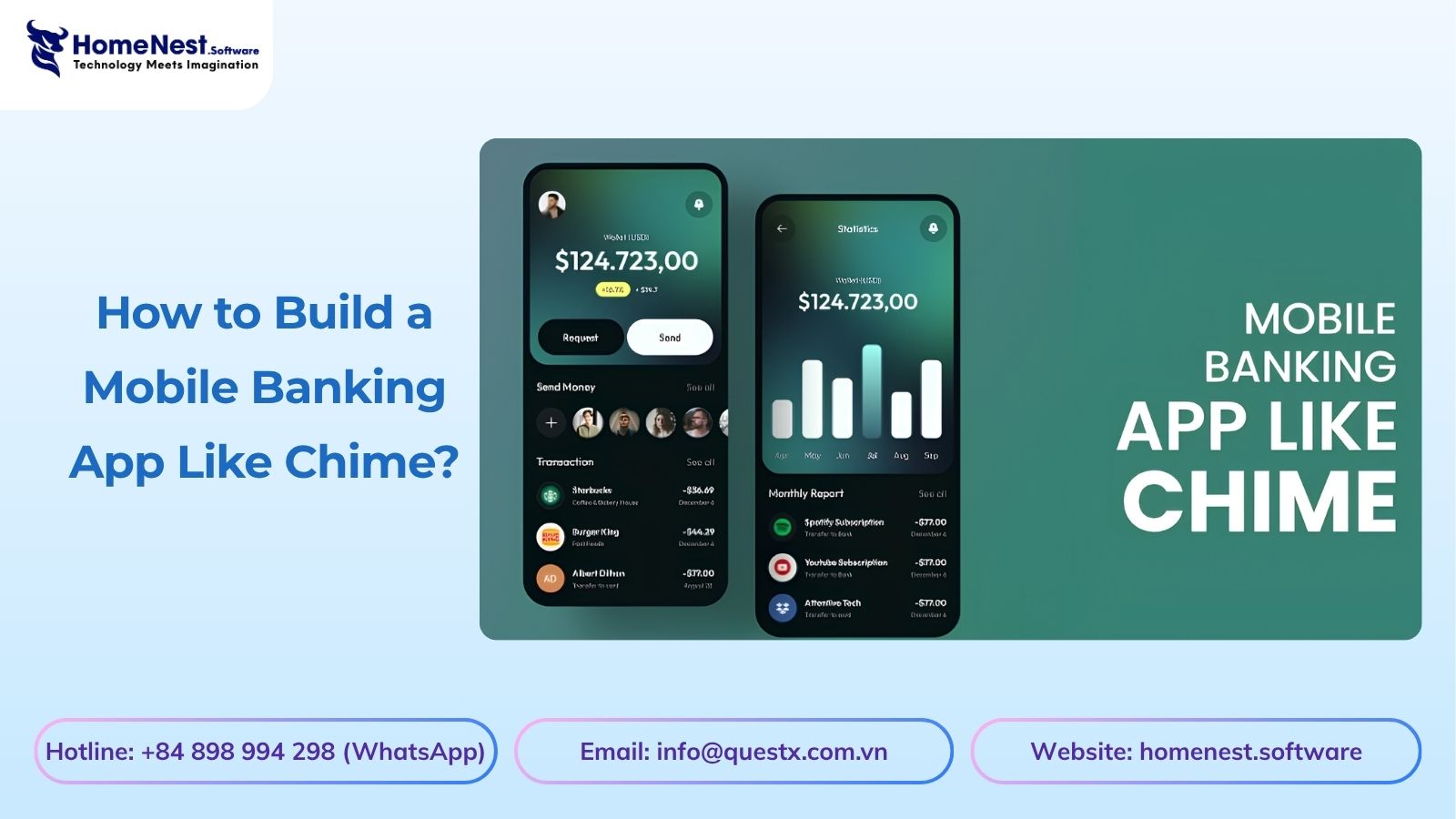
How to Build a Mobile Banking App Like Chime?
Building a mobile banking app like Chime is not just about features, it is about delivering a secure, scalable, and user-centric financial experience. From planning the right architecture to optimizing mobile banking app development cost, every decision directly impacts your product’s success. Leveraging Fintech app development services, starting with MVP app development, and scaling through on-demand app development solutions allows businesses to reduce risk and accelerate time to market. To stay competitive, combining Android app development services and iOS app development solutions ensures wider reach, while continuous updates through maintenance software development services keep your app secure and future-ready.

How to Build a Banking App Like Barclays: A Complete Entrepreneur’s Guide
Building a banking app like Barclays requires more than just development. It demands a strong product vision, secure architecture, and a clear monetization strategy. From optimizing cost and selecting the right tech stack to ensuring compliance and scalability, every decision impacts long-term success. Partnering with an experienced team like HomeNest Software helps accelerate development, reduce risks, and deliver a high-quality fintech product that can compete in today’s fast-evolving digital banking landscape.