
AI in Real Estate: The Smart Technology Driving Modern Property Management
AI is transforming the real estate industry by enabling smarter decision-making, automating operations, and delivering highly personalized user experiences. From property valuation and predictive analytics to virtual tours and fraud detection, AI driven solutions are reshaping how properties are managed and transacted. By adopting a strategic approach to AI implementation focused on the right use cases, scalable architecture, and continuous optimization businesses can unlock greater efficiency, reduce costs, and gain a strong competitive edge in the evolving digital real estate market.
Scope of Work

The real estate industry is rapidly evolving through digital transformation, with Artificial Intelligence (AI) at the forefront. The global AI in real estate market is projected to surpass $1.5 billion by 2030, driven by growing demand for automation and data driven decision making.
From tenant screening and predictive maintenance to virtual tours and AI powered chatbots, intelligent technologies are reshaping how properties are managed and operated. These innovations streamline workflows, reduce operational costs, and enhance both tenant and owner experiences.
Whether you’re a property manager, investor, or developer, adopting AI is no longer optional it’s essential to stay competitive in an increasingly tech driven market. In this blog, we’ll explore how AI is transforming property management and what the future holds for the real estate industry.
Overview of AI in Real Estate

Artificial Intelligence (AI) is reshaping the real estate industry by transforming how properties are bought, sold, managed, and invested in through data driven technologies. Capabilities such as predictive analytics, automated property valuation, intelligent search, and virtual assistants are redefining how decisions are made across the sector.
AI enables automation of routine tasks, enhances operational efficiency, and delivers highly personalized user experiences. Leading real estate platforms are leveraging AI to recommend properties, detect fraudulent activities, improve customer communication, and provide real time market insights. For property managers, AI simplifies processes like maintenance tracking, tenant screening, rent collection, and more.
As a result, AI has become a key driver of innovation in real estate making the industry smarter, faster, and more efficient for all stakeholders.
How Does AI Work in the Real Estate Industry?
AI in real estate operates by collecting, analyzing, and leveraging large volumes of data to automate processes, enhance decision making, and deliver personalized experiences. Here’s a step by step breakdown of how AI functions in the real estate ecosystem:
1. Data Collection
The process begins with gathering vast amounts of structured and unstructured data from multiple sources, including property listings, historical sales records, market trends, satellite imagery, and demographic data such as user behavior and social interactions.
2. Data Processing and Cleaning
Raw data is then processed to remove errors, duplicates, and inconsistencies. Clean, structured data is essential for training machine learning models that can identify patterns and generate accurate insights.
3. Predictive Modeling
AI uses historical data and real time market indicators to build predictive models. These models help forecast property values, rental yields, and market trends enabling investors and agents to make data driven decisions.
4. Smart Recommendations
Based on user preferences, search behavior, and past interactions, AI delivers personalized property recommendations. This improves the user experience by showing the most relevant listings quickly and efficiently.
5. Natural Language Processing (NLP)
NLP allows AI systems to understand and respond to user queries in real time. AI powered chatbots can answer questions, schedule property visits, and assist with basic negotiations enhancing customer engagement without constant human involvement.
6. Image Recognition and Virtual Tours
AI can analyze property images to assess quality, features, and condition. It also enables the creation of immersive 3D virtual tours and virtual staging, making remote property exploration more interactive and engaging.
7. Risk and Fraud Detection
AI systems can scan legal documents, ownership records, and transaction data to detect anomalies or potential fraud. This improves transparency, reduces risk, and ensures safer real estate transactions.
By combining these capabilities, AI is transforming real estate into a more intelligent, efficient, and data driven industry.
Top 10 Use Cases of AI in Real Estate
If you’re wondering how AI is applied in real estate, here are the most impactful use cases transforming the industry today:
1. Property Valuation
AI analyzes market trends, property features, and historical sales data to deliver accurate, real time property valuations. This helps buyers, sellers, and agents make informed decisions while reducing reliance on manual appraisals.
2. Predictive Analytics
AI models use historical and real time data to forecast property prices, rental yields, and investment potential. This enables investors and real estate professionals to minimize risk and maximize returns.
3. Smart Property Search
AI powered search engines leverage personalization and natural language processing (NLP) to recommend relevant listings based on user preferences and behavior significantly improving the property discovery experience.
4. Chatbots and Virtual Assistants
AI driven chatbots provide 24/7 customer support, handling inquiries, scheduling property visits, and delivering instant information. This automates lead generation and enhances customer engagement.
5. Fraud Detection
AI detects anomalies in property documents, ownership records, and transactions, helping identify fraud, title issues, and financial irregularities ensuring safer and more transparent deals.
6. Automated Valuation Models (AVMs)
AI powered AVMs provide instant property appraisals using real time data and algorithms. These models improve accuracy, speed up decision making, and reduce human bias in valuations.
7. Tenant Screening
AI streamlines tenant selection by analyzing credit history, rental behavior, and background data. This helps landlords identify reliable tenants while reducing vacancy risks.
8. Automated Property Management
AI automates tasks such as rent collection, maintenance scheduling, and service requests. It also enables predictive maintenance, helping property managers reduce costs and improve efficiency.
9. Market Analysis and Investment Insights
AI continuously monitors market trends, demographics, and economic indicators to generate actionable insights. This helps investors identify high potential opportunities and optimize their portfolios.
10. Virtual Tours and Property Staging
AI enables immersive virtual tours and digital property staging, allowing buyers to explore properties remotely. Features like 3D walkthroughs and virtual furnishing enhance marketing and attract more potential buyers.
These use cases demonstrate how AI is revolutionizing real estate making processes smarter, faster, and more data driven for all stakeholders.
6 Real World Examples of AI in Real Estate Apps
Here are some notable real world applications of AI in real estate, showcasing how leading platforms are leveraging intelligent technologies to transform the industry:
1. Zillow
Zillow uses AI to power its well known “Zestimate” feature, which provides real time property valuations. By analyzing user submitted data, public records, and market trends, Zillow helps users quickly estimate property values and make informed buying or selling decisions.
2. Redfin
Redfin integrates machine learning to enhance the property search experience. Its platform offers personalized recommendations, predictive pricing insights, and virtual tour capabilities helping buyers and sellers interact with listings more efficiently.
3. Reonomy
Reonomy focuses on commercial real estate intelligence by using AI to analyze ownership data, property details, and transaction history. This enables investors and brokers to identify opportunities, conduct research faster, and make data driven investment decisions.
4. Compass
Compass provides AI powered tools for real estate agents, including property recommendations, pricing analysis, and automated marketing. Its collaborative features, such as “Collections,” allow clients and agents to explore and evaluate properties together in a more interactive way.
5. Rex
Rex leverages AI and machine learning to market properties directly to potential buyers using predictive targeting. By analyzing user behavior and optimizing pricing strategies, Rex streamlines the sales process and reduces reliance on traditional listing systems.
6. Opendoor
Opendoor uses AI to deliver instant home buying and selling experiences. Its algorithms assess property values, automate transactions, and provide near instant offers making the process faster, more transparent, and convenient for both buyers and sellers.
These examples highlight how AI is being actively applied in real estate to improve accuracy, efficiency, and user experience across the entire property lifecycle.
Key Implementation Stages of AI in Real Estate
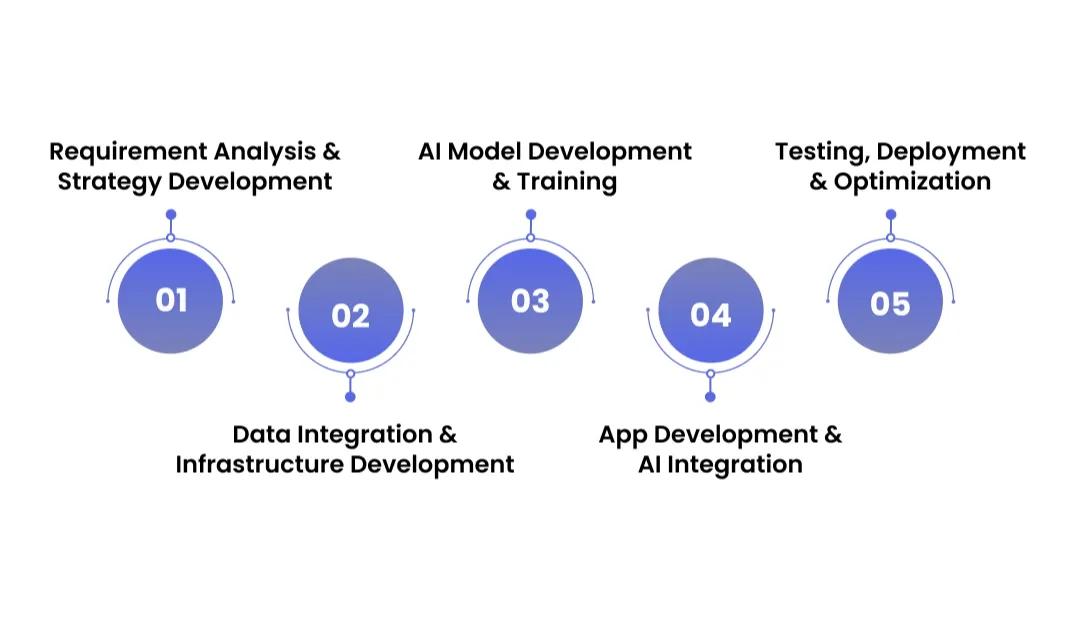
Integrating AI into real estate applications is a structured, step by step process designed to maximize performance, accuracy, and user experience. When working with a professional development team, AI implementation typically follows these key stages:
1. Requirement Analysis & Strategy
The process begins with a clear understanding of business goals, target users, and application requirements. At this stage, teams identify high impact use cases for AI such as property recommendations, predictive analytics, chatbots, or virtual assistants to ensure strong ROI.
2. Data Integration & Infrastructure Setup
Data is the backbone of any AI system. Developers collect and integrate both structured and unstructured data from sources like property listings, user behavior, market trends, CRM systems, and third party APIs. A scalable cloud infrastructure is typically used to ensure security, performance, and flexibility.
3. AI Model Development & Training
Machine learning engineers build and train AI models using historical and real time data. These models power functionalities such as price prediction, fraud detection, smart search, and conversational AI. Continuous training and iteration improve model accuracy over time.
4. App Development & AI Integration
Once the models are ready, they are integrated into the application’s frontend and backend. This enables features like intelligent property matching, AI chatbots, automated valuation, and virtual property tours enhancing both functionality and user engagement.
5. Testing, Deployment & Optimization
In the final stage, the application undergoes rigorous testing to ensure performance, security, and usability. After deployment, developers continuously monitor user behavior and real time data to refine AI models and adapt to changing market conditions.
Following these stages ensures a smooth and effective AI implementation, resulting in a scalable, intelligent real estate solution that evolves with user needs and market dynamics.
How HomeNest Software Can Help You Build an AI Powered Real Estate App
HomeNest Software, a trusted AI app development company, specializes in building intelligent real estate applications that deliver smarter, data driven property experiences. From advanced property listings and predictive analytics to chatbot integration and immersive virtual tours, we develop tailored solutions aligned with your business objectives.
Our team of AI and machine learning experts goes beyond implementation we focus on optimizing workflows, enhancing customer engagement, and enabling better decision making through high performance, scalable applications. By combining innovation with robust architecture, HomeNest Software helps you stand out in a competitive real estate market.
If you’re looking to turn your data driven vision into a powerful AI enabled platform, HomeNest Software is ready to support you at every stage of development.
FAQs
1. What is AI in real estate?
AI in real estate refers to the use of technologies like machine learning, predictive analytics, and automation to improve property search, valuation, management, and investment decisions.
2. How is AI used in real estate apps?
AI is used for property recommendations, price prediction, chatbots, virtual tours, fraud detection, tenant screening, and market analysis enhancing both user experience and operational efficiency.
3. How much does it cost to build an AI real estate app?
The cost typically ranges from $5,000 to $15,000+, depending on features, AI complexity, integrations, and scalability requirements.
4. What are the key features of an AI real estate app?
Core features include smart search, personalized recommendations, AI chatbots, virtual tours, predictive analytics, automated valuation, and secure transaction management.
5. Do I need AI for my real estate business?
While not mandatory, AI provides a strong competitive advantage by improving efficiency, reducing costs, and offering personalized user experiences.
6. Which technologies are used in AI real estate app development?
Common technologies include TensorFlow, PyTorch, OpenAI APIs, along with React Native/Flutter for frontend and Node.js/Python for backend systems.
7. Can AI help with property valuation?
Yes, AI powered models (AVMs) can analyze market data and property attributes to provide accurate, real time property valuations.
8. Is AI in real estate secure?
Yes, with proper implementation of data encryption, secure authentication, and compliance with regulations like GDPR, AI systems can ensure high levels of security and privacy.
9. How long does it take to develop an AI real estate app?
Development typically takes 6 to 16 weeks, depending on the app’s complexity and AI feature integration.
10. Why should I hire a professional AI development company?
A professional Mobile App Development and AI partner ensures scalable architecture, faster delivery, optimized performance, and successful implementation of advanced AI features.
Latest Articles
View All
Criteria For Choosing The Right App Design Agency
UI/UX design is the logical foundation of a system, not merely a visual element. Choosing the wrong partner will directly lead to technical debt, budget overruns, and disruptions in the development process. This article provides a 6-step evaluation framework and a list of operational risks, helping businesses eliminate subjective design advice and accurately assess agency capabilities based on developer handoff standards and practical business performance.

How Does AI in Banking Industry Impact the Future?
Artificial intelligence (AI) has transitioned from a supplementary tool to a core infrastructure of financial data management, optimizing profitability through real-time fraud detection, natural language processing (NLP), and high-speed credit scoring models. “Deploying AI in the financial sector requires more than just algorithmic accuracy, it demands a highly secure cloud architecture and rigorous data governance,” commented Nguyen Tien, co-founder of HomeNest Software. Why read this guide? We skip the theoretical jargon to focus entirely on technical implementation. Whether you’re evaluating a vendor or planning a system overhaul, this article will detail: Operational Efficiency: Automating unstructured data workflows at scale. Risk Architecture: Implementing real-time threat detection and AML compliance. Data ownership: The essential need for 100% ownership of the source code to ensure full algorithm auditability.

How to Make a Banking App like Bank of America?
Developing a mobile banking application like Bank of America extends far beyond basic UI design; it requires engineering a fault-tolerant backend capable of real-time ledger synchronization, biometric authentication, and high-volume data processing under strict regulatory frameworks. Drawing from HomeNest Software’s deep experience in architecting enterprise-grade fintech solutions, this guide strips away theoretical jargon to focus entirely on operational and technical execution. What you will find in this guide: We break down the precise development roadmap, from mapping out microservices and ensuring PCI-DSS compliance to estimating MVP development costs and securing absolute data sovereignty through 100% source code ownership. If you are preparing to build, scale, or audit a financial platform, this blueprint provides the exact framework you need.

Banking App Development Cost
Building a banking application is rarely a simple process; it’s a complex technical challenge requiring a balance between complying with stringent financial regulations, handling large transaction volumes, and a scalable cloud architecture. Miscalculating these technical requirements from the outset often leads to significant technical debt and budget overruns. Based on HomeNest Software’s practical experience in designing enterprise-grade fintech solutions, this guide bypasses generic estimates to provide a realistic analysis of banking application development costs. What you’ll find in this guide: We analyze the true cost factors, from technology selection and API integration to the hidden costs of regulatory compliance and security infrastructure. Whether you’re launching a minimum viable product or expanding an existing financial platform, this analysis provides the precise operational data you need to plan your budget effectively.

How to Build a Mobile Banking App Like Chime?
Building a mobile banking app like Chime is not just about features, it is about delivering a secure, scalable, and user-centric financial experience. From planning the right architecture to optimizing mobile banking app development cost, every decision directly impacts your product’s success. Leveraging Fintech app development services, starting with MVP app development, and scaling through on-demand app development solutions allows businesses to reduce risk and accelerate time to market. To stay competitive, combining Android app development services and iOS app development solutions ensures wider reach, while continuous updates through maintenance software development services keep your app secure and future-ready.

How to Build a Banking App Like Barclays: A Complete Entrepreneur’s Guide
Building a banking app like Barclays requires more than just development. It demands a strong product vision, secure architecture, and a clear monetization strategy. From optimizing cost and selecting the right tech stack to ensuring compliance and scalability, every decision impacts long-term success. Partnering with an experienced team like HomeNest Software helps accelerate development, reduce risks, and deliver a high-quality fintech product that can compete in today’s fast-evolving digital banking landscape.