
eCommerce App Development Cost: A Full Breakdown
Scope of Work
The rise of mobile commerce has transformed the way consumers shop, making an e-commerce app essential for the survival and growth of any startup. However, understanding development costs upfront can be the difference between success and failure.
Without a clear budget, startups often face costly mistakes, such as:
-
Running out of funds mid-development: Brandless shut down in 2020 after spending USD 240 million in venture capital due to unsustainable cost structures. (Source: TechCrunch)
-
Launching without key features: Fast closed in 2022 despite raising USD 120 million, as it failed to deliver a competitive one-click payment solution. (Source: Business Insider)
To help startups avoid these pitfalls, we’ve created a detailed breakdown of eCommerce app development costs, enabling you to plan your budget effectively and make informed decisions.
How Much Does It Cost to Develop an eCommerce App?
The cost of developing an e-commerce app can vary widely, typically ranging from $20,000 to $500,000, depending on the scope of your product and business requirements.
How do we arrive at these figures? After over 10 years of helping startups launch eCommerce storefronts, we’ve analyzed numerous projects and seen firsthand how various factors impact development costs.
As a startup founder, understanding these factors is crucial. They allow you to optimize your budget while ensuring no critical features are overlooked. Key factors include:
-
App complexity – simple vs. advanced functionality
-
Design requirements – UI/UX sophistication and branding
-
Platform choice – iOS, Android, or cross-platform
-
Feature list – essential and advanced functions
-
Integration needs – payment gateways, ERP, CRM, etc.
-
Customization requests – tailored solutions beyond standard templates
In the next section, we’ll dive deeper into each of these factors so you can accurately plan your eCommerce app development costs.
Factors That Influence eCommerce Mobile App Development Cost
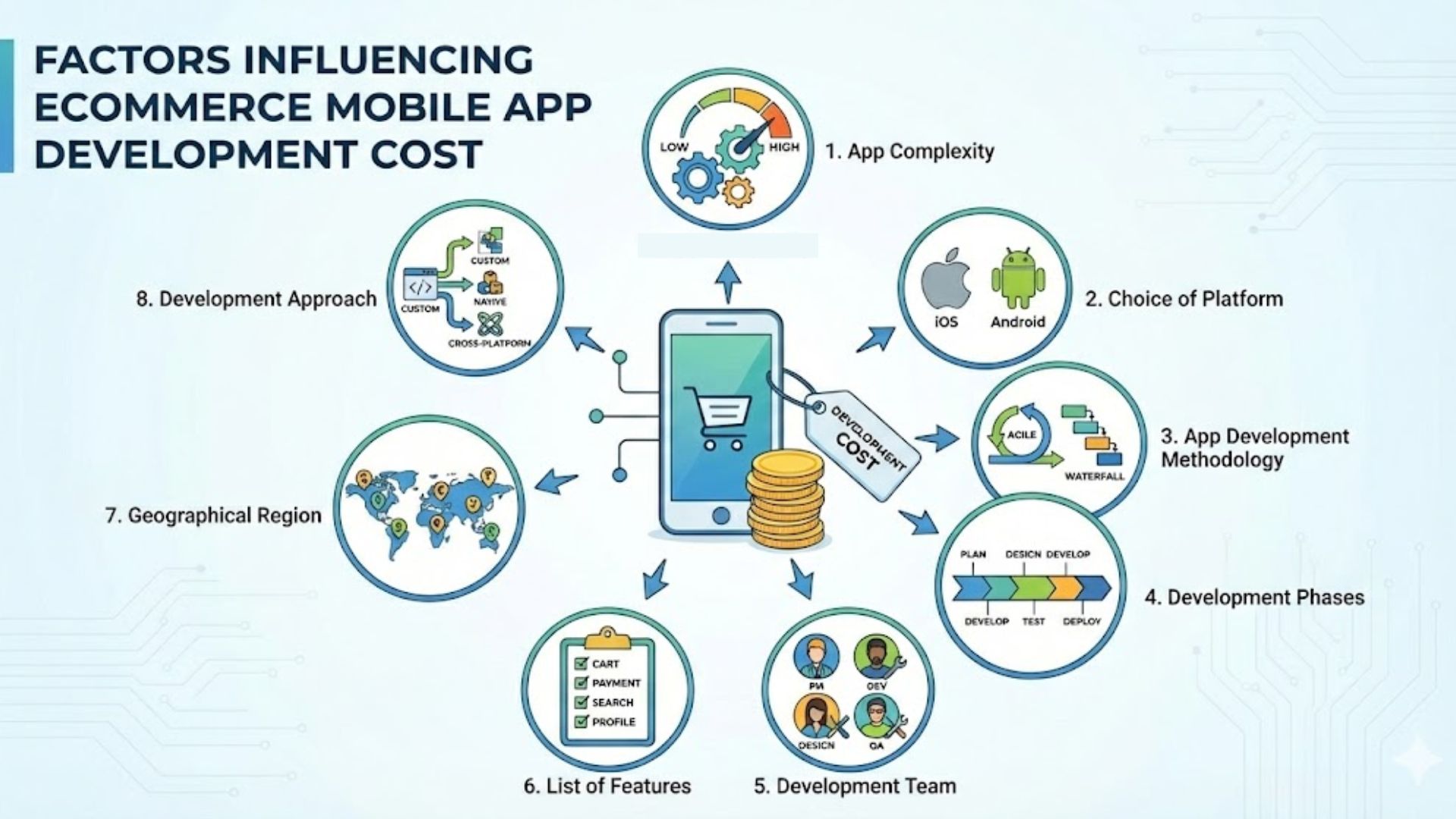
Building a successful eCommerce app requires careful planning and precise budgeting. Development costs can vary significantly, depending on whether you’re creating a simple storefront or a complex marketplace.
Understanding these factors helps you make informed decisions and plan your budget effectively. Let’s explore the key elements that influence eCommerce app development costs, along with practical insights.
1. App Complexity
The complexity of your app is one of the most significant factors affecting cost:
-
Basic Apps: Include essential features like product listings and simple checkout processes.
-
Mid-Level Apps: Add functionalities such as user accounts, multiple payment gateways, and order tracking.
-
Advanced Apps: Incorporate sophisticated features like AI-powered recommendations, AR product visualization, loyalty programs, and advanced analytics.
| Complexity Level | Features | Cost Range (USD) | Development Time | Examples |
| Basic | Simple product catalog, basic search, standard checkout, minimal payment options, simple admin panel | 20,000 – 40,000 | 2–3 months | Small boutique stores, single-vendor shops |
| Mid-Level | User accounts, wishlist, multiple payment gateways, basic analytics, push notifications, order tracking, simple CMS | 40,000 – 80,000 | 3–5 months | Brand-specific retail apps, multi-category stores |
| Advanced | AI recommendations, AR try-on features, advanced search, loyalty programs, multi-language support, complex admin dashboard, and advanced analytics | 80,000 – 300,000 | 5–10 months | Marketplace platforms, multivendor solutions |
Note: Pricing varies depending on the project scope and final assessment.
2. Choice of Platform
The platform you choose directly impacts both development costs and your potential market reach:
-
iOS: Typically requires less testing due to fewer device variations and offers faster development, targeting a smaller but often higher-spending audience.
-
Android: Requires more testing across a variety of devices but provides broader market penetration.
-
Both Platforms: Developing for iOS and Android maximizes reach but increases the initial investment.
| Platform | Pros | Cons | Cost Range (USD) |
| iOS | Higher average revenue per user, faster development, and more uniform design standards | Smaller market share, premium positioning | 20,000 – 80,000 |
| Android | Larger market share, wider demographic reach, greater device diversity | More testing required, fragmentation issues | 20,000 – 100,000 |
| Both | Maximum market reach, comprehensive customer base, unified brand presence | Higher initial investment, parallel development challenges | 40,000 – 180,000 |
Note: Costs may vary depending on project scope and final assessment.
3. App Development Methodology
The development approach significantly affects your app’s performance, user experience, and overall cost:
-
Native Development: Building separate apps for each platform using platform-specific languages (Swift/Objective-C for iOS, Kotlin/Java for Android). Offers top performance and platform-specific features but comes at a higher cost.
-
Hybrid Development: Uses frameworks like Ionic or Cordova, enabling a single codebase for multiple platforms. Cost-effective but may have moderate performance.
-
Cross-Platform Development: Uses React Native, Flutter, or Xamarin to deliver near-native performance with faster deployment and reduced development time.
| Development Approach | Tech Stack | Performance | Cost Range (USD) | Best For |
| Native | Swift/Objective-C (iOS), Kotlin/Java (Android) | Superior performance, platform-specific features, and best user experience | 40,000 – 200,000 | Performance-critical apps, premium brands |
| Hybrid | Ionic, Cordova, HTML5 | Moderate performance, cost-effective, single codebase | 30,000 – 120,000 | Budget-conscious projects, content-focused apps |
| Cross-Platform | React Native, Flutter, Xamarin | Good performance, faster deployment, near-native experience | 35,000 – 150,000 | Projects needing balanced performance at a reasonable cost |
Note: Costs may vary depending on project scope and final assessment.
4. Development Phases
The development of an eCommerce app involves several critical phases, each contributing to the overall cost. Understanding these phases helps in budgeting accurately and ensuring a successful app launch.
-
Discovery & Planning: While initial research may raise costs, it ensures precise requirements and market fit.
-
Design: Custom interfaces and complex UX can significantly increase expenses.
-
Development: Costs rise with feature complexity, integrations, and chosen technologies.
-
Testing: Comprehensive quality assurance is essential but adds to both time and budget.
-
Deployment & Maintenance: Launch, hosting, and ongoing updates contribute to long-term costs.
| Development Phase | Key Activities | Cost Range (USD) | Timeline | Deliverables |
| Discovery & Planning | Market research, competitor analysis, requirement gathering, user personas, feature prioritization, project roadmap | 5,000 – 15,000 | 2–4 weeks | Project specifications, wireframes, development plan |
| Design | UX/UI design, wireframing, prototyping, user flow mapping, branding integration, design system creation | 10,000 – 50,000 | 3–8 weeks | UI mockups, interactive prototypes, design assets |
| Development | Frontend & backend coding, API integration, database setup, payment gateway integration, admin panel development | 20,000 – 200,000 | 2–6 months | Functional application, backend systems, APIs |
| Testing | Quality assurance, functional testing, performance testing, security testing, user acceptance testing, bug fixing | 5,000 – 30,000 | 2–6 weeks | Test reports, certified applications, performance metrics |
| Deployment & Maintenance | App store submission, server setup, monitoring, regular updates, customer support, performance optimization | 10,000 – 100,000 annually | Ongoing | Live application, update schedule, support system |
Note: Costs are subject to project scope and final assessment.
5. Development Team
The composition and location of your development team significantly impact costs. A well-rounded team typically includes project managers, designers, developers, QA specialists, and DevOps engineers. The team size usually scales with project complexity.
| Team Size | Composition | Project Complexity | Cost Range (USD) |
| Small (3–5) | Project Manager, Designer, 1–2 Developers, QA Engineer | Basic to Mid-level | 25,000 – 80,000 |
| Medium (6–10) | Project Manager, UX Designer, UI Designer, 3–5 Developers, QA Team, DevOps Engineer | Mid to Advanced | 80,000 – 200,000 |
| Large (10+) | Project Manager, Business Analyst, UI/UX Team, Frontend/Backend Developers, QA Team, DevOps Team, Security Specialist | Advanced | 200,000 – 500,000 |
Note: Costs depend on project scope and final assessment.
6. List of Features
The features of your eCommerce app directly influence development cost and complexity:
-
Essential Features: Product catalogs, checkout, and payment processing keep costs minimal.
-
Standard Features: User accounts, order tracking, and analytics add moderate expenses.
-
Advanced Features: AI recommendations, AR shopping, voice search, and omnichannel integrations significantly increase development effort and cost.
| Feature Category | Examples | Cost Range (USD) | Development Time |
| Essential | Product catalog, category navigation, cart, checkout, basic search, payment integration | 20,000 – 50,000+ | 1–3 months |
| Standard | User profiles, wishlist, reviews/ratings, multiple payment methods, order tracking, push notifications, basic analytics, simple CMS | 30,000 – 100,000+ | 2–4 months |
| Advanced | AR visualization, AI recommendations, chatbots, voice search, social shopping, loyalty programs, advanced analytics, multi-language support, omnichannel integration | 50,000 – 200,000+ | 3–6 months |
Note: Costs vary based on project scope and final assessment.
7. Geographical Region
The cost of eCommerce app development personnel varies significantly by country and region. Vietnam is currently one of the most cost-competitive markets in Asia while offering high-quality talent, especially in the field of software outsourcing.
| Region | Hourly Rate (USD) | Project Rate (USD) |
|---|---|---|
| North America | 100 – 250 | 80,000 – 500,000 |
| Western Europe | 80 – 200 | 60,000 – 400,000 |
| Eastern Europe | 40 – 100 | 30,000 – 200,000 |
| Middle East | 40 – 120 | 30,000 – 250,000 |
| Asia (general) | 20 – 70 | 20,000 – 140,000 |
| Vietnam | 18 – 45 | 18,000 – 120,000 |
| Australia / New Zealand | 80 – 180 | 60,000 – 350,000 |
Why Vietnam is a Top Choice for eCommerce App Development
-
Competitive costs: Significantly lower rates than North America or Western Europe, saving your budget.
-
High-quality talent: Strong technical skills and problem-solving ability for complex projects.
-
International experience: Teams have worked on projects in the US, EU, and Singapore.
-
Good English communication: Easy collaboration with international clients.
-
Global standards: Many companies hold ISO and CMMI certifications, ensuring quality and professional processes.
Insight: Hiring developers from regions with lower rates like Vietnam can drastically reduce your project cost. However, careful project management and clear communication are key to ensuring quality and timely delivery.
8. Development Approach
Your development approach also heavily influences costs, control, and project outcomes:
| Approach | Control Level | Cost Range (USD) | Best For | Pros | Cons |
| In-House | High | 150,000 – 500,000 annually | Long-term strategic projects, core business apps, continuous development | Full alignment with company vision, direct communication, knowledge retention, flexible pivoting | Higher costs, recruitment challenges, overhead, longer setup time |
| Outsource | Medium | 50,000 – 350,000 per project | Standalone projects, specialized needs, limited budgets | Cost-effective, specialized expertise, scalable resources, faster startup | Communication challenges, potential quality control issues, less business context |
| Freelancers | Low | 30,000 – 200,000 per project | Simple projects, limited scope, tight budgets | Lowest cost, flexible engagement, specialized skills | Higher management overhead, reliability concerns, coordination challenges |
Note: Costs depend on project scope and final assessment.
eCommerce App Development Cost Estimation Based on Popular eCommerce Apps
Analyzing successful eCommerce apps provides valuable benchmarks for planning your project budget. Large platforms like Amazon and Shopify require significant investment, while mid-tier platforms such as Etsy represent more moderate development costs. Understanding these benchmarks helps startups set realistic budget expectations for their own eCommerce ventures.
| App Example | Type | Estimated Cost (USD) | Key Features | Development Time |
| Amazon | Full-service marketplace | 300,000 – 500,000 | Massive catalog, advanced recommendations, multi-seller support, complex logistics, comprehensive analytics | 10–14 months |
| Shopify | eCommerce platform | 150,000 – 300,000 | Store management, inventory control, payment processing, analytics, marketing tools | 6–10 months |
| Etsy | Specialized marketplace | 100,000 – 250,000 | Artisan focus, custom categories, seller tools, community features | 5–9 months |
| ASOS | Fashion retail | 120,000 – 280,000 | Visual search, outfit recommendations, style guides, size assistant | 6–9 months |
| Zara | Retail brand app | 80,000 – 200,000 | Brand-focused UI, AR try-on, store integration, scan-to-shop | 4–8 months |
| Wayfair | Home goods marketplace | 150,000 – 300,000 | AR room planner, visual search, complex filtering, delivery tracking | 6–10 months |
| Sephora | Beauty retail | 100,000 – 250,000 | Virtual try-on, personalized recommendations, loyalty program | 5–9 months |
Note: Costs depend on project scope and final assessment.
Developing an app similar to an established brand often requires a significant initial investment, which may be challenging for startups with tight budgets. Cloning an app can be a cost-effective alternative, allowing startups to leverage proven business models while reducing design and research costs.
| Clone Type | Customization Level | Cost Range (USD) | Development Time | Market Positioning |
| Basic Clone | Minimal customization, similar UI/UX, core functionality replication | 20,000 – 60,000 | 2–3 months | Limited differentiation, price competition |
| Enhanced Clone | Moderate customization, some unique features, branded design | 60,000 – 150,000 | 3–5 months | Partial differentiation, requires marketing efforts |
| Inspired App | Significant customization, unique selling points, innovative features | 150,000 – 350,000 | 5–8 months | Strong differentiation, unique value proposition |
Insight: Choosing the right cloning approach balances cost savings with the potential for innovation and competitive advantage.
10 Ways to Reduce eCommerce App Development Costs
Developing an eCommerce app can be costly, especially for startups with limited budgets. However, with strategic planning and smart choices, you can significantly reduce development expenses without compromising quality. Here are ten effective strategies:
1. Start with an MVP

Focus on core features that solve your customers’ main needs. Launch a minimum viable product first to test ideas, gather feedback, and avoid spending on unnecessary features.
Pro Tip: Define clear success metrics for your MVP and track user engagement to identify the most valuable features before scaling.
2. Choose Cross-Platform Development
Use frameworks like React Native or Flutter to build one app for both iOS and Android, saving time, reducing costs, and simplifying maintenance.
Pro Tip: Pick a framework with strong community support and pre-built components for long-term maintainability.
3. Use Open-Source Solutions
Platforms such as WooCommerce, Magento, or OpenCart provide ready-made features for product management, shopping carts, and payment integrations, minimizing development time and cost.
Pro Tip: Contribute to the open-source community to build relationships with developers who can help solve technical challenges without expensive consulting fees.
4. Outsource Wisely

Hire experienced developers from regions with lower labor costs. Clear milestones, communication channels, and small test projects help ensure quality while saving expenses.
Pro Tip: Review portfolios, check references, and start with small test projects before committing to a full development partnership.
5. Consider Cloning Established Platforms
Start by cloning a successful eCommerce platform and customizing it to your needs. This saves time and money on proven architecture and design choices while reducing development complexity.
Pro Tip: Differentiate your clone by adding unique features or targeting underserved customer needs.
6. Implement Progressive Web Apps (PWAs)
PWAs provide app-like experiences without the cost of native app development. They work across devices, load quickly, and don’t require app store approvals.
Pro Tip: Enhance user engagement by implementing offline functionality and smart caching strategies.
7. Optimize eCommerce App Design
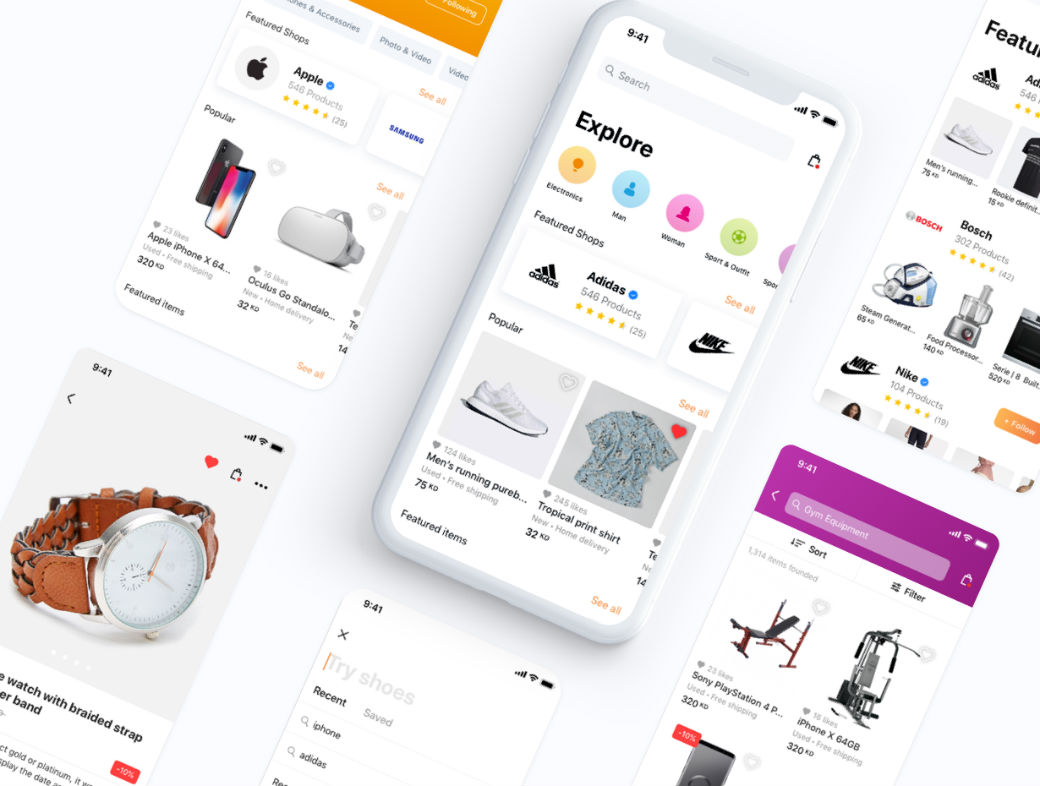
Prioritize simple and intuitive UX over flashy visuals. A well-planned design reduces development complexity, lowers maintenance costs, and increases conversion rates.
Pro Tip: Use design systems and reusable components to maintain consistency and speed up development.
8. Integrate Third-Party Services
Use existing solutions for payment gateways, shipping calculators, and analytics instead of building from scratch. These integrations are reliable and cost-effective, helping control app development costs.
Pro Tip: Choose scalable services with flexible pricing that grow with your business.
9. Implement Agile Development
Use agile methodologies to identify and resolve issues early. Breaking development into sprints reduces costly rework and keeps projects on time and budget.
Pro Tip: Hold regular sprint reviews with stakeholders to prevent scope creep and unexpected cost increases.
10. Plan for Scalability from the Start
Design your architecture to handle growth without major rewrites. This foresight prevents expensive overhauls and allows your app to scale efficiently as your user base expands.
Pro Tip: Invest in automated testing to maintain platform stability as new features are added.
Hidden Costs of eCommerce App Development and How to Reduce Them
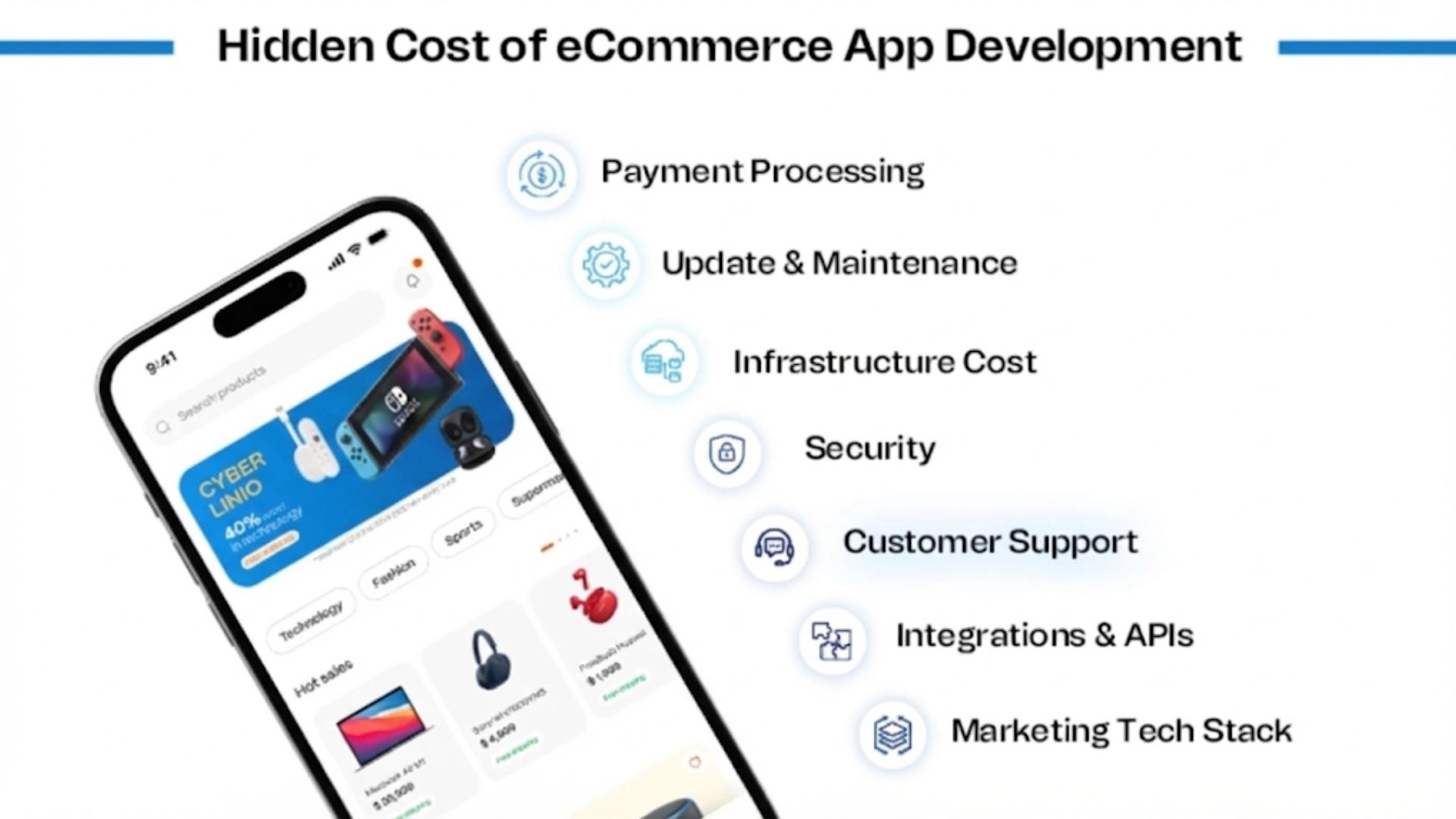
Building an eCommerce app involves more than just the initial development fees. Many startup founders are caught off guard by hidden costs that appear during development and after launch. Understanding these expenses helps you plan your budget realistically and avoid unpleasant surprises.
1. Payment Processing Complexities
Payment gateway integration includes transaction fees, security compliance, multi-currency support, and constant technical updates.
Pro Tip: Start with essential payment methods and expand only when revenue justifies it.
2. Continuous Updates and Maintenance
Apps require ongoing OS updates, security patches, and UX improvements—creating continuous maintenance costs.
Pro Tip: Work with a team offering monthly maintenance packages instead of paying for emergency fixes.
3. Infrastructure Costs
As traffic grows, server, bandwidth, and database optimization costs increase rapidly.
Pro Tip: Use cloud solutions with pay-as-you-grow pricing to control infrastructure spending.
4. Security and Compliance
Meeting PCI-DSS, privacy regulations, and security audit requirements can be expensive—especially if added late.
Pro Tip: Build security and compliance into your app from day one.
5. Customer Support Infrastructure
More users mean more inquiries, requiring ticketing tools, knowledge bases, and support staff.
Pro Tip: Start with AI chatbots for common questions and scale your human team gradually.
6. Integrations and APIs
Integrating inventory systems, shipping providers, and marketing tools involves recurring fees and occasional compatibility issues.
Pro Tip: Prioritize integrations that directly impact revenue and delay non-essential ones.
7. Marketing Technology Stack
Analytics, email marketing, and retargeting tools can become a significant recurring cost as your marketing scales.
Pro Tip: Use lean marketing tools suitable for startups, not expensive enterprise platforms.
Summing Up
Wondering how much it really costs to develop your eCommerce app? Many startup founders lose sleep over this question. Understanding the cost breakdown of eCommerce app development provides clarity and helps you plan your budget effectively.
We understand the unique challenges eCommerce founders face and offer transparent pricing with no hidden fees. Ready to build your eCommerce app without overspending? Contact HomeNest today for a free consultation and let us be your trusted technology partner.
HomeNest Software – A Foundation for Sustainable Growth for Vietnamese Businesses.

Contact Information:
- Address: The Sun Avenue, 28 Mai Chi Tho Street, Binh Trung Ward, Ho Chi Minh City
- Hotline: +84 898 994 298 ( WhatsApp )
- Website: homenest.software
Frequently Asked Questions (FAQ)
1. How much does it cost to develop an eCommerce app?
Costs typically range from USD 15,000 to USD 500,000, depending on app complexity and features. Basic apps are on the lower end, while full-featured marketplaces reach the higher end.
2. What affects the cost?
Key factors include platform choice (iOS, Android, or both), feature complexity, design, backend infrastructure, third-party integrations, developer rates, security, payment gateways, and whether the app is native or cross-platform.
3. How long does development take?
Development usually takes 3–12 months. Simple apps can be done in 3–4 months, while complex marketplaces may take 6–9 months or more.
4. How much does developing an eCommerce app like Noon cost?
Developing a marketplace app like Noon costs around USD 20,000 – USD 200,000, covering user management, vendor portals, advanced search, and multilingual support.
5. How much will developing an eCommerce Android & iOS app cost?
Basic iOS and Android apps cost USD 20,000 – USD 50,000; advanced apps with more features can reach USD 100,000 – USD 150,000.
eCommerce App Development Pricing Explained: A Full Breakdown
Latest Articles
View All
How Much Does It Cost to Build a Shopping App Like Temu?
Temu’s meteoric rise to over 900 million global downloads proves the power of combining AI, gamification, and social commerce, but building a similar viral shopping platform requires careful financial and technical planning. Developing an app like Temu typically costs anywhere from $40,000 for a basic Minimum Viable Product (MVP) to over $300,000 for a fully-featured platform. This guide breaks down every cost category, analyzes the core features driving Temu’s success, highlights the best technology stacks, and offers practical strategies to optimize your development budget without compromising on quality.

Criteria For Choosing The Right App Design Agency
UI/UX design is the logical foundation of a system, not merely a visual element. Choosing the wrong partner will directly lead to technical debt, budget overruns, and disruptions in the development process. This article provides a 6-step evaluation framework and a list of operational risks, helping businesses eliminate subjective design advice and accurately assess agency capabilities based on developer handoff standards and practical business performance.

How Does AI in Banking Industry Impact the Future?
Artificial intelligence (AI) has transitioned from a supplementary tool to a core infrastructure of financial data management, optimizing profitability through real-time fraud detection, natural language processing (NLP), and high-speed credit scoring models. “Deploying AI in the financial sector requires more than just algorithmic accuracy, it demands a highly secure cloud architecture and rigorous data governance,” commented Nguyen Tien, co-founder of HomeNest Software. Why read this guide? We skip the theoretical jargon to focus entirely on technical implementation. Whether you’re evaluating a vendor or planning a system overhaul, this article will detail: Operational Efficiency: Automating unstructured data workflows at scale. Risk Architecture: Implementing real-time threat detection and AML compliance. Data ownership: The essential need for 100% ownership of the source code to ensure full algorithm auditability.
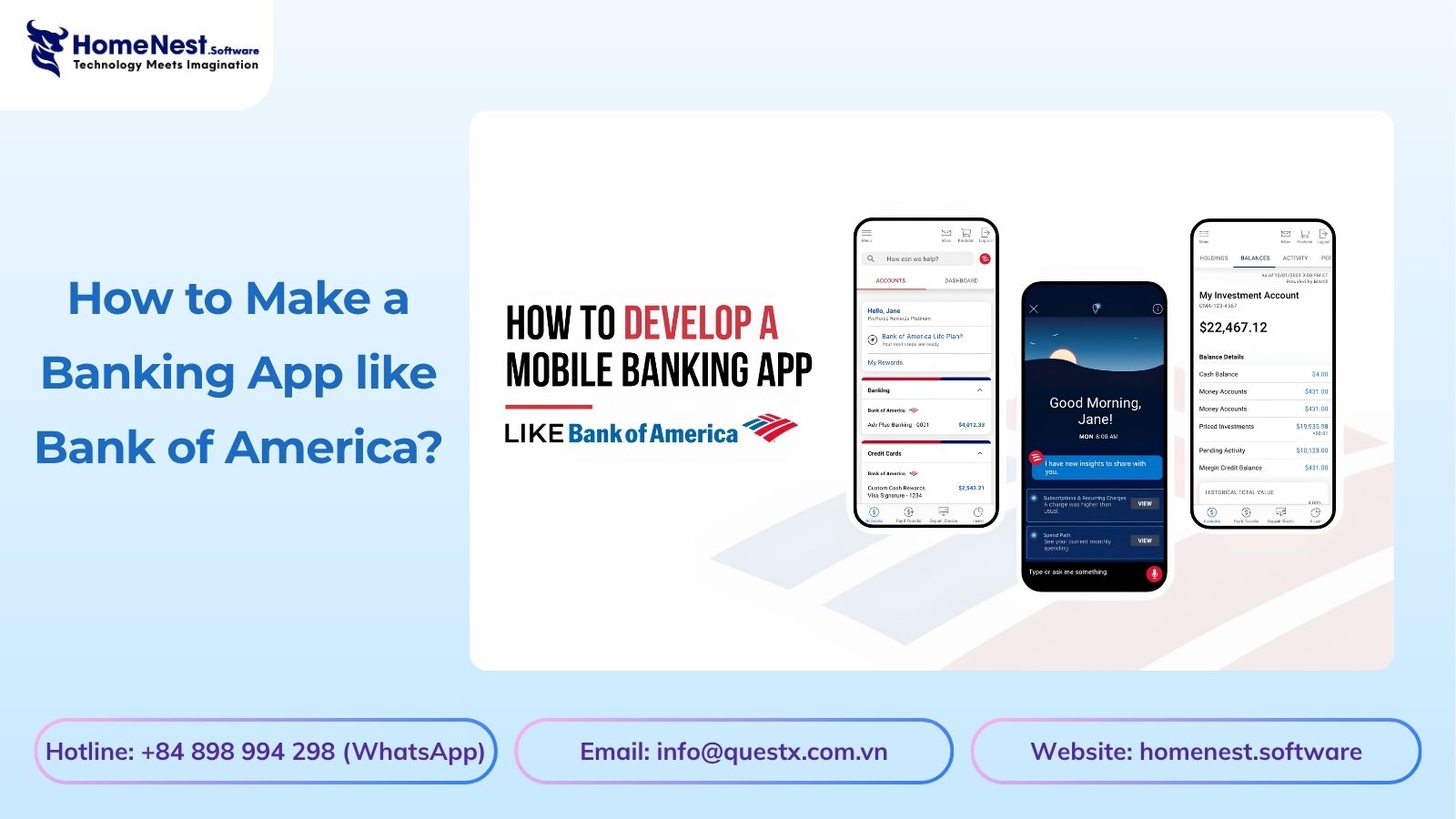
How to Make a Banking App like Bank of America?
Developing a mobile banking application like Bank of America extends far beyond basic UI design; it requires engineering a fault-tolerant backend capable of real-time ledger synchronization, biometric authentication, and high-volume data processing under strict regulatory frameworks. Drawing from HomeNest Software’s deep experience in architecting enterprise-grade fintech solutions, this guide strips away theoretical jargon to focus entirely on operational and technical execution. What you will find in this guide: We break down the precise development roadmap, from mapping out microservices and ensuring PCI-DSS compliance to estimating MVP development costs and securing absolute data sovereignty through 100% source code ownership. If you are preparing to build, scale, or audit a financial platform, this blueprint provides the exact framework you need.
Banking App Development Cost
Building a banking application is rarely a simple process; it’s a complex technical challenge requiring a balance between complying with stringent financial regulations, handling large transaction volumes, and a scalable cloud architecture. Miscalculating these technical requirements from the outset often leads to significant technical debt and budget overruns. Based on HomeNest Software’s practical experience in designing enterprise-grade fintech solutions, this guide bypasses generic estimates to provide a realistic analysis of banking application development costs. What you’ll find in this guide: We analyze the true cost factors, from technology selection and API integration to the hidden costs of regulatory compliance and security infrastructure. Whether you’re launching a minimum viable product or expanding an existing financial platform, this analysis provides the precise operational data you need to plan your budget effectively.
How to Build a Mobile Banking App Like Chime?
Building a mobile banking app like Chime is not just about features, it is about delivering a secure, scalable, and user-centric financial experience. From planning the right architecture to optimizing mobile banking app development cost, every decision directly impacts your product’s success. Leveraging Fintech app development services, starting with MVP app development, and scaling through on-demand app development solutions allows businesses to reduce risk and accelerate time to market. To stay competitive, combining Android app development services and iOS app development solutions ensures wider reach, while continuous updates through maintenance software development services keep your app secure and future-ready.