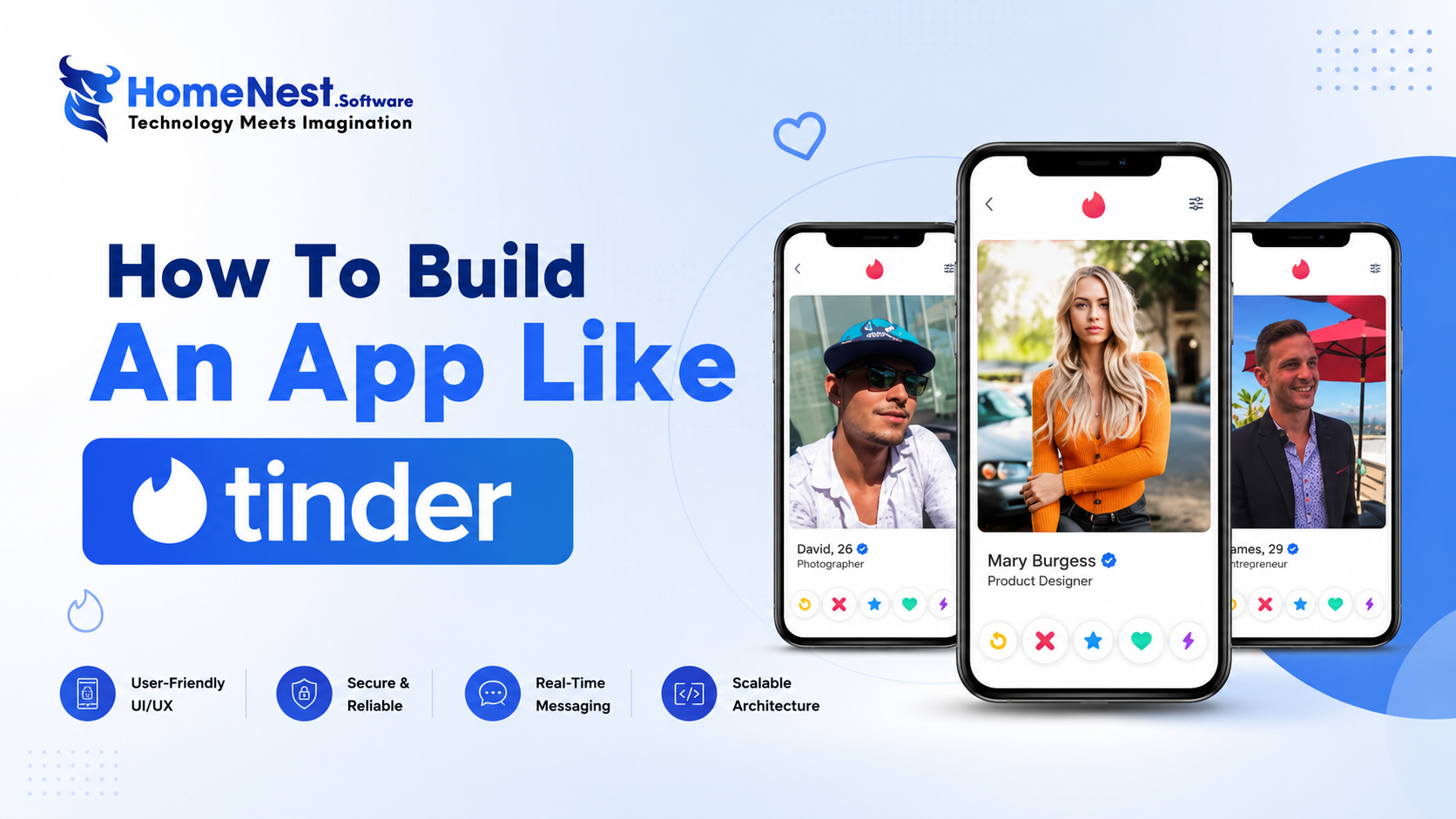
Dating in the digital age is now as simple as a swipe. Apps like Tinder, Bumble, and Hinge have completely redefined how people meet and form connections—fueling explosive growth in the online dating industry. According to Statista, the global digital dating market is expected to reach US$3.45 billion by 2029, making it one of the fastest-growing digital sectors today.
If you’re thinking about creating your own dating app, there has never been a better time. But turning an idea into a successful product requires more than inspiration—it requires a well-structured plan. From crafting engaging features and selecting the right technology stack to shaping your monetization model and development roadmap, every decision plays a crucial role.
In this guide, we’ll walk you through every step of building a dating app from the ground up, offering practical insights and proven strategies to help your product stand out in an increasingly competitive market.
Let’s dive in!
Dating App Market: Key Statistics and Emerging Trends
Stay informed with the latest insights shaping the dating app industry. Below are the most recent statistics and trends that highlight the growth and potential of dating mobile app development.
1. Leading Apps Dominate Global Revenue
Tinder, Bumble, and Hinge continue to transform the dating landscape. According to Statista, in June 2024, Tinder generated the highest in-app purchase revenue worldwide—over $82 million in a single month.
Bumble followed with approximately $43.4 million, while Hinge secured third place with around $26.22 million.
These figures reinforce the growing profitability and user engagement across major dating platforms.
2. The Online Dating Market Is Expanding Rapidly
The global online dating industry shows no sign of slowing down. Statista’s Worldwide Online Dating Report projects the market to reach $3.46 billion by 2028, driven by increased smartphone adoption, social acceptance of online dating, and advanced matching algorithms.
3. Over 300 Million Active Users Worldwide
Recent data from Business of Apps reveals that more than 300 million users are actively using dating apps globally.
Notably, around 20 million users subscribe to premium plans—showcasing a strong willingness to pay for enhanced features such as advanced filters, boosted visibility, and curated matches.
This trend highlights a shift toward paid digital matchmaking experiences and a growing reliance on technology for relationship-building.
Step-by-Step Process to Create a Dating App (6 Simple Stages)
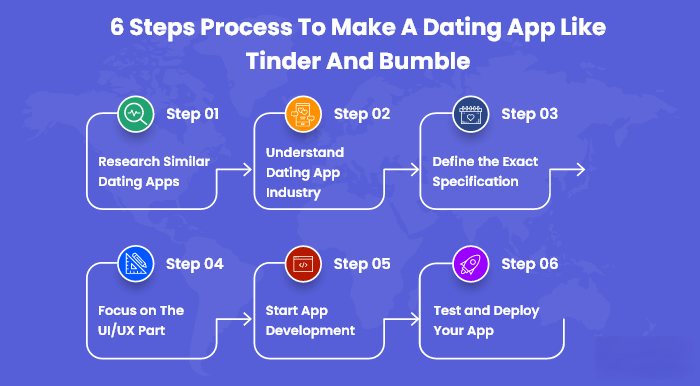
If you’re wondering, “How do I build a dating app from scratch?” — the process is similar to developing any successful mobile application. It requires structure, research, smart planning, and a user-first mindset. Below is the streamlined step-by-step approach to building a high-performing dating app.
Step 1: Research the Dating App Market
Just like researching before buying a phone, developing a dating app requires a deep understanding of the market. Thorough competitive research helps you identify opportunities, user needs, and gaps in existing solutions.
Key Questions to Ask:
-
Who is your target audience?
-
How big is the dating app market in your region?
-
Which dating apps are trending and why?
-
What unique value do apps like Tinder, Bumble, or Hinge provide?
-
Are you building for a general audience or a niche group (e.g., LGBTQ+)?
Your research determines your app’s direction—from features to monetization. For example, Grindr and Hinge serve entirely different segments and use different feature sets.
Helpful Market Research Tools
| Tool |
Purpose |
| Google Trends |
Discover trending dating apps and search behavior |
| AnswerThePublic |
Identify common user questions and keyword phrases |
| ThinkWithGoogle |
Access research insights, trends, and planning tools |
Step 2: Understand What Works in the Dating App Industry
Before jumping into feature development, study leading dating apps to understand what drives user engagement.
Focus Areas:
-
Identify your niche
-
Define your USP (unique selling proposition)
-
Spot user pain points and unmet needs
-
Analyze which features resonate the most
Examples of niche dating apps:
-
Hily: Uses algorithms to analyze user interests and behavior; supports video calls and compatibility quizzes.
-
League: Matches users based on career and educational background.
-
Coffee Meets Bagel: Curates one meaningful match per day; strong LGBTQ+ community support.
-
Hinge: Designed for serious relationships with deep user profiles.
These examples help you determine what type of dating experience you want to build.
Step 3: Define Clear App Specifications
Now that you’ve researched the market and identified your direction, outline your exact requirements.
This step ensures clarity for the development team and eliminates costly rework.
Crucial Questions:
-
Should you build a native or cross-platform app?
-
What unique features will your app offer?
-
Are you targeting a broad audience or a niche?
-
What monetization model will you use (subscriptions, ads, in-app purchases)?
The clearer the specifications, the better the development outcome.
Step 4: Focus on UI/UX Design
Dating apps live or die by their user experience. Your design must be clean, intuitive, and emotion-driven.
What Makes Great Dating App UI/UX?
-
Smooth swipe gestures (Tinder-style)
-
Quick transitions between match, message, and profile screens
-
Minimal friction during onboarding
-
Intuitive profile browsing and liking
Tools Used by HomeNest Designers
| Tool |
Purpose |
| Adobe XD |
Build interactive prototypes and animated wireframes |
| Sketch |
Create consistent UI components with plugin support |
We prioritize UI/UX at HomeNest because design directly impacts user engagement and long-term retention.
Step 5: Start Custom Dating App Development
With the design approved, development begins—starting with the MVP version.
An MVP helps you validate your concept, test early users, and refine features before scaling.
Essential Matching Algorithm Techniques
| Method |
How It Works |
| Geolocation Data |
Recommends nearby users using location services |
| Mathematical Matching |
Matches users based on age, interests, preferences |
| Behavior Analysis (Big Data) |
Studies user actions for more accurate matches |
| AI & AR Integration |
Personalizes recommendations like Netflix/Amazon |
These components ensure the matching logic feels relevant, personalized, and smart.
Step 6: Test and Launch Your App
Before going live, thorough testing is essential to ensure everything works smoothly.
Testing Checklist:
-
API response testing
-
Login & signup flow
-
Matching algorithm accuracy
-
Messaging functionality
-
In-app purchases (Stripe, PayPal)
-
UI/UX performance
-
Cross-device compatibility
Once testing is complete, publish your app to the Google Play Store and Apple App Store—following their submission guidelines.
How Much Time Does It Take to Develop a Dating App?
The development timeline for a dating app depends heavily on its complexity and feature set. On average:
-
Core mobile app development: 900–1,000 hours
-
Backend development: 300+ hours
-
Testing & pre-launch preparation: around 60 hours
These estimates account for essential dating app features, including:
-
Sign-in & authentication
-
User profile creation
-
Geolocation services
-
Match recommendations
-
Swipe functionality
-
In-app chat
-
Push notifications
-
Profile verification
-
Behavioral analysis
The more advanced the features (e.g., AI-based matching, video calling, or gamification), the longer the timeline. If you want, I can also provide a full timeline table (MVP vs. full version) or a cost breakdown based on the hours above.
How Much Does It Cost to Develop a Dating App?
The cost of developing a dating app like Tinder typically ranges from $10,000 to $150,000+, depending on the app’s features, complexity, and overall functionality. The more advanced the feature set—such as behavioral matching, AI-driven recommendations, or in-app video calls—the higher the development cost.
If you’re planning to build a Tinder-like dating app and want an accurate estimate, you can schedule a free consultation with our dating app experts.
Below is a general phase-wise breakdown of dating app development costs:
| Development Phase |
Estimated Cost |
| UI/UX Design |
$5,000 – $15,000 |
| Core Development |
$5,000 – $25,000 |
| Testing & Deployment |
$2,500 – $10,000 |
| Total Custom Dating App Development Cost |
$50,000+ |
How to Calculate the Cost of a Dating App
Use this simple formula to estimate development cost:
Hourly Rate × Total Development Hours = Project Cost
Example:
If the hourly rate is $35/hour and the project takes 600 hours, then:
$35 × 600 = $21,000
(Estimated total cost: $20,000 – $25,000)
This formula helps you estimate your budget based on the scope and the team’s hourly rate.
Want to Know the Exact Cost of Your Dating App?
Contact us today. We’ll validate your idea, outline the technical requirements, and provide a detailed time and cost estimate tailored to your business goals.
Essential Tech Stack for Developing a Dating App
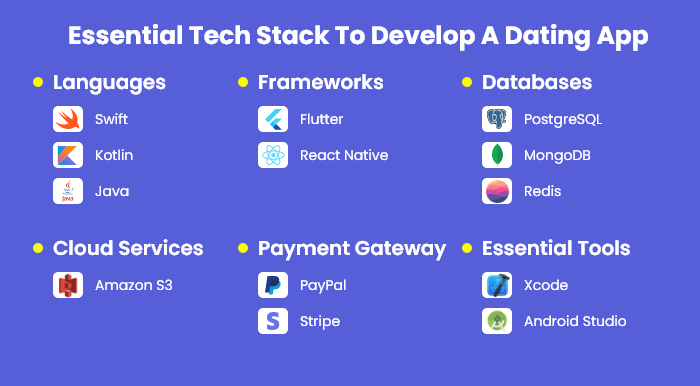
Selecting the right technology stack is a critical step in building a successful dating app. Your tech stack directly impacts the app’s performance, scalability, security, and long-term maintainability. If you’re planning to build your own dating platform, choosing reliable and modern tools is essential.
At HomeNest, our development team leverages a proven combination of technologies to create scalable, high-performing dating apps and web platforms. Below is the core tech stack we typically use to deliver robust and future-ready solutions.
| Development Tools |
Development Technologies |
| Programming Languages |
|
| Programming Frameworks |
|
| Databases |
|
| Cloud Services |
|
| Payment Gateway |
|
| Essential Tools |
|
What Features Do You Need to Build a Dating App?
Below is a list of essential features required to create a functional, user-friendly, and secure dating app. Each feature is accompanied by a brief explanation to help you understand why it plays a critical role in delivering a smooth dating experience.
| Feature |
Explanation |
| Registration & Login |
New users can sign up using social media or Google accounts, while existing users can log in with their saved credentials. This simplifies onboarding and increases conversion. |
| Push Notifications |
Keeps users engaged by sending real-time alerts—new matches, messages, likes, and personalized updates—without requiring them to open the app. |
| User Profile Verification |
Users upload identity proof (such as a driver’s license or address verification) to ensure authenticity and reduce the number of fake profiles on the platform. |
| Preference Selection |
Allows users to set their dating preferences, such as gender and age range, to receive more accurate match suggestions. |
| GPS-Based Search |
Enables users to find potential matches nearby by using location tracking—an essential feature for modern dating apps. |
| Chat & AI-Based Live Video |
After matching, users can send messages or engage in real-time video calls for deeper interactions and safer first impressions. |
| Fake Profile Detection |
Advanced tools help identify suspicious behavior and minimize fake accounts. Studies show 75.3% of users admit to lying about money, making verification and detection crucial. |
| Privacy Controls & Profile Reporting |
All personal data must follow strict privacy standards. Users should be able to report suspicious or inappropriate profiles to maintain a safe environment. |
| Gamification Features |
Adding interactive elements—such as swipe-based games, quizzes, or mini challenges—boosts engagement and encourages daily app use. |
| Lookalike Matching |
Using facial recognition technology, users can discover matches who resemble their ideal type or share similar facial features. |
How Do Dating Apps Make Money? (4 Proven Monetization Strategies)
You’ve invested months of effort and significant resources into building your dating app — now it’s time to monetize it effectively. But how exactly do dating apps make money, and which monetization strategies actually work?
To put things into perspective, Tinder generated $1.794 billion in revenue in 2022, a 25% increase from 2020. So how does Tinder (and other major dating apps) turn user interactions into profit?
Below are four of the most successful monetization models you can apply to your own dating app.
1. In-App Purchases
Most dating apps rely heavily on in-app purchases to enhance user experience. These optional upgrades give users access to premium features that help them get more matches, stand out, or interact more effectively.
Popular In-App Purchase Features:
-
Profile boost
-
Unlimited swipes
-
Featured profile placement
-
Ability to message exclusive users
-
See who liked your profile
-
Send gifts or super likes
Benefits of In-App Purchases:
2. Affiliate Marketing & Paid Ads
Another way to generate revenue is through affiliate partnerships. Dating apps can promote related products or services and earn a commission for every purchase made through referral links.
Many well-known platforms like Match, EliteSingles, and Cupid Media use affiliate marketing programs to bring in additional income and attract new traffic.
Benefits of Affiliate Marketing:
3. Subscription & Premium Plans
This is one of the most popular and predictable monetization strategies. Apps like Tinder, Bumble, and Hinge offer subscription tiers that unlock advanced features.
For example, Tinder Plus users get unlimited swipes, extra boosts, and more control over their visibility.
Benefits of Subscription Models:
4. Paid Text & Video Upgrades
Modern users expect more meaningful ways to connect — which makes chat and video calling essential. Apps like Match.com and eHarmony offer premium communication features where users must upgrade to chat with certain matches.
Benefits of Messaging & Video Upgrades:
Curious how major dating apps like Tinder, Bumble, and Badoo earn billions? In the next section, we reveal exactly how these giants structure their revenue streams.
Let’s explore deeper.
How Tinder Makes Money: Inside the Tinder Business Model
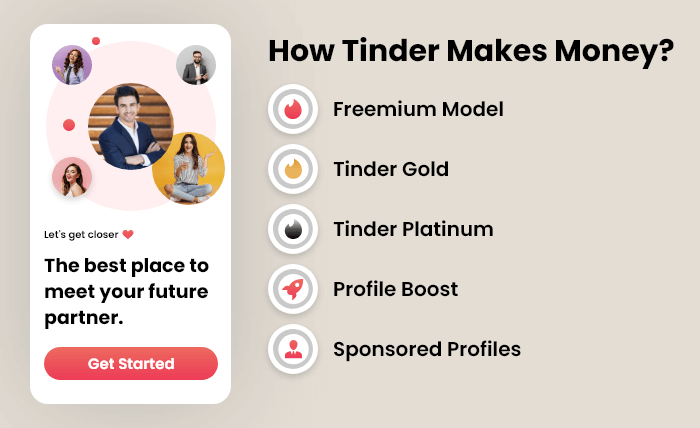
Tinder is one of the world’s most successful online dating platforms, and its revenue continues to rise year after year—driven primarily by subscription plans and in-app purchases.
While Tinder offers basic features like swiping and matching for free, its monetization strategy is built on converting active users into paying subscribers. According to global revenue reports, Tinder’s monthly in-app purchase revenue steadily increased from 2015 to 2022, solidifying its position as a market leader.
Below is a breakdown of Tinder’s revenue model and its premium offerings.
1. Freemium Model (Tinder Plus)
Tinder uses a classic freemium model: users get core features at no cost, but must upgrade to access premium benefits.
Tinder Plus starts at $9.99/month and unlocks several advanced features, including:
-
Unlimited likes
-
Unlimited rewinds
-
Passport (change your location)
-
Match, chat, and meet without restrictions
-
Ad-free experience
Users often encounter upgrade prompts after reaching swipe limits—driving conversions through convenience and curiosity.
2. Tinder Gold
Tinder Gold builds on Tinder Plus by adding more exclusive perks. Users can easily upgrade from Plus to Gold for an additional fee.
Top Tinder Gold Features:
This transparency creates a sense of instant gratification, increasing user engagement and subscription purchases.
3. Tinder Platinum
Tinder Platinum is the most premium subscription tier, offering enhanced visibility and priority interactions.
Key Platinum Features:
Platinum targets power users who want maximum exposure and higher match rates.
4. Boost & Super Boost Features
Boosting elevates a user’s profile to the top of the swipe deck for 30 minutes, generating:
Other dating apps, like Bumble, have integrated similar boost features due to their high revenue potential.
5. Sponsored Profiles
Tinder also monetizes through sponsored content. Brands partner with Tinder to promote special campaigns directly within the swipe interface.
When a user swipes right on a sponsored profile, they may receive a pre-written message from the advertiser—creating a unique interaction experience. This advertising strategy brings in additional revenue while offering brands access to a highly engaged audience.
Curious how Tinder’s competitors monetize their platforms?
Next, explore how Bumble, Badoo, and other leading dating apps convert free users into paying subscribers.
How Bumble Makes Money? | Bumble Business Model
Bumble, being one of the top players in the dating service market, Bumble works on the freemium business model. You may consider the example of Spotify, Google, and YouTube as freemium programs.
Talking about the revenue, in the 4th quarter of 2021, Bumble’s revenue was between $208 million – $211 million.
But, you might question yourself, how does the Bumble app become so huge? What was its core proposition? The answer to your question is, that the Bumble app only allows female users to make the first move after a heterosexual match.
The interesting thing is that the match will only last for 24 hours if the woman does not respond. Now, the male user just has 24 hours to lock in the date. Next, we will discuss the monetization strategies of the Bumble app.
The following table shows the paid plans of Bumble and the features each plan provides against a specific charge.
How Bumble Makes Money: Inside the Bumble Business Model
Bumble is one of the leading players in the global online dating market, operating primarily on a freemium model—similar to platforms like Spotify, YouTube, and Google services. Users can access core features for free, but must upgrade to premium plans to unlock enhanced functionality.
In the fourth quarter of 2021, Bumble generated between $208 million and $211 million in revenue, showcasing strong global demand and a loyal user base.
What Makes Bumble Unique?
Bumble’s rise to success is rooted in its core value proposition:
In heterosexual matches, only women can initiate the first message.
This approach empowered female users, differentiated Bumble from competitors, and created a safer, more intentional dating environment.
Additionally:
This sense of urgency encourages interaction and boosts user engagement—directly increasing monetization potential.
Bumble’s Monetization Strategy
Bumble offers several paid tiers and in-app purchases. Below is a breakdown of its main revenue streams:
| Bumble Paid Plan |
Explanation |
| Bumble Premium |
Costs $12.99 per week. Includes unlimited advanced filters, unlimited swipes, and 5 SuperSwipes per week. |
| Bumble Boost |
Priced at $14.99/month (varies by region). Offers one Spotlight, five weekly SuperSwipes, and unlimited swipes. |
| SuperSwipes |
Allows users to show elevated interest. One SuperSwipe = 1 Bumble Coin ($1.99 per coin). |
| Spotlight |
Pushes your profile to the top for increased visibility. Requires 2 Bumble Coins to activate. |
Similar to Tinder, Bumble leverages boosters, visibility upgrades, and premium subscriptions to drive recurring revenue and enhance user engagement.
How Badoo Makes Money: Understanding the Badoo Business Model
After Tinder, Badoo stands as one of the major players in the online dating industry. As of May 2021, Badoo had achieved 3.9 million downloads, with the majority of users coming from Europe, the Middle East, and Africa (EMEA). Interestingly, Badoo launched even before Tinder and Bumble, giving it an early advantage in the digital dating space.
If you’re wondering how Badoo earns revenue, here’s a breakdown of its monetization strategy:
Badoo’s Monetization Plans
| Badoo Paid Plan |
Explanation |
| Badoo Premium |
Pricing starts at $9.99/month, with a lifetime subscription option for $59.99. Premium users unlock additional visibility, enhanced messaging features, and more control over their profile interactions. |
| Badoo Premium Plus |
Offers advanced perks such as unrestricted chatting with anyone and boosted profile visibility to attract more matches. |
| Badoo Credits |
Users can purchase credits to access specific premium actions. Examples include:
• Spend 50 credits to appear at the top of nearby user lists.
• Spend 100 credits to view more profiles and increase match opportunities. |
Badoo’s flexible payment system—combining subscriptions with microtransactions—allows users to customize their experience while enabling Badoo to generate consistent, scalable revenue.
Now that you understand the tech stack, must-have features, and the business models of leading dating apps, the following FAQs will address common questions you may encounter while building your own dating app.
Contact HomeNest Software today for a free consultation and inquire about our all-inclusive App Design package offers!
HomeNest Software – Empowering Long-Term Growth for Modern Businesses.

Contact Information:
- Address: The Sun Avenue, 28 Mai Chi Tho Street, Binh Trung Ward, Ho Chi Minh City
- Hotline: +84 898 994 298 ( WhatsApp )
- Website: homenest.software
FAQs
1. How much does it cost to develop a dating app like Tinder or Bumble?
A dating app typically costs $10,000 to $150,000+, depending on features, UI/UX complexity, backend requirements, and platform choice (iOS, Android, or both).
2. How long does it take to build a dating app?
On average, developing a dating app requires:
-
900–1,000 hours for core mobile development
-
300+ hours for backend development
-
60+ hours for testing and deployment
A full-featured version can take 3–6 months.
3. What are the essential features of a dating app?
Key features include:
-
User registration & login
-
Geolocation-based matching
-
Swipe or preference-based interactions
-
Chat and video calling
-
Fake profile detection
-
Push notifications
-
Profile verification
-
Behavioral or AI-based matching algorithms
4. Which monetization strategy works best for dating apps?
Top revenue models include:
-
Subscriptions (Tinder Plus, Bumble Premium)
-
In-app purchases (boosts, super likes, visibility upgrades)
-
Paid ads & sponsored content
-
Affiliate partnerships
-
Video or chat upgrade features
5. Do I need a backend server for my dating app?
Yes. Dating apps rely on backend infrastructure for:
-
User authentication
-
Matching algorithms
-
Real-time messaging
-
Location services
-
Data storage & analytics
A strong backend ensures stability, security, and scalability.
6. Should I build a native or cross-platform dating app?
For MVPs, cross-platform development is often the best option.
7. How do dating apps prevent fake profiles?
Common methods include:
8. Can AI improve a dating app’s matching accuracy?
Absolutely. AI enhances:
AI/ML is now a standard feature in modern dating apps.
9. How do I protect user privacy in dating apps?
Implement:
User trust is crucial in dating applications.
10. How do I get an accurate cost estimate for my dating app idea?
You can request a detailed estimate by sharing your:
-
Feature list
-
Desired platforms
-
Monetization strategy
-
Design preferences
-
Project timeline
Our team can validate your idea and provide a precise time & cost estimation.