Software development is a fundamental driver of innovation, operational efficiency, and enhanced customer experiences. As organizations strive to build scalable, high performance applications in an increasingly competitive digital landscape, a crucial question often emerges: Should you build your software in house or partner with an external outsourcing provider?
In this article, we examine the key differences between in house and outsourced software development, analyze the advantages and limitations of each approach, and outline practical steps to help you determine the best model for your upcoming IT project. Let’s explore your options.
What Is In House Software Development?
In house software development is the practice of designing, building, and maintaining software solutions using your organization’s internal team. This typically involves hiring full time developers, UI/UX designers, QA engineers, DevOps specialists, and project managers who operate within your company’s structure and reporting system.
In this model, all technical resources are directly employed and managed by your organization.
One of the primary advantages of in house development is full ownership and control over the entire process. Your internal team defines the product roadmap, aligns technical execution with business strategy, customizes workflows to fit company standards, and ensures close collaboration between stakeholders and developers. This structure enables faster internal communication, stronger product alignment, and deeper integration with your company culture and long term vision.
What Is Outsourcing Software Development?
Outsourcing software development is the process of assigning your software projects or specific development tasks to an external vendor, agency, or dedicated development team. These partners may operate locally (onshore), in neighboring regions (nearshore), or in overseas markets (offshore), each offering different advantages in cost structure, talent availability, and time zone compatibility.
Rather than recruiting and managing a full internal team, businesses that outsource leverage external expertise to speed up project timelines, optimize operational expenses, and access specialized technical skills that may not be readily available in house.
In House vs. Outsourcing: Key Differences
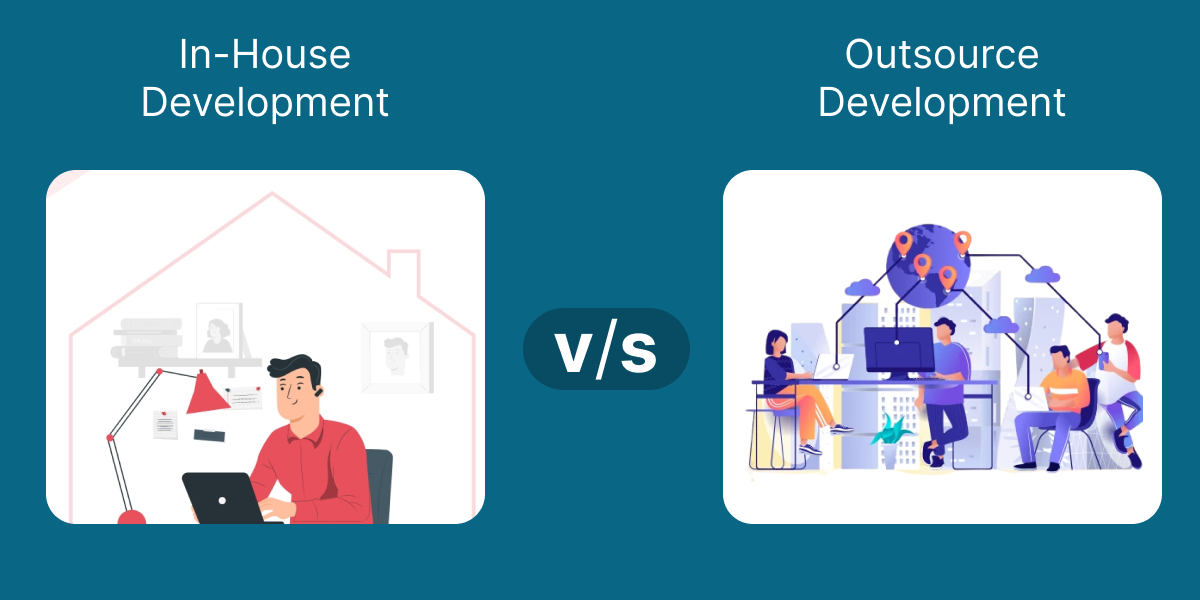
Deciding between in house and outsourced software development goes beyond budget considerations. It affects how quickly you can scale, how much control you maintain, and whether you have access to the right expertise for your project.
Below is a structured comparison to help you evaluate both models:
| Factor |
In House Development |
Outsourcing Development |
| Cost |
Higher upfront and ongoing costs (salaries, benefits, infrastructure, recruitment) |
Lower overall cost with flexible pricing (hourly, fixed price, or dedicated team) |
| Speed to Market |
Slower start due to hiring and onboarding |
Faster launch with ready to deploy teams |
| Talent Access |
Limited to local talent pool |
Access to global experts and niche specialists |
| Control & Communication |
Direct oversight and real time collaboration |
Requires structured communication and defined processes |
| Scalability |
Slower and more expensive to scale |
Flexible scaling based on project needs |
| Data Security & IP |
Full internal control |
Dependent on vendor security practices and contractual safeguards |
Cost
Cost is often the deciding factor when comparing in house vs. outsourced development. Building an internal team involves more than just salaries it includes recruitment fees, benefits, training, office space, hardware, software licenses, and long term payroll commitments.
Outsourcing, on the other hand, typically reduces overhead by allowing businesses to pay only for the services required. Whether through hourly billing, fixed price projects, or dedicated teams, outsourcing offers greater financial flexibility especially for short to mid term initiatives.
Speed to Market
In fast paced industries such as fintech, e commerce, and health tech, speed can determine competitive advantage.
In house development requires time to recruit, onboard, and structure teams. This process can delay project kickoff by weeks or even months. Additionally, internal teams may already be committed to other priorities.
Outsourcing accelerates time to market by providing immediate access to experienced professionals. Established vendors often operate with agile workflows and proven delivery frameworks, enabling faster execution and quicker product launches.
Talent Access
Access to skilled talent is one of the biggest differentiators between the two models.
Hiring internally allows full control over team composition and cultural alignment. However, attracting and retaining top tier developers especially in competitive markets like the U.S., Japan, or Singapore can be challenging and expensive. Specialized skills such as AI engineering, blockchain development, or DevOps expertise may be scarce locally.
Outsourcing opens access to a global talent pool. Companies can quickly onboard dedicated developers, cloud engineers, data scientists, or niche technical experts without long recruitment cycles.
Control and Communication
In house teams typically operate within the same time zone and organizational structure, enabling direct management and real time collaboration. This can foster stronger alignment and quicker feedback cycles.
However, internal miscommunication can still occur especially when departments work in silos or juggle multiple initiatives.
Outsourcing introduces geographic and cultural differences that require structured communication. Successful partnerships depend on clear documentation, regular updates, agile processes, and dedicated project managers. When managed properly, external teams can collaborate just as effectively as internal ones.
Scalability and Flexibility
Business demands fluctuate, and development capacity must adapt accordingly.
Scaling an in house team is often slow and costly due to hiring timelines, budget approvals, and infrastructure limitations. If demand drops, managing excess staff becomes an additional burden.
Outsourcing provides agility. Companies can quickly scale development resources up or down depending on project scope, deadlines, or market opportunities. This flexibility is especially valuable for startups and growing enterprises facing unpredictable demand.
Data Security & Intellectual Property Protection
Protecting sensitive data and intellectual property (IP) is critical in any development model.
In house development offers direct control over data access, internal security policies, and compliance management making it suitable for highly regulated industries or proprietary systems.
Outsourcing requires careful vendor selection. Businesses must ensure clear contracts, NDAs, IP protection clauses, and robust security practices. While external collaboration introduces additional considerations, reputable outsourcing partners implement strict data protection protocols to safeguard client information.
There is no universal “best” choice between in house and outsourcing software development. The right approach depends on your budget, timeline, technical requirements, and long term strategic goals.
Companies prioritizing full control and long term product ownership may prefer in house teams. Organizations seeking speed, cost efficiency, and specialized expertise often benefit from outsourcing.
Careful evaluation of your business objectives will help determine the model that best supports sustainable growth and innovation.
Read more: Top IT Outsourcing Companies in Vietnam
Pros and Cons of In House vs. Outsourcing Software Development
Both in house development and outsourcing offer distinct advantages and trade offs. The right choice depends on your strategic priorities, available budget, timeline, and the complexity of your technical requirements.
Below is a structured comparison to help you evaluate each model more effectively.
In House Software Development: Advantages & Limitations
Building software internally provides maximum control and deeper integration with your organization’s culture and long term strategy. However, this approach often requires significant investment and operational commitment.
Advantages
-
Full project control over roadmap, priorities, and execution
-
Strong alignment with company vision and internal objectives
-
Real time collaboration within the same organizational structure
-
Better knowledge retention and ownership of processes
-
Greater oversight of data management and internal security policies
Limitations
-
High operational costs, including recruitment, salaries, benefits, and infrastructure
-
Longer time to market due to hiring and onboarding cycles
-
Limited access to niche expertise, especially in emerging technologies
-
Scaling challenges, particularly for short term or urgent projects
Outsourcing Software Development: Advantages & Limitations
Outsourcing has become a strategic option for companies seeking agility, cost efficiency, and specialized capabilities. While it offers speed and flexibility, it requires structured management and clear communication frameworks.
Advantages
-
Lower development costs with reduced overhead
-
Faster project initiation through ready to deploy expert teams
-
Access to global talent pools and specialized skill sets
-
Flexible scalability to adjust team size based on project demands
-
Reduced recruitment burden and administrative workload
Limitations
-
Less direct day to day control over external teams
-
Potential communication barriers across time zones or cultures
-
Data security and IP protection considerations, requiring clear contracts
-
Quality variability depending on vendor reliability and experience
Neither model is inherently superior each serves different business contexts.
Companies prioritizing long term product ownership and internal control may lean toward in house development. Organizations focused on speed, cost efficiency, and rapid scalability often benefit more from outsourcing.
Aligning your development approach with your business strategy will help ensure sustainable growth and successful project outcomes.
When to Choose In House vs. Outsourcing Software Development
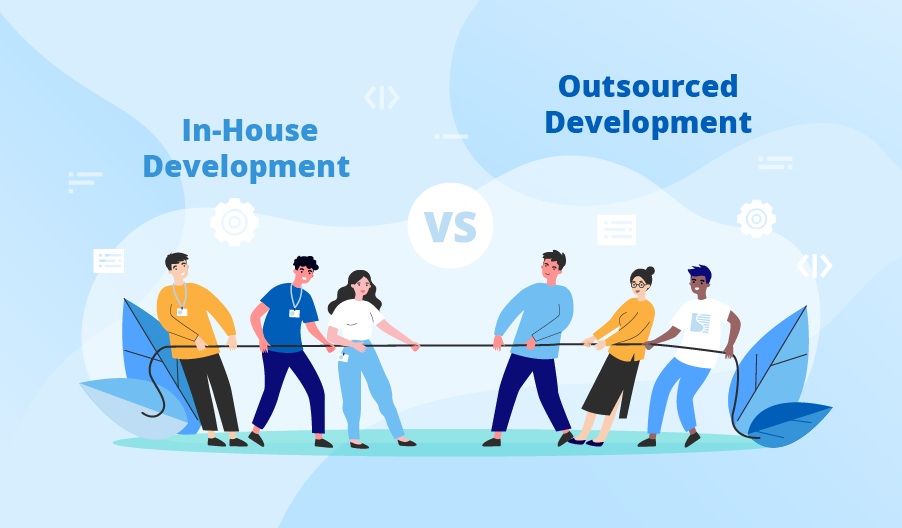
The decision between in house and outsourced development should be guided by your business priorities, project scope, internal capabilities, and long term strategy. Each model addresses different operational needs, and the right choice depends on whether you prioritize control, speed, cost efficiency, or scalability.
Choose In House Development When:
-
Your project involves highly sensitive data, proprietary systems, or strict regulatory compliance
-
You require full control over product direction, technical decisions, and team management
-
Long term product evolution and internal knowledge retention are strategic priorities
-
You have sufficient time, budget, and infrastructure to recruit and maintain a dedicated team
-
Continuous collaboration between departments is essential for success
In house development is particularly suitable for core platforms or mission critical systems that require sustained internal ownership.
Choose Outsourcing When:
-
You need to accelerate time to market and avoid lengthy hiring processes
-
Internal technical resources are limited
-
Budget flexibility is important
-
Specialized expertise (e.g., AI, blockchain, DevOps, cybersecurity) is not available internally
-
You are developing a short to mid term project such as an MVP, prototype, or standalone mobile application
Outsourcing is often ideal for projects that demand rapid execution, flexible scaling, or access to niche skills without long term employment commitments.
A Hybrid Approach: The Best of Both Worlds
For many organizations, the optimal solution is a hybrid model. This approach keeps core product strategy and intellectual ownership in house while outsourcing specific components, technical modules, or short term initiatives to external partners.
By combining internal control with outsourced agility, businesses can maintain strategic oversight while improving speed, scalability, and cost management.
Steps to Choose the Right Software Development Model
Selecting the most suitable development model requires a clear, structured evaluation of your business objectives, technical needs, and operational constraints. Whether you are considering in house, outsourcing, or a hybrid approach, the following steps will help guide your decision.
1. Define Your Project Scope and Objectives
Start by clarifying the nature of your project. Is it a core strategic initiative, an experimental innovation, or an operational improvement? Determine whether speed, control, cost efficiency, or long term ownership is your primary priority.
2. Assess Internal Capabilities
Evaluate your current team’s technical skills, availability, and workload. If significant hiring or training is required to execute the project, outsourcing may offer a faster and more cost effective alternative.
3. Evaluate Time and Budget Constraints
In house development often requires higher upfront investment in recruitment, salaries, infrastructure, and onboarding. Outsourcing allows quicker project initiation with more flexible cost structures. Align your choice with your timeline and financial capacity.
4. Consider Strategic Importance and Risk Sensitivity
If the project involves proprietary systems, sensitive customer data, or strict regulatory requirements, in house development may provide stronger oversight. However, experienced outsourcing partners can also implement robust security measures and compliance frameworks.
5. Analyze Long Term vs. Short Term Needs
Projects requiring continuous maintenance, product evolution, and long term knowledge retention may benefit from internal teams. Conversely, outsourcing is often ideal for short term initiatives such as MVPs, prototypes, or feature specific builds.
6. Compare Total Costs and Business Impact
Look beyond salary comparisons. Factor in overhead costs, employee turnover, infrastructure, administrative burden, and time to market. Outsourcing can reduce operational complexity while accelerating delivery.
7. Explore Hybrid Models
Many organizations adopt a hybrid approach maintaining strategic ownership internally while outsourcing specialized development or support functions. This model balances control, flexibility, and scalability.
8. Select the Right Partner (If Outsourcing)
If outsourcing is your chosen path, conduct thorough due diligence. Assess potential vendors based on technical expertise, industry experience, past projects, communication standards, and delivery methodology. A strong partnership is critical to long term success.
By following a structured evaluation process, you can align your development model with your strategic goals, ensuring efficient execution and sustainable growth.
How HomeNest Software Supports Your IT Outsourcing Needs
At HomeNest Software, we empower businesses worldwide to accelerate digital initiatives through reliable, scalable, and cost efficient IT outsourcing services. Whether you’re developing a full scale digital product or strengthening your existing team with additional expertise, our solutions are tailored to meet your specific objectives.
With over 100 successful projects delivered to 100+ global clients, we bring proven experience across:
-
Web and mobile application development
-
AI and machine learning solutions
-
Cloud migration and DevOps services
-
Quality assurance and software testing
Our flexible engagement models ranging from dedicated development teams and project based delivery to staff augmentation allow you to scale resources quickly without the long term overhead of in house recruitment. Our engineers are highly skilled, fluent in English, and experienced in agile methodologies, ensuring seamless onboarding and efficient collaboration.
More than a service provider, HomeNest Software operates as a strategic technology partner. We align closely with your internal teams to maintain transparency, deliver measurable outcomes, and support your long term growth objectives. Whether you are launching a new product, modernizing legacy systems, or expanding technical capabilities, we provide the expertise and adaptability to help you succeed.
Request a cost estimate today and explore how we can support your next project.
Conclusion
Choosing between in house and outsourcing development is a strategic decision shaped by your business goals, available resources, project timeline, and technical complexity. In house teams offer direct control and strong cultural alignment, while outsourcing delivers speed, scalability, and access to global expertise. In many scenarios, a hybrid approach combines the strengths of both.
The key is to evaluate your priorities carefully and select a model that supports sustainable growth. If your organization is looking to accelerate delivery, optimize costs, or access specialized technical talent, HomeNest Software is ready to become your trusted development partner.
HomeNest Software – Empowering Long Term Growth for Modern Businesses.
Contact Information:
- Address: The Sun Avenue, 28 Mai Chi Tho Street, Binh Trung Ward, Ho Chi Minh City
- Hotline: +84 898 994 298 ( WhatsApp )
- Website: homenest.software
Frequently Asked Questions (FAQs)
1. What types of IT outsourcing services does HomeNest Software provide?
HomeNest Software offers end to end IT outsourcing services, including web and mobile app development, AI and machine learning solutions, cloud migration, DevOps, QA/testing, and IT staff augmentation. Services are tailored to match each client’s technical and business requirements.
2. Can I hire a dedicated development team instead of outsourcing a full project?
Yes. HomeNest Software provides flexible engagement models, including dedicated development teams, staff augmentation, and full project based outsourcing. This allows businesses to scale resources based on workload and strategic needs.
3. How quickly can a project start?
Project timelines depend on scope and requirements, but outsourcing enables faster onboarding compared to building an in house team. In many cases, development teams can be assembled and launched within weeks.
4. How does HomeNest Software ensure quality and performance?
The company follows structured development processes, agile methodologies, and rigorous QA/testing procedures to ensure high quality delivery. Regular progress updates and transparent communication help maintain alignment throughout the project lifecycle.
5. Is IT outsourcing suitable for startups as well as enterprises?
Yes. Startups benefit from cost efficiency and rapid scalability, while enterprises leverage outsourcing for specialized expertise, digital transformation initiatives, and operational optimization.
6. How do I get a cost estimate for my project?
You can request a customized cost estimate by sharing your project scope, technical requirements, and timeline. The team will analyze your needs and propose a solution aligned with your budget and objectives.
If you’re considering IT outsourcing to accelerate innovation and optimize costs, partnering with an experienced provider like HomeNest Software can help you move forward with confidence.