In today’s fast-moving digital economy, organizations worldwide are searching for smarter and more flexible ways to build and scale their software development capabilities. As digital transformation becomes essential for growth, many companies are turning to nearshore software development as a practical strategy that balances cost efficiency, real-time collaboration, and cultural alignment.
In this comprehensive guide, we explore everything you need to know about nearshore software development how it compares with offshore models, the most common engagement structures, its key advantages and challenges, and why Vietnam is increasingly recognized as one of Asia’s emerging nearshore technology hubs. Let’s take a closer look.
What Is Nearshore Software Development?

Nearshore software development is an outsourcing model where companies collaborate with software development teams located in nearby or neighboring countries, typically within the same or a closely aligned time zone. This approach creates a balance between onshore development (teams in the same country) and offshore development (teams located in distant regions).
For example, companies in Singapore often nearshore to Vietnam or other Southeast Asian countries, while businesses in the United States commonly nearshore to Mexico or Latin America. The proximity allows teams to collaborate more easily through overlapping working hours, shorter travel times, and similar cultural or business practices.
Nearshore development is increasingly popular because it combines the cost advantages of outsourcing with the benefits of real-time communication and stronger team collaboration.
Industry data also reflects this growing adoption. According to a 2024 report by Valuates Reports, the global market for nearshore outsourcing services was valued at $2.67 billion and is projected to reach $3.55 billion by 2031, growing at a compound annual growth rate (CAGR) of 4.6%. This trend highlights a broader shift toward outsourcing models that prioritize both efficiency and seamless collaboration.
Nearshore vs Offshore vs Onshore: Key Differences
When companies outsource software development, they usually choose among three primary models: onshore, nearshore, and offshore. Each approach offers different advantages depending on factors such as cost, collaboration efficiency, cultural compatibility, and access to talent.
Understanding how these models differ can help businesses select the option that best aligns with their project requirements, budget, and long-term development strategy.
| Aspect |
Onshore (Same Country) |
Nearshore (Neighboring Country) |
Offshore (Distant Country) |
| Location |
Development team located in the same country as the client |
Team based in a nearby country with geographic proximity |
Team located in a distant region |
| Time Zone Alignment |
Perfect alignment |
High alignment (usually 0–3 hour difference) |
Large differences (often 6–12+ hours) |
| Communication |
Real-time communication during the same working hours |
Mostly real-time collaboration with minor scheduling adjustments |
Often relies on asynchronous communication |
| Cultural Compatibility |
Very high due to shared business culture |
Generally high with similar working styles |
May vary and require cultural adaptation |
| Cost |
Highest development costs |
Moderate costs, typically 20–40% lower than onshore |
Lowest costs, often up to 60–70% lower than onshore |
| Travel Convenience |
No travel required |
Short and relatively inexpensive travel |
Long-distance travel with higher costs |
| Project Management |
Simplest coordination and oversight |
Easy collaboration with frequent real-time meetings |
Requires structured processes and communication frameworks |
| Scalability |
Limited by local talent availability |
Access to regional talent pools |
Access to large global talent pools |
| Best Use Cases |
Highly sensitive or mission-critical projects requiring close oversight |
Agile development, rapid iteration, and collaborative projects |
Cost-focused development or large long-term projects |
Each model has its place depending on business priorities. Companies that value close collaboration and faster communication often choose nearshore development, while organizations focused primarily on cost efficiency may prefer offshore models. Onshore development remains useful for projects that require strict regulatory compliance or direct in-person collaboration.
Types of Nearshore Development Models
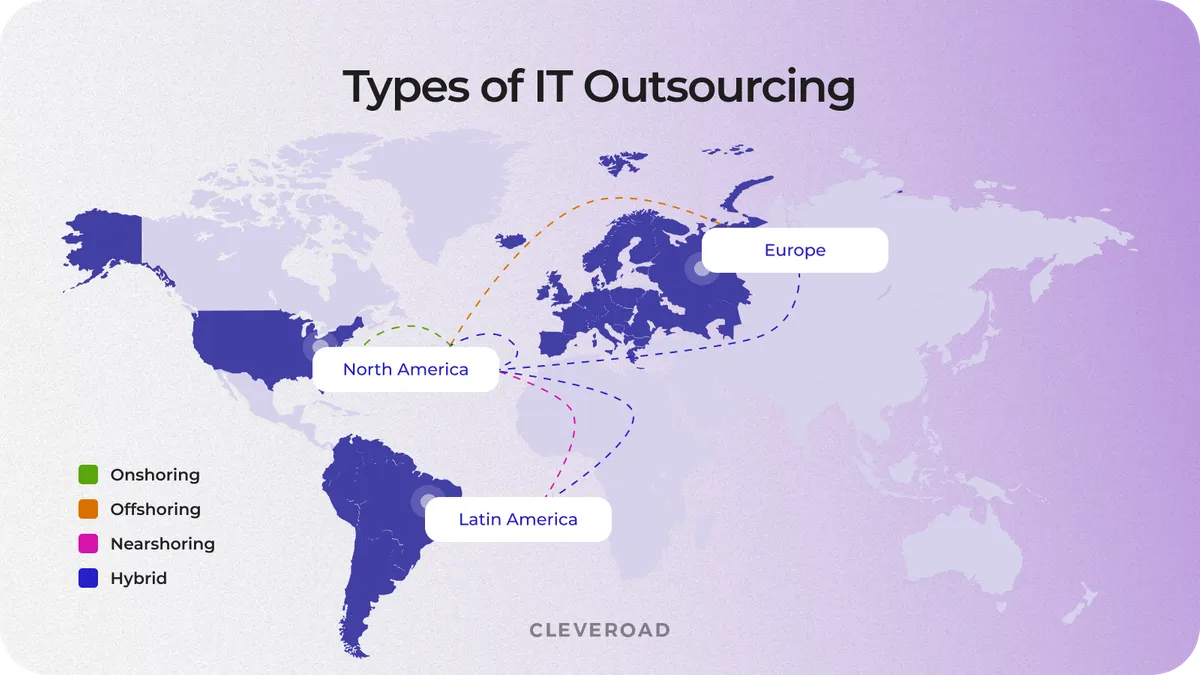
When working with a nearshore software development partner, companies can choose from several collaboration models depending on their project requirements, internal capabilities, and long-term goals. The most common approaches include staff augmentation, dedicated agile teams, and outcome-based projects.
Each model offers a different balance of control, flexibility, and management responsibility.
Staff Augmentation
Staff augmentation is ideal for companies that need to quickly expand their internal development capacity or fill specific skill gaps without committing to long-term hiring.
In this model, the nearshore provider supplies individual developers who integrate directly into your existing team. These developers follow your workflows, tools, and project management processes while contributing to ongoing development tasks.
Key features:
-
The client retains full control over project management and priorities
-
Developers work in similar time zones, enabling real-time collaboration
-
Contracts are typically based on time-and-materials or fixed monthly rates per developer
Staff augmentation is particularly useful for organizations with established product managers or technical leads who want to scale their teams while maintaining full oversight of development.
Dedicated Agile Teams
The dedicated team model provides a fully assembled nearshore development team tailored to your project. This team may include developers, QA engineers, designers, and Scrum Masters who work exclusively on your product.
Dedicated teams typically follow Agile methodologies and operate as an extension of your internal organization, making them well suited for long-term or evolving projects.
Key features:
-
Faster delivery through established Agile workflows
-
The nearshore partner manages team coordination and operations
-
Pricing is usually structured as a fixed monthly cost for the full team
With a dedicated team, companies benefit from consistent delivery, stronger product knowledge retention, and the ability to scale team size as development needs grow.
Outcome-Based Projects
Outcome-based engagements focus on delivering a clearly defined project within a specified timeline and budget. In this model, the nearshore partner takes responsibility for project execution and delivery based on predefined requirements.
This approach allows companies to delegate the entire development process while focusing internally on strategic business priorities.
Key features:
-
Clearly defined scope, deliverables, and success metrics
-
Minimal management involvement required from the client
-
Pricing is typically structured as fixed-price contracts or milestone-based payments
Outcome-based projects are well suited for companies launching new digital products, MVPs, or specific feature modules where requirements are well defined and day-to-day management is not required from internal teams.
Read more: Best Countries to Outsource Software Development
Benefits of Nearshore Software Development
Nearshore software development has become an attractive alternative to traditional onshore and offshore outsourcing models. It allows companies to collaborate with skilled development teams in nearby countries while maintaining strong communication, cultural alignment, and lower operational costs.
Below are the main advantages that make nearshore development a popular strategy for businesses worldwide.
Faster Collaboration with Minimal Time Zone Differences
One of the biggest benefits of nearshore development is the ability to collaborate in real time. Teams located in nearby time zones can communicate more easily, schedule meetings during overlapping working hours, and resolve issues quickly. This supports smoother sprint planning, faster feedback cycles, and more effective Agile development practices.
Cost Efficiency Compared to Onshore Development
Nearshore development provides access to highly skilled engineers at significantly lower rates than hiring locally in high-cost markets such as the United States, Europe, Japan, or Singapore. Industry research indicates that many companies adopt nearshore outsourcing specifically to reduce operational expenses while maintaining development quality. Although nearshore rates may be slightly higher than offshore options, the improved communication and collaboration often justify the investment.
Strong Cultural and Business Alignment
Teams in neighboring regions often share similar business practices, work ethics, and communication styles. This cultural compatibility helps reduce misunderstandings, improves teamwork, and ensures smoother collaboration throughout the entire project lifecycle.
Faster Access to Experienced Talent
Building an internal development team can take months due to recruitment, onboarding, and training. Nearshore partners, however, already maintain established teams of experienced developers who can begin contributing to projects almost immediately. This allows companies to accelerate development without lengthy hiring processes.
Flexibility and Scalability for Agile Development
Nearshore development models provide flexibility to scale teams up or down depending on project requirements. Whether launching a new product, expanding development capacity, or adjusting resources during an Agile sprint cycle, companies can quickly adapt their teams to meet evolving business needs.
By combining cost efficiency, improved communication, cultural compatibility, and flexible scaling, nearshore software development offers a balanced outsourcing model that supports both productivity and long-term collaboration.
Who Should Consider Nearshore Software Development?

Nearshore software development can be a valuable solution for many types of organizations, from startups to large enterprises. Companies that need to expand development capacity, improve collaboration, or control costs often find nearshore partnerships particularly effective.
This model may be a good fit if your organization faces the following situations:
You need to scale your development team quickly
Fast-growing companies or businesses launching new products often require additional engineering capacity on short notice. Nearshore partners can provide experienced developers quickly, helping teams ramp up without long recruitment delays.
You are working with a limited development budget
Startups and small-to-medium-sized businesses can access skilled developers at lower costs compared to hiring locally in high-cost markets, allowing them to build quality software while managing budgets more effectively.
Your team relies on Agile workflows and daily collaboration
Nearshore teams typically operate within similar time zones, which supports real-time communication, daily stand-up meetings, and continuous collaboration throughout the development cycle.
You need specialized technical expertise
If your internal team lacks experience in certain technologies such as AI, cloud computing, mobile development, or DevOps nearshore partners can provide specialists without requiring long-term hiring commitments.
You are experiencing local talent shortages
Many technology-driven markets face strong competition for skilled developers. Nearshore development allows companies to access a broader regional talent pool while maintaining efficient collaboration.
You want to reduce operational and delivery risks
Nearshore teams often share closer cultural alignment and communication styles, which can improve project coordination. Geographic proximity also makes occasional in-person workshops or visits more practical when needed.
For organizations seeking a balance between cost efficiency, collaboration, and access to skilled developers, nearshore software development offers a practical and scalable approach.
Common Challenges and Solutions for Nearshore Development
Although nearshore software development offers strong collaboration and cost advantages, organizations may still encounter certain challenges when working with distributed teams. Understanding these issues in advance and implementing the right processes helps ensure smoother collaboration and better project outcomes.
| Challenge |
Solution |
| Misalignment in goals, scope, or delivery expectations can create confusion and delays during the project. |
Clearly define the project scope, deliverables, and performance metrics at the beginning. Use shared documentation and collaborative planning sessions to keep all stakeholders aligned. |
| Communication gaps, even within similar time zones, may lead to misunderstandings. |
Establish regular communication routines such as daily stand-ups or weekly check-ins. Use collaboration tools like Slack, Zoom, and Jira to maintain transparency and track progress. |
| Remote developers may feel disconnected from the core team, which can affect engagement and productivity. |
Integrate nearshore developers into regular team activities such as sprint planning, stand-ups, and retrospectives. Encourage shared workflows and open communication channels. |
| Cross-border legal concerns, including intellectual property protection, compliance requirements, and contractual obligations. |
Sign comprehensive agreements such as NDAs and service-level agreements (SLAs). Work with partners who follow recognized legal and security frameworks. |
| Inconsistent coding standards or testing practices can impact product quality. |
Implement structured development processes such as code reviews, QA reporting, and regular product demos. Starting with a pilot project can also help evaluate the partner’s capabilities before scaling the collaboration. |
By proactively addressing these challenges, companies can build more effective nearshore partnerships and ensure consistent quality throughout the development lifecycle.
Why Vietnam Is an Ideal Nearshore Software Development Destination in Asia

Vietnam has rapidly emerged as one of the most attractive nearshore software development destinations in the Asia-Pacific region. Its strategic location, competitive development costs, growing pool of skilled engineers, and strong communication capabilities in English and Japanese make it a preferred technology partner for many regional businesses.
Companies across Asia increasingly choose Vietnam as a nearshore hub because it offers a balanced combination of technical capability, cost efficiency, and convenient collaboration.
Singapore
Vietnam is located only a 2–3 hour flight from Singapore, with just a one-hour time zone difference. This proximity allows teams to collaborate in real time, making Agile workflows, daily stand-ups, and sprint reviews easier to manage.
Many Singaporean companies already rely on Vietnam as a nearshore development hub due to its strong engineering talent and cost advantages. Cultural similarities within Southeast Asia also help improve communication and business alignment.
Japan
Vietnam has become one of Japan’s most important destinations for nearshore and offshore software development. Many Vietnamese engineers are proficient in Japanese, and numerous technology companies provide Bridge System Engineers (BrSEs) who support communication between Japanese clients and development teams.
With decades of strong economic cooperation and growing technological collaboration, partnerships between Japanese and Vietnamese companies continue to expand.
South Korea
Technology collaboration between South Korea and Vietnam has grown significantly in recent years. The two countries share a similar time zone, enabling smooth real-time communication and efficient project coordination.
As a result, many Korean companies partner with Vietnamese development teams to expand their engineering capacity without making large domestic hiring investments.
Australia
Vietnam’s time zone is only two to three hours behind major Australian cities such as Sydney and Melbourne. This allows teams to schedule meetings easily and maintain overlapping working hours for real-time collaboration.
At the same time, development costs in Vietnam are considerably lower than in Australia, allowing companies to scale their engineering teams while maintaining high quality standards.
Other Asia-Pacific Markets
Vietnam is also an attractive nearshore option for other Asia-Pacific markets including Malaysia, Thailand, Hong Kong, and Taiwan. The country offers convenient travel access, a strong technical education system, and a young, rapidly growing technology workforce.
With flexible collaboration models such as staff augmentation and dedicated development teams, Vietnam provides the scalability and adaptability needed for companies across the region seeking reliable nearshore software development partners.
Read more: Top IT Outsourcing Companies in Vietnam
How to Choose a Nearshore Development Company
Selecting the right nearshore software development partner is a crucial step in ensuring the success of your project. The ideal partner should not only provide strong technical capabilities but also align with your business goals, communication style, and long-term collaboration needs.
Below is a practical step-by-step framework to help you evaluate and choose a nearshore development company that fits your requirements.
Step 1: Define Your Project Requirements
Begin by clearly outlining the scope of your project, including its goals, preferred technologies, timeline, and available budget. You should also determine the collaboration model that best suits your needs, such as staff augmentation, a dedicated development team, or a project-based engagement.
Having well-defined requirements makes it easier to identify vendors that match your expectations.
Step 2: Identify Suitable Nearshore Locations
Evaluate potential nearshore regions based on key factors such as time zone compatibility, engineering talent availability, development costs, and language proficiency.
For companies in the Asia-Pacific region, Vietnam is often considered an attractive nearshore destination due to its strong developer talent pool, competitive costs, and geographic proximity to countries such as Singapore, Japan, South Korea, and Australia.
Step 3: Research and Compare Vendors
Once you have identified potential locations, research development companies within those regions. Review their portfolios, case studies, client testimonials, certifications, and industry experience.
Third-party platforms such as Clutch, GoodFirms, and LinkedIn can provide valuable insights into vendor reputation and client satisfaction.
Step 4: Evaluate Communication and Cultural Fit
Schedule initial meetings with shortlisted vendors to assess their communication style and cultural compatibility. Effective collaboration depends on clear communication, transparency, and shared working values.
Strong language proficiency and well-defined communication processes are essential for maintaining long-term project alignment.
Step 5: Assess Technical Expertise and Scalability
Ask potential partners about their development methodologies, quality assurance processes, DevOps capabilities, and their ability to scale development teams as the project grows.
It is also helpful to verify whether the company can provide specialists in specific areas such as AI, cloud engineering, mobile development, or cybersecurity if your project requires them.
Step 6: Request a Proposal or Start with a Pilot Project
After narrowing down your shortlist, request a detailed project proposal or consider starting with a small pilot engagement. A pilot project allows you to evaluate the vendor’s technical skills, communication practices, and delivery quality in a real working environment with minimal risk.
Step 7: Formalize the Partnership
Once you have selected a partner, finalize the collaboration through a structured contract. The agreement should include clear service-level agreements (SLAs), confidentiality agreements (NDAs), intellectual property protection, and governance processes.
It is also important to define responsibilities, communication schedules, escalation procedures, and performance metrics. A well-organized onboarding process will help establish a strong foundation for a successful nearshore partnership.
The Future of Nearshore Software Development
As organizations continue to prioritize agility, cost efficiency, and access to specialized technical skills, nearshore software development is evolving to meet modern business needs. Companies are no longer viewing nearshoring purely as a cost-saving strategy, but as a long-term partnership that supports innovation and scalable product development.
Several emerging trends are shaping the future of nearshore development.
AI and Automation Integration
Nearshore development teams are increasingly adopting AI-powered tools to improve coding efficiency, automate testing, and enhance DevOps workflows. These technologies help accelerate development cycles and support data-driven decision-making.
Growing Focus on Sustainable Partnerships
Businesses are becoming more selective when choosing outsourcing partners, evaluating factors such as ethical labor practices, long-term collaboration potential, and responsible business operations.
Continuous Upskilling and Reskilling
To remain competitive in the global technology market, nearshore vendors are investing heavily in training programs that help engineers stay updated with new frameworks, programming languages, and emerging technologies.
Demand for Specialized Industry Expertise
Companies are increasingly seeking nearshore teams with deep expertise in industries such as fintech, healthcare, logistics, and biotechnology areas where specialized technical knowledge is essential.
Stronger Data Security and Compliance Standards
As organizations handle more sensitive customer and business data, security requirements are becoming stricter. Nearshore vendors are expected to follow international standards for data protection, secure development practices, and regulatory compliance.
HomeNest Software – Your Nearshore Software Development Partner
HomeNest Software is a trusted nearshore software development company based in Vietnam, supporting clients across Japan, Singapore, South Korea, Australia, and other Asia-Pacific markets. With years of experience delivering scalable digital solutions, HomeNest Software provides flexible engagement models such as staff augmentation, dedicated development teams, and project-based collaboration.
The company’s team of more than 100 engineers offers expertise across a wide range of technologies, including web and mobile development, artificial intelligence, cloud solutions, DevOps, and quality assurance. By working within similar time zones and aligning with clients’ preferred tools and development methodologies, the team ensures efficient collaboration and faster delivery.
HomeNest Software follows international development and security standards, helping businesses build reliable and secure software solutions. These practices make the company a dependable technology partner for organizations across multiple industries.
Beyond delivering technical solutions, HomeNest Software focuses on building long-term partnerships based on transparency, trust, and shared growth. Whether companies are launching new digital products, scaling development teams, or adopting emerging technologies, the team supports clients at every stage of their digital journey.
Conclusion
Nearshore software development has become a powerful strategy for companies seeking to accelerate innovation, reduce operational costs, and access high-quality engineering talent. By choosing the right development model and working with an experienced partner, organizations can build scalable products while maintaining strong collaboration and delivery efficiency.
Countries such as Vietnam are increasingly recognized as leading nearshore destinations in the Asia-Pacific region, offering a strong combination of technical expertise, competitive pricing, and cultural compatibility.
For businesses exploring nearshore development as part of their growth strategy, partnering with an experienced provider like HomeNest Software can help unlock new opportunities for innovation and long-term success.
HomeNest Software – Empowering Long-Term Growth for Modern Businesses.
Contact Information:
- Address: The Sun Avenue, 28 Mai Chi Tho Street, Binh Trung Ward, Ho Chi Minh City
- Hotline: +84 898 994 298 ( WhatsApp )
- Website: homenest.software
Frequently Asked Questions (FAQ)
What is nearshore software development?
Nearshore software development is an outsourcing model where companies work with development teams located in nearby or neighboring countries that share similar time zones. This approach allows businesses to benefit from lower development costs while maintaining real-time communication and easier collaboration.
How is nearshore development different from offshore development?
The main difference is geographic distance and time zone alignment.
Nearshore development involves teams located in nearby countries with minimal time differences, enabling real-time collaboration. Offshore development typically involves teams located in distant regions with larger time zone gaps, which may require more asynchronous communication.
What are the main advantages of nearshore software development?
Nearshore development offers several benefits, including improved communication due to similar time zones, lower costs compared to onshore development, better cultural alignment, and faster access to experienced engineering talent.
Which companies benefit the most from nearshore development?
Nearshore development is ideal for startups, small and medium-sized businesses, and large enterprises that need to scale their development teams quickly, access specialized technical skills, or accelerate product development while maintaining close collaboration with their engineering teams.
What types of projects are suitable for nearshore development?
Nearshore development is commonly used for projects such as web and mobile applications, SaaS platforms, enterprise systems, cloud-based solutions, and long-term product development initiatives that require frequent collaboration between teams.
Why is Vietnam considered a strong nearshore development destination in Asia?
Vietnam offers a large and growing pool of skilled software engineers, competitive development costs, strong technical education, and convenient time zone alignment with many Asia-Pacific countries. These advantages make it an attractive nearshore partner for companies seeking reliable and scalable development teams.
How can companies choose the right nearshore development partner?
Businesses should evaluate potential partners based on technical expertise, communication capabilities, project management practices, industry experience, and security standards. Starting with a small pilot project can also help assess collaboration quality before committing to a long-term partnership.
Is nearshore development suitable for long-term projects?
Yes. Many companies use nearshore teams for long-term product development. Dedicated nearshore teams can work as an extension of internal engineering departments, supporting continuous development, maintenance, and feature improvements over time.