
PWA Development Cost in 2026: A Complete Pricing Guide
Scope of Work

In 2026, Progressive Web Apps (PWAs) are emerging as a smart and cost-effective alternative to native mobile applications. PWAs blend the strengths of both web and mobile platforms, delivering fast performance, offline functionality, and a seamless app-like user experience—without the need to build separate apps for iOS and Android. For businesses that find native app development time-consuming or resource-intensive, PWAs offer a simpler and more efficient solution.
However, before starting a PWA project, it’s essential to understand the key cost components involved. PWA development costs can vary significantly depending on factors such as app features, technical complexity, UI/UX design, and scalability requirements.
In this blog, we’ll provide a comprehensive breakdown of PWA development costs in 2026 and explore the main factors that influence pricing. By understanding these elements, businesses can plan their budgets more effectively and select the most suitable development strategy. Let’s get started!
What Are Progressive Web Apps (PWAs)?
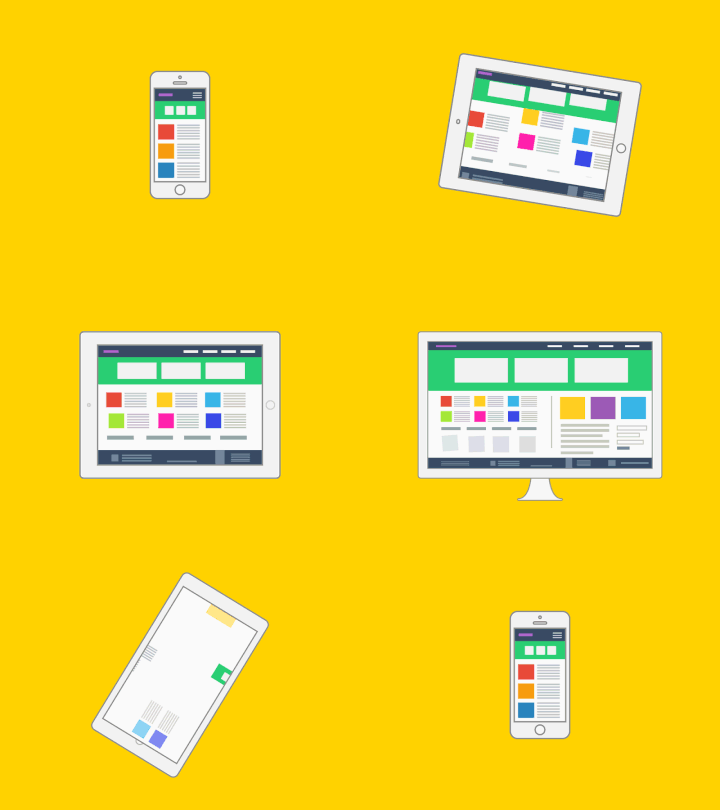
A Progressive Web App (PWA) is a modern web application designed to deliver an experience similar to a native mobile app. By leveraging advanced web technologies, PWAs combine the flexibility of websites with the performance and usability of mobile applications.
When comparing PWA vs. Native Apps, PWAs stand out for being fast, reliable, and highly engaging—all while remaining accessible through a web browser. Users can install a PWA directly onto their device’s home screen, just like a native app, and enjoy consistent performance across multiple devices using a single codebase.
Unlike native app development, PWAs do not require specialized programming languages such as Java or Objective-C. They can be built, deployed, and updated without relying on the Google Play Store or Apple App Store, making development and distribution simpler, faster, and more cost-efficient.
Progressive Web App Market Statistics
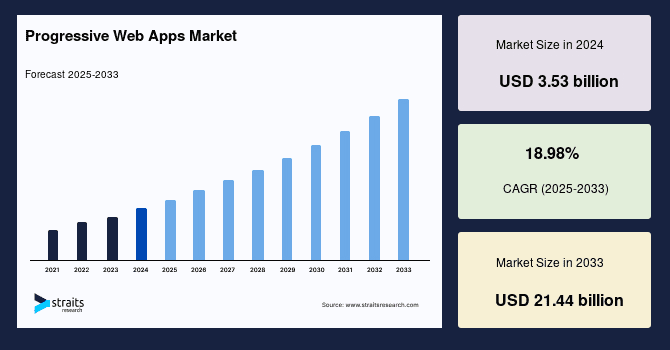
The global Progressive Web App (PWA) market was valued at USD 3.53 billion in 2024 and is expected to grow from USD 5.23 billion in 2025 to approximately USD 21.44 billion by 2033. During the forecast period from 2025 to 2033, the market is projected to expand at a strong compound annual growth rate (CAGR) of 18.98%, highlighting the rapid adoption of PWAs across industries.
In terms of user engagement, PWAs have demonstrated significant performance advantages. Studies show a 70% increase in session duration and a 20% rise in page views per session compared to traditional web applications, reinforcing their effectiveness in improving user experience and retention.
Key players driving innovation in the PWA market include Google, Microsoft, OutSystems, Alokai, IBM Corporation, Cloud Four, DockYard Inc., Enonic AS, GoodBarber, Meta, and Svelte, alongside numerous regional and emerging competitors.
What Is the Average Progressive Web App Development Cost?
Compared to native mobile applications, the cost to develop a Progressive Web App (PWA) is significantly lower—often 3 to 4 times more affordable, depending on platform requirements and feature complexity. On average, PWA development costs range from $8,000 to $25,000, making them an attractive option for businesses seeking high performance at a reasonable budget.
Basic PWAs with core functionality and minimal customization typically fall at the lower end of the cost spectrum. However, incorporating advanced features, custom UI/UX design, and third-party integrations can increase the overall development cost. Even so, most PWA projects remain within a mid-range budget, offering a cost-effective solution without compromising performance, quality, or user experience.
The table below outlines typical PWA development timelines and estimated costs:
| PWA Type | Development Timeline | Estimated Cost Range |
|---|---|---|
| Basic PWA | 4–6 weeks | $8,000 – $12,000 |
| Standard PWA | 6–10 weeks | $12,000 – $18,000 |
| Advanced PWA | 10–16 weeks | $18,000 – $25,000 |
What Factors Impact the Cost of PWA Development?
After understanding the average cost of building a Progressive Web App (PWA), it’s important to explore the key factors that influence overall pricing. Elements such as app features, UI/UX design, backend architecture, security requirements, testing, and post-launch maintenance all play a critical role in determining the final PWA development cost.
Below is a detailed breakdown of the most important cost-driving factors.
1. Features & App Complexity
The scope and complexity of features significantly affect the cost to develop a PWA. Basic functionalities such as offline access, search, or simple content display require less development effort. In contrast, advanced features increase development time and cost.
High-end functionalities—such as AI/ML integration, real-time updates, background sync, push notifications, and payment gateways—demand more resources and technical expertise, resulting in higher costs.
| Feature Level | Estimated Cost | Timeline |
|---|---|---|
| Basic | $2,000 – $4,000 | 2–3 weeks |
| Medium | $4,000 – $7,000 | 3–5 weeks |
| Advanced | $7,000 – $10,000 | 5–7 weeks |
2. UI/UX Design
UI/UX design is one of the most influential factors in PWA development pricing. A well-designed PWA must deliver a native app-like experience while remaining fast, responsive, and adaptable across devices.
Simple layouts with standard components cost less, whereas custom designs with animations, micro-interactions, and advanced user flows require more design effort and higher investment.
| Design Level | Estimated Cost | Timeline |
|---|---|---|
| Basic | $2,000 – $4,000 | 2–3 weeks |
| Medium | $4,000 – $7,000 | 3–5 weeks |
| Advanced | $7,000 – $10,000 | 5–7 weeks |
3. Backend Development & Integrations
Backend infrastructure, databases, and third-party integrations—such as payment gateways, CRM systems, and analytics tools—directly impact PWA development costs. Complexity increases with real-time data syncing, security layers, and scalability requirements.
While building everything from scratch can be expensive, leveraging existing APIs and cloud services can significantly reduce development time and cost.
| Team Type | Estimated Cost | Timeline |
|---|---|---|
| Junior / Offshore Team | $2,000 – $4,000 | 5–7 weeks |
| Mid-Level Developers | $4,000 – $6,000 | 4–6 weeks |
| Senior / Enterprise Team | $6,000 – $8,000 | 3–5 weeks |
4. Developer Expertise & Location
The experience level and geographic location of developers strongly influence PWA development pricing. Senior developers bring expertise in performance optimization, scalable architecture, service workers, and modern frameworks—ensuring faster delivery and fewer post-launch issues, but at higher hourly rates.
Development costs are generally higher in North America and Western Europe. In contrast, Asia-Pacific and Latin American regions offer skilled developers at more affordable rates without sacrificing quality.
| Team Type | Estimated Cost | Timeline |
|---|---|---|
| Junior / Offshore Team | $2,000 – $4,000 | 5–7 weeks |
| Mid-Level Developers | $4,000 – $6,000 | 4–6 weeks |
| Senior / Enterprise Team | $6,000 – $8,000 | 3–5 weeks |
5. Security & Compliance Requirements
Security is essential for PWAs handling sensitive data, online payments, or healthcare information. Compliance with regulations such as GDPR, HIPAA, or PCI-DSS requires encrypted data storage, secure authentication, access control, and regular security audits.
These requirements increase development effort and cost but are critical for legal compliance and user trust.
| Security Level | Estimated Cost | Timeline |
|---|---|---|
| Basic Security | $1,000 – $2,000 | 1 week |
| Standard Compliance | $2,000 – $4,000 | 2–3 weeks |
| Enterprise-Grade Security | $4,000 – $6,000 | 3–4 weeks |
6. Platform Support & Distribution
Supporting multiple browsers, devices, and operating systems adds to the overall PWA cost. Additional investment may be required for older browser compatibility, performance tuning, and app store distribution using Trusted Web Activity (TWA).
While these enhancements improve reach and user experience, they also increase development complexity and cost.
| Support Level | Estimated Cost | Timeline |
|---|---|---|
| Web-Only PWA | $500 – $1,500 | 1 week |
| Multi-Browser Optimization | $1,500 – $3,000 | 2 weeks |
| App Store Distribution (TWA) | $3,000 – $4,000 | 2–3 weeks |
7. Testing & Performance Optimization
Comprehensive testing ensures a fast, stable, and reliable PWA. This includes cross-browser testing, device compatibility checks, functional testing, and stress testing under high traffic conditions.
Performance optimization adds extra QA cycles but directly impacts user engagement, retention, and long-term success.
| Testing Scope | Estimated Cost | Timeline |
|---|---|---|
| Basic QA Testing | $1,000 – $2,000 | 1–2 weeks |
| Cross-Device & Browser QA | $2,000 – $3,500 | 2–3 weeks |
| Performance & Load Testing | $3,500 – $5,000 | 3–4 weeks |
8. Ongoing Maintenance & Support
Post-launch maintenance includes updates, bug fixes, security patches, and performance improvements. On average, PWA maintenance costs account for 20–25% of the initial development cost.
Compared to native apps, PWAs are generally easier and more cost-effective to maintain due to a single codebase and web-based updates.
| PWA Type | Total Cost Range | Total Timeline |
|---|---|---|
| Basic PWA | $8,000 – $12,000 | 6–8 weeks |
| Mid-Level PWA | $12,000 – $18,000 | 8–10 weeks |
| Advanced PWA | $18,000 – $25,000 | 10–14 weeks |
Read more: Hire Developers in Vietnam
Progressive Web App Development Cost by App Type
After reviewing the average cost to build a Progressive Web App (PWA), it’s important to note that development costs vary significantly depending on the app type. Each category—such as eCommerce, social & media, enterprise, or responsive web PWAs—requires different features, integrations, scalability levels, and performance standards. As a result, the PWA development cost for Android and iOS can differ based on use case and complexity.
Below is a detailed cost breakdown by PWA type.
1. E-commerce PWAs
E-commerce PWAs deliver fast, reliable, app-like shopping experiences directly through a web browser. Key features include offline access, push notifications, home screen installation, and seamless checkout flows—without requiring users to download apps from an app store.
Many businesses adopt e-commerce PWAs to boost conversions, improve SEO, and reduce development costs, as a single PWA works across all devices and platforms.
| Complexity Level | Estimated Cost | Development Timeline |
|---|---|---|
| Basic Storefront | $10,000 – $14,000 | 6–8 weeks |
| Mid-Scale Store | $14,000 – $20,000 | 8–10 weeks |
| Advanced / Headless PWA | $20,000 – $25,000 | 10–14 weeks |
2. Social & Media PWAs
Social and media PWAs are content-driven applications designed for fast access, offline reading, push notifications, and high user engagement. Popular examples include lightweight versions of social platforms and news portals.
These PWAs combine the accessibility of the web with native app capabilities, enabling reliable performance and strong engagement without app store dependency—making them ideal for high-traffic media and social platforms.
| Complexity Level | Estimated Cost | Development Timeline |
|---|---|---|
| Basic Content App | $8,000 – $12,000 | 5–7 weeks |
| Interactive Platform | $12,000 – $18,000 | 7–10 weeks |
| High-Traffic Media App | $18,000 – $25,000 | 10–14 weeks |
3. Enterprise PWAs
Enterprise PWAs are built using standard web technologies such as HTML, CSS, and JavaScript, offering a secure, scalable, and native-like experience for internal business operations.
These apps eliminate the need for platform-specific development or app store distribution while delivering essential features such as offline access, push notifications, and home screen installation—making them ideal for internal tools and large-scale business systems.
| Complexity Level | Estimated Cost | Development Timeline |
|---|---|---|
| Internal Tools | $12,000 – $16,000 | 6–8 weeks |
| Business Operations App | $16,000 – $22,000 | 8–12 weeks |
| Enterprise-Grade Platform | $22,000 – $25,000+ | 12–16 weeks |
4. Responsive Web PWAs
Responsive Web PWAs combine responsive web design with native app features to deliver fast, installable, and cross-device experiences. These PWAs adapt seamlessly to different screen sizes while supporting offline functionality, push notifications, and home screen installation.
They are a cost-effective solution for businesses looking to enhance an existing website with app-like performance and usability.
| Complexity Level | Estimated Cost | Development Timeline |
|---|---|---|
| Basic Responsive PWA | $8,000 – $10,000 | 4–6 weeks |
| Enhanced Performance PWA | $10,000 – $14,000 | 6–8 weeks |
| Optimized UX & Offline-First | $14,000 – $18,000 | 8–10 weeks |
PWA App Development Cost Breakdown by Region
In addition to technical and functional factors, the cost of Progressive Web App (PWA) development services also varies significantly by geographic region. Developer expertise, labor costs, compliance standards, and collaboration models all influence regional pricing. Below is a comparison of average PWA development costs across major global regions.
1. North America (USA & Canada)
North America has the highest PWA development costs due to advanced technical expertise, strict security standards, and rigorous regulatory compliance. This region is ideal for businesses requiring complex integrations, enterprise-grade performance, premium UI/UX quality, and long-term scalability.
| Cost Component | Estimated Range |
|---|---|
| Basic PWA | $16,000 – $20,000 |
| Standard PWA | $20,000 – $24,000 |
| Advanced PWA | $24,000 – $30,000 |
2. Western Europe
Western Europe is known for its highly skilled developers and strong focus on quality and compliance. While PWA development costs are slightly lower than in North America, the overall service quality and reliability remain comparable.
This region is well-suited for multilingual, compliance-driven PWAs that require custom UI/UX design and long-term maintenance support.
| Cost Component | Estimated Range |
|---|---|
| Basic PWA | $9,000 – $13,000 |
| Standard PWA | $13,000 – $17,000 |
| Advanced PWA | $17,000 – $22,000 |
3. Eastern Europe
Eastern Europe offers an excellent balance between cost efficiency and development quality. With strong engineering talent, modern technology stacks, and efficient delivery timelines, the region is ideal for scalable mid-sized PWAs and backend-intensive applications.
| Cost Component | Estimated Range |
|---|---|
| Basic PWA | $10,000 – $14,000 |
| Standard PWA | $14,000 – $18,000 |
| Advanced PWA | $18,000 – $22,000 |
4. Latin America
Latin America is a popular choice for nearshore PWA development, particularly for North American companies. The region offers competitive pricing, cultural alignment, and overlapping time zones—making collaboration smoother and faster.
It is well-suited for startups and growing businesses seeking reliable development with moderate project complexity.
| Cost Component | Estimated Range |
|---|---|
| Basic PWA | $10,000 – $14,000 |
| Standard PWA | $14,000 – $18,000 |
| Advanced PWA | $18,000 – $22,000 |
5. Asia (Vietnam / Southeast Asia)
Vietnam and Southeast Asia have emerged as top destinations for cost-effective PWA development. The region offers a large pool of skilled developers, fast development cycles, and flexible engagement models—making it ideal for startups, MVPs, and budget-conscious businesses.
Despite lower costs, development quality remains competitive, with strong technical execution and growing expertise in modern web technologies.
| Cost Component | Estimated Range |
|---|---|
| Basic PWA | $9,000 – $13,000 |
| Standard PWA | $13,000 – $17,000 |
| Advanced PWA | $17,000 – $22,000 |
What Are the Monetization Strategies for Progressive Web Apps?
One of the key benefits of Progressive Web Apps (PWAs) for businesses is their flexibility in monetization. PWAs support multiple revenue-generation models, allowing businesses to choose strategies that align with their target audience, product type, and long-term goals. Monetization involves integrating methods that generate sustainable income while maintaining a smooth user experience.
Below are some of the most effective monetization strategies to consider when investing in PWA development.
1. Advertising
PWAs commonly use CPC (Cost Per Click) or CPM (Cost Per Mille) advertising models through platforms such as Google AdSense or native ad networks. To maximize engagement and retention, ads should be lightweight, contextually relevant, and strategically placed. When implemented correctly, advertising does not disrupt the core functionality or user experience of the app.
2. Freemium Model
The freemium model provides basic features for free while reserving advanced tools, premium content, ad-free usage, or enhanced functionality for paying users. This strategy accelerates user acquisition, builds trust, and increases conversion rates by allowing users to experience the app’s value before upgrading to paid plans or one-time purchases.
3. Subscription-Based Model
Subscription monetization enables businesses to generate predictable, recurring revenue by offering continuous access to premium features, services, or exclusive content. Monthly or annual subscription plans work especially well for fitness, education, SaaS, and media PWAs, where users expect regular updates, personalization, customer support, and long-term value.
4. In-App Purchases (IAPs)
In-app purchases allow users to buy digital items such as feature unlocks, add-ons, virtual goods, or exclusive content directly within the PWA. These purchases may be consumable or non-consumable, offering flexible monetization options while letting users pay only for the features they find valuable or engaging.
5. Paid Access or One-Time Purchases
Paid access requires users to pay an upfront fee to access or download the PWA. Although less popular today compared to freemium models, this approach remains effective for niche, professional, or enterprise-focused applications that deliver specialized tools, premium features, or exclusive content without ongoing subscription commitments.
Conclusion
We hope this guide has helped you better understand PWA development costs and monetization strategies. Progressive Web Apps continue to gain momentum and are becoming a vital part of modern web development. With the right monetization approach and careful budget planning, PWAs offer long-term value, strong performance, and excellent scalability.
If your business is planning to build a high-quality PWA, partnering with an experienced progressive web app development company can help ensure success. Stay tuned for more expert insights and industry updates.
HomeNest Software – Empowering Long-Term Growth for Modern Businesses.

Contact Information:
- Address: The Sun Avenue, 28 Mai Chi Tho Street, Binh Trung Ward, Ho Chi Minh City
- Hotline: +84 898 994 298 ( WhatsApp )
- Website: homenest.software
HomeNest Services: Website Design – App Design – Software Development – Digital Marketing.
Frequently Asked Questions (FAQs)
1. Which monetization model works best for PWAs?
There is no one-size-fits-all model. Subscriptions work best for SaaS, education, and media PWAs, while freemium and in-app purchases are ideal for consumer-facing apps. Advertising is effective for high-traffic PWAs with strong user engagement.
2. Can PWAs support subscriptions and recurring payments?
Yes. PWAs fully support subscription-based monetization through secure payment gateways and web billing systems. Businesses can offer monthly or annual plans with recurring payments, similar to native apps.
3. Are in-app purchases allowed in PWAs?
PWAs can offer in-app purchases for digital goods, premium features, and add-ons. Unlike native apps, PWAs are not restricted by app store commission policies, allowing businesses to retain a higher share of revenue.
4. Is advertising effective in Progressive Web Apps?
Advertising can be highly effective in PWAs if implemented correctly. Lightweight, contextual ads that do not interrupt the user experience help maintain engagement while generating steady revenue through CPC or CPM models.
5. Can PWAs generate revenue without app store distribution?
Yes. One major advantage of PWAs is that they can be monetized entirely outside app stores. Businesses can sell subscriptions, premium access, or digital products directly through the web, avoiding platform fees.
6. Is the freemium model suitable for PWAs?
Absolutely. The freemium model is one of the most popular monetization strategies for PWAs. It allows users to access basic features for free while encouraging upgrades to premium plans once value is demonstrated.
7. How much revenue can a PWA generate compared to a native app?
PWAs often achieve higher conversion rates due to faster load times, broader reach, and lower friction (no app store download). Combined with lower development and maintenance costs, PWAs can deliver strong ROI compared to native apps.
8. What factors should businesses consider when choosing a PWA monetization strategy?
Key factors include target audience behavior, app category, expected user engagement, content update frequency, and long-term scalability. Choosing the right monetization strategy ensures sustainable revenue without harming user experience.
Latest Articles
View All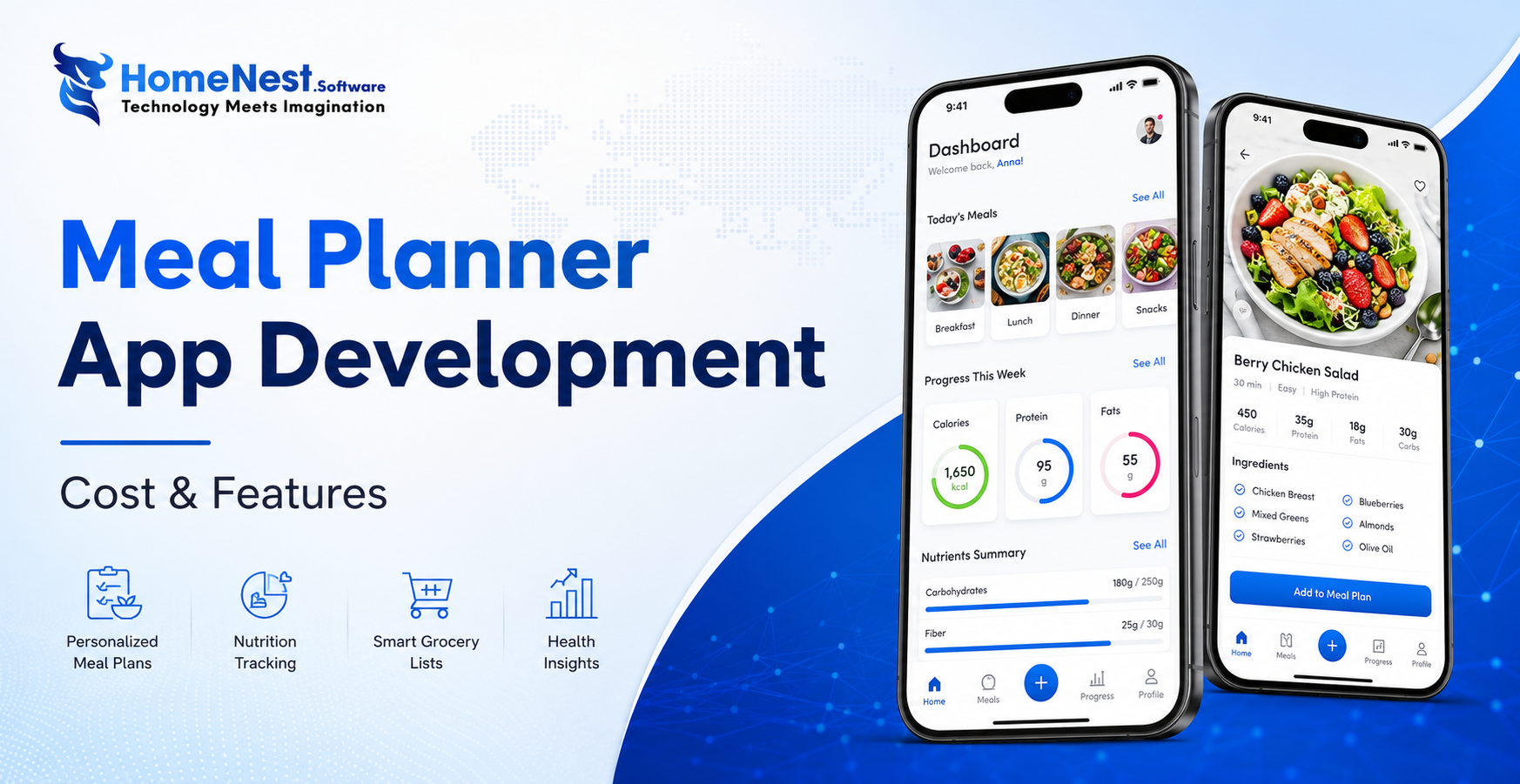
How to Build a Meal Planning App: A Complete Step-by-Step Guide
Building a successful meal planning app goes beyond creating an attractive interface it requires a clear business strategy, personalized user experiences, and scalable technology. By combining essential features like AI-powered meal recommendations, nutrition tracking, grocery list automation, and wearable integration, businesses can deliver lasting value to users while capitalizing on the growing digital health market. Partnering with an experienced mobile app development company ensures your solution is secure, future-ready, and designed to succeed in an increasingly competitive health-tech industry.
How Much Does It Cost to Build a Shopping App Like Temu?
Temu’s meteoric rise to over 900 million global downloads proves the power of combining AI, gamification, and social commerce, but building a similar viral shopping platform requires careful financial and technical planning. Developing an app like Temu typically costs anywhere from $40,000 for a basic Minimum Viable Product (MVP) to over $300,000 for a fully-featured platform. This guide breaks down every cost category, analyzes the core features driving Temu’s success, highlights the best technology stacks, and offers practical strategies to optimize your development budget without compromising on quality.

Criteria For Choosing The Right App Design Agency
UI/UX design is the logical foundation of a system, not merely a visual element. Choosing the wrong partner will directly lead to technical debt, budget overruns, and disruptions in the development process. This article provides a 6-step evaluation framework and a list of operational risks, helping businesses eliminate subjective design advice and accurately assess agency capabilities based on developer handoff standards and practical business performance.
How Does AI in Banking Industry Impact the Future?
Artificial intelligence (AI) has transitioned from a supplementary tool to a core infrastructure of financial data management, optimizing profitability through real-time fraud detection, natural language processing (NLP), and high-speed credit scoring models. “Deploying AI in the financial sector requires more than just algorithmic accuracy, it demands a highly secure cloud architecture and rigorous data governance,” commented Nguyen Tien, co-founder of HomeNest Software. Why read this guide? We skip the theoretical jargon to focus entirely on technical implementation. Whether you’re evaluating a vendor or planning a system overhaul, this article will detail: Operational Efficiency: Automating unstructured data workflows at scale. Risk Architecture: Implementing real-time threat detection and AML compliance. Data ownership: The essential need for 100% ownership of the source code to ensure full algorithm auditability.
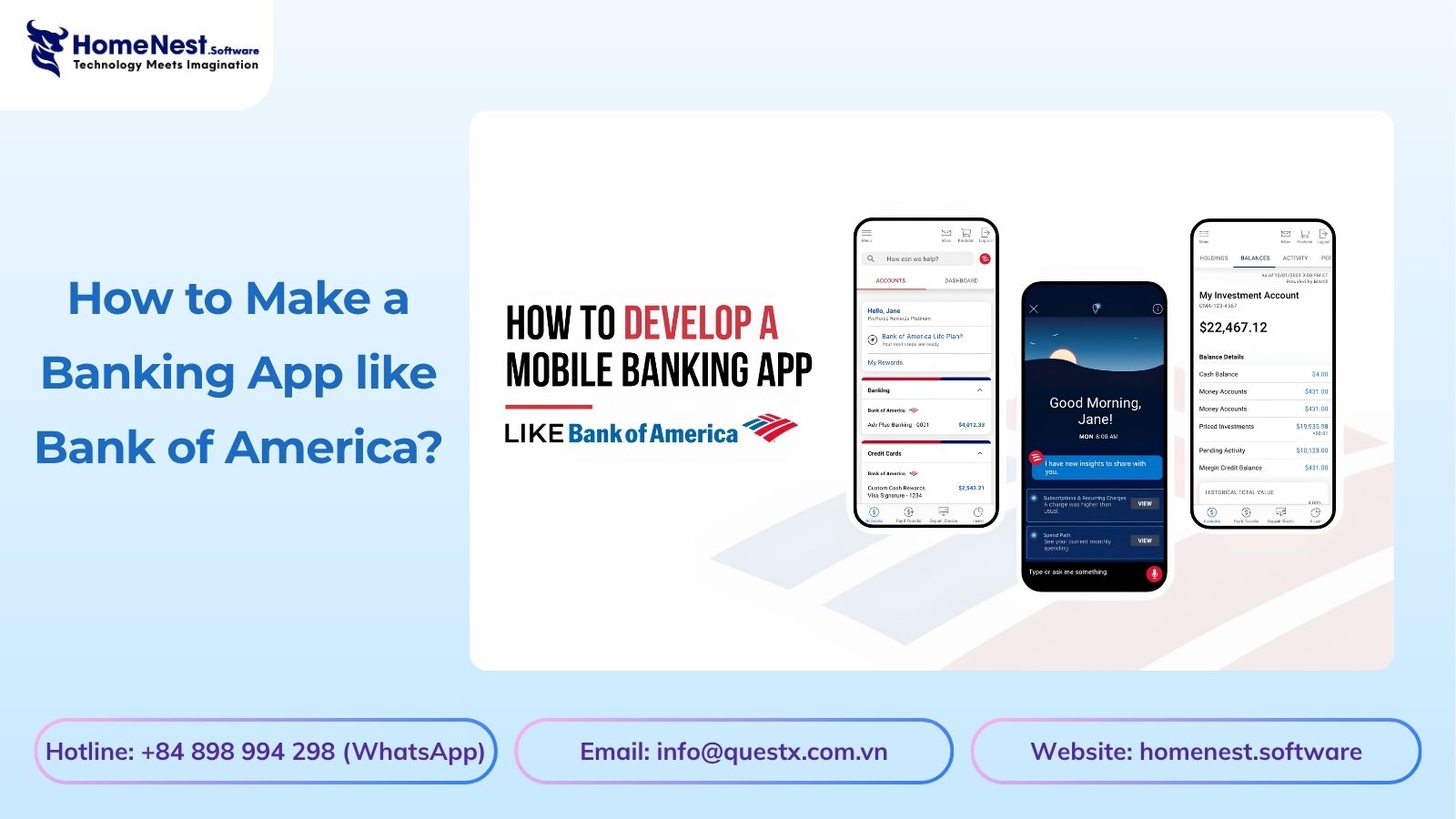
How to Make a Banking App like Bank of America?
Developing a mobile banking application like Bank of America extends far beyond basic UI design; it requires engineering a fault-tolerant backend capable of real-time ledger synchronization, biometric authentication, and high-volume data processing under strict regulatory frameworks. Drawing from HomeNest Software’s deep experience in architecting enterprise-grade fintech solutions, this guide strips away theoretical jargon to focus entirely on operational and technical execution. What you will find in this guide: We break down the precise development roadmap, from mapping out microservices and ensuring PCI-DSS compliance to estimating MVP development costs and securing absolute data sovereignty through 100% source code ownership. If you are preparing to build, scale, or audit a financial platform, this blueprint provides the exact framework you need.
Banking App Development Cost
Building a banking application is rarely a simple process; it’s a complex technical challenge requiring a balance between complying with stringent financial regulations, handling large transaction volumes, and a scalable cloud architecture. Miscalculating these technical requirements from the outset often leads to significant technical debt and budget overruns. Based on HomeNest Software’s practical experience in designing enterprise-grade fintech solutions, this guide bypasses generic estimates to provide a realistic analysis of banking application development costs. What you’ll find in this guide: We analyze the true cost factors, from technology selection and API integration to the hidden costs of regulatory compliance and security infrastructure. Whether you’re launching a minimum viable product or expanding an existing financial platform, this analysis provides the precise operational data you need to plan your budget effectively.