
Software Development Requirements: A Complete Guide with Singapore Practical Tips
Scope of Work

In today’s fast moving digital economy, clearly defined and well documented software development requirements form the foundation of every successful project especially in a technology driven hub like Singapore. Whether you are developing a new mobile application, modernizing internal systems, or applying for a government grant to support digital transformation, strong requirements ensure that your team and development partners stay aligned from the very beginning.
This comprehensive 2026 guide covers everything you need to know from functional and non functional requirements to agile documentation practices and local compliance considerations. Whether you are a startup founder, product owner, or enterprise CIO, this guide will help you plan and build better software faster, smarter, and more cost effectively. Let’s get started.
What Are Software Development Requirements?

Software development requirements are the clearly documented needs, features, limitations, and expectations that define what a software system is intended to achieve. They act as a blueprint that guides developers, designers, testers, and business stakeholders in understanding how the product should function and perform.
In essence, software development requirements outline both the system’s core functionalities and the performance standards it must satisfy.
These requirements also serve as a bridge between business objectives and technical execution. By documenting them clearly, organizations ensure that everyone involved from product owners and managers to engineers and QA teams shares the same understanding of what is being built, why it matters, and how its success will be evaluated.
Why Are Clear Software Requirements Important?
Clear and well structured software requirements documents form the foundation of any successful software development project or contract. They define what needs to be built, how the system should operate, and why it is important ensuring that all stakeholders share the same vision from the very beginning.
Without clearly defined requirements, teams may face misunderstandings, missed deadlines, budget overruns, and products that fail to meet user expectations. Below are several reasons why well documented requirements are essential:
Align Business and Technical Teams
Clear requirements establish a shared understanding between business stakeholders, developers, designers, and testers. Everyone involved gains clarity on project goals, system features, limitations, and expected outcomes.
Enable Accurate Budget and Timeline Planning
Detailed requirements allow teams to estimate project scope more precisely. This leads to more realistic timelines, accurate budgeting, and reduced risk of scope creep during development.
Improve Product Quality and Minimize Rework
When requirements are documented thoroughly, developers can work with greater confidence and fewer assumptions. This helps reduce errors, bugs, and the need for costly revisions later in the development cycle.
Support Agile Development and Continuous Iteration
In agile environments, user stories, product backlogs, and sprint planning rely on clearly defined initial requirements. These requirements provide a solid framework that allows teams to iterate quickly while staying aligned with business objectives.
Enhance Collaboration Between Clients and Vendors
For organizations that outsource development, well defined requirements improve communication with external partners. They make it easier to compare vendors, set clear expectations, and maintain accountability throughout the project lifecycle.
Ensure Compliance with Legal and Regulatory Standards
Poorly documented requirements may overlook critical compliance obligations or industry specific regulations. Clear documentation helps organizations address security, privacy, and legal requirements from the early stages of development.
Read more: Top 10 Software Development Companies in Singapore
Types of Software Development Requirements
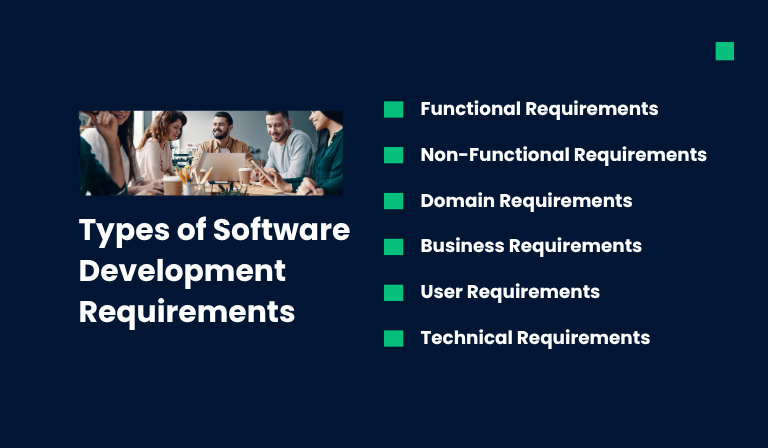
Software development requirements can be divided into several categories, each playing a specific role in shaping how a system is planned, developed, and evaluated. Understanding these different requirement types helps teams avoid missing critical details especially in complex projects or when collaborating with external development partners.
Below are the six key types of software development requirements commonly used in modern projects: functional, non functional, business, user, domain, and technical requirements.
Functional Requirements
Functional requirements describe the specific features and actions the software must perform. They define how the system behaves and how users interact with it.
These requirements typically cover system operations, workflows, and user interactions.
Examples:
- Users must be able to register using an email address or phone number
- Administrators can generate monthly sales reports
- The system sends automated email notifications for password resets
Functional requirements essentially define what the software does. They form the basis for UI/UX design, development planning, and software testing.
Non Functional Requirements
Non functional requirements describe how the system performs rather than the functions it provides. They usually focus on system quality attributes such as performance, reliability, scalability, security, and compliance.
Examples:
- The application should load within 2 seconds on a 4G connection
- The platform must maintain 99.9% uptime under the service level agreement (SLA)
- Data storage and processing must comply with Singapore’s PDPA regulations
In highly competitive technology markets like Singapore, strong performance and security standards are particularly important, especially in industries such as fintech, healthcare, and e commerce.
Domain Requirements
Domain requirements are industry specific rules and constraints that the system must follow. These requirements reflect the regulations, operational processes, and standards of a particular sector.
Examples:
- Fintech platforms must comply with the MAS Technology Risk Management Guidelines
- Healthcare systems must encrypt patient data and meet MOH digital health standards
Failing to address domain specific requirements can lead to regulatory violations, legal risks, or operational issues particularly in highly regulated industries.
Business Requirements
Business requirements outline the strategic goals behind building the software. They answer the fundamental question: Why is this system being developed?
These requirements guide decision making, feature prioritization, and project success metrics.
Examples:
- Automate 70% of internal reporting processes
- Enable online booking to reduce customer service workload by 50%
- Launch a minimum viable product (MVP) within three months to qualify for IMDA funding
Business requirements help ensure the final product delivers measurable value to the organization.
User Requirements
User requirements describe what end users expect from the system in terms of usability, accessibility, and overall experience.
They focus on how people interact with the software and how intuitive the system should be.
Examples:
- The interface should be accessible for elderly users with larger fonts and strong color contrast
- The mobile app must support both English and Chinese languages
- Users should be able to complete the checkout process in fewer than five clicks
In diverse markets such as Singapore, multilingual support and mobile first design are critical for improving user adoption.
Technical Requirements
Technical requirements define the technological framework and constraints for building the system. These requirements include preferred programming languages, infrastructure, architecture, and third party integrations.
Examples:
- The backend should be developed using Node.js
- The application must be hosted on the AWS Singapore region with auto scaling enabled
- The platform must integrate with third party APIs such as PayNow or Singpass
Technical requirements may also specify programming languages such as Java, Python, JavaScript, or Go depending on project needs. These choices directly influence system architecture, scalability, and long term maintainability.
Read more: Top IT Outsourcing Companies in Vietnam
Requirements in Agile vs. Waterfall Projects
Understanding how software requirements are managed in Agile and Waterfall methodologies is crucial when selecting the right development approach for your project. Each framework handles requirements differently, which can significantly influence project timelines, costs, flexibility, and collaboration especially when working with outsourced development teams or applying for digital transformation grants in markets like Singapore.
Below is a comparison of how requirements are handled in both approaches:
| Criteria | Waterfall | Agile |
|---|---|---|
| Requirements Gathering | All requirements are defined and finalized before development begins. | Requirements evolve continuously throughout the project. |
| Flexibility to Changes | Low – making changes later in the process is complex and expensive. | High – changes are expected and easily incorporated. |
| Documentation | Extensive documentation, typically in the form of detailed Software Requirement Specifications (SRS). | Lightweight documentation using user stories, acceptance criteria, and product backlogs. |
| Project Planning | Linear structure with clearly defined phases from start to finish. | Iterative structure divided into short development cycles (sprints). |
| Best Suited For | Projects with fixed scopes or strict regulatory requirements, such as government or financial systems. | MVPs, startups, and projects where user needs may evolve over time. |
| Client Involvement | Limited involvement after the initial planning phase. | Continuous feedback and collaboration throughout the development lifecycle. |
| Time & Cost Estimation | Estimates can be precise early on but become risky if requirements change. | Initial estimates are less precise but adapt as the project progresses. |
| Testing Approach | Testing occurs after the development phase is completed. | Testing is continuous, with quality assurance integrated into every sprint. |
Both methodologies have their strengths. Waterfall works well for projects with clearly defined requirements and strict compliance standards, while Agile is better suited for dynamic environments where flexibility, rapid iteration, and ongoing stakeholder feedback are essential.
How to Create Software Development Requirements

Developing clear and well structured software requirements is critical to building a product that aligns with both business objectives and user needs. Whether you are working with an in house development team or outsourcing software development in Singapore, following a structured process helps ensure alignment, minimize costly revisions, and lay a strong foundation for project success.
Below is a practical step by step guide to creating effective software development requirements.
Step 1 – Define the Business Objectives
Begin by clarifying the purpose of the project. Identify the key business problem the software is intended to solve or the opportunity it aims to capture.
Examples:
- Automate 60% of manual reporting tasks
- Launch a B2C mobile app targeting Gen Z consumers in Singapore
- Increase customer retention by 20% through personalized user experiences
To ensure clarity, define goals using the SMART framework Specific, Measurable, Achievable, Relevant, and Time bound.
Step 2 – Identify Stakeholders and End Users
Next, determine who will use the software and influence its development.
Key groups may include:
- Internal stakeholders: executives, department leaders, IT managers
- End users: customers, employees, or partners interacting with the system
- External stakeholders: regulators, investors, or outsourced development vendors
Gather insights through interviews, workshops, and surveys to understand different perspectives and expectations.
Step 3 – Gather Initial Requirements
Once stakeholders are identified, collect the initial requirements that describe what the software should do and how it should perform.
These typically include:
- Functional requirements – system features and behaviors
- Non functional requirements – performance, security, scalability
- Domain or compliance requirements – industry regulations and standards
Sources for gathering requirements may include:
- Stakeholder interviews
- Existing systems and workflows
- Competitor analysis
- Regulatory frameworks (such as PDPA or MAS TRM in Singapore)
Common tools for organizing requirements include Notion, Jira, Confluence, and Excel.
Step 4 – Prioritize Features and Requirements
Not every feature carries the same level of importance. Prioritizing requirements helps teams focus on delivering the most valuable functionality first.
Popular prioritization frameworks include:
- MoSCoW Method: Must have, Should have, Could have, Won’t have
- RICE Framework: Reach, Impact, Confidence, Effort
Early priorities should typically include:
- Core business critical features
- Minimum viable product (MVP) functionality
- Workflows that directly impact user experience
Step 5 – Use Visual Aids to Clarify Ideas
Visual elements can make complex requirements easier to understand and help stakeholders align on the product vision.
Useful visual tools include:
- Wireframes: Figma, Balsamiq
- User flows and process diagrams: Lucidchart, Draw.io
- Mockups and interactive prototypes
These visuals are particularly valuable when working with remote teams or outsourced developers, as they reduce ambiguity and improve communication.
Step 6 – Write Clear and Testable Requirement Statements
Requirements should be written in a clear, concise, and measurable format so that developers and testers can easily interpret them.
Example formats:
Functional requirement format:
“The system shall allow users to reset their password through email verification.”
Agile user story format:
“As a customer, I want to receive an email confirmation after placing an order so that I know my purchase was successful.”
Whenever possible, include acceptance criteria to define what constitutes a completed feature.
Step 7 – Review and Validate with Stakeholders
Before finalizing the requirements, conduct a review session with stakeholders to confirm accuracy and completeness.
Validation checklist:
- Do the requirements reflect the original business goals?
- Are legal or regulatory requirements addressed?
- Have user needs been clearly validated?
- Is the solution technically feasible?
Including both business leaders and technical experts in this stage helps identify potential gaps early.
Step 8 – Select the Appropriate Documentation Format
Finally, choose a documentation format that matches your development methodology and team workflow.
| Format | Best Use Case | Common Tools |
|---|---|---|
| Software Requirements Specification (SRS) | Waterfall projects, RFPs, grant submissions | Word, Google Docs |
| User stories and product backlog | Agile development teams | Jira, Notion, Trello |
| Visual user journey maps | UX driven projects | Miro, FigJam |
Selecting the right format ensures requirements remain organized, accessible, and easy to maintain throughout the project lifecycle.
Read more: Top 10 IT Outsourcing Challenges and Solutions for Singapore Businesses
Best Practices for Documenting Software Requirements
After gathering your software development requirements, the way you document them plays a critical role in how clearly they are understood, implemented, and delivered by your team or external development partners. Well structured documentation improves communication, reduces misunderstandings, and ensures smoother collaboration throughout the project lifecycle.
Follow these best practices to keep your requirements documentation clear, practical, and easy to work with.
DO’s
Keep documentation concise yet complete
Ensure each requirement is clearly explained without unnecessary detail. The goal is to make requirements easy to understand while avoiding ambiguity.
Use a consistent structure throughout the document
Whether you’re writing user stories, functional specifications, or acceptance criteria, maintain a consistent format across the entire document. This makes it easier for teams to review and implement requirements.
Define essential technical constraints
Clearly specify baseline technical requirements such as supported platforms, browser compatibility, system environments, and programming language constraints.
Encourage collaborative documentation
Use shared tools like Confluence, Notion, or Google Docs so stakeholders can review, comment, and contribute in real time. This improves transparency and keeps everyone aligned.
Reference existing resources instead of repeating information
If diagrams, wireframes, or related documents already exist, link to them instead of duplicating content. This keeps documentation organized and easier to maintain.
Track versions and changes
Maintain a changelog that records updates, responsible contributors, and timestamps. Version control is particularly important for long term projects or projects with regulatory requirements.
DON’Ts
Avoid vague or subjective language
Terms like “fast,” “simple,” or “user friendly” can be interpreted differently by different people. Instead, provide measurable criteria for example, “the page should load within two seconds on a 4G connection.”
Don’t exclude stakeholder input
Requirements documentation should reflect input from both business and technical stakeholders. Developing specifications in isolation can lead to misalignment and missing requirements.
Don’t treat documentation as a one time activity
Requirements should evolve alongside the project. Update documentation regularly as new insights emerge or as priorities change especially in Agile environments.
Avoid creating documentation that is difficult to access
Large standalone PDFs or scattered spreadsheets make collaboration harder. Keep documentation centralized and accessible through shared platforms.
Don’t combine strategic goals with technical specifications
Separate high level business objectives from detailed technical requirements. Using layered documentation helps maintain clarity and allows different teams to focus on relevant information.
Special Considerations for Software Development Requirements in Singapore
Singapore has become one of the world’s most advanced digital economies, supported by strong government initiatives, high internet adoption, and a thriving innovation ecosystem. However, building software for this market involves more than strong technical capabilities. Businesses must also address regulatory compliance, funding eligibility, localization needs, and cross border collaboration. These factors should be clearly reflected in your software development requirements from the beginning.
Below are five important considerations when defining software requirements for projects targeting the Singapore market.
Data Privacy and PDPA Compliance
Singapore’s Personal Data Protection Act (PDPA) places strict obligations on how organizations collect, store, and process personal data. Software requirements should therefore include provisions for consent management, secure data handling, encryption standards, and mechanisms that allow users to access or manage their personal information.
Local Outsourcing and Cross Border Collaboration
Many Singapore based companies work with international development teams. To ensure smooth collaboration, requirements documentation should be written clearly in English and supported with diagrams, wireframes, and process flows. Well structured documentation helps reduce misunderstandings and improves communication with offshore teams.
IMDA Grant Requirements (e.g., PSG)
Businesses applying for government support programs such as the Productivity Solutions Grant (PSG) should align their software requirements with grant criteria. This typically involves clearly defining expected business outcomes, project milestones, cybersecurity measures, and measurable productivity improvements.
Bilingual or Multilingual User Experience
Singapore’s multicultural population means that multilingual interfaces may be necessary. If relevant, requirements should specify language support, interface toggles, and localization guidelines for languages such as English, Chinese, Malay, or Tamil to improve accessibility and user adoption.
Alignment with Government Digital Initiatives
Singapore’s national programs, including Smart Nation and SMEs Go Digital, encourage automation, cloud adoption, and digital productivity. When defining software requirements, it is beneficial to highlight how the solution supports these goals such as through workflow automation, cloud infrastructure, or data driven decision making.
Failing to consider these factors early in the planning process can delay product launches or cause businesses to miss valuable funding opportunities.
In the next section, we’ll explore how HomeNest Software, one of the leading software development companies supporting Singapore based businesses, helps organizations define clear requirements and deliver well structured, compliant software solutions.
HomeNest Software – A Trusted Software Development Partner for Singapore Businesses
At HomeNest Software, we help businesses in Singapore transform innovative ideas into scalable, reliable, and compliant software solutions. With more than a decade of industry experience and extensive expertise in cross border collaboration, our team understands the unique challenges faced by companies operating in Singapore’s fast moving and innovation driven market.
HomeNest Software delivers agile, secure, and cost effective software solutions tailored specifically to the needs of Singapore based organizations.
Why Singapore Companies Partner with HomeNest Software
Deep Understanding of the Singapore Market
We have successfully supported clients across multiple industries in Singapore, including finance, education, logistics, and e commerce. Our experience allows us to design solutions that align with local business practices and digital transformation trends.
Compliance Focused Development
Our development teams are familiar with key regulatory frameworks such as PDPA, MAS Technology Risk Management (TRM) guidelines, and IMDA grant requirements, helping clients build software that meets both operational and legal standards.
Agile and Business Oriented Approach
We combine agile development methodologies with thorough business analysis. This ensures that project requirements evolve alongside business objectives while maintaining flexibility and efficiency.
Strong Cross Border Collaboration Capabilities
Based in Vietnam, our experienced software engineers are skilled at translating complex requirements into high performance, scalable systems. Our teams work seamlessly with Singapore stakeholders through structured communication and transparent workflows.
End to End Development Services
From requirement analysis and documentation to system design, development, testing, and long term maintenance, we provide full cycle software development support.
Our Core Services
- Business Analysis and Requirements Engineering
- Custom Web and Mobile Application Development
- Cloud Migration and DevOps (AWS, Azure)
- Artificial Intelligence Development
- OCR and Document Automation Solutions
- Dedicated Development Teams (Staff Augmentation)
Whether you are building an internal system supported by government grants, launching an MVP for a new product, or scaling an existing digital platform, HomeNest Software can serve as your trusted IT outsourcing partner. We help organizations define clear requirements and deliver software solutions that generate measurable business value.
Conclusion
Clearly defined and well structured software development requirements are a key factor in delivering successful digital projects especially in a sophisticated market like Singapore, where high user expectations, strict regulatory frameworks, and cross border collaboration are common.
From addressing PDPA compliance and aligning with IMDA grant criteria to supporting bilingual user experiences and agile development practices, thorough requirements documentation helps ensure that your software meets both business objectives and user expectations.
Whether you are launching a new MVP, modernizing internal operations, or outsourcing development, investing time in gathering and documenting requirements will ultimately save time, reduce costs, and lead to more successful software outcomes.
Contact Information:
- Address: The Sun Avenue, 28 Mai Chi Tho Street, Binh Trung Ward, Ho Chi Minh City
- Hotline: +84 898 994 298 ( WhatsApp )
- Website: homenest.software
Frequently Asked Questions (FAQs)
What are software development requirements?
Software development requirements are documented descriptions of the features, functions, constraints, and expectations that define how a software system should work. They guide developers, designers, testers, and stakeholders throughout the development process to ensure the final product meets both business objectives and user needs.
What are the main types of software development requirements?
The main categories of software development requirements include:
- Functional requirements – define what the system should do
- Non functional requirements – describe performance, security, and scalability standards
- Business requirements – outline the strategic goals of the project
- User requirements – focus on user needs and experience
- Domain requirements – industry specific regulations or operational rules
- Technical requirements – specify technologies, platforms, and system architecture
What is the difference between functional and non functional requirements?
Functional requirements describe specific features and system behaviors, such as user registration or payment processing.
Non functional requirements define how well the system performs, including speed, security, scalability, and reliability.
For example, “users can create an account” is a functional requirement, while “the page must load within two seconds” is a non functional requirement.
How do you gather software development requirements?
Requirements can be gathered using several techniques, including:
- Stakeholder interviews and workshops
- User surveys and feedback sessions
- Analysis of existing systems or workflows
- Competitor and market research
- Regulatory and compliance reviews
Combining these methods helps teams build a comprehensive understanding of both technical and business needs.
What is a Software Requirements Specification (SRS)?
A Software Requirements Specification (SRS) is a detailed document that outlines all system requirements, including functional, non functional, technical, and business requirements. It acts as a reference point for developers, project managers, and stakeholders throughout the software development lifecycle.
How often should software requirements be updated?
Software requirements should be reviewed and updated regularly, especially in Agile projects where features evolve over time. Continuous updates help ensure the documentation reflects changing priorities, new insights, and stakeholder feedback.
Why are software requirements important for outsourced development?
Clear requirements are essential when outsourcing development because they reduce misunderstandings between clients and vendors. Well defined documentation helps external teams understand project goals, technical expectations, and success criteria, leading to more efficient collaboration and better outcomes.
What compliance factors should be considered for software projects in Singapore?
Software projects in Singapore should consider compliance with regulations such as the Personal Data Protection Act (PDPA), industry specific standards like MAS Technology Risk Management (TRM) guidelines, and cybersecurity requirements. Businesses applying for government funding may also need to align their projects with IMDA grant criteria.
Latest Articles
View All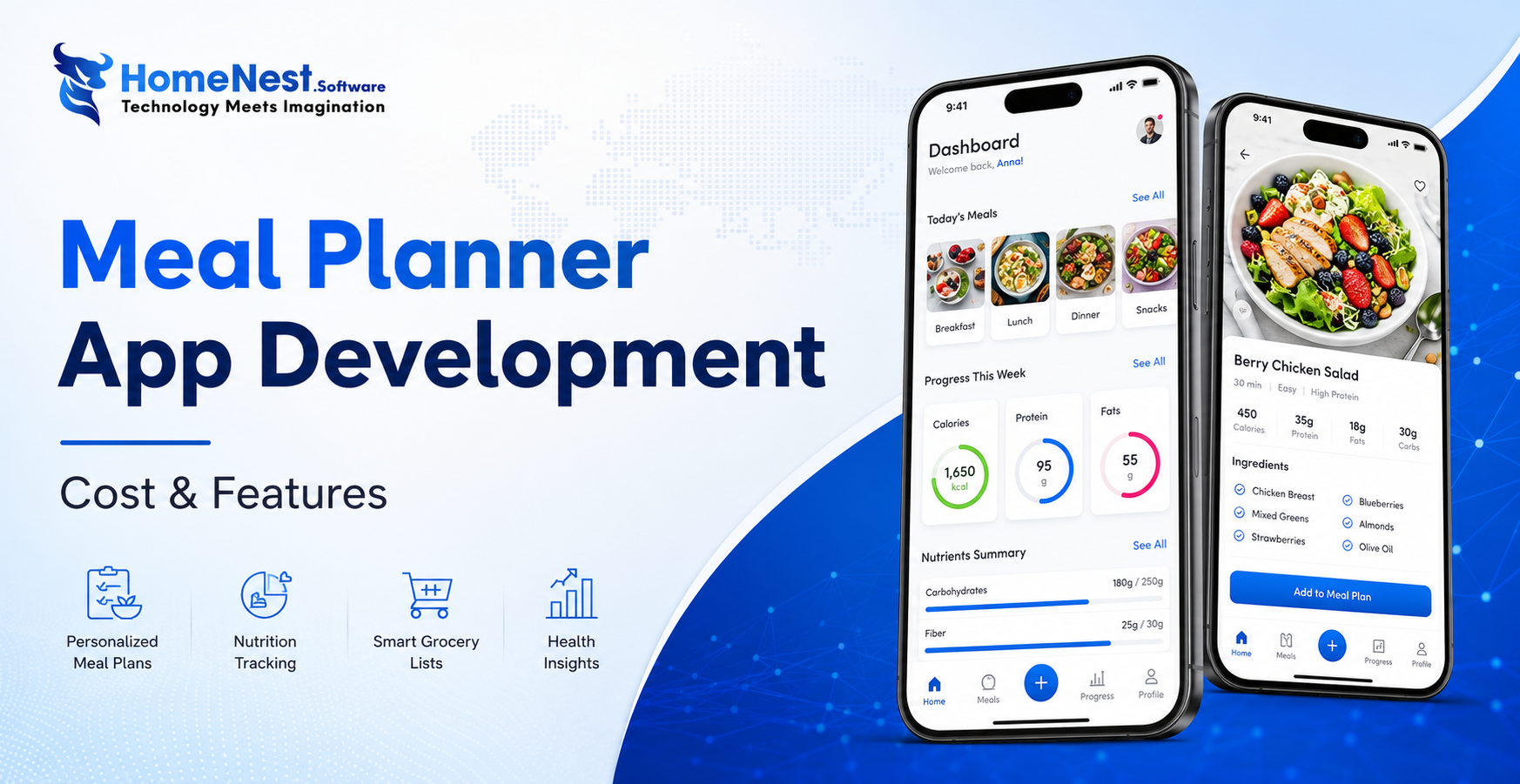
How to Build a Meal Planning App: A Complete Step-by-Step Guide
Building a successful meal planning app goes beyond creating an attractive interface it requires a clear business strategy, personalized user experiences, and scalable technology. By combining essential features like AI-powered meal recommendations, nutrition tracking, grocery list automation, and wearable integration, businesses can deliver lasting value to users while capitalizing on the growing digital health market. Partnering with an experienced mobile app development company ensures your solution is secure, future-ready, and designed to succeed in an increasingly competitive health-tech industry.

How Much Does It Cost to Build a Shopping App Like Temu?
Temu’s meteoric rise to over 900 million global downloads proves the power of combining AI, gamification, and social commerce, but building a similar viral shopping platform requires careful financial and technical planning. Developing an app like Temu typically costs anywhere from $40,000 for a basic Minimum Viable Product (MVP) to over $300,000 for a fully-featured platform. This guide breaks down every cost category, analyzes the core features driving Temu’s success, highlights the best technology stacks, and offers practical strategies to optimize your development budget without compromising on quality.

Criteria For Choosing The Right App Design Agency
UI/UX design is the logical foundation of a system, not merely a visual element. Choosing the wrong partner will directly lead to technical debt, budget overruns, and disruptions in the development process. This article provides a 6-step evaluation framework and a list of operational risks, helping businesses eliminate subjective design advice and accurately assess agency capabilities based on developer handoff standards and practical business performance.
How Does AI in Banking Industry Impact the Future?
Artificial intelligence (AI) has transitioned from a supplementary tool to a core infrastructure of financial data management, optimizing profitability through real-time fraud detection, natural language processing (NLP), and high-speed credit scoring models. “Deploying AI in the financial sector requires more than just algorithmic accuracy, it demands a highly secure cloud architecture and rigorous data governance,” commented Nguyen Tien, co-founder of HomeNest Software. Why read this guide? We skip the theoretical jargon to focus entirely on technical implementation. Whether you’re evaluating a vendor or planning a system overhaul, this article will detail: Operational Efficiency: Automating unstructured data workflows at scale. Risk Architecture: Implementing real-time threat detection and AML compliance. Data ownership: The essential need for 100% ownership of the source code to ensure full algorithm auditability.

How to Make a Banking App like Bank of America?
Developing a mobile banking application like Bank of America extends far beyond basic UI design; it requires engineering a fault-tolerant backend capable of real-time ledger synchronization, biometric authentication, and high-volume data processing under strict regulatory frameworks. Drawing from HomeNest Software’s deep experience in architecting enterprise-grade fintech solutions, this guide strips away theoretical jargon to focus entirely on operational and technical execution. What you will find in this guide: We break down the precise development roadmap, from mapping out microservices and ensuring PCI-DSS compliance to estimating MVP development costs and securing absolute data sovereignty through 100% source code ownership. If you are preparing to build, scale, or audit a financial platform, this blueprint provides the exact framework you need.
Banking App Development Cost
Building a banking application is rarely a simple process; it’s a complex technical challenge requiring a balance between complying with stringent financial regulations, handling large transaction volumes, and a scalable cloud architecture. Miscalculating these technical requirements from the outset often leads to significant technical debt and budget overruns. Based on HomeNest Software’s practical experience in designing enterprise-grade fintech solutions, this guide bypasses generic estimates to provide a realistic analysis of banking application development costs. What you’ll find in this guide: We analyze the true cost factors, from technology selection and API integration to the hidden costs of regulatory compliance and security infrastructure. Whether you’re launching a minimum viable product or expanding an existing financial platform, this analysis provides the precise operational data you need to plan your budget effectively.