Top 10 MVP Development Services for Startups

AuthorPhương Ly
Year2026

MVP development services enable startups to move from idea to market with speed, clarity, and controlled risk. By focusing on essential features, validating assumptions early, and iterating based on real user feedback, businesses can avoid costly mistakes and build products that truly meet market demand. In 2026, success with MVPs is no longer just about launching fast—it is about learning fast, making data-driven decisions, and scaling with confidence.

Scope of Work
Top 10 MVP Development Services for Startups

Launching a product without validating market demand can quickly consume both time and budget with little to show in return. That’s why many founders rely on MVP development services to test ideas early, minimize initial risks, and move from concept to market with greater clarity. In this guide, HomeNest Software explores how minimum viable product development enables startups to build strategically, validate faster, and scale with confidence.
What Are MVP Development Services?

What Are MVP Development Services?

MVP development services are specialized solutions that help businesses, especially early stage startups, build a minimum viable product (MVP). This is the simplest functional version of a product, designed to validate an idea with real users before investing in a full scale build. Instead of adding unnecessary features, an MVP focuses only on core functionalities that solve a specific user problem.

A comprehensive MVP development service typically includes idea validation, UI/UX design, development, testing, and launch preparation. This end to end process allows businesses to move from concept to a working product in a structured and measurable way, ensuring that early investments remain efficient and strategically aligned.

A well known example is Dropbox, where a simple MVP demo video helped grow its beta waiting list from 5,000 to 75,000 users in a very short time. This demonstrates how MVPs can effectively validate demand before committing to full product development.

Top 10 MVP Development Services For Startups In 2026

The companies listed below are recognized for delivering reliable and scalable solutions tailored for early stage businesses. These providers are known for offering strong startup MVP development services that help founders move from idea validation to market entry with clarity and speed.

1. HomeNest Software

When startups look for a dependable partner for MVP development services in Asia, HomeNest Software consistently stands out as a leading choice. With over 10 years of experience in software outsourcing and engineering, the company has successfully delivered more than 500 projects for clients across 15+ countries, including Japan, The US, Canada, Autralia, Singapore, Vietnam, and other APAC markets.

HomeNest Software focuses on building practical and scalable MVP solutions that are ready for real users. Its teams work closely with founders to validate ideas, define core features, and launch functional products without unnecessary complexity in the early stages. This approach enables startups to manage budgets effectively while accelerating real market validation.

Recognized as a Top 10 ICT company in Vietnam, HomeNest Software offers strong technical capabilities across offshore web development, mobile applications, cloud systems, and emerging technologies. The company follows Agile and Scrum methodologies, ensuring clear milestones, fast iteration cycles, and transparent communication. Its long term partnerships with enterprises and startups reflect consistent quality and strong business alignment.

2. Altar.io

Altar.io is widely regarded as a leading provider supporting startups in early stage product development. The company brings together multidisciplinary experts who collaborate to design products centered around user needs. Its team guides businesses through custom MVP services, ensuring that each product includes only the most essential features for target users.

Altar.io focuses on delivering high quality MVPs that can reach the market quickly. Even with limited resources, it provides strategic guidance that helps startups remain competitive in demanding industries. The company maintains a 4.9 rating on Clutch, reflecting strong client satisfaction.

3. Apriorit

Apriorit is a forward thinking software engineering firm that supports startups and technology companies in building advanced digital products. With over 22 years of experience and a team of more than 250 professionals, the company has established itself as a trusted provider of MVP development services.

Apriorit works with Fortune 500 companies and international startups, delivering solutions that drive measurable business outcomes. Its strong expertise in minimum viable product development ensures high technical standards and long term reliability.

4. Emergent Software

Emergent Software has built a solid reputation as a trusted provider of high quality MVP development solutions. With a strong track record and a 4.9 Clutch rating, the company has successfully delivered solutions for hundreds of clients across multiple industries.

Its experienced team focuses on delivering real business value and achieving high levels of customer satisfaction. By leveraging modern technologies and Agile practices, Emergent Software enables faster product releases while maintaining reliability and scalability.

5. Flylight Media

Flylight Media is a recognized provider of professional MVP development services that help startups scale effectively. Established in 2011, the company has built a strong presence in the technology sector and maintains a 5.0 rating on Clutch.

With a team of experienced specialists, Flylight Media is capable of handling complex product requirements with confidence. The company supports startups in addressing user needs and expanding their customer base through well structured MVP solutions.

6. Method

Founded in 1999, Method is a well established name in MVP development and experience design. The company combines creative thinking with enterprise level capabilities through its association with GlobalLogic.

With more than 25 years of experience and a team of over 250 professionals, Method delivers high level product development services. Its expertise in design and engineering enables the creation of meaningful, user focused digital products that support long term growth.

7. Icreon

Icreon is recognized as one of the leading MVP development providers in the United States, offering tailored digital solutions for startups and enterprises. With over 24 years of experience, the company specializes in custom digital experience design that enhances customer journeys and integrates seamlessly with backend systems.

Icreon works closely with Fortune 500 companies and nonprofit organizations, combining strategic thinking with advanced engineering to accelerate innovation and business growth.

8. Cheesecake Labs

Cheesecake Labs is a nearshore development firm specializing in backend systems and generative AI integration. The company supports startups and Fortune 500 organizations in building and scaling MVPs into market ready products.

With over 10 years of experience and more than 300 successful applications delivered, Cheesecake Labs combines strategy, design, and technical execution to deliver clear business outcomes. Its expertise in SaaS MVP development ensures scalable and stable product growth.

9. Dashbouquet Development

Dashbouquet Development is a reliable MVP development partner delivering high quality solutions to global startups and businesses. Since its founding in 2014, the company has supported hundreds of clients worldwide.

With a team of skilled engineers, Dashbouquet focuses on providing tailored development solutions and consulting services to refine product ideas. Its use of modern technologies ensures efficient project delivery and successful product launches.

10. Emerline

Emerline is an international software engineering company offering end to end MVP development services alongside digital transformation capabilities. The company supports startups and enterprises in building scalable products for long term growth.

With strong expertise in AI, cloud platforms, and infrastructure engineering, Emerline delivers secure and reliable solutions. Its partnerships with AWS, Microsoft, Google, and Databricks, along with multiple ISO certifications, reinforce its position as a trusted technology partner for industries such as Fintech, Healthcare, and eCommerce.

Why Startups Invest in MVP Development Services

Why Startups Invest in MVP Development Services

In March 2023, only 34.7% of U.S. private sector businesses established in March 2013 were still operating. This reality explains why many founders prioritize early validation instead of committing all resources to a full scale product launch. Adopting a Minimum Viable Product (MVP) strategy allows startups to test ideas with limited investment, validate market demand, and reduce uncertainty.

MVP development services play a critical role in this process by enabling faster launches, rapid feedback collection, and continuous product improvement without unnecessary delays or wasted resources.

Faster Time to Market

An MVP focuses exclusively on core features, allowing startups to launch products significantly faster and capture early market opportunities.

According to Harvard Business Review, launching a product six months late can reduce after tax profit by up to 33% over five years, while exceeding the budget by 50% results in only a 3.5% profit reduction. This highlights why speed is often more critical than cost in early stage development.

Lower Initial Development Costs

Building an MVP helps startups control early stage expenses by avoiding overinvestment before validating product market fit.

Research cited by Martin Fowler (from the Standish Group) shows that 45% of product features are never used, while only 20% are used frequently. By focusing on essential functionality, startups can significantly reduce wasted development effort and optimize budget allocation.

Reduced Product and Market Risk

Launching a simplified version of the product allows startups to assess real customer interest before scaling further.

This approach minimizes the risk of building a solution that does not align with market needs, enabling more informed decisions based on actual user behavior rather than assumptions.

Early Access to Real User Feedback

Gathering feedback from real users is one of the most valuable advantages of MVP development.

The Nielsen Norman Group found that testing with just five users can uncover up to 85% of usability issues. Early insights help startups understand user expectations, refine features, and improve the overall product experience based on real world usage.

Controlled and Scalable Growth

An MVP allows startups to begin with a focused product and expand progressively.

Instead of building everything at once, businesses can introduce new features over time as the product proves its value and addresses user needs effectively. This ensures more sustainable and manageable growth.

Increased Investor Confidence

An MVP demonstrates tangible progress and market validation, making startups more attractive to investors.

According to Crunchbase, global venture funding reached $445 billion in 2022, a 35% decrease from $681 billion in 2021. In a more competitive funding environment, startups that can show real traction through an MVP have a stronger chance of securing investment.

Investing in MVP development services is not just a cost saving strategy it is a smarter way to build products. By prioritizing speed, validation, and iterative improvement, startups can reduce risks, optimize resources, and position themselves for long term success in a highly competitive market.

Core Responsibilities Within Professional MVP Development Services

Professional teams delivering MVP development services follow a structured, end to end approach to transform ideas into functional, market ready products. Their responsibilities span from early stage validation to post launch optimization, ensuring both a successful release and a clear path for long term growth.

Discovery and Validation

The process begins with defining the core problem and identifying the right target audience. This involves market research, competitor analysis, and direct user interviews to validate whether the idea addresses a real and meaningful need.

Feature Selection and Scope Definition

Teams prioritize features using proven frameworks such as MoSCoW (Must have, Should have, Could have, Won’t have). This ensures that only the most critical functionalities are included in the first release, helping reduce complexity and keep development focused.

Prototype and Wireframe Development

Before coding begins, interactive prototypes and wireframes are created to visualize user flows and product structure. Modern tools, including AI assisted design platforms, are often used to validate usability and refine the user experience early.

Iterative Agile Development

MVPs are built using Agile methodologies, typically delivered in short 1–2 week sprint cycles. This allows teams to release incremental versions, gather feedback continuously, and adapt quickly to changing requirements or insights.

Continuous Optimization and Scaling

After launch, teams analyze user behavior and feedback to guide product improvements. Based on real world data, they decide whether to refine existing features, pivot the product direction, or scale toward a more advanced version such as Version 2.0.

These structured responsibilities ensure that MVP development is not just about launching quickly, but about building a product that evolves intelligently driven by real user data and aligned with long term business goals.

How to Select the Right MVP Development Services Partner

How to Select the Right MVP Development Services Partner

While each company listed above is capable of supporting a successful Minimum Viable Product (MVP) launch, it is essential to conduct your own due diligence before making a final decision. Choosing the right provider requires a structured evaluation process to ensure alignment with your business goals, technical requirements, and long term vision.

Review Past Work and Portfolio

A company’s portfolio offers critical insight into its capabilities and delivery standards. When reviewing previous projects, focus on:

  • Experience with MVP app development
  • Demonstrated project management and delivery processes
  • Industry specific expertise relevant to your business
  • Proven ability to build products similar to your intended solution
  • Familiarity with modern technologies required for your MVP

A strong partner should showcase a diverse portfolio that includes successful MVP implementations for both startups and established organizations.

Evaluate Independent Reviews and Ratings

While internal case studies highlight selected successes, they should be complemented by independent feedback from clients.

Platforms such as Clutch and G2 provide unbiased reviews that reflect real customer experiences. Consistently high ratings and positive feedback are strong indicators of a provider’s reliability, communication quality, and delivery performance.

Request Detailed Case Studies

Reputable MVP development companies typically provide comprehensive case studies that demonstrate their expertise across industries and product types.

When analyzing case studies, pay attention to:

  • Projects within industries similar to yours
  • Products that align with your planned solution
  • A clear and structured MVP development strategy
  • Evidence of strong product management from concept to launch
  • Effective application of MVP principles, including fast validation and feature prioritization

You can also request tailored case studies that closely match your specific business objectives.

Align on Budget and Communication

Budget considerations are a key factor when selecting an MVP development partner. While choosing the lowest cost option may lead to long term issues, it is possible to find high quality services at competitive rates especially by exploring offshore markets.

Regions such as India, Vietnam, and Mexico offer cost advantages while still providing access to skilled development teams.

When working with an offshore provider, ensure that they have strong capabilities in:

  • Market research and product discovery
  • UI/UX design and technical architecture
  • Agile development and iterative delivery
  • Testing, deployment, and continuous improvement

Equally important is communication. Schedule direct discussions with the team to assess their English proficiency, responsiveness, and ability to collaborate effectively across time zones and cultural differences.

Selecting the right MVP development services partner is not just about technical capability it is about finding a team that understands your product vision, communicates clearly, and can execute efficiently from idea validation to market launch. A well chosen partner can significantly reduce risk, accelerate development, and set a strong foundation for future growth.

MVP Development Services Pricing Outlook for 2026

The cost of MVP development services in 2026 is influenced by several key factors, including product complexity, level of AI integration, and the geographic location of the development team. Compared to 2025, global pricing has increased by approximately 15%, driven by rising demand and ongoing talent shortages.

While basic MVPs can still be developed at relatively moderate costs, projects that incorporate advanced technologies such as AI, machine learning, or complex integrations can see a significant increase in budget. In addition, infrastructure considerations particularly cloud usage play a crucial role in long term cost planning and runway estimation.

Typical Cost Ranges

The total investment required for MVP development varies depending on the scope, architecture, and technical sophistication of the product. Common pricing benchmarks include:

  • Simple MVP: $30,000–$55,000
    Example: Landing page or basic application with CRUD functionality
  • Standard SaaS MVP: $55,000–$140,000
    Example: Multi tenant dashboard with core business features
  • AI Powered MVP: $140,000–$300,000+
    Example: Products with LLM integrations, automation, or predictive analytics
  • Enterprise MVP: $200,000–$500,000+
    Example: Compliance heavy systems in industries such as healthcare or fintech

Cost Breakdown by Development Phase

A typical MVP project is divided into multiple phases, each contributing a specific portion to the total cost. Understanding this breakdown helps businesses allocate budgets more effectively:

  • Discovery (10%): $5K–$15K
    Concept validation, research, and product strategy
  • UI/UX Design (15%): $8K–$20K
    Wireframes, prototypes, and user experience design
  • Frontend Development (20%): $15K–$40K
    Implementation using frameworks like React or Flutter
  • Backend Development (25%): $20K–$50K
    API development using Node.js or Python
  • Database Setup (8%): $5K–$15K
    Configuration of systems like PostgreSQL
  • Integrations (10%): $5K–$20K
    Third party services such as Stripe or analytics tools
  • AI Modules (15% for AI MVPs): $20K–$80K
    LLM integrations (e.g., Claude, Llama) and intelligent features
  • DevOps (7%): $5K–$15K
    Deployment on AWS, GCP, or similar platforms
  • Quality Assurance (10%): $8K–$20K
    Manual and automated testing
  • Project Management (10%): $10K–$25K
    Agile coordination and delivery oversight
  • Maintenance (Ongoing): $6K–$60K/year
    Typically around 20% of initial development cost annually

Expected Development Timelines

The timeline for MVP delivery depends on complexity, feature set, and validation requirements:

  • Simple MVP: 5–8 weeks
    Suitable for rapid validation or micro MVPs
  • Mid Level MVP: 8–14 weeks
    Includes integrations and standard SaaS features
  • Complex MVP: 3–6 months
    Involves AI capabilities, scalability, and compliance requirements

Regional Cost Comparison

Development costs vary significantly across regions due to differences in labor markets and technical ecosystems:

  • US/UK: $100–$200/hour
    Total project cost often exceeds $100K due to premium expertise
  • Eastern Europe: $50–$80/hour
    Total $40K–$100K, offering a balance between quality and cost
  • LATAM: $40–$70/hour
    Total $30K–$80K, with strong communication and agile teams
  • Asia (Vietnam, India, etc.): $30–$60/hour
    Total $25K–$70K, known for cost efficiency and scalable talent pools

MVP pricing in 2026 reflects a shift toward more intelligent, scalable products especially with the growing adoption of AI. To manage costs effectively, businesses must align their scope, technology choices, and development partner with clear validation goals. A well planned MVP investment not only reduces risk but also lays a strong foundation for future product growth.

Real World Examples That Started as MVPs

A Minimum Viable Product (MVP) is far more than a temporary prototype or a short term experiment. Many of today’s most successful global platforms began as simple MVP initiatives, focused on validating a core idea before scaling into full fledged products.

Amazon

In the early 1990s, Jeff Bezos recognized the rapid growth potential of eCommerce and sought the most viable entry point. He chose to start with an online bookstore, launching the business from his garage as a focused MVP.

This initial version was intentionally simple, concentrating solely on selling books. However, strong customer demand quickly revealed opportunities to expand into other categories such as electronics, clothing, and consumer goods. By starting with a narrow MVP, Amazon gained critical insights into user behavior and purchasing patterns, which later enabled it to scale effectively.

What began as a basic online bookstore eventually evolved into one of the world’s largest companies within just two decades demonstrating the power of starting small and scaling strategically.

Uber

The global ride hailing platform Uber did not begin as the fully developed mobile application we know today. Founders Garrett Camp and Travis Kalanick initially launched a simple MVP called UberCab in San Francisco.

This early version was an iPhone based SMS service that allowed users to request rides locally. By testing the concept within a single city, the founders were able to validate demand, refine the user experience, and iterate based on real feedback before expanding further.

Over time, Uber evolved through multiple iterations. It moved beyond traditional taxis to include private drivers, ride sharing options, and additional services. Today, the platform supports millions of trips daily worldwide yet it all started from a lean MVP focused on solving a single problem.

Spotify

In 2006, the music streaming industry faced significant challenges, including limited music libraries, high subscription costs, and unstable playback experiences. To address these issues, Daniel Ek and Martin Lorentzon introduced Spotify as a simple MVP.

The initial version was essentially a landing page paired with a working streaming system, designed to test performance and user interest with a small group of beta users. Their primary goal was to ensure fast, reliable playback while demonstrating value to both users and music labels.

Once the concept was validated and key technical challenges were resolved, Spotify expanded its platform and launched publicly. It has since grown into one of the world’s leading music streaming services.

These examples highlight a consistent pattern: successful companies do not start with fully developed products. Instead, they begin with focused MVPs that validate core assumptions, gather real user feedback, and evolve over time. This approach reduces risk, accelerates learning, and creates a strong foundation for scalable growth.

MVP Development Services Trends Shaping 2026

MVP Development Services Trends Shaping 2026

As we move into 2026, several key software development trends are reshaping how MVP development services are delivered. The focus is shifting from simply building fast to learning faster, with greater emphasis on validation, adaptability, and intelligent product design.

AI First MVP Development

The rise of AI driven development is already transforming how MVPs are built. Tools such as Cursor, v0, and GitHub Copilot can now generate production ready components, significantly accelerating development speed.

However, this shift introduces new challenges. As AI contributes more to the codebase, maintaining code quality, consistency, and scalable architecture becomes critical. High performing teams address this by applying structured prompt engineering practices and establishing strict guidelines to control AI generated outputs.

Micro MVP Validation Cycles

Short release cycles of 2–6 weeks are becoming the standard for MVP delivery. While this accelerates time to market, it also increases the risk of weak validation if not managed properly.

To be effective, each micro MVP should focus on testing a single core hypothesis, supported by clear success metrics. Speed alone is not enough structured experimentation is essential to ensure meaningful insights.

AI Native Product Concepts

The competitive edge in 2026 lies in building AI native products, particularly through multi agent systems and industry specific copilots.

Generic AI features are no longer sufficient. Real differentiation comes from solutions that understand domain specific workflows and user contexts. Instead of adding a standard chatbot, businesses are increasingly investing in AI capabilities that integrate deeply into their core operations and industry language.

No Code and Pro Code Hybrid Models

Combining no code and pro code approaches is becoming a practical strategy to accelerate development while maintaining flexibility.

  • No code tools are used for UI and workflow automation
  • Pro code is applied for business logic, integrations, and scalability

This hybrid model can improve development speed by 40–60%, while still allowing customization as the product evolves.

Composable, API Driven Architectures

Modern MVP development is moving toward modular, API first architectures.

Rather than building large monolithic systems, teams are adopting smaller, interchangeable components that can be updated or replaced independently. This approach enables faster iteration, easier scaling, and more efficient adaptation based on user feedback.

Early Stage Predictive User Modeling

While predictive analytics is valuable, it is often over engineered in early stage products.

For MVPs, it is more practical to begin with basic cohort analysis and A/B testing before investing in complex predictive models. Early datasets are typically too limited to support accurate forecasting, making lightweight analytics a more effective starting point.

Final Insight

The overarching trend for 2026 is clear: MVP development is no longer just about speed it is about learning velocity. Success depends less on how quickly a product is built and more on how quickly teams can generate insights, validate assumptions, and make informed decisions.

Conclusion

Selecting the right MVP development services plays a critical role in how quickly your startup can validate ideas, gain early users, and secure investment. From cost planning and partner evaluation to staying aligned with emerging trends in 2026, a well defined MVP strategy allows you to minimize risk and focus on real market demand.

If you are ready to transform your concept into a scalable, market ready product, HomeNest Software is here to guide you at every stage. Contact us today to discuss your MVP roadmap and take the next step with confidence.

Frequently Asked Questions (FAQs)

What are MVP development services?

MVP development services help businesses build a minimum viable product, focusing only on core features to validate an idea, test market demand, and gather real user feedback before full scale development.

How long does it take to build an MVP?

The timeline typically ranges from 5 to 14 weeks for most MVPs. Simple products can be launched faster, while more complex solutions with integrations or AI features may take 3–6 months.

How much do MVP development services cost in 2026?

Costs vary depending on complexity:

  • Simple MVP: $30,000–$55,000
  • Standard SaaS MVP: $55,000–$140,000
  • AI powered MVP: $140,000–$300,000+
  • Enterprise MVP: $200,000–$500,000+

Why should startups start with an MVP instead of a full product?

An MVP allows startups to validate ideas early, reduce risk, and save costs. It helps avoid building unnecessary features and ensures the product aligns with real user needs.

What features should be included in an MVP?

Only essential features that solve the main problem should be included. Prioritization frameworks like MoSCoW help define what is critical for the first release.

Can an MVP be scaled into a full product?

Yes. An MVP is designed as the foundation for future development. Based on user feedback, new features and improvements can be added to evolve it into a complete product.

How do I choose the right MVP development partner?

Look for a partner with:

  • Proven MVP project experience
  • Strong client reviews (Clutch, G2)
  • Relevant industry expertise
  • Clear communication and transparent pricing

Is outsourcing MVP development a good option?

Yes. Outsourcing to regions like Vietnam or India can reduce costs by 50–70% while still providing access to skilled developers and scalable teams.

What industries benefit most from MVP development?

MVP development is widely used in SaaS, Fintech, Healthcare, eCommerce, and AI driven products, where rapid validation and iteration are critical.

What happens after launching an MVP?

After launch, teams collect user feedback, analyze behavior, and iterate on the product. This may involve refining features, pivoting strategy, or scaling toward a full product version.

Latest Articles

View All
Criteria For Choosing The Right App Design Agency
METHODOLOGYOFFSHORING

Criteria For Choosing The Right App Design Agency

UI/UX design is the logical foundation of a system, not merely a visual element. Choosing the wrong partner will directly lead to technical debt, budget overruns, and disruptions in the development process. This article provides a 6-step evaluation framework and a list of operational risks, helping businesses eliminate subjective design advice and accurately assess agency capabilities based on developer handoff standards and practical business performance.

Huu Tri
May 20, 20260
How Does AI in Banking Industry Impact the Future
METHODOLOGY

How Does AI in Banking Industry Impact the Future?

Artificial intelligence (AI) has transitioned from a supplementary tool to a core infrastructure of financial data management, optimizing profitability through real-time fraud detection, natural language processing (NLP), and high-speed credit scoring models. “Deploying AI in the financial sector requires more than just algorithmic accuracy, it demands a highly secure cloud architecture and rigorous data governance,” commented Nguyen Tien, co-founder of HomeNest Software. Why read this guide? We skip the theoretical jargon to focus entirely on technical implementation. Whether you’re evaluating a vendor or planning a system overhaul, this article will detail: Operational Efficiency: Automating unstructured data workflows at scale. Risk Architecture: Implementing real-time threat detection and AML compliance. Data ownership: The essential need for 100% ownership of the source code to ensure full algorithm auditability.
Phương Ly
Apr 21, 20260
How to Make a Banking App like Bank of America
INDUSTRY

How to Make a Banking App like Bank of America?

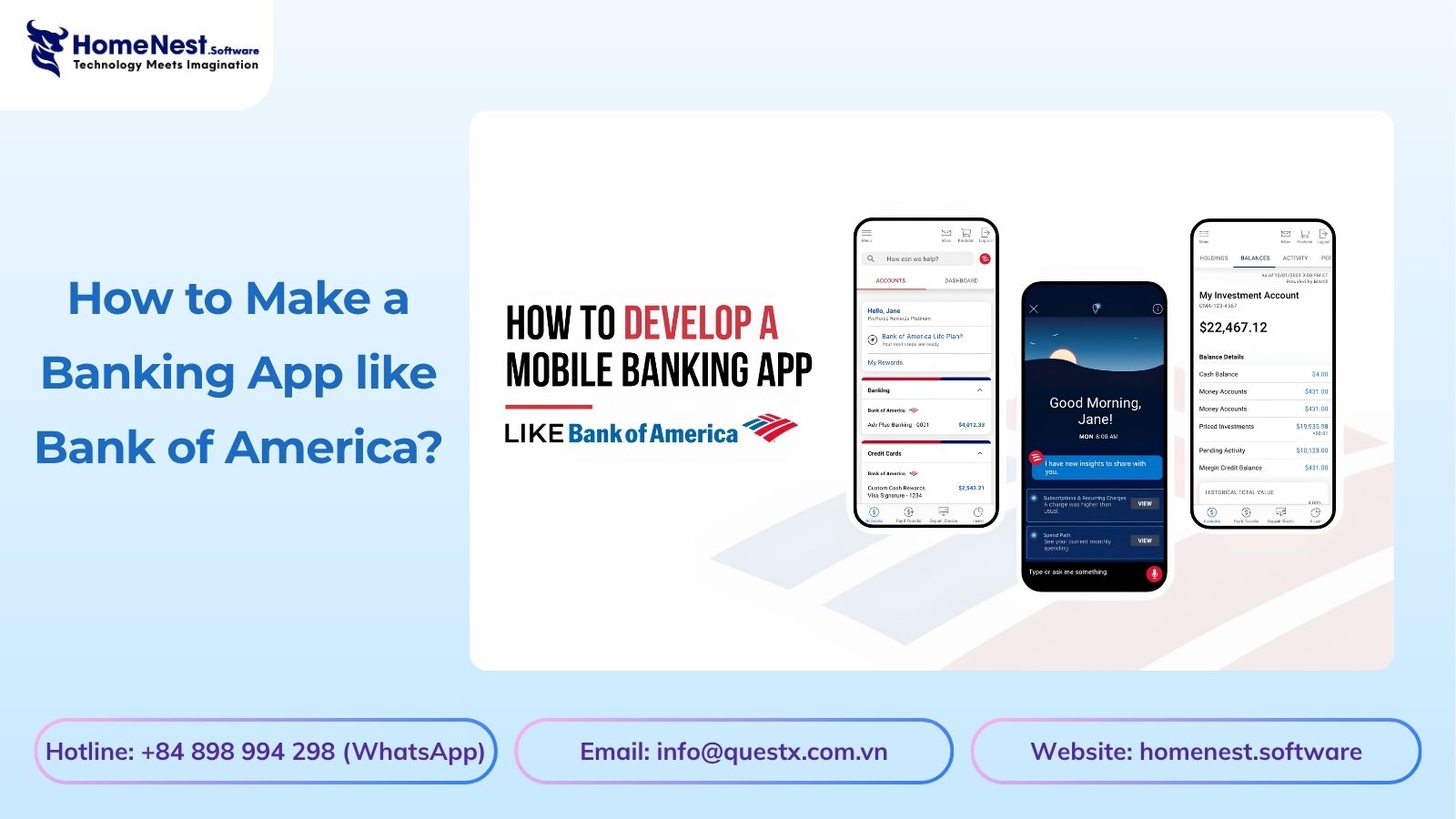
Developing a mobile banking application like Bank of America extends far beyond basic UI design; it requires engineering a fault-tolerant backend capable of real-time ledger synchronization, biometric authentication, and high-volume data processing under strict regulatory frameworks. Drawing from HomeNest Software’s deep experience in architecting enterprise-grade fintech solutions, this guide strips away theoretical jargon to focus entirely on operational and technical execution. What you will find in this guide: We break down the precise development roadmap, from mapping out microservices and ensuring PCI-DSS compliance to estimating MVP development costs and securing absolute data sovereignty through 100% source code ownership. If you are preparing to build, scale, or audit a financial platform, this blueprint provides the exact framework you need.
Phương Ly
Apr 21, 20260
Banking App Development Cost
INDUSTRY

Banking App Development Cost

Building a banking application is rarely a simple process; it’s a complex technical challenge requiring a balance between complying with stringent financial regulations, handling large transaction volumes, and a scalable cloud architecture. Miscalculating these technical requirements from the outset often leads to significant technical debt and budget overruns. Based on HomeNest Software’s practical experience in designing enterprise-grade fintech solutions, this guide bypasses generic estimates to provide a realistic analysis of banking application development costs. What you’ll find in this guide: We analyze the true cost factors, from technology selection and API integration to the hidden costs of regulatory compliance and security infrastructure. Whether you’re launching a minimum viable product or expanding an existing financial platform, this analysis provides the precise operational data you need to plan your budget effectively.
Phương Ly
Apr 21, 20260
How to Build a Mobile Banking App Like Chime
INDUSTRY

How to Build a Mobile Banking App Like Chime?

Building a mobile banking app like Chime is not just about features, it is about delivering a secure, scalable, and user-centric financial experience. From planning the right architecture to optimizing mobile banking app development cost, every decision directly impacts your product’s success. Leveraging Fintech app development services, starting with MVP app development, and scaling through on-demand app development solutions allows businesses to reduce risk and accelerate time to market. To stay competitive, combining Android app development services and iOS app development solutions ensures wider reach, while continuous updates through maintenance software development services keep your app secure and future-ready.

Phương Ly
Apr 21, 20260
How to Build a Banking App Like Barclays
INDUSTRY

How to Build a Banking App Like Barclays: A Complete Entrepreneur’s Guide

Building a banking app like Barclays requires more than just development. It demands a strong product vision, secure architecture, and a clear monetization strategy. From optimizing cost and selecting the right tech stack to ensuring compliance and scalability, every decision impacts long-term success. Partnering with an experienced team like HomeNest Software helps accelerate development, reduce risks, and deliver a high-quality fintech product that can compete in today’s fast-evolving digital banking landscape.

Phương Ly
Apr 21, 20260