
Vietnam vs India: Which Is the Best Outsourcing Country?
Vietnam stands out as a strong outsourcing destination for companies focused on long-term product development, thanks to its stable teams, predictable costs, and growing technical capabilities. While India remains effective for rapid scaling, Vietnam offers better continuity and control over time. Ultimately, success depends on choosing a partner who can align with your goals and grow with your product, not just deliver in the short term.
Scope of Work
As global teams reassess their outsourcing strategies, the comparison between Vietnam and India is becoming a critical decision point for tech leaders.
Rising cost pressures, talent shortages, and delivery risks are forcing companies to evaluate more carefully not just move faster.
In this guide, HomeNest Software takes a practical, on the ground look at both markets, helping you determine which destination truly aligns with your growth strategy in 2026.
Why the Vietnam vs India Comparison Matters More Than Ever for Global Businesses
Global teams are operating under real pressure today. Budgets are tighter, hiring cycles are slower, but delivery expectations haven’t changed. In that context, choosing an outsourcing partner is no longer a routine decision it’s a strategic one.
That’s exactly why the Vietnam vs India comparison has become increasingly important.
Both countries are well established in offshore development. Both consistently appear on shortlists. But in practice, they operate very differently. Understanding those differences early helps you avoid unnecessary complexity and build a more controlled, predictable outsourcing strategy.
Rising Demand Driven by AI and Automation
AI is reshaping how software gets built, from coding and testing to deployment and review. It’s not just about speed anymore; it’s about engineering maturity.
Companies are no longer outsourcing just to save costs. They’re looking for teams that can work with AI tools effectively from day one, not teams that are still catching up.
This is where the Vietnam vs India comparison becomes more nuanced.
One market tends to move faster with lean, highly focused teams. The other offers scale across a broader range of roles. That difference can significantly impact long term delivery performance.
Tighter Budgets in a Volatile Global Economy
With global tariffs, inflation, and uneven economic recovery, cost control has become a top priority.
Outsourcing is no longer just about finding the lowest rate, it’s about maintaining predictable, sustainable costs over time.
In this context, the India vs Vietnam cost structure becomes a key consideration. Stable, transparent pricing supports better planning, while wide fluctuations can introduce risk.
Vietnam, for example, is emerging quickly with its IT outsourcing sector reaching approximately $698 million in 2024 and continuing to grow. This reflects strong demand for high quality, cost effective services.
Talent Shortages Driving Offshore Strategy Earlier
Hiring locally remains a challenge across major tech hubs. Senior engineers are limited, hiring timelines are longer, and retention is harder.
As a result, many companies are moving offshore earlier in the product lifecycle, not just during scaling phases.
At that point, the choice between Vietnam and India directly affects:
- How quickly teams can be assembled
- How stable those teams remain over time
- How effectively they integrate into your delivery process
These factors explain why this comparison matters now more than ever.
You’re not simply choosing a location.
You’re defining how your teams will build, ship, and scale in the years ahead.
Vietnam Overview: A Fast Rising Tech Hub with Long Term Potential

Vietnam is no longer an emerging option on outsourcing shortlists it’s becoming a strategic destination for long term technology investment. You can see this shift clearly in deal pipelines, hiring strategies, and the growing number of sustained partnerships.
Rather than competing in the shadow of legacy markets, Vietnam is building its own trajectory driven by consistent talent development, a strong education system, and a focused commitment to technology.
A Talent Pipeline Built for Scale and Stability
Vietnam’s advantage starts with scale but what matters more is consistency and quality over time.
Each year, the country produces over 50,000 IT graduates, giving companies the ability to expand teams without aggressive hiring spikes. This steady inflow reduces pressure on senior engineers and supports more sustainable growth planning.
Beyond volume, the education system emphasizes STEM disciplines and applied problem solving. Graduates often enter projects with hands on experience, which shortens onboarding time and improves delivery efficiency.
What’s changing quickly is the skill mix. Universities are increasingly integrating AI, cloud computing, and cybersecurity into their curricula. This means teams are not just growing they’re staying aligned with modern technology stacks, reducing the need for extensive retraining.
Cost Structure That Supports Long Term Planning
Cost remains a central factor in outsourcing decisions but predictability matters more than headline rates.
Vietnam offers a balanced cost structure across junior to senior roles, allowing companies to build teams without extreme salary gaps. Compared to other markets, pricing tends to be more stable, with fewer fluctuations tied to geography or vendor scale.
This stability becomes a strategic advantage. Finance teams can plan multi year roadmaps with greater confidence, avoiding the disruptions caused by sudden rate increases.
In addition, operational costs including office space, utilities, and infrastructure remain relatively low in major tech hubs. Combined with more stable currency trends, this creates a more controlled cost environment for long term projects.
Where Vietnam Stands Out in Outsourcing
Vietnam’s real strengths become clear after teams move beyond the initial setup phase.
One of the most noticeable advantages is low attrition. Teams tend to stay together longer, which reduces the hidden costs of rehiring and retraining. Over time, this leads to more consistent velocity and fewer delivery disruptions.
There is also strong government support for digital growth, including incentives, tech parks, and workforce development programs. This creates a more stable environment for companies planning long term investments.
From an operational perspective, Vietnamese teams align well with Agile methodologies. Sprint cycles, continuous feedback, and iterative delivery are widely adopted, making collaboration with global product teams smoother.
At the same time, cross cultural collaboration is improving. Many teams now include professionals with international experience, helping bridge communication styles and reduce friction in distributed environments.
Challenges to Address Early
Like any outsourcing destination, Vietnam comes with trade offs but they are manageable with the right approach.
Communication style is one area to be aware of. Engineers may initially be more reserved in expressing disagreement, which can delay the surfacing of issues. Establishing clear feedback loops early helps mitigate this.
Cultural alignment also takes time. Differences in work habits, communication, and decision making can create friction if not addressed upfront. However, a structured onboarding process typically resolves these gaps quickly.
These are not structural barriers they are operational considerations that shape how teams are integrated and managed.
What This Means for Global Teams
Vietnam is not just a cost effective outsourcing destination.
It is a market built for steady scaling, predictable delivery, and long term collaboration.
For companies willing to invest in the partnership not just the price
Vietnam offers a model where quality compounds over time.
India Overview: A Mature Outsourcing Giant with Global Reach
India has been at the center of the global outsourcing industry for decades. A significant portion of enterprise systems worldwide has been built, maintained, or scaled by teams based there. Its combination of scale, experience, and global delivery capability continues to make it a top choice for organizations that need both depth and volume.
Deep Talent Pool Backed by Industry Maturity
India’s core advantage lies in its sheer workforce size and long standing delivery experience.
With an estimated 6 million IT professionals, the talent pool spans across web, mobile, data engineering, ERP, cloud infrastructure, and more. This breadth allows companies to assemble large, multi functional teams quickly a key factor in complex, enterprise scale programs.
The pipeline remains strong, with hundreds of thousands of engineering graduates entering the market each year. This continuous inflow supports rapid scaling, especially for companies that need to ramp up capacity in a short time.
Another defining strength is India’s deep experience with enterprise and legacy systems. Many teams have spent years working with ERP platforms, banking systems, and large scale data migrations. This makes India particularly well suited for projects involving modernization without disrupting existing operations.
A Cost Structure Defined by Scale and Variation
India’s pricing model reflects its scale offering flexibility, but also introducing variability.
Mid level engineering costs are often lower than in Vietnam, making India attractive for companies prioritizing rapid team expansion at competitive rates.
However, pricing can vary significantly depending on location, vendor size, and service model. Large firms typically command higher rates, while smaller vendors compete aggressively on price. Currency fluctuations can also impact short term budgeting and contract stability.
This wide range creates both opportunity and complexity. With the right vendor selection and governance, companies can optimize cost. Without it, variability can introduce risk into long term planning.
Where India Excels in Outsourcing
India’s reputation has been built on consistency at scale.
One of its strongest advantages is its familiarity with Western business environments. Decades of collaboration with clients from the US, Europe, and Australia have shaped communication styles, reporting structures, and delivery expectations. This reduces friction in large, structured engagements.
India also stands out in its ability to deliver at very large scale. Projects involving hundreds of engineers, distributed teams, and 24/7 development cycles are common. This model works particularly well for organizations with fixed timelines and heavy workloads.
English proficiency is another key strength. Communication across roles is generally strong, supporting smoother coordination in global teams even if nuances vary depending on experience level.
Challenges That Require Active Management
India’s scale brings complexity and that requires structured oversight.
One of the most common challenges is higher attrition, especially in major tech hubs. Engineers frequently move between companies for incremental salary increases, which can disrupt continuity in long term projects.
Large delivery centers can also introduce additional layers of process and hierarchy. While this structure supports governance, it may slow decision making and reduce agility compared to smaller, more focused teams.
Time zone differences can further impact collaboration. For companies in Europe or North America, overlapping working hours are limited, which can extend feedback cycles and require more reliance on asynchronous communication.
These challenges don’t limit success but they do require clear governance, strong communication frameworks, and proactive planning to manage effectively.
What This Means for Global Businesses
India remains one of the most powerful outsourcing destinations globally particularly for organizations that need:
- Large scale delivery
- Diverse technical capabilities
- Proven enterprise experience
For companies that can manage complexity and prioritize structure,
India offers a model built on scale, repetition, and global execution maturity.
Direct Comparison: Vietnam vs India Across Key Outsourcing Factors

When leaders evaluate outsourcing options, general statements are not enough. What really matters are the factors that affect delivery every day. Talent, cost behavior, communication, and team stability will determine whether a project runs smoothly or becomes difficult to manage over time.
Talent Availability and Skill Depth
Both Vietnam and India offer strong engineering talent, but they differ in how that talent performs in long term projects.
Vietnam has a fast growing workforce with a clear focus on modern technologies such as mobile, cloud, and AI. Teams are often smaller and more specialized. This helps them align quickly, take ownership, and reduce coordination overhead.
India offers a much larger and more diverse talent pool. It covers everything from modern development to legacy systems. This makes it a strong choice for large and complex programs, but it usually requires more structure and closer management to maintain consistency.
The key difference is how teams build experience. In Vietnam, teams grow through long term product ownership and stable collaboration. In India, experience is built through repeated delivery at scale across many projects.
Cost Efficiency and Long Term Value
Cost decisions rarely fail at the beginning. Problems usually appear later when rates change, teams shift, and budgets tighten.
Vietnam stands out for its predictability. Salary ranges are more consistent across roles and locations. This makes it easier to plan long term budgets and avoid unexpected increases.
India offers competitive entry level pricing, especially for mid level roles. However, pricing can vary widely depending on the vendor, city, and engagement model. This flexibility can be useful, but it also introduces more complexity when managing costs over time.
In simple terms, Vietnam is better suited for long term planning and stable investment. India is often chosen when companies need to scale quickly and accept more variation in cost.
English Skills and Communication Experience
Both countries work well in English, but the style and consistency are different.
Vietnam’s English proficiency has improved quickly, especially among younger engineers. Communication is usually clear and structured. Teams tend to be concise in meetings and effective in written updates.
India has broader English fluency across the workforce. This helps when coordinating across multiple teams and departments. However, communication styles and accents can vary depending on region and background.
In practice, communication quality depends more on team habits, feedback loops, and collaboration processes than on language alone.
Delivery Models and Team Stability
This is one of the biggest differences between the two markets.
Vietnam performs well with stable, long term teams. Engineers tend to stay longer, which helps retain knowledge and maintain consistent delivery. This is ideal for product development and continuous improvement over time.
India is strong in scaling teams quickly. It can support large programs with many engineers working across time zones. This works well for projects with strict timelines and heavy workloads. However, it often requires stronger coordination to maintain continuity.
Vietnam focuses on stability and long term ownership. India focuses on scale and speed.
Ecosystem and Infrastructure
Infrastructure affects how smoothly teams can operate on a daily basis.
Vietnam is investing steadily in digital infrastructure. Internet quality, power stability, and technology hubs continue to improve. Government support also plays a role in strengthening the ecosystem. This creates a reliable environment for long term development.
India has a more mature and widely distributed infrastructure. Major cities offer strong resources and support large operations. At the same time, scale can introduce challenges such as congestion and operational complexity in busy tech hubs.
Vietnam offers a more controlled and stable environment. India offers scale with more moving parts to manage.
What This Means for Your Business
This comparison is not about choosing which country is better. It is about choosing what fits your business model.
If your goal is to build long term products with stable teams and predictable costs, Vietnam is a strong option.
If your priority is rapid scaling and access to a very large talent pool, India remains a solid choice.
In the end, you are not just selecting a location. You are deciding how your teams will work, collaborate, and grow over time.
Why Choose Vietnam for Your Outsourcing Strategy
Outsourcing success is not just about where you build. It is about how your teams perform over time. When companies compare Vietnam with India, the real question is which model supports long term delivery, stability, and sustainable growth.
For most product driven businesses, Vietnam aligns better with those goals.
Vietnam works well for organizations that value focus, continuity, and clear ownership. Teams are comfortable working in short development cycles, responding quickly to feedback, and maintaining responsibility for what they build. Long term partnerships are common, which helps retain knowledge within the team and reduces disruption from frequent handovers. Cost structures also remain relatively stable as teams expand, making it easier to plan budgets over multiple years.
Another advantage is how teams operate on a daily basis. Smaller, well structured teams make communication more direct and decision making faster. Engineers are quick to adopt modern technologies such as cloud platforms and AI supported workflows, which helps speed up development and reduce the learning curve. Low attrition plays an important role as well. When teams stay together, progress builds steadily instead of restarting with each change.
India continues to be a strong option for companies that need large scale teams, continuous development across time zones, or deep experience with legacy systems. It is particularly effective for projects that require volume and rapid expansion.
However, for businesses focused on long term product development, stable collaboration, and predictable execution, Vietnam often delivers better results.
Vietnam is a strong fit for companies that plan ahead, value consistency, and want their development momentum to grow steadily year after year.
HomeNest Software – Your Reliable Vietnam Outsourcing Partner
After comparing talent, cost, delivery models, and team stability, the decision becomes more practical. The next step is choosing a partner who can turn those advantages into consistent results. That is where HomeNest Software comes in.
We work with global teams that want steady progress without unnecessary complexity. Our focus is on long term delivery, not short term wins.
Engineering Teams with Real Global Experience
Our engineers have worked with clients across the US, Europe, and Asia. They understand how products are built and evolved, not just how tasks are completed. This reduces back and forth, speeds up execution, and keeps development aligned with business goals.
Stable Teams That Grow with Your Product
We prioritize team continuity. Engineers stay with projects long enough to build deep understanding and take ownership. This helps retain knowledge, maintain momentum, and avoid the disruptions that come with frequent team changes.
Modern Development That Reduces Risk
Our teams use up to date technologies, including cloud platforms and AI supported workflows. We focus on early testing, continuous integration, and regular code reviews. This approach keeps issues small and manageable, instead of letting them grow into larger problems later.
Clear Communication and Transparent Progress
You always have a clear view of where things stand. Updates are concise and focused on what matters. Risks are identified early, and reporting is structured to support real decisions, not just documentation.
A True Extension of Your Team
We work as part of your team, not as a separate vendor. Planning, feedback, and priorities are shared. Decisions move quickly because there are no unnecessary layers or delays.
Choosing HomeNest Software means choosing consistency and long term thinking. You get a Vietnam based partner who understands global standards and is committed to building with you, not just delivering for you.
Conclusion
Choosing between Vietnam and India is not just about location. It reflects how you want your product teams to grow, collaborate, and stay stable over time.
For companies focused on long term product development, Vietnam often proves to be the better fit. It supports stable teams, consistent delivery, and a working model that scales without creating unnecessary complexity.
The key is not only choosing the right market, but also the right partner. You need a team that can grow with your roadmap, adapt as your product evolves, and maintain continuity throughout the journey.
If your priority is stable collaboration, clear communication, and predictable results, HomeNest Software is ready to support you.
Get in touch with us to explore how we can help you plan and execute your next outsourcing strategy with confidence.
FAQ
1. Is Vietnam cheaper than India for software outsourcing?
Not always at the entry level. India can offer lower rates for junior and mid level roles. However, Vietnam provides more stable pricing over time, which helps reduce unexpected cost increases in long term projects.
2. Which country is better for long term product development?
Vietnam is generally a better fit for long term product development due to lower attrition, more stable teams, and stronger focus on product ownership.
3. When should companies choose India over Vietnam?
India is a good choice when you need to scale quickly, require a large number of engineers, or are working with complex legacy systems that need specialized experience.
4. How does team stability compare between Vietnam and India?
Vietnam typically has lower attrition rates, which helps maintain continuity and retain project knowledge. India’s higher competition in major tech hubs can lead to more frequent team changes.
5. Is communication a challenge when outsourcing to Vietnam?
Not significantly. English proficiency in Vietnam is improving quickly, especially among younger engineers. With proper processes and regular communication, collaboration is smooth and effective.
6. What should I look for in an outsourcing partner in Vietnam?
Focus on team stability, experience with global clients, clear communication practices, and the ability to align with your product goals over time. A strong partner should act as an extension of your team, not just a vendor.
7. Why choose HomeNest Software as an outsourcing partner?
HomeNest Software offers stable engineering teams, modern development practices, and strong experience working with international clients. The focus is on long term collaboration, predictable delivery, and building products that scale with your business.
Latest Articles
View All
Criteria For Choosing The Right App Design Agency
UI/UX design is the logical foundation of a system, not merely a visual element. Choosing the wrong partner will directly lead to technical debt, budget overruns, and disruptions in the development process. This article provides a 6-step evaluation framework and a list of operational risks, helping businesses eliminate subjective design advice and accurately assess agency capabilities based on developer handoff standards and practical business performance.

How Does AI in Banking Industry Impact the Future?
Artificial intelligence (AI) has transitioned from a supplementary tool to a core infrastructure of financial data management, optimizing profitability through real-time fraud detection, natural language processing (NLP), and high-speed credit scoring models. “Deploying AI in the financial sector requires more than just algorithmic accuracy, it demands a highly secure cloud architecture and rigorous data governance,” commented Nguyen Tien, co-founder of HomeNest Software. Why read this guide? We skip the theoretical jargon to focus entirely on technical implementation. Whether you’re evaluating a vendor or planning a system overhaul, this article will detail: Operational Efficiency: Automating unstructured data workflows at scale. Risk Architecture: Implementing real-time threat detection and AML compliance. Data ownership: The essential need for 100% ownership of the source code to ensure full algorithm auditability.

How to Make a Banking App like Bank of America?
Developing a mobile banking application like Bank of America extends far beyond basic UI design; it requires engineering a fault-tolerant backend capable of real-time ledger synchronization, biometric authentication, and high-volume data processing under strict regulatory frameworks. Drawing from HomeNest Software’s deep experience in architecting enterprise-grade fintech solutions, this guide strips away theoretical jargon to focus entirely on operational and technical execution. What you will find in this guide: We break down the precise development roadmap, from mapping out microservices and ensuring PCI-DSS compliance to estimating MVP development costs and securing absolute data sovereignty through 100% source code ownership. If you are preparing to build, scale, or audit a financial platform, this blueprint provides the exact framework you need.
Banking App Development Cost
Building a banking application is rarely a simple process; it’s a complex technical challenge requiring a balance between complying with stringent financial regulations, handling large transaction volumes, and a scalable cloud architecture. Miscalculating these technical requirements from the outset often leads to significant technical debt and budget overruns. Based on HomeNest Software’s practical experience in designing enterprise-grade fintech solutions, this guide bypasses generic estimates to provide a realistic analysis of banking application development costs. What you’ll find in this guide: We analyze the true cost factors, from technology selection and API integration to the hidden costs of regulatory compliance and security infrastructure. Whether you’re launching a minimum viable product or expanding an existing financial platform, this analysis provides the precise operational data you need to plan your budget effectively.
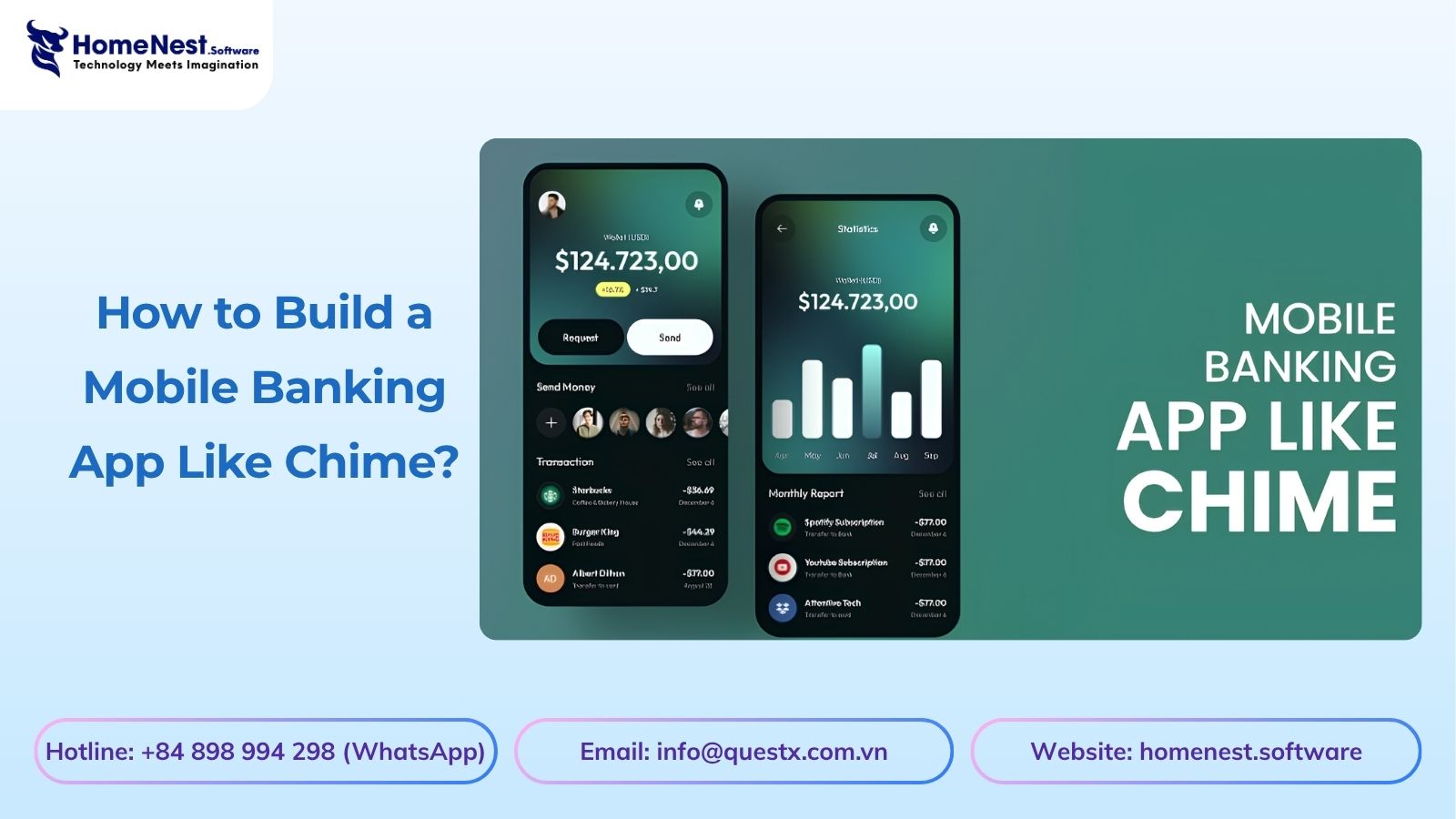
How to Build a Mobile Banking App Like Chime?
Building a mobile banking app like Chime is not just about features, it is about delivering a secure, scalable, and user-centric financial experience. From planning the right architecture to optimizing mobile banking app development cost, every decision directly impacts your product’s success. Leveraging Fintech app development services, starting with MVP app development, and scaling through on-demand app development solutions allows businesses to reduce risk and accelerate time to market. To stay competitive, combining Android app development services and iOS app development solutions ensures wider reach, while continuous updates through maintenance software development services keep your app secure and future-ready.

How to Build a Banking App Like Barclays: A Complete Entrepreneur’s Guide
Building a banking app like Barclays requires more than just development. It demands a strong product vision, secure architecture, and a clear monetization strategy. From optimizing cost and selecting the right tech stack to ensuring compliance and scalability, every decision impacts long-term success. Partnering with an experienced team like HomeNest Software helps accelerate development, reduce risks, and deliver a high-quality fintech product that can compete in today’s fast-evolving digital banking landscape.