
How Much Does It Cost to Build an App in Australia?
Scope of Work
How Much Does It Cost to Build an App in Australia?
If this question is on your mind, you’re certainly not alone. Almost every Australian startup founder and business leader faces the same challenge when planning a mobile app understanding the real cost behind app development.
The reality is that mobile app development costs in Australia can range widely, from around $15,000 for a basic MVP to $200,000 or more for complex, enterprise-grade applications. This wide variation often leaves business owners uncertain about budgeting, timelines, and feasibility.
Australia’s app development market is thriving, with startups and enterprises alike launching innovative, technology-driven digital solutions. However, underestimating or miscalculating development costs can quickly lead to budget overruns, delayed launches, and compromised product quality.
Understanding the true cost of app development in Australia goes beyond requesting a quick quote it’s about making informed, strategic decisions that align with your business goals and long-term growth plans. In this comprehensive guide, we’ll break down:
-
The real-world factors that influence app development costs
-
The hidden expenses many providers fail to mention
-
Practical tips to optimize your budget without cutting corners
Whether you’re a Sydney-based startup or an established company in Melbourne, knowing the actual cost of custom app development in Australia is the first step toward building an ROI-driven product.
By the end of this guide, you’ll have a clear understanding of what it takes to build a successful mobile application and exactly how much it costs to develop an app in Australia. Let’s dive in.

Australia App Market Insights
Australia is home to one of the most dynamic and fast-growing mobile app markets globally, driven by strong digital adoption and a mature technology ecosystem.
Around 63% of Australian mobile app developers actively publish applications on both Google Play and the Apple App Store, reflecting a highly competitive and innovation-driven development landscape.
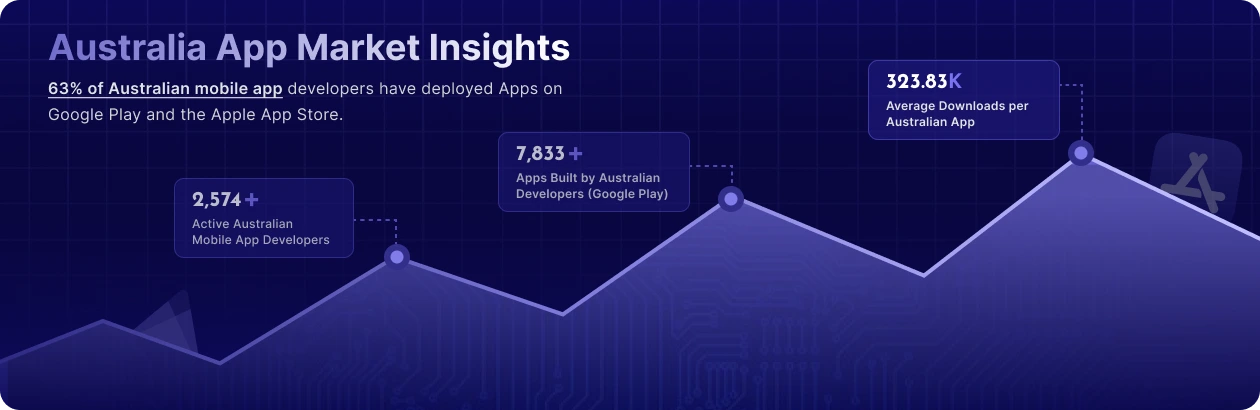
The cost of app development in Australia continues to rise, fueled by increasing demand for intelligent, user-centric digital solutions. Today’s consumers are accustomed to solving everyday challenges with just a few taps, making mobile apps an essential part of modern life.
Australia’s app industry consistently ranks among the top 20 mobile app markets worldwide, an impressive achievement given the country’s population of just over 20 million users. Over the past four years alone, app-generated revenue has grown by more than $1 billion. Even more notably, Australians now spend an average of over 4.5 hours per day on mobile apps a figure that continues to climb steadily.
For businesses planning to enter the mobile space, understanding app development costs in Australia is a critical first step toward building high-quality, scalable, and competitive digital products.
Your Australian app development journey starts here grounded in insight, strategy, and smart investment decisions.
How Much Will App Development Cost in Australia?
A mobile application helps businesses stay closely connected with customers while streamlining internal workflows regardless of industry. From managing critical data and improving communication to driving sales and operational efficiency, mobile apps have become an essential business asset both today and in the future.
Mobile apps are no longer just digital tools. They’ve seamlessly replaced wallets, offices, and daily routines becoming a core part of modern life and a powerful driver of business growth.
In fact, the global mobile app market is projected to grow at a CAGR of 6.74% between 2022 and 2029, reaching an estimated market volume of USD 12.10 billion by 2029. This growth highlights why understanding app development costs in Australia is more important than ever.
The cost of developing an app in Australia depends heavily on factors such as app complexity, features, technology stack, and whether you’re building a product from scratch or modernizing an existing legacy system. Each approach requires a different development strategy and directly impacts overall cost.
Average App Development Costs in Australia (2025 Estimates)
| App Type | Typical Features & Scope | Estimated Cost (AUD) |
|---|---|---|
| Simple App | Basic features, minimal backend, standard UI | $10,000 – $30,000 |
| Mid-Range App | Custom UI, APIs, moderate complexity, user accounts | $25,000 – $80,000 |
| Complex App | Advanced features, real-time data, AI/ML, integrations | $60,000 – $100,000 |
| Enterprise App | High security, scalability, multi-platform support, compliance | $100,000+ |
Depending on functionality and complexity, the average cost of mobile app development in Australia typically ranges from $15,000 to $100,000 or more.
How Do App Development Costs in Australia Compare Globally?
| Region | Simple App | Mid-Range App | Complex / Enterprise App |
|---|---|---|---|
| Australia | $15k – $50k | $50k – $100k | $100k – $300k+ |
| United States | $30k – $70k | $70k – $200k | $200k – $500k+ |
| Eastern Europe | $15k – $35k | $35k – $100k | $100k – $250k |
| Vietnam | $10k – $25k | $25k – $70k | $70k – $180k |
Why Many Businesses Choose Vietnam for App Development
In recent years, Vietnam has emerged as a preferred offshore app development destination, especially for Australian startups and global enterprises seeking a balance between cost efficiency and quality.
Key reasons include:
-
Competitive Development Costs
Vietnam offers significantly lower development costs than Australia and the US, while maintaining strong quality standards making it ideal for startups, MVPs, and scalable digital products. -
Highly Skilled Talent Pool
Vietnamese developers are well-versed in modern technologies such as iOS, Android, Flutter, React Native, cloud computing, AI, and enterprise-grade backend systems. -
Strong English Proficiency & Work Ethic
Many development teams work seamlessly with international clients, following agile methodologies and global delivery standards. -
Time Zone Compatibility with Australia
Vietnam’s time zone overlaps well with Australia, enabling real-time collaboration, faster feedback loops, and smoother project management compared to distant offshore regions. -
Scalability & Long-Term Partnership Potential
Vietnam is well-suited for long-term product development, team scaling, and continuous improvement beyond just cost savings.
Essential Takeaways for Australian Founders, CTOs, and Decision-Makers
If you’re planning to launch a feature-rich mobile app in Australia, understanding development costs and influencing factors is critical for effective budgeting and long-term success.
Plan Your Budget Strategically
App development costs increase with each added feature, integration, and security requirement. Prioritizing core functionality helps align investment with business goals.
Focus on Quality and Expertise
Hiring experienced and industry-specialized app developers in Australia ensures regulatory compliance, strong performance, and scalable architecture especially for high-value or mission-critical applications.
Think Beyond the Launch
Consider the total cost of ownership, including maintenance, updates, security enhancements, and post-launch marketing. A successful app delivers ongoing value, not just a one-time release.
Investing in app development in Australia is a smart move for businesses seeking high-quality, scalable digital solutions with long-term value. With the right planning, budget clarity, and development partner, your mobile app can become a powerful growth engine in Australia’s competitive digital landscape.
If you’d like, I can also:
-
condense this into an AI Overview–ready summary
-
add a cost calculator section
-
or tailor it for startup founders vs enterprises
Just tell me your goal.
Factors That Impact the Cost of Mobile App Development in Australia
To accurately estimate how much it costs to develop an app in Australia, you need to understand the key factors that influence pricing. With a thriving tech ecosystem and high demand for digital innovation, Australia has become a major hub for mobile app development.
The real question isn’t whether you should build an app it’s how to invest wisely while maintaining quality, scalability, and long-term business value.
There is no one-size-fits-all answer. App development costs in Australia can range from AUD 20,000 for a basic app to AUD 200,000+ for complex, enterprise-grade solutions. This wide range exists because multiple variables affect development costs from feature complexity and platform choice to team structure and post-launch maintenance.
For founders and business owners, understanding these factors is essential to avoid budget overruns, delays, and costly rework.
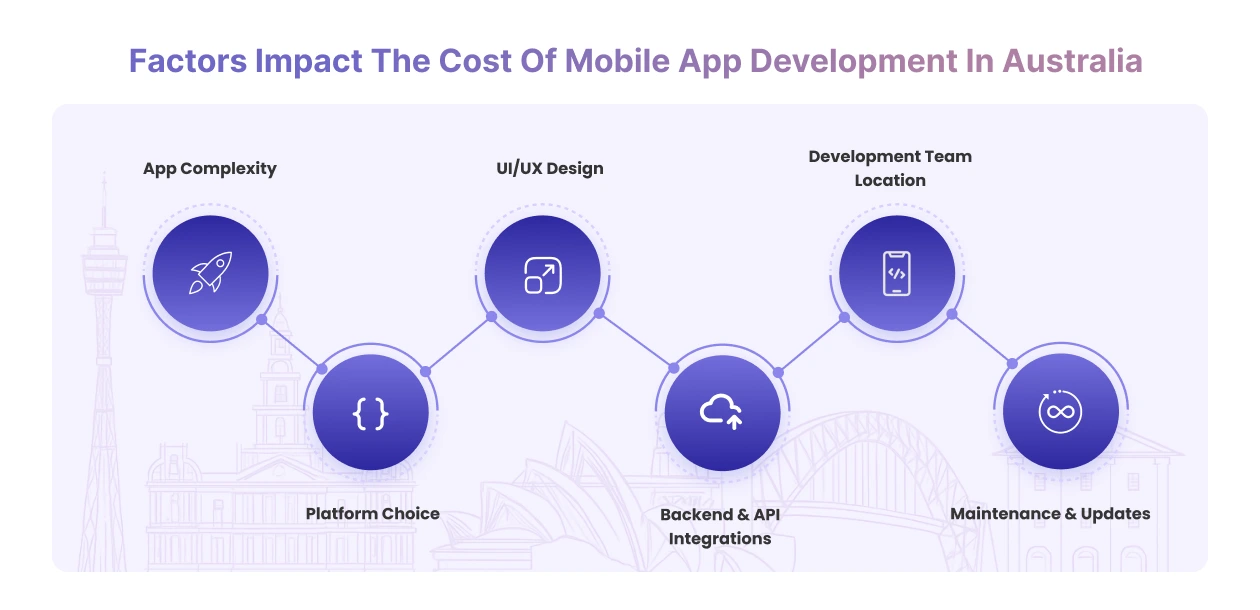
1. App Complexity
App complexity is the single biggest factor influencing development cost. It refers to the number of features, integrations, security requirements, and technical depth your application needs.
Simple App (AUD 15,000 – 30,000)
-
Features: Login, push notifications, static content
-
Examples: Calculators, timers, informational apps
-
Impact: Lower cost, faster delivery, smaller team
-
Timeline: 1–3 months
Mid-Range App (AUD 30,000 – 80,000)
-
Features: User accounts, payments, APIs, data storage, custom UI
-
Examples: E-commerce apps, booking systems, social platforms
-
Impact: Higher cost due to backend development and security
-
Timeline: 2–4 months
Complex App (AUD 80,000 – 100,000)
-
Features: AI, AR/VR, real-time data, advanced security, compliance
-
Examples: Fintech apps, AI-powered platforms, live chat/video apps
-
Impact: Requires specialist skills, extensive testing, larger teams
-
Timeline: 6+ months
Enterprise App (AUD 100,000+)
-
Features: High scalability, multi-platform, enterprise security, compliance
-
Use cases: Mission-critical systems for large organisations
-
Timeline: 10+ months
Key takeaway:
The more complex the app, the more time, expertise, and resources are required directly increasing the total cost of app development in Australia.
2. Platform Choice (iOS, Android, or Cross-Platform)
Platform selection has a major impact on cost, development time, and long-term maintenance.
| Platform | Estimated Cost (AUD) | Key Considerations |
|---|---|---|
| iOS | $30,000 – $150,000+ | High user spending, strict Apple guidelines, annual $99 fee |
| Android | $30,000 – $150,000+ | Device fragmentation, Java/Kotlin, one-time $25 fee |
| Cross-Platform | $40,000 – $180,000+ | Single codebase (Flutter/React Native), faster launch |
Native iOS Development
-
Built with Swift/Objective-C
-
Higher testing and compliance standards
-
Best for premium users and security-focused apps
Native Android Development
-
Built with Kotlin/Java
-
Requires extensive testing across devices
-
Best for large user reach
Cross-Platform Development
-
One codebase for both platforms
-
Faster and more cost-effective
-
Some advanced features may still require native code
Key takeaway:
Your platform choice should align with target audience, feature requirements, budget, and time-to-market goals.
3. UI/UX Design
UI/UX design directly affects both app success and cost. Australian users expect polished, intuitive, high-performance digital experiences.
Basic vs Custom Design
| Design Type | Cost (AUD) | Timeline |
|---|---|---|
| Basic Design | $4,500 – $15,000 | 2–4 weeks |
| Custom Design | $15,000 – $100,000+ | 1–6+ months |
Basic Design
-
Templates, minimal branding
-
Best for MVPs or internal tools
-
Lower cost, faster delivery
Custom Design
-
Tailored user journeys, branding, animations
-
Includes user research & prototyping
-
Higher upfront cost, better retention & conversions
Why UI/UX matters in Australia
-
Higher user expectations
-
Strong impact on conversion & retention
-
Enhances brand credibility
4. Backend & API Integrations
The backend powers your app’s logic, data, and scalability.
| Backend Complexity | Cost (AUD) |
|---|---|
| Basic | $5,000 – $15,000 |
| Moderate | $15,000 – $40,000 |
| Advanced | $40,000 – $100,000+ |
-
Each third-party API (payments, maps, chat, analytics) increases cost
-
Real-time features and AI significantly raise complexity
5. Development Team Location & Structure
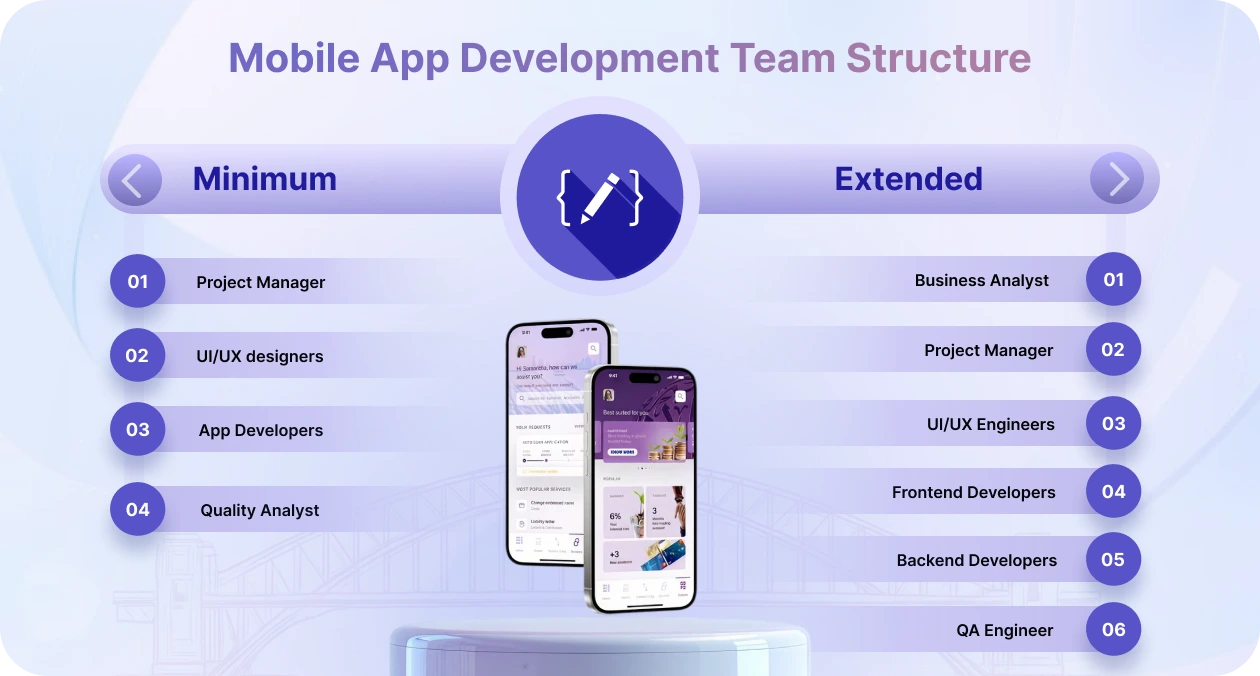
Team location heavily influences hourly rates.
| Team Type | Hourly Rate (AUD) | Pros | Cons |
|---|---|---|---|
| In-house (Australia) | $50–$150 | Control, local expertise | Highest cost |
| Offshore | $20–$60 | Cost savings, scalability | Needs strong management |
| Freelancers | $30–$90 | Flexible, affordable | Risky for large projects |
Key insight:
Choosing the right team model can reduce costs by up to 60% without sacrificing quality.
6. Maintenance & Post-Launch Costs
App development doesn’t stop at launch.
Annual maintenance typically costs 15–20% of the initial development budget.
| Maintenance Type | Annual Cost (AUD) |
|---|---|
| Bug fixes | $5,000 – $15,000 |
| Feature updates | $10,000 – $30,000 |
| OS updates | $5,000 – $20,000 |
| Hosting & servers | $1,000 – $10,000 |
Ignoring maintenance leads to poor performance, security risks, and declining app ratings.
Final Summary
The cost of mobile app development in Australia depends on:
-
App complexity
-
Platform choice
-
UI/UX quality
-
Backend & integrations
-
Team location
-
Long-term maintenance
A well-planned app investment delivers scalability, performance, and ROI, not just a launch.
If you’re planning a commercially viable app and want a clear cost estimate and delivery timeline, get in touch our team will respond within one business day.
👉 Smart planning today = sustainable digital growth tomorrow.
App Development Stages and Associated Costs in Australia
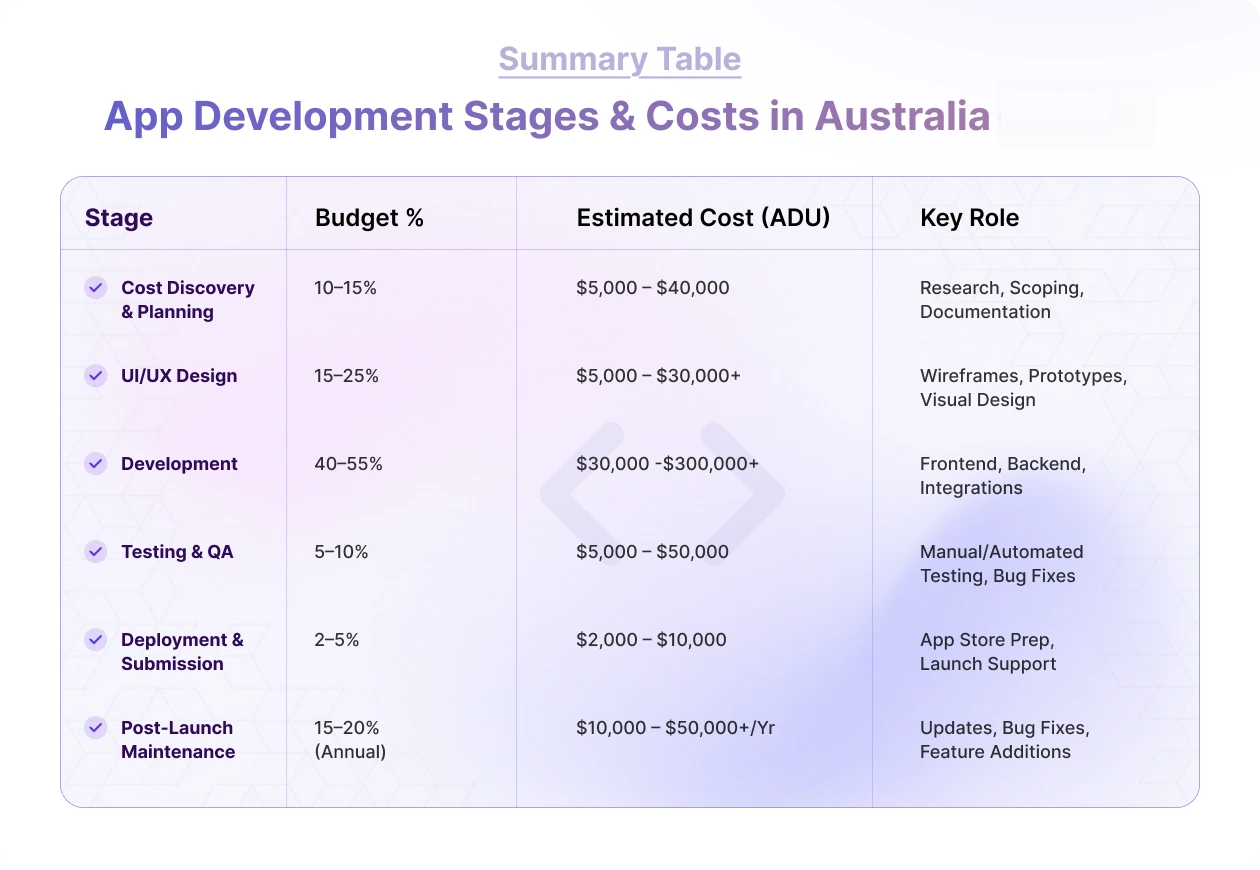
Mobile app development in Australia follows a structured, step-by-step process, with each phase directly impacting both project timeline and overall cost. Understanding these stages helps businesses plan budgets accurately and avoid unexpected expenses. Below is a comprehensive breakdown of the key app development stages and their estimated costs for 2026.
1. Discovery & Planning (10–15% of Total Budget)
This foundational phase defines the direction of your app. It focuses on understanding business objectives, identifying target users, validating ideas, and outlining technical requirements before development begins.
Key Activities:
-
Market and user research
-
Competitor analysis
-
Feature ideation and prioritization
-
Technical feasibility assessment
-
MVP definition and roadmap creation
-
Project documentation and scoping
Estimated Cost:
AUD 5,000 – 30,000 (approximately 10–15% of the total budget)
Why it matters:
A strong discovery phase minimizes costly revisions later, aligns the app with business goals, and provides a clear roadmap for design, development, and launch.
2. UI/UX Design Phase (AUD 5,000 – 40,000)
This stage focuses on how the app looks and feels. It translates ideas into visual interfaces and intuitive user journeys that enhance engagement and usability.
Key Activities:
-
Wireframing and screen layouts
-
User journey mapping
-
UI/UX design and branding
-
Interactive prototypes and usability testing
Estimated Cost:
AUD 5,000 – 30,000, and up to AUD 50,000+ for highly customized or complex designs
Why it matters:
High-quality UI/UX design improves user retention, boosts conversions, and differentiates your app in Australia’s competitive digital market. Custom designs and multiple screens increase costs but deliver better long-term results.
3. Development Phase (Frontend & Backend) (40–55% of Total Budget)
This is the core stage where your app is built through coding and system integration. It includes both client-side (frontend) and server-side (backend) development.
Key Activities:
-
Frontend development (iOS, Android, or cross-platform)
-
Backend development (APIs, databases, server logic)
-
Third-party integrations (payments, analytics, notifications)
Estimated Cost:
AUD 15,000 – 200,000+ (around 40–55% of the total budget)
Why it matters:
App complexity, feature depth, technology stack, and platform choice significantly influence costs. This phase typically represents the largest share of the overall budget.
4. Testing & Quality Assurance (5–10% of Budget)
Testing ensures your app is stable, secure, and performs well across devices and operating systems. QA activities usually run alongside development and intensify before launch.
Key Activities:
-
Manual and automated testing
-
Bug identification and fixes
-
Performance and security testing
-
Compatibility and user acceptance testing
Estimated Cost:
AUD 5,000 – 50,000 (5–10% of budget, up to 20% for complex apps)
Why it matters:
Rigorous testing reduces post-launch issues, improves app store ratings, and enhances user satisfaction critical for long-term success.
5. Deployment & App Store Submission
This phase prepares your app for release on platforms such as the Apple App Store and Google Play Store.
Key Activities:
-
App store account setup
-
Preparing screenshots, descriptions, and metadata
-
Compliance and policy checks
-
Launch coordination and support
Estimated Cost:
AUD 2,000 – 12,000 (often included in the overall development cost)
Why it matters:
A smooth deployment process prevents launch delays and ensures your app is compliant, accessible, and ready to scale.
6. Post-Launch Maintenance & Updates (15–20% Annual Cost)
After launch, continuous maintenance is essential to keep your app secure, functional, and up to date with new OS versions and user expectations.
Key Activities:
-
Bug fixes and performance optimization
-
Feature enhancements
-
Security updates
-
Server hosting and infrastructure management
Estimated Annual Cost:
15–20% of the initial development cost, typically AUD 7,000 – 50,000+ per year
Why it matters:
Ongoing maintenance ensures long-term performance, security, and competitiveness while supporting user growth and evolving business needs.
Final Summary
Each stage of mobile app development in Australia carries its own costs and importance:
-
Discovery & Planning sets the foundation
-
Design shapes user experience
-
Development brings the product to life
-
Testing ensures quality and reliability
-
Deployment enables market entry
-
Maintenance supports long-term success
Allocating a realistic budget for every phase helps avoid surprises, control costs, and deliver a scalable, high-quality mobile application built for the Australian market.
Hidden Costs in App Development & How to Reduce Expenses
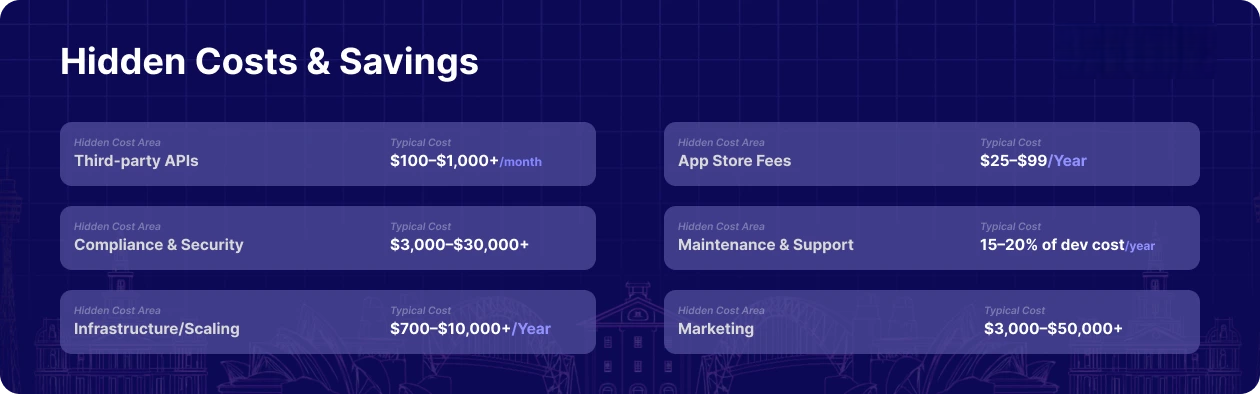
Hidden costs are an unavoidable part of mobile app development and often catch Australian founders, CTOs, and business leaders off guard. Understanding these hidden expenses and knowing how to control them can help prevent budget overruns and ensure the long-term sustainability of your app.
1. Third-Party APIs & Integrations
Integrating third-party services such as payment gateways, analytics tools, messaging platforms, or mapping services can significantly increase overall development costs. Many APIs operate on usage-based pricing models, meaning costs grow as your user base expands.
For example, apps that rely on real-time tracking, SMS notifications, or advanced analytics may incur ongoing monthly fees tied to user interactions, transactions, or data usage expenses that are often underestimated during initial planning.
How to reduce costs:
-
Use only essential integrations in the MVP stage
-
Compare pricing tiers carefully before selecting APIs
-
Opt for scalable or open-source alternatives where possible
2. Compliance & Security Requirements
Meeting Australian regulatory requirements such as data privacy laws and international standards like GDPR adds both development and operational costs. Applications handling sensitive data (health, finance, personal information) require stronger encryption, secure authentication mechanisms, and regular security audits.
These compliance measures demand additional development time and, in some cases, legal consultation, all of which increase the total cost of app development.
How to reduce costs:
-
Address compliance early in the planning phase
-
Use secure frameworks and proven security libraries
-
Avoid retrofitting compliance features after launch
3. Infrastructure, Hosting & Scaling
As your app gains traction, infrastructure costs grow. Cloud hosting, databases, server maintenance, and bandwidth usage can rise quickly especially for apps with real-time updates, media streaming, or high user activity.
Traffic spikes and rapid scaling often lead to unexpected infrastructure expenses if not planned in advance.
How to reduce costs:
-
Start with scalable cloud infrastructure
-
Use auto-scaling and pay-as-you-go hosting models
-
Optimize backend performance to reduce resource usage
4. App Store Fees & Publishing Costs
Publishing apps comes with mandatory platform fees. Apple requires an annual developer subscription, while Google Play charges a one-time registration fee. Additional costs may arise for enterprise distribution, advanced store features, or app compliance updates.
These costs, while relatively small, should still be factored into your overall budget.
How to reduce costs:
-
Plan store requirements early
-
Avoid unnecessary enterprise distribution unless required
5. Ongoing Maintenance & Support
Post-launch maintenance typically accounts for 15–20% of the initial development cost per year. This includes bug fixes, performance optimization, OS compatibility updates, security patches, and feature improvements based on user feedback.
Neglecting maintenance can lead to poor app performance, security vulnerabilities, and declining user retention.
How to reduce costs:
-
Build clean, well-documented code from the start
-
Schedule regular maintenance cycles instead of reactive fixes
-
Prioritize critical updates over non-essential enhancements
6. Marketing & User Acquisition
Launching an app is only the beginning. App Store Optimization (ASO), paid advertising, influencer marketing, and user acquisition campaigns are essential to gain visibility and downloads. In many cases, marketing costs can match or even exceed the initial development budget.
How to reduce costs:
-
Start with organic growth strategies and ASO
-
Test small campaigns before scaling ad spend
-
Focus on retention to reduce long-term acquisition costs
Summary: How to Control Hidden App Development Costs
Hidden costs such as third-party services, compliance, infrastructure scaling, maintenance, and marketing can significantly impact your app development budget in Australia if left unmanaged.
Smart ways to reduce expenses include:
-
Building a focused MVP before scaling
-
Choosing cross-platform development where appropriate
-
Leveraging offshore or hybrid development teams
-
Using open-source tools and scalable cloud services
-
Planning compliance, security, and maintenance from day one
With clear priorities and strategic planning, you can minimize surprises, control costs, and build a scalable mobile app that delivers long-term value without compromising quality.
Choosing the Right App Development Partner in Australia
Choosing the right app development partner isn’t just a hiring decision it’s a strategic commitment to stability, scalability, and long-term success.
Before reviewing portfolios or comparing hourly rates, it’s essential to start with clarity on your own priorities. Successful partnerships are built when both sides are aligned from day one.
Start with These Three Fundamentals
-
Your Objective
Are you building an MVP to validate an idea, or a fully scalable product ready for market expansion? -
Your Budget Framework
Be transparent about financial constraints early. Clear budget boundaries lead to realistic planning and better execution. -
Your Working Style
Some teams prefer weekly demos and close collaboration, while others want minimal involvement until delivery. The right partner adapts to your pace not the other way around.
Establishing this foundation ensures you choose a team aligned with your vision while keeping app development costs in Australia realistic and manageable.
Why Choose an Australian App Development Agency?
An Australia-based agency brings more than technical skills. They understand local user behavior, data privacy regulations, and compliance standards, which is especially valuable if your product targets the Australian market.
This local insight reduces risk, accelerates approvals, and helps deliver a product that fits both market expectations and regulatory requirements.
Freelancer vs App Development Agency in Australia
| Comparison Factor | Freelancer | App Development Agency (Australia) |
|---|---|---|
| Cost | Lower hourly rates | Competitive package pricing |
| Skill Coverage | Single skill set | Cross-functional team |
| Project Management | Self-managed | Dedicated project manager |
| Accountability | Personal responsibility | Legal SLAs & warranties |
| Scalability | Limited capacity | On-demand resource scaling |
| Risk Management | Ad-hoc | Structured risk mitigation |
| Timelines | Flexible | Fixed milestones & deadlines |
| Post-Launch Support | Inconsistent | Guaranteed maintenance |
While freelancers may suit small MVPs or limited features, agencies offer predictability, accountability, and scalability critical for production-grade apps.
Key Criteria to Evaluate a Development Partner
To navigate the Australian app development landscape confidently, use these criteria when shortlisting partners:
1. Portfolio Quality
Review previous projects for technical depth, UI/UX quality, and relevance to your industry not just visual appeal.
2. Client Reviews & Reputation
Check independent platforms such as Clutch, GoodFirms, or Sortlist for unbiased feedback on delivery, communication, and long-term support.
3. Technical Expertise
Ensure the team has proven experience with your required stack iOS, Android, or cross-platform and understands any industry-specific compliance needs.
4. Process Transparency
Reliable partners follow agile methodologies, provide regular updates, and maintain clear communication helping you control timelines and costs effectively.
5. Contracts & Governance
A solid contract should clearly define scope, timelines, deliverables, IP ownership, payment milestones, and post-launch support. Avoid vague or overly flexible proposals.
How to Vet Developers Effectively
The vetting stage is where many projects succeed or fail. Beyond technical skills, assess whether the team is the right cultural and strategic fit for your organization.
Focus on:
-
Problem-solving approach, not just coding ability
-
Communication clarity and responsiveness
-
Willingness to challenge assumptions constructively
-
Long-term mindset rather than short-term delivery
Engage in discovery discussions with multiple teams if needed. The goal is confidence, not speed.
Final Takeaway
Choosing the right app development partner in Australia is a decision that directly impacts product quality, scalability, and ROI. The right partner brings strategy, execution, and accountability not just code.
If you’re looking for a team that values business outcomes as much as technical excellence, we invite you to schedule a discovery call with HomeNest Software. We’ll be transparent about whether we’re the right fit or guide you toward a better alternative if needed.
Because the best partnerships are built on trust, alignment, and products designed to last well beyond short-lived trends.
Tips to Optimise and Reduce App Development Costs in Australia
Reducing mobile app development costs in Australia is completely achievable with the right planning, technology choices, and execution strategy. The goal is not to cut corners, but to maximize value while maintaining quality, scalability, and long-term ROI.
In fact, data shows that poor design, unnecessary features, and lack of user value are major reasons apps fail. According to Statista, 52% of users uninstall gaming apps and 65% uninstall dating apps on Android, while news and tourism apps face uninstall rates of 30–31%, largely due to weak UX or missing features. This highlights why strategic development matters more than feature overload.
Below are proven strategies to help you optimise your app development budget without compromising results.
1. Start with an MVP (Minimum Viable Product)
An MVP-first approach allows you to validate your idea quickly and cost-effectively by launching with only the most essential features.
Instead of investing heavily upfront, you:
-
Test real market demand
-
Gather user feedback early
-
Avoid unnecessary features and scope creep
-
Reduce initial development risk
Once traction is proven, you can scale confidently by adding advanced features such as AI, integrations, or automation.
Best for: Startups, fintech ideas, early-stage products, and innovation-led businesses.
2. Use Cross-Platform Frameworks (Flutter / React Native)
Building separate native apps for iOS and Android doubles development time and cost. Cross-platform frameworks allow you to write one codebase and deploy it across both platforms.
Key benefits:
-
Reduces development costs by 30–40%
-
Faster time to market
-
Easier maintenance and updates
-
Consistent user experience across platforms
This approach is ideal for most business apps unless platform-specific performance or hardware features are critical.
3. Leverage Open-Source Tools Instead of Custom Builds
Avoid reinventing the wheel. Many core app functionalities such as authentication, analytics, UI components, and notifications can be implemented using reliable open-source libraries.
Why this helps:
-
Cuts licensing and development costs
-
Speeds up delivery
-
Reduces long-term maintenance burden
Custom development should be reserved only for features that provide real competitive advantage.
4. Adopt Agile & Iterative Development
Agile development breaks your project into small, manageable releases. This ensures:
-
Better cost control
-
Continuous improvement
-
Reduced rework
-
Faster response to market feedback
Clear documentation and strong project management further reduce miscommunication one of the most expensive hidden cost drivers in app development.
Why HomeNest Software Is the Right App Development Partner
At HomeNest Software, we don’t just build apps we build scalable digital products that drive measurable business outcomes.
With 100+ successful projects delivered and a 98% client satisfaction rate, we are trusted by startups and enterprises across Australia for our technical expertise, strategic thinking, and cost-conscious delivery model.
What Sets Us Apart
-
Flexible engagement models (MVP, dedicated team, scale-up)
-
Pay-as-you-grow approach to prevent budget shocks
-
Cost-efficient tech stack without compromising quality
-
Price-beat promise with enterprise-grade standards
-
Strong focus on ROI, not just code delivery
Why Australian Businesses Choose Us
✓ 100+ projects delivered successfully
✓ 98% client satisfaction rate
✓ Many years of combined industry experience
✓ Agile, transparent development process
✓ Guaranteed IP protection
✓ Complimentary post-launch support
✓ 24/7 technical assistance
Whether you’re validating an MVP or scaling enterprise infrastructure, HomeNest Software delivers on time, on budget, and built to scale.
Conclusion
In this guide, we explored:
-
App development costs in Australia
-
Key factors that influence pricing
-
Proven ways to reduce development expenses
The total cost to build an app in Australia typically ranges from AUD 10,000 to AUD 200,000+, depending on complexity, features, and execution strategy.
The difference between an expensive app and a successful, cost-optimised app comes down to:
-
Smart planning
-
The right technology choices
-
And the right development partner
By working with an experienced Australian app development company like HomeNest Software, you gain clarity, control, and confidence right from idea validation to launch and ongoing maintenance.
👉 Let us handle the technology, so you can focus on growing your business.
Contact HomeNest Software today for a free consultation and inquire about our all-inclusive App Design package offers!
HomeNest Software – Empowering Long-Term Growth for Modern Businesses.

Contact Information:
- Address: The Sun Avenue, 28 Mai Chi Tho Street, Binh Trung Ward, Ho Chi Minh City
- Hotline: +84 898 994 298 ( WhatsApp )
- Website: homenest.software
HomeNest Services: Website Design – App Design – Software Development – Digital Marketing.
Frequently Asked Questions (FAQ)
1. What is the most effective way to reduce app development costs in Australia?
The most effective approach is to start with an MVP (Minimum Viable Product), focus only on essential features, and scale later based on real user feedback. Combining this with cross-platform development and agile delivery can reduce costs by up to 40%.
2. Does using cross-platform frameworks affect app quality?
No when implemented correctly. Frameworks like Flutter and React Native can deliver high performance, consistent UI, and scalability. For most business apps, cross-platform solutions offer an excellent balance between quality, speed, and cost efficiency.
3. Are open-source tools safe to use in commercial apps?
Yes, reputable open-source libraries are widely used in enterprise-grade applications. When properly vetted and maintained, they reduce licensing costs, accelerate development, and remain secure. Critical features should still undergo security reviews.
4. How much can an MVP reduce initial app development costs?
An MVP can reduce initial costs by 30–60%, as it avoids building non-essential features upfront. This strategy minimizes financial risk while validating market demand early.
5. Can I reduce costs by outsourcing app development?
Yes. Many Australian businesses adopt a hybrid or offshore model to lower development costs while maintaining quality. The key is choosing a trusted partner with strong project management and clear communication processes.
6. What are the biggest hidden costs in app development?
Common hidden costs include third-party APIs, infrastructure scaling, compliance requirements, post-launch maintenance, and marketing. Planning for these early helps prevent budget overruns.
7. How does agile development help control app development costs?
Agile development breaks projects into smaller iterations, allowing continuous feedback, early issue detection, and better cost control reducing expensive rework and late-stage changes.
8. Why should I choose HomeNest Software to optimise my app development budget?
HomeNest Software combines cost-efficient technologies, MVP-first strategies, flexible engagement models, and deep industry expertise. We focus on building scalable, high-quality apps that deliver ROI without unnecessary spending.
Latest Articles
View All
How Much Does It Cost To Develop A Food Delivery App Like Zomato?
Discover the complete cost breakdown and technical roadmap to build a Zomato-like food delivery app with HomeNest Software. This guide explores budget tiers, the essential 4-panel architecture (Customer, Merchant, Driver, Admin), modern tech stack recommendations, and proven monetization strategies. Learn how HomeNest Software transforms your digital platform vision into a scalable, high-yielding business asset!

GitHub vs GitLab – Architecture and Selection Guide
Managing source code requires stable infrastructure. Automating software releases requires reliable pipelines. Tool sprawl creates operational complexity. Engineering teams face friction when using fragmented DevOps tools. Selecting between GitHub and GitLab shapes long term development efficiency.
The True Cost of an Employee: A Complete Breakdown for Employers
This article reveals that the true cost of an employee is typically 25% to 40% higher than their base salary due to hidden expenses like taxes, benefits, workspace, and recruiting. To address this, the guide provides a detailed 7-step framework to accurately calculate total employer costs, alongside actionable strategies to optimize budgets and improve retention without reducing pay.
Essential Tips To Develop A Music Streaming App
Discover expert tips to develop a successful music streaming app with HomeNest Software. This guide covers essential features, legal licensing, and scalable technology stacks. Learn how to build a robust, cross-platform application with AI personalization to stand out in the 2026 competitive audio market.

How to Build a Language Learning App Like Cake
Discover how to build a successful language learning app like Cake with this comprehensive guide from HomeNest Software. We explore market research, essential MVP features, advanced AI integrations, tech stack selection, and estimated development costs. Partner with HomeNest Software to create a scalable, gamified, and highly engaging educational platform tailored to your business goals. Start your app development journey with us today.
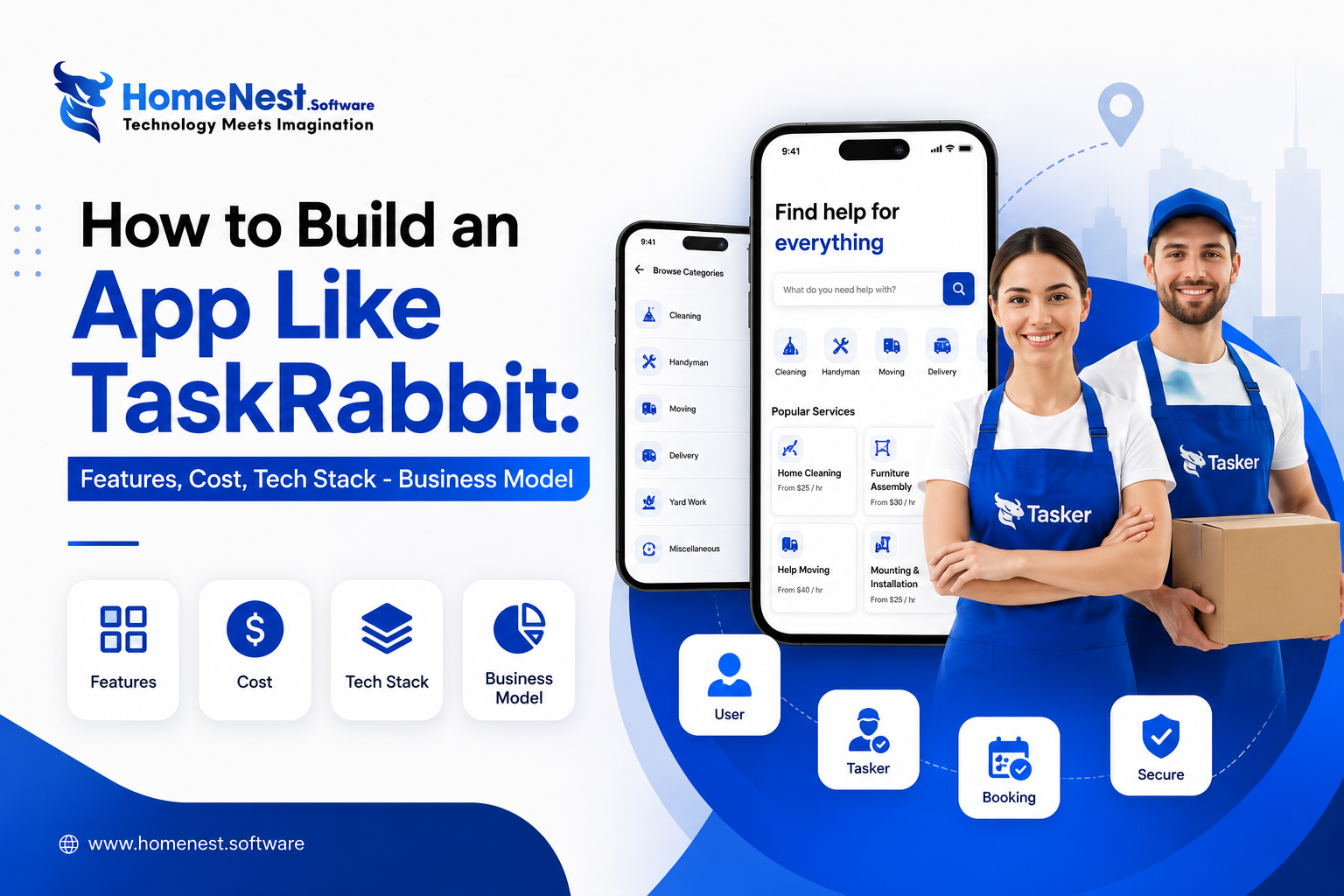
How to Build an App Like TaskRabbit: Features, Cost, Tech Stack – Business Model
Building an app like TaskRabbit is more than replicating existing features—it’s about creating a trusted marketplace that seamlessly connects customers with skilled service providers. By combining an intuitive user experience, secure payment systems, scalable architecture, and the right business model, you can launch a competitive on-demand platform. Partnering with an experienced app development company like HomeNest Software ensures your product is built with the technology, flexibility, and long-term scalability needed to succeed in the rapidly growing gig economy.