
Virtual Property Tours and AR/VR Apps: How They Are Transforming Real Estate in the UAE
Scope of Work
Here is a polished and rewritten English version with clearer flow, professional tone, and improved readability while keeping the original meaning:
The transformation of the UAE real estate market is happening at an unprecedented pace—not through soaring prices or extravagant developments, but through technology. Virtual Reality (VR), Augmented Reality (AR), and 360° virtual property tours are redefining how properties are showcased and experienced.
These immersive technologies allow buyers to explore, evaluate, and experience properties without ever visiting them in person. Today, AR/VR applications enable clients to tour everything from luxury apartments to high-end villas in Abu Dhabi. Users can visualize interiors, check dimensions, and instantly view changes in layouts and design options in real time.
This industry-wide technological shift is accelerating property sales while significantly reducing time and costs for both real estate agents and buyers. In this blog, we explore how virtual property tours and AR/VR solutions are transforming the UAE real estate market and shaping its future.
UAE Real Estate Market Overview
-
$65 billion – Estimated total value of real estate transactions in the UAE in 2023
-
7% annual growth rate in property sales across major emirates
-
15,000+ residential units launched in Dubai during the first half of 2024
-
8–12% average ROI for residential properties in Dubai and Abu Dhabi
-
70% surge in overseas investors since 2022
-
30,000+ active real estate brokers and agencies operating across the UAE
-
Top 5 globally – Dubai ranks among the world’s leading cities for luxury real estate investment
-
Over 60% of property buyers prefer a virtual tour before scheduling an in-person visit
-
AED 35 million – Price of the most expensive property sold entirely through a virtual transaction in 2024
The Role of AR/VR in Real Estate
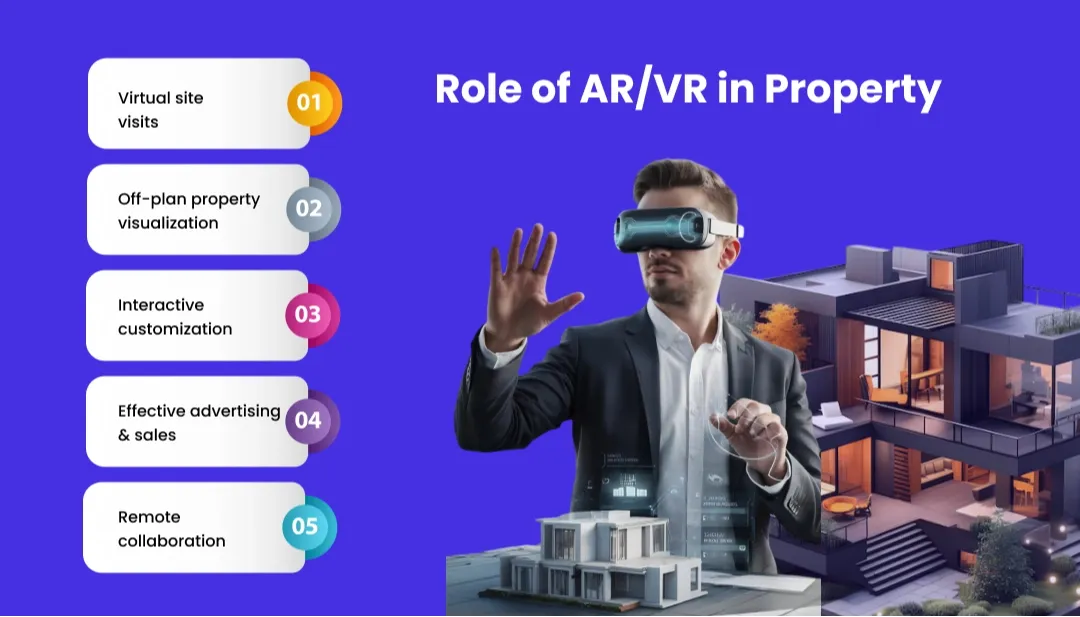
Augmented Reality (AR) and Virtual Reality (VR) technologies are playing a transformative role in the growth of the real estate industry in the United Arab Emirates. From property presentations to client engagement, AR/VR solutions are redefining how real estate is marketed, evaluated, and sold. Below are five key areas where AR/VR is shaping modern real estate.
1. Virtual Site Visits
Virtual reality enables buyers to take immersive property tours without being physically present. Whether a property is fully completed or still under construction, virtual site visits allow clients to explore units, review floor plans, and understand layouts in detail. This helps buyers make faster, more informed decisions while saving time and travel costs.
2. Off-Plan Property Visualization
One of the most valuable applications of AR/VR in real estate is off-plan visualization. Developers can showcase upcoming or under-construction projects through realistic VR environments that replicate the experience of stepping into a finished property. This allows investors and buyers to experience the space long before construction is complete.
3. Interactive Customization
AR/VR truly stands out in its ability to offer interactive customization. Through immersive applications, users can personalize properties in real time—changing wall colors, rearranging furniture, adjusting lighting, modifying layouts, and experimenting with décor. This interactive experience makes the buying process more engaging and helps clients clearly visualize their future home or workspace.
4. Enhanced Advertising and Sales
Real estate companies are increasingly using AR/VR content in advertisements, websites, and sales presentations to capture attention and generate high-quality leads. These immersive previews build buyer confidence, establish trust, and significantly shorten the sales cycle by providing a realistic property experience upfront.
5. Remote Collaboration
Virtual property tours also enable seamless remote collaboration between agents, architects, developers, and buyers. Stakeholders can walk through designs together, discuss changes, and refine layouts without meeting in person. This streamlined, flexible approach reflects the future of efficient real estate operations.
Read more: How Much Does Mobile App Development Cost in the UAE?
Advantages of Virtual Property Tours & AR/VR Applications
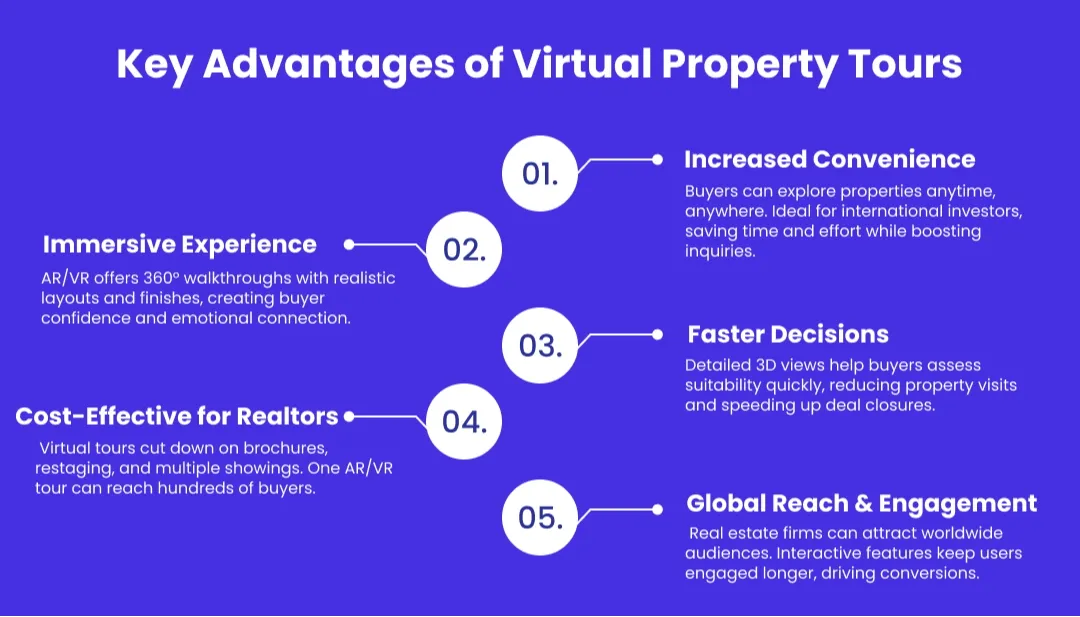
Virtual property tours and AR/VR applications are revolutionizing how real estate is marketed and sold in the United Arab Emirates. These technologies enhance buyer experience, streamline sales processes, and open new opportunities for real estate professionals. Below are the five key advantages of adopting virtual tours and AR/VR solutions.
1. Greater Convenience for Buyers
Virtual property tours allow buyers to explore properties anytime and from anywhere. This level of flexibility is especially valuable for international investors who may not be able to travel frequently. Buyers can view multiple property types within minutes, without the logistical challenges of scheduling, traveling, or attending physical viewings. This convenience significantly increases buyer interest and inquiry rates.
2. Realistic and Immersive Property Experience
AR/VR technologies deliver highly realistic, 360-degree property walkthroughs that showcase layouts, room dimensions, and finishes in detail. Buyers gain a stronger emotional connection and greater confidence when they can experience a property as if they were physically present. While developing AR/VR applications may involve higher upfront costs, the immersive experience often justifies the investment through higher-quality leads.
3. Faster and More Confident Decision-Making
With access to detailed 3D visualizations and customizable design options, buyers can quickly determine whether a property meets their needs. This clarity accelerates decision-making, shortens sales cycles, and reduces the number of unnecessary property visits for both buyers and agents.
4. Cost-Effective Sales Tool for Realtors
Virtual tours significantly reduce expenses related to repeated physical showings, printed marketing materials, and property staging. A single high-quality AR/VR tour can be shared with hundreds of potential clients, making it a scalable and cost-efficient marketing asset with long-term value.
5. Global Reach and Higher Engagement
AR/VR solutions enable real estate companies to reach international audiences and engage them more effectively. Interactive features—such as virtual furniture placement, color customization, and floor plan adjustments—encourage users to spend more time exploring properties. Higher engagement often leads to increased conversions and stronger buyer intent.
Top Real Estate Companies in the UAE Using AR/VR
Several technology companies are helping transform the UAE real estate sector by integrating Augmented Reality (AR) and Virtual Reality (VR) into property marketing, sales, and visualization. Below are some of the leading companies driving AR/VR adoption in the region.
1. HomeNest Software
HomeNest Software is a leading real estate app development company in Dubai, delivering advanced AR/VR solutions that enable immersive virtual property tours and interactive design previews. Their technology helps developers and realtors enhance client engagement, showcase properties more effectively, and accelerate sales closures across the UAE market.
2. Hyperlink InfoSystem
Hyperlink InfoSystem specializes in developing realistic AR/VR applications for real estate companies across the Middle East. Their solutions allow prospective buyers to explore properties in 3D, experience virtual walkthroughs, and better understand layouts—boosting buyer confidence while enabling developers to market projects more efficiently.
3. Infosys
Infosys delivers immersive AR and VR platforms that allow real estate firms to offer highly realistic property walkthroughs. These solutions are particularly valuable for luxury and off-plan developments, helping companies shorten sales cycles, improve communication, and close deals faster without requiring frequent site visits.
4. HCL
HCL develops AR/VR applications that enable real estate companies to present properties in rich visual detail. Their solutions support interactive layouts and real-time design customization, allowing buyers to engage more deeply with properties. This immersive experience increases buyer trust, interaction, and overall satisfaction.
5. Tata Consultancy Services (TCS)
Tata Consultancy Services provides scalable AR/VR software that allows property developers to digitally showcase villas, apartments, and commercial spaces. With features such as 360-degree virtual tours and real-time visualization, TCS supports real estate marketing, leasing, and sales teams throughout the UAE.
6. Wipro
Wipro leverages AR/VR technologies to create virtual tours, interior décor visualization, and interactive property experiences. These solutions help real estate agents present off-plan projects, minimize the need for physical site visits, and engage international buyers through immersive digital platforms.
The Future of Real Estate Technology in the UAE
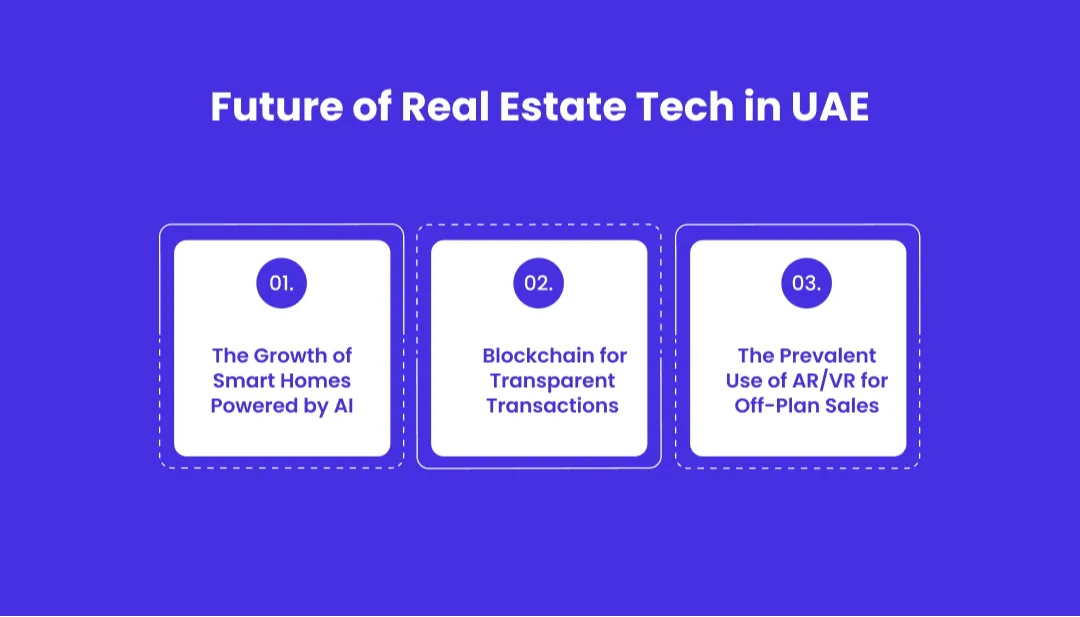
The future of real estate technology in the United Arab Emirates is poised to position the nation as a global leader in smart and digital real estate. Driven by a tech-savvy population and strong government support for innovation, emerging technologies are set to reshape the sector in several transformative ways. Below are three key trends that will define the next phase of real estate in the UAE.
1. The Rise of AI-Powered Smart Homes
Artificial Intelligence is rapidly becoming a core component of home automation across the UAE. AI-powered smart homes will intelligently manage lighting, security, climate control, and energy usage based on user behavior and preferences. These systems will allow residents to personalize their living environments while optimizing efficiency and sustainability. As demand grows, developers are increasingly integrating AI-driven features to attract tech-oriented buyers and forward-thinking investors.
2. Blockchain-Enabled Transparent Transactions
Blockchain technology is set to revolutionize real estate transactions by introducing greater transparency, security, and efficiency. Smart contracts will reduce reliance on paperwork, minimize fraud risks, and significantly shorten legal and administrative processes. Dubai has already begun experimenting with blockchain-based property registration, setting a benchmark that is likely to influence real estate practices across the wider region.
3. Widespread Adoption of AR/VR for Off-Plan Sales
Augmented Reality (AR) and Virtual Reality (VR) will soon become standard tools for marketing off-plan and luxury properties. Buyers will be able to explore homes in fully immersive 3D environments, customize layouts, materials, and interior finishes, and experience properties long before construction is completed. This enhanced visualization will boost buyer confidence, reduce uncertainty, and drive higher off-plan sales volumes.
Building a Virtual Property Tour App in the UAE
Developing a high-quality virtual property tour app in the United Arab Emirates requires a structured and strategic approach. When partnering with a professional real estate app development company in Dubai, the process typically follows these key stages:
1. Requirements Analysis & Feature Planning
The development journey begins with a deep understanding of your business goals, target audience, and market positioning. The development team works closely with you to define core features such as 3D virtual walkthroughs, floor-plan-based navigation, AR-powered interior customization, and live chat integration.
Once requirements are finalized, a detailed project scope, technical architecture, timeline, and budget are established to ensure clarity and alignment from the outset.
2. UI/UX Design & Wireframing
User experience plays a critical role in real estate applications. Designers create intuitive UI/UX designs and interactive wireframes that support seamless property exploration, smart search functionality, and immersive storytelling. These designs focus on smooth VR transitions, clear property filtering, and engaging user journeys across mobile, tablet, and web platforms.
3. Core Development & System Integration
At this stage, developers build the front-end and back-end using modern technology stacks such as Unity, Unreal Engine, React Native, or Flutter. AR/VR SDKs, 3D property models, real estate listing APIs, and CRM systems are integrated to deliver real-time data and immersive experiences. Robust security protocols, scalable architecture, and performance optimization are implemented to ensure reliability.
4. Testing & Quality Assurance
Before launch, the application undergoes rigorous testing to validate functionality, performance, and cross-platform compatibility. Quality assurance teams evaluate AR/VR features, loading speeds, navigation flows, and data accuracy. This phase is essential for identifying and resolving bugs, ensuring smooth virtual property viewings, and delivering a premium user experience.
5. Deployment & Ongoing Maintenance
Once testing is complete, the app is deployed across relevant platforms, including Android, iOS, and web. Post-launch support includes continuous maintenance, performance monitoring, user feedback analysis, feature updates, and future enhancements such as virtual staging or metaverse integration. Ongoing maintenance ensures the app evolves alongside the UAE’s fast-moving real estate market.
Why the UAE Is a Global Hub for AR/VR Real Estate Innovation
The UAE has earned a strong global reputation as a leader in AR/VR-driven real estate innovation. Its forward-thinking vision, technology-friendly regulatory environment, and luxury-focused property market create ideal conditions for digital transformation. Cities such as Dubai and Abu Dhabi are at the forefront, supported by initiatives like Smart Dubai and the Dubai Metaverse Strategy.
AR/VR technologies enable developers to market off-plan and high-end residential or commercial projects to international investors with greater transparency and confidence. Immersive virtual experiences help overcome the challenges of remote buying, allowing investors to understand properties clearly without physical site visits.
Additionally, the UAE’s strong tech ecosystem, advanced infrastructure, widespread adoption of immersive devices, and thriving tourism industry make investment in virtual property tour apps more accessible than in many other regions. As virtual viewing becomes an expected part of the buyer journey, the UAE continues to set global benchmarks in AR/VR real estate adoption.
Conclusion
Virtual property tour and AR/VR app development are transforming the UAE real estate sector—making property marketing faster, smarter, and more engaging. These solutions empower buyers with remote viewing capabilities while enabling developers and brokers to showcase projects creatively on a global scale.
As the UAE accelerates its smart city and digital innovation initiatives, AR/VR-powered real estate solutions are no longer optional—they are becoming the new industry standard.
Contact HomeNest Software today for a free consultation and inquire about our all-inclusive App Design package offers!
HomeNest Software – Empowering Long-Term Growth for Modern Businesses.

Contact Information:
- Address: The Sun Avenue, 28 Mai Chi Tho Street, Binh Trung Ward, Ho Chi Minh City
- Hotline: +84 898 994 298 ( WhatsApp )
- Website: homenest.software
HomeNest Services: Website Design – App Design – Software Development – Digital Marketing.
Frequently Asked Questions (FAQ)
What is a virtual property tour app?
A virtual property tour app allows users to explore real estate properties digitally using 360° views, 3D walkthroughs, or AR/VR technology. Buyers can view layouts, interiors, and property details remotely without visiting the site in person.
How do AR/VR property tours benefit real estate buyers in the UAE?
AR/VR property tours help buyers save time, reduce travel costs, and make more confident decisions. This is especially valuable for overseas investors purchasing properties in the United Arab Emirates, as they can experience properties remotely with high realism and transparency.
Are virtual property tours suitable for off-plan real estate projects?
Yes. Virtual property tours are ideal for off-plan projects, allowing buyers to visualize unfinished developments in realistic 3D environments. AR/VR enables customization of layouts, materials, and interiors, increasing buyer confidence and off-plan sales conversions.
How much does it cost to develop a virtual property tour app in the UAE?
The cost depends on factors such as app features, AR/VR complexity, supported platforms (iOS, Android, web), and integrations with CRM or listing systems. Basic virtual tour apps cost less, while advanced AR/VR customization and metaverse-ready solutions require higher investment.
Can virtual property tour apps integrate with existing real estate CRM systems?
Yes. Most modern virtual property tour apps can integrate with CRM platforms, property listing APIs, live chat tools, and analytics systems. This allows real estate companies to manage leads, track user behavior, and improve sales performance.
Do buyers still need physical property visits after virtual tours?
In many cases, virtual tours significantly reduce the need for physical visits. While some buyers may still prefer an in-person walkthrough before finalizing a purchase, virtual tours help filter serious buyers and shorten the overall sales cycle.
Why is the UAE a leader in AR/VR real estate adoption?
The UAE’s leadership in AR/VR real estate is driven by smart city initiatives, strong digital infrastructure, government-backed innovation programs, and a luxury-focused property market. Cities like Dubai and Abu Dhabi continue to set global benchmarks in immersive real estate technology.
Latest Articles
View All
Criteria For Choosing The Right App Design Agency
UI/UX design is the logical foundation of a system, not merely a visual element. Choosing the wrong partner will directly lead to technical debt, budget overruns, and disruptions in the development process. This article provides a 6-step evaluation framework and a list of operational risks, helping businesses eliminate subjective design advice and accurately assess agency capabilities based on developer handoff standards and practical business performance.

How Does AI in Banking Industry Impact the Future?
Artificial intelligence (AI) has transitioned from a supplementary tool to a core infrastructure of financial data management, optimizing profitability through real-time fraud detection, natural language processing (NLP), and high-speed credit scoring models. “Deploying AI in the financial sector requires more than just algorithmic accuracy, it demands a highly secure cloud architecture and rigorous data governance,” commented Nguyen Tien, co-founder of HomeNest Software. Why read this guide? We skip the theoretical jargon to focus entirely on technical implementation. Whether you’re evaluating a vendor or planning a system overhaul, this article will detail: Operational Efficiency: Automating unstructured data workflows at scale. Risk Architecture: Implementing real-time threat detection and AML compliance. Data ownership: The essential need for 100% ownership of the source code to ensure full algorithm auditability.

How to Make a Banking App like Bank of America?
Developing a mobile banking application like Bank of America extends far beyond basic UI design; it requires engineering a fault-tolerant backend capable of real-time ledger synchronization, biometric authentication, and high-volume data processing under strict regulatory frameworks. Drawing from HomeNest Software’s deep experience in architecting enterprise-grade fintech solutions, this guide strips away theoretical jargon to focus entirely on operational and technical execution. What you will find in this guide: We break down the precise development roadmap, from mapping out microservices and ensuring PCI-DSS compliance to estimating MVP development costs and securing absolute data sovereignty through 100% source code ownership. If you are preparing to build, scale, or audit a financial platform, this blueprint provides the exact framework you need.
Banking App Development Cost
Building a banking application is rarely a simple process; it’s a complex technical challenge requiring a balance between complying with stringent financial regulations, handling large transaction volumes, and a scalable cloud architecture. Miscalculating these technical requirements from the outset often leads to significant technical debt and budget overruns. Based on HomeNest Software’s practical experience in designing enterprise-grade fintech solutions, this guide bypasses generic estimates to provide a realistic analysis of banking application development costs. What you’ll find in this guide: We analyze the true cost factors, from technology selection and API integration to the hidden costs of regulatory compliance and security infrastructure. Whether you’re launching a minimum viable product or expanding an existing financial platform, this analysis provides the precise operational data you need to plan your budget effectively.
How to Build a Mobile Banking App Like Chime?
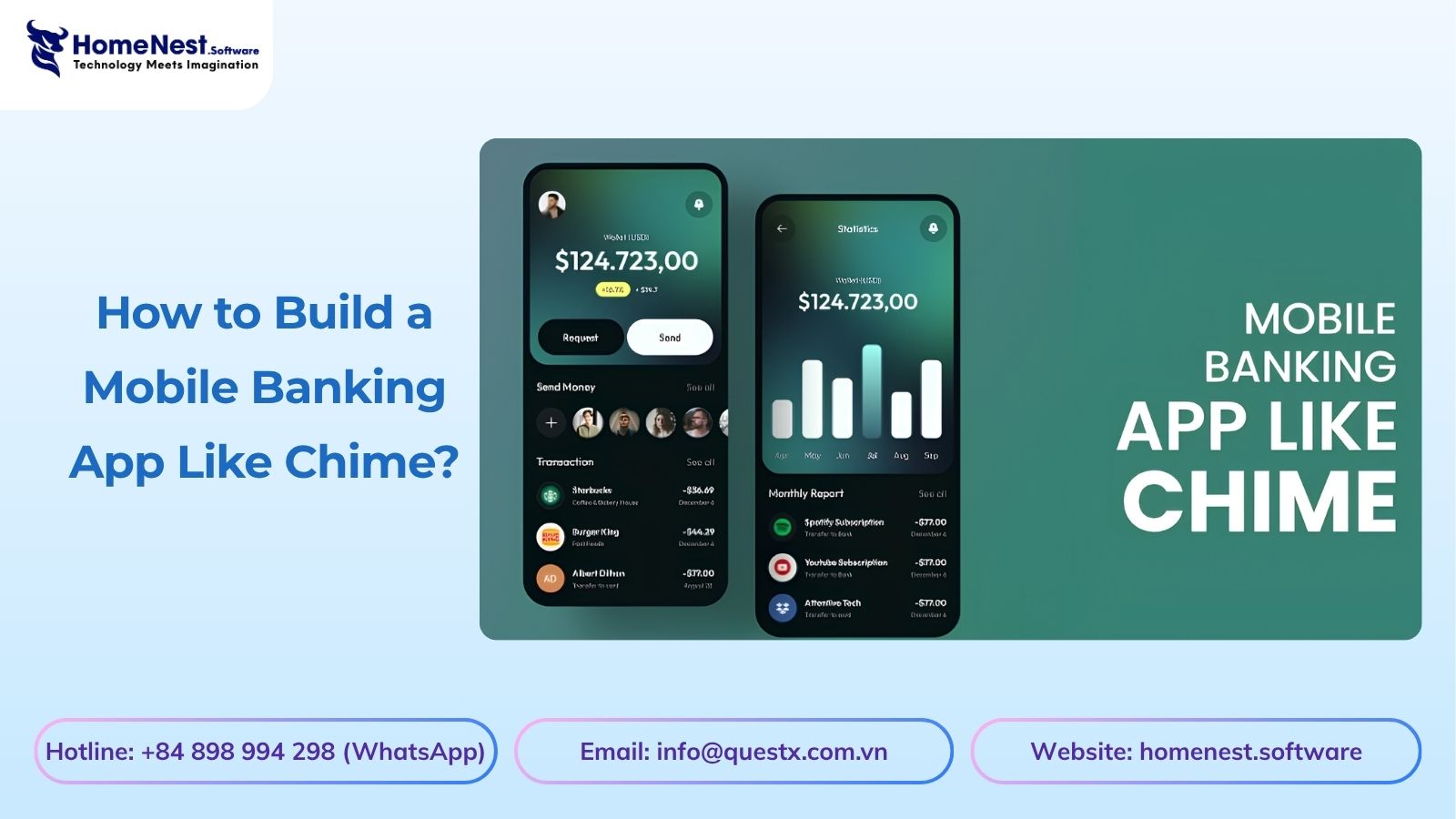
Building a mobile banking app like Chime is not just about features, it is about delivering a secure, scalable, and user-centric financial experience. From planning the right architecture to optimizing mobile banking app development cost, every decision directly impacts your product’s success. Leveraging Fintech app development services, starting with MVP app development, and scaling through on-demand app development solutions allows businesses to reduce risk and accelerate time to market. To stay competitive, combining Android app development services and iOS app development solutions ensures wider reach, while continuous updates through maintenance software development services keep your app secure and future-ready.

How to Build a Banking App Like Barclays: A Complete Entrepreneur’s Guide
Building a banking app like Barclays requires more than just development. It demands a strong product vision, secure architecture, and a clear monetization strategy. From optimizing cost and selecting the right tech stack to ensuring compliance and scalability, every decision impacts long-term success. Partnering with an experienced team like HomeNest Software helps accelerate development, reduce risks, and deliver a high-quality fintech product that can compete in today’s fast-evolving digital banking landscape.