
Offshore Software Development Pricing in Singapore: Rates, Models, and Cost Breakdown
Offshore software development is no longer just a cost-saving tactic for Singapore companies it is a strategic approach to scaling engineering capacity, accelerating delivery, and accessing global talent. By understanding rate differences across regions, roles, and technology stacks, businesses can optimize budgets while maintaining high quality. Among all options, Vietnam stands out for its strong cost quality balance, engineering discipline, and seamless collaboration making it an ideal partner for long-term, scalable development.
Scope of Work
As businesses in Singapore accelerate their digital transformation initiatives, the demand to deliver high quality software faster and more cost effectively continues to intensify. At the same time, the limited availability and high cost of local engineering talent are driving organizations to consider offshore development as a strategic scaling approach. However, selecting the right destination or vendor requires a clear understanding of offshore software development rates and how they vary across different markets.
This guide offers a practical, Singapore focused perspective on offshore development covering cost structures, key pricing drivers, potential hidden expenses, and the actual savings companies can expect. It also highlights why Vietnam has emerged as a preferred offshore destination for Singapore-based businesses, offering a compelling balance of cost efficiency, technical capability, and delivery reliability. Let’s break down the numbers and insights that matter most.
Singapore Market Context Why Offshore Development Is Accelerating
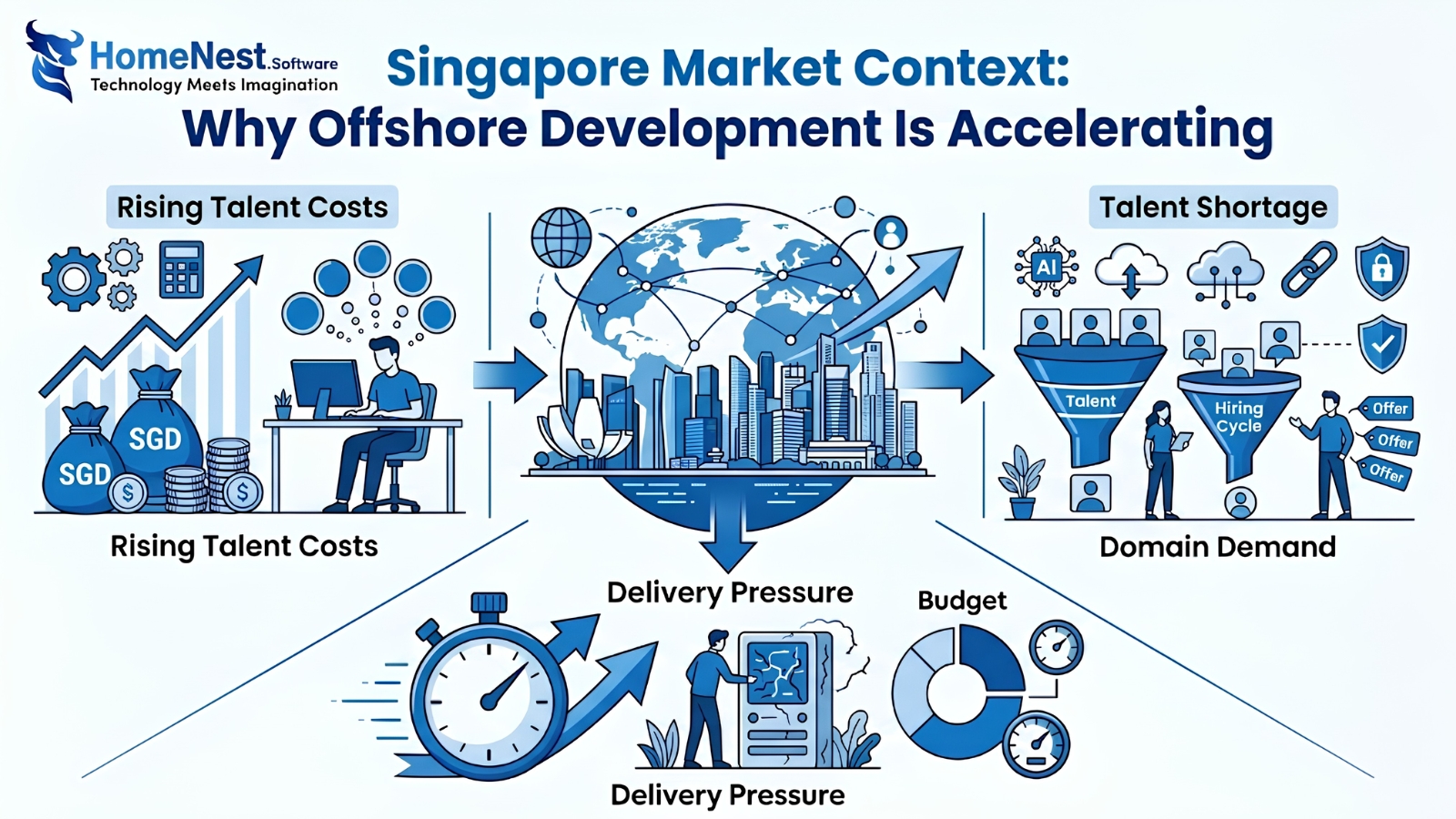
Singapore’s digital economy continues to expand at pace, but the availability and cost of local engineering talent have emerged as structural bottlenecks. Across sectors such as finance, healthcare, logistics, and retail, companies are increasingly adopting offshore software development as a strategic lever to scale efficiently without compromising speed or quality.
Rising Engineering Talent Costs and Salary Pressure
Senior developers in Singapore typically command salaries in the range of SGD 7,000–14,000 per month, with niche roles in cloud, DevOps, and AI often exceeding this range. When factoring in CPF contributions, bonuses, workspace costs, and long term retention efforts, the total cost of local hiring becomes significantly higher making it difficult for many SMEs and even larger organizations to sustain.
Talent Shortages in High Demand Domains
Despite strong government support and talent development programs, Singapore continues to face a shortage of experienced engineers particularly in high growth areas such as AI, cloud engineering, blockchain, and cybersecurity. Hiring cycles are often prolonged, competition for senior talent is intense, and candidates frequently hold multiple offers, resulting in unpredictable recruitment outcomes.
Increasing Pressure to Deliver Faster at Lower Cost
Organizations are under constant pressure to accelerate product delivery, modernize legacy systems, and adopt emerging technologies often within tighter budget constraints. Offshore development provides a more flexible and cost efficient model, enabling companies to scale engineering capacity without increasing fixed overhead or long term payroll commitments.
Offshore Development as a Strategic Default
What was once considered a cost saving option is now becoming a standard operating model. Startups, SMEs, and large enterprises alike are leveraging offshore teams to bridge skill gaps, extend development capacity, and maintain delivery momentum. By accessing a broader global talent pool, companies can scale teams dynamically, reduce delivery risk, and operate with greater agility positioning offshore development as a core component of modern technology strategy in Singapore.
Onshore vs Offshore Rates: Singapore Cost Comparison (2026)
Before deciding where to build or scale your engineering team, Singapore-based businesses need a clear view of how onshore vs offshore software development rates compare both in direct pricing and total cost of ownership.
Onshore Developer Rates in Singapore
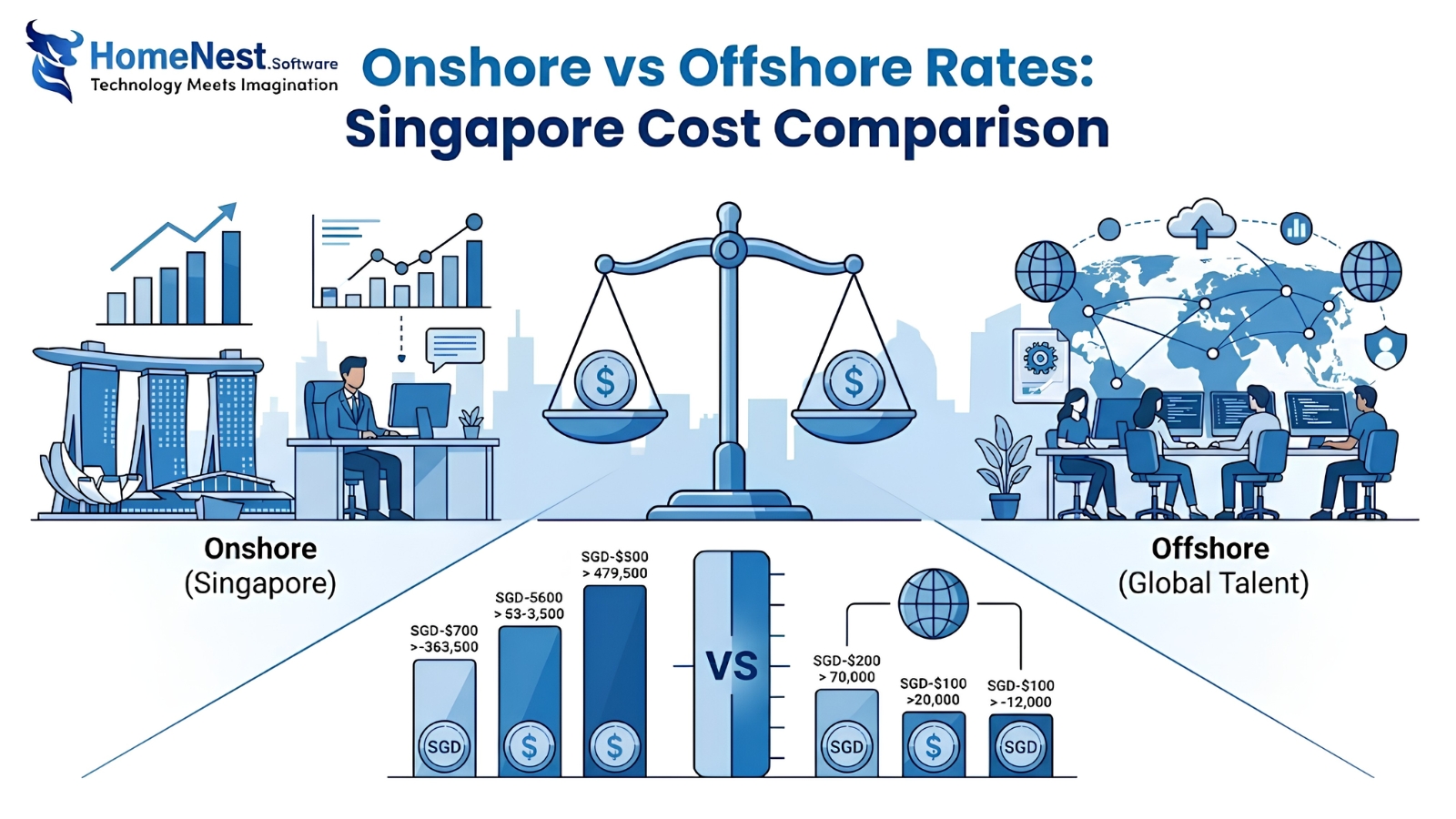
Local tech talent in Singapore commands premium rates across most domains. Contract developers typically charge SGD 60–120 per hour, depending on seniority and technology stack. For specialized roles such as AI, cloud, or DevOps, rates can exceed SGD 150/hour, particularly for short term or high demand engagements.
Fully Loaded Cost of Local Hiring
Base salary is only part of the equation. Employers must also factor in CPF contributions, performance bonuses, insurance, equipment, office space, and HR overhead. As a result, the true monthly cost of a senior engineer can reach SGD 10,000–18,000, making large scale local hiring financially challenging even for well funded teams.
Offshore Rate Comparison (Vietnam vs India vs Philippines vs Eastern Europe)
Offshore markets offer a compelling cost advantage while providing access to diverse and scalable talent pools:
| Region / Country | Typical Hourly Rate (USD) | Key Strengths |
|---|---|---|
| Vietnam | 18–45/hr | Strong engineering fundamentals, improving English proficiency, excellent cost–quality balance |
| India | 20–40/hr | Massive talent pool; quality varies across vendors and regions |
| Philippines | 18–35/hr | Strong communication skills; well suited for web development, support, and hybrid teams |
| Eastern Europe | 40–80/hr | High technical depth, product mindset; higher cost but strong delivery quality |
Cost Savings for Singapore Companies
By leveraging offshore development, Singapore companies can typically reduce engineering costs by 40–60%. Among available destinations, Vietnam often delivers the strongest ROI combining competitive pricing, time zone alignment, and consistent delivery standards shaped by long term collaboration with demanding markets such as Japan and Singapore.
Offshore Software Development Rates by Region (Updated 2026)
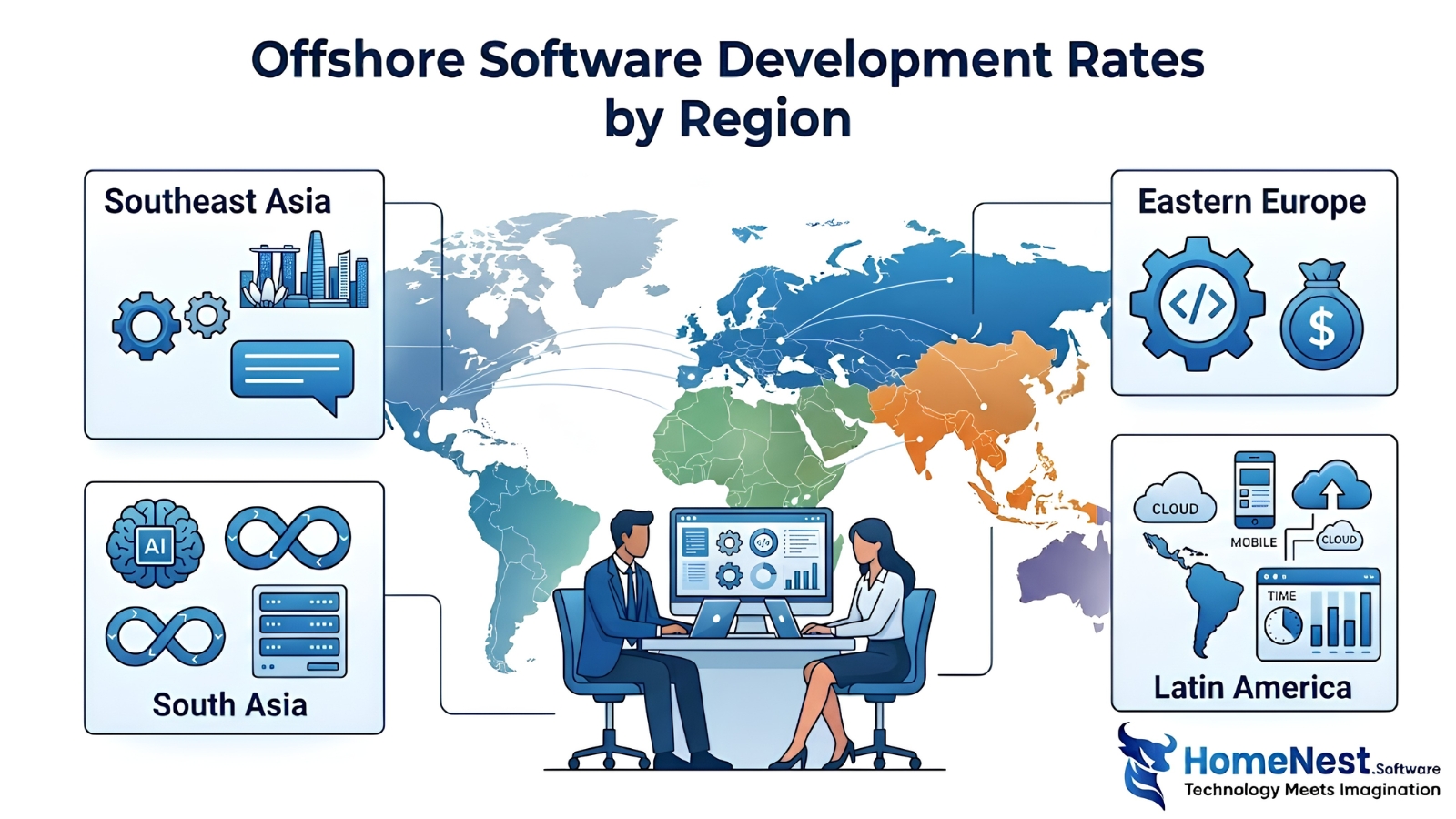
Offshore development rates vary significantly by country, influenced by talent maturity, English proficiency, and market demand. For Singapore-based companies, understanding these regional differences is essential to achieving the right balance between cost efficiency, communication, and delivery quality.
Southeast Asia (Vietnam, Philippines, Indonesia)
Southeast Asia remains the most strategically aligned region for Singapore, thanks to time zone proximity, cultural compatibility, and strong communication capabilities. Vietnam continues to stand out as the leading destination, offering a strong combination of engineering discipline, cost efficiency, and consistent delivery standards.
Key insights:
- Typical rates range from USD 18–45/hour, depending on seniority and technology stack.
- Vietnam offers the best overall balance of cost, quality, and reliability for long term development teams.
- The Philippines excels in communication heavy and customer facing roles.
- Indonesia provides a fast growing talent pool with competitive pricing for junior to mid level engineers.
South Asia (India, Bangladesh, Pakistan)
South Asia remains one of the most established global outsourcing hubs, known for its vast talent pool and competitive pricing. India leads in scale and technical breadth, while Bangladesh and Pakistan present strong value options for cost sensitive projects.
Key insights:
- Rates typically fall between USD 15–35/hour.
- India offers extensive expertise across a wide range of technologies, from legacy systems to AI and DevOps.
- Bangladesh and Pakistan provide cost advantages but require careful vendor selection to ensure consistency.
- Larger time zone differences can impact real time collaboration with Singapore teams.
Eastern Europe (Ukraine, Poland, Romania)
Eastern Europe is recognized for its deep technical expertise and strong product engineering mindset. Although more expensive than Asian markets, it remains a preferred choice for complex, high value projects.
Key insights:
- Rates generally range from USD 30–80/hour.
- Ukraine and Poland are known for highly skilled engineers, particularly in backend systems and AI/ML.
- English proficiency is strong, though time zone differences require structured collaboration.
- Ideal for enterprise grade systems, R&D, and technically demanding solutions.
Latin America (Brazil, Argentina, Mexico)
Latin America is a strong outsourcing destination for North American companies due to time zone alignment. For Singapore businesses, however, the region offers capable talent at a higher cost relative to Asia.
Key insights:
- Rates typically range from USD 35–75/hour.
- Strong capabilities in full stack, mobile app development, cloud, and DevOps development.
- Significant time zone gaps require flexible working arrangements.
- Generally less cost effective than Southeast Asia for Singapore-based teams.
North America & Western Europe
These regions represent the highest end of the global pricing spectrum. While engineering quality, compliance, and process maturity are exceptional, their cost structure makes them unsuitable for offshore cost optimization.
Key insights:
- Rates range from USD 70–180/hour, depending on specialization.
- Typically used for niche expertise or highly regulated, security sensitive projects.
- Serve primarily as benchmarks for evaluating offshore cost savings rather than practical outsourcing destinations.
Overall, Southeast Asia particularly Vietnam continues to offer the most compelling value proposition for Singapore companies, combining competitive rates with strong technical capabilities and operational alignment.
Offshore Software Development Rates by Role (Detailed Breakdown)
Offshore software development costs vary not only by geography but also by role, seniority, and specialization. For Singapore-based companies planning budgets or building long term offshore teams, understanding rate differences by job function is critical to accurate cost estimation and team structuring.
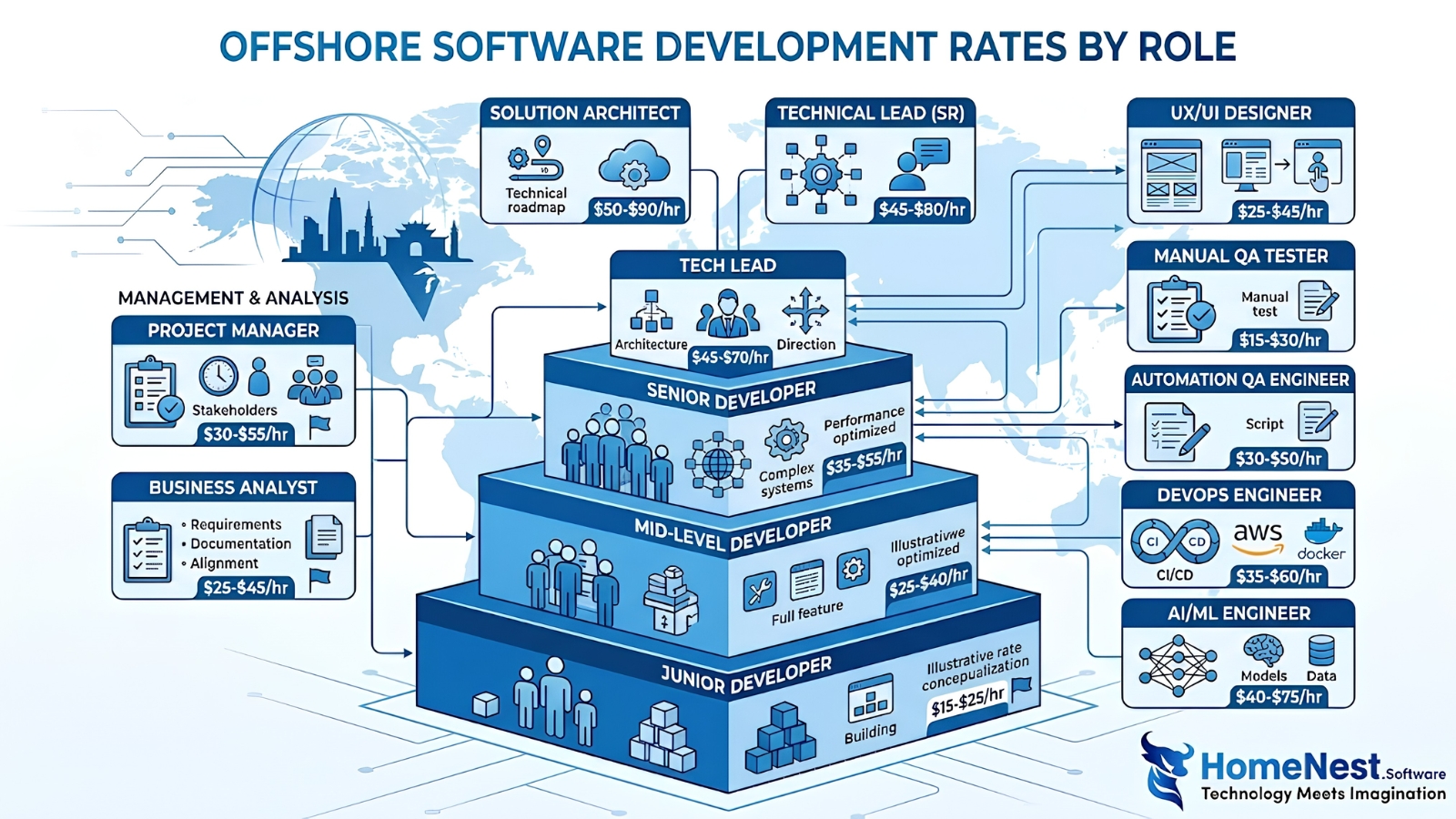
Below is a detailed 2026 breakdown of typical offshore developer hourly rates by role:
Typical Offshore Rates by Role (2026)
| Role | Typical Hourly Rate (USD) | Description / Notes |
|---|---|---|
| Junior Developer | 15–25/hr | 1–2 years’ experience; handles basic features, maintenance, UI updates |
| Mid level Developer | 25–40/hr | 3–5 years’ experience; delivers full features and production ready code |
| Senior Developer | 35–55/hr | 5–8+ years; strong technical depth; handles complex systems and integrations |
| Lead Developer / Tech Lead | 45–70/hr | Oversees architecture, code quality, and technical direction |
| Project Manager (PM) | 30–55/hr | Manages scope, timelines, risks, and stakeholder communication |
| Business Analyst (BA) | 25–45/hr | Defines requirements, documentation, and aligns stakeholders |
| Bridge System Engineer (BrSE) | 30–55/hr | Combines technical expertise with bilingual communication (SG/Japan focus) |
| UX/UI Designer | 25–45/hr | Designs wireframes, UI, and user experience flows |
| Manual QA Tester | 15–30/hr | Performs functional, regression, and exploratory testing |
| Automation QA Engineer | 30–50/hr | Builds automated testing frameworks (Selenium, Cypress, Appium) |
| DevOps Engineer | 35–60/hr | Manages CI/CD, cloud infrastructure, containers, and monitoring |
| AI/ML Engineer | 40–75/hr | Develops ML models, NLP, computer vision, and AI integrations |
| Solution Architect | 50–90/hr | Defines system architecture, cloud strategy, and technical roadmap |
| Technical Lead (Senior) | 45–80/hr | Leads large systems, mentors teams, ensures scalability and performance |
Developer Rates by Seniority
For most Singapore companies, seniority level is the primary cost driver, influenced by experience, domain expertise, and familiarity with modern tech stacks such as React, Node.js, Java, .NET, and Flutter.
- Junior Developer (USD 15–25/hr):
Suitable for simple implementation tasks, bug fixing, and UI level work. - Mid level Developer (USD 25–40/hr):
Capable of delivering end to end features, integrations, and stable production code. - Senior Developer (USD 35–55/hr):
Handles complex systems, performance optimization, and provides technical guidance. - Lead Developer / Tech Lead (USD 45–70/hr):
Responsible for architecture decisions, technical leadership, and scaling engineering teams.
PM, BA, BrSE, and UX/UI Roles
Non engineering roles play a critical role in ensuring delivery success especially in offshore setups where communication and clarity are essential.
- Project Manager (USD 30–55/hr):
Oversees timelines, scope, risks, and stakeholder coordination. - Business Analyst (USD 25–45/hr):
Translates business needs into technical requirements and documentation. - Bridge System Engineer (USD 30–55/hr):
Acts as a communication bridge with both technical and language capabilities especially valuable for Singapore and Japan markets. - UX/UI Designer (USD 25–45/hr):
Focuses on user experience, interface design, and usability optimization.
QA and Testing Roles
Quality assurance ensures product stability and minimizes costly rework making it essential for offshore delivery models.
- Manual QA Tester (USD 15–30/hr):
Performs functional, regression, and exploratory testing. - Automation QA Engineer (USD 30–50/hr):
Develops automated test frameworks, reducing long term testing costs and improving release speed.
DevOps Engineer Rates
DevOps engineers are in high demand as companies adopt cloud native architectures and continuous delivery practices.
- Typical rate: USD 35–60/hr
- Expertise includes AWS, Azure, GCP, Docker, Kubernetes, Terraform, CI/CD pipelines, and monitoring systems.
AI/ML Engineer Rates
AI and machine learning specialists command premium rates due to their niche expertise and high business impact.
- Typical rate: USD 40–75/hr
- Skills include machine learning models, NLP, computer vision, LLM integration, and data engineering.
Solution Architect and Technical Leadership
These senior roles are responsible for shaping system architecture and long term scalability.
- Solution Architect (USD 50–90/hr):
Defines architecture, integration patterns, cloud strategy, and technical roadmap. - Technical Lead (USD 45–80/hr):
Oversees complex systems, mentors teams, and ensures high performance, scalability, and code quality.
For Singapore companies, optimizing offshore costs is not about hiring the cheapest roles but about building the right mix of seniority and functions. A well structured offshore team combining mid level engineers, senior oversight, and strong PM/BA support delivers the best balance of cost, speed, and quality.
Rates by Technology Stack
Offshore software development rates vary significantly based on the technology stack, with modern, specialized, or enterprise grade technologies typically commanding higher pricing due to talent scarcity and implementation complexity. For Singapore companies outsourcing in 2026, understanding these differences is key to accurate budgeting and selecting the right technical approach.
Typical Offshore Rates by Technology Stack (2026)
| Technology Stack | Typical Hourly Rate (USD) | Notes / Use Cases |
|---|---|---|
| React / Vue (Frontend) | 20–45/hr | Ideal for dashboards, web apps, portals, and modern UI/UX projects; strong offshore talent pool |
| Node.js / Laravel (Backend) | 22–45/hr | Suitable for APIs, backend services, SaaS platforms, and high traffic systems |
| Flutter (Cross Platform Mobile) | 25–45/hr | Cost efficient alternative to native; single codebase for iOS and Android |
| iOS / Android (Native Mobile) | 30–55/hr | Higher rates due to platform specific expertise and performance optimization |
| AI / ML / Computer Vision | 40–75/hr | Used for predictive analytics, NLP, LLM integration, and intelligent automation |
| DevOps / Cloud (AWS, Azure, GCP) | 35–60/hr | Covers CI/CD pipelines, Kubernetes, Docker, Terraform, and cloud infrastructure |
| .NET / Java (Enterprise Systems) | 30–60/hr | Common in large scale enterprise systems, ERP integration, and secure backend platforms |
| SAP Integration | 45–75/hr | Premium rates due to niche expertise and enterprise level complexity |
| Automation & RPA (UiPath, AA, Power Automate) | 30–55/hr | Ideal for workflow automation, bots, and process optimization |
| Low Code / No Code (OutSystems, Mendix, Power Apps) | 30–50/hr | Accelerates development for internal tools, enterprise apps, and rapid delivery use cases |
For Singapore companies, technology choice directly impacts offshore costs. While modern stacks like React, Node.js, and Flutter offer strong cost efficiency due to abundant talent, specialized domains such as AI, DevOps, and SAP command premium rates.
The optimal approach is to align the tech stack with business goals balancing cost, scalability, and long term maintainability rather than defaulting to the most advanced or expensive technologies.
Country Outsourcing Cost Comparison: Vietnam vs India vs Philippines
Selecting the right offshore destination is a critical decision for Singapore companies looking to scale engineering capacity. While “nearshore” typically refers to geographically closer markets, for Singapore this often includes Southeast Asian countries such as Vietnam and the Philippines thanks to strong time zone alignment and operational compatibility.
Cost Comparison Overview
The table below provides a practical comparison of key offshore markets to help Singapore businesses evaluate the best fit based on cost, talent, and delivery reliability:
| Criteria | Vietnam | India | Philippines |
|---|---|---|---|
| Typical Hourly Rate (USD) | 18–45/hr | 20–40/hr | 18–35/hr |
| Cost–Quality Balance | Strongest overall; consistent mid–senior talent | High end talent available but inconsistent across vendors | Good for support and frontend; improving engineering depth |
| Engineering Discipline | Structured processes, strong QA (influenced by Japan) | Broad talent pool; quality varies significantly | Solid for web/mobile; limited depth in complex systems |
| English Proficiency | Good among senior roles and PMs | Very strong; widely fluent | Excellent; among the best in Asia |
| Time Zone Alignment (SG) | Near perfect (≈1 hour difference) | 2.5–3.5 hours behind; manageable | Perfect (same time zone) |
| Communication Style | Structured, process driven | Direct, globally oriented | Customer focused, relationship driven |
| Project Reliability | High stability, lower turnover, mature vendors | Vendor dependent; higher attrition risk | Reliable for support; growing project maturity |
| Best Use Cases | Enterprise systems, AI/ML, mobile apps, long term teams | Large scale builds, legacy systems, diverse stacks | Support, customer facing apps, hybrid BPO dev models |
| Overall Fit for Singapore | Excellent – best balance of cost, quality, and alignment | Good – strong talent but variable consistency | Good – strong communication, smaller senior talent pool |
Why Vietnam Is Emerging as a Leading Offshore Destination for Singapore
Vietnam has rapidly become one of the most attractive offshore software development destinations for Singapore companies, offering a compelling combination of cost efficiency, engineering quality, and operational alignment.
Key Advantages
- Outstanding cost–quality ratio:
With typical rates of USD 18–45/hour, Vietnam delivers high engineering standards comparable to more expensive regions making it ideal for cost conscious yet quality driven teams. - Strong engineering discipline:
Long standing collaboration with Japan has shaped a culture of structured development, rigorous QA practices, and clear documentation resulting in consistent delivery outcomes. - Seamless time zone alignment:
Minimal time difference enables real time collaboration, daily standups, and faster iteration cycles unlike regions with larger time gaps. - High cultural compatibility:
Vietnamese teams typically follow structured, professional workflows that align well with Singapore’s expectations for clarity, discipline, and accountability. - Growing senior talent pool:
Vietnam has developed strong capabilities across AI/ML, cloud engineering, mobile development, DevOps, and enterprise systems supporting both innovation and modernization initiatives. - Lower attrition, better stability:
Compared to many offshore markets, Vietnam offers greater team continuity, especially at mid to senior levels reducing disruption and preserving project knowledge. - Expanding tech ecosystem:
Continued government investment in ICT education and digital infrastructure is strengthening Vietnam’s talent pipeline, positioning it as one of Asia’s fastest growing technology hubs.
For Singapore companies, Vietnam stands out not just as a cost saving option, but as a strategic offshore partner capable of delivering high quality software at scale while maintaining speed, stability, and long term collaboration efficiency.
Offshore software development rates are determined by a combination of variables, including talent maturity, project scope, and regional economic conditions. For Singapore companies, understanding these factors is essential to setting realistic budgets and selecting the most effective outsourcing strategy.
Key Factors Shaping Offshore Development Costs
- Skill level and technical expertise:
Rates increase significantly for senior engineers and specialists with expertise in high demand areas such as AI/ML, DevOps, cybersecurity, and cloud architecture. In contrast, widely adopted stacks like React or Node.js tend to be more cost efficient due to broader talent availability. - Project complexity and domain requirements:
More complex systems such as enterprise platforms, large scale integrations, or AI driven applications require advanced technical capabilities, leading to higher costs. Additionally, industries like fintech, healthcare, and logistics often demand domain specific knowledge, further increasing rates. - Talent availability by region:
Markets with a large pool of mid to senior engineers (e.g., Southeast Asia) generally offer more competitive pricing. Regions with limited senior talent such as parts of Eastern Europe or Latin America tend to command higher rates, especially for niche skill sets. - Engagement model:
Dedicated teams typically provide the most cost efficient blended rates over time. Time & Materials (T&M) models follow role based hourly pricing, while fixed price contracts often include risk buffers resulting in higher effective hourly costs. - Project duration (long term vs short term):
Long term engagements benefit from better pricing, team stability, and optimized onboarding. Short term or urgent projects often come at a premium due to rapid resource allocation and increased delivery pressure. - Communication and management overhead:
Factors such as time zone differences, language proficiency, and requirement clarity can impact coordination costs. Regions like Vietnam and the Philippines tend to offer smoother collaboration for Singapore companies, reducing operational overhead. - Market stability and economic conditions:
Local economic factors such as inflation, currency fluctuations, and rising tech salaries directly influence offshore pricing. Stable markets tend to offer more predictable rates, while rapidly growing regions may see year over year cost increases.
For Singapore businesses, offshore pricing is not just about hourly rates it reflects a combination of talent quality, operational efficiency, and long term scalability. The most effective strategy is to evaluate these factors holistically to achieve the best balance between cost, speed, and delivery reliability.
Hidden Costs Singapore Companies Often Overlook
Many Singapore companies underestimate the hidden costs of offshore outsourcing, which can quietly inflate total project budgets if not proactively managed.
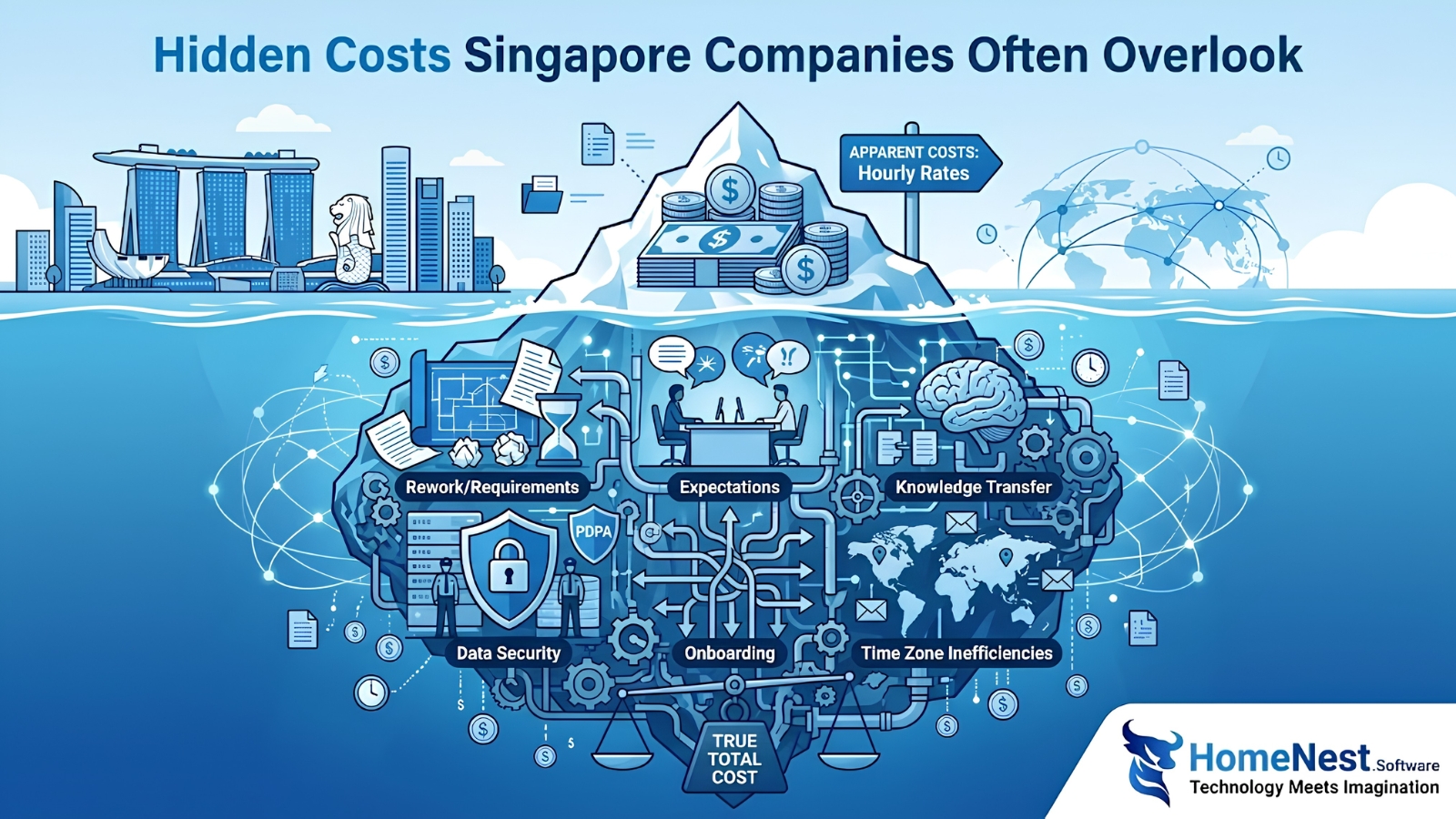
Common Hidden Cost Drivers
- Rework due to unclear requirements:
Ambiguous or frequently changing requirements often lead to rework adding development hours, increasing costs, and delaying timelines. - Misaligned expectations with offshore vendors:
Differences in interpreting scope, quality standards, or deliverables can create gaps that require additional clarification, revisions, and coordination. - Knowledge transfer and onboarding effort:
Offshore teams need time to understand your systems, architecture, and business logic. This ramp up phase can temporarily reduce productivity and increase initial costs. - PDPA compliance and data security requirements:
Singapore’s data protection regulations may require secure environments, restricted access controls, or data anonymization introducing additional setup and operational costs. - Vendor onboarding and process alignment:
New vendors must align with your workflows, coding standards, and communication processes before reaching optimal efficiency, which adds to early stage overhead. - Time zone inefficiencies (outside Southeast Asia):
Limited working hour overlap with regions such as India, Eastern Europe, or Latin America can slow response times, extend feedback loops, and impact delivery speed.
The true cost of offshore development goes beyond hourly rates. For Singapore companies, minimizing hidden costs requires clear requirements, strong governance, and selecting partners with proven delivery maturity and regional alignment.
How to Calculate Offshore Development Cost for Your Project
Accurately estimating offshore development costs requires a structured, methodical approach. For Singapore companies, the goal is not just to calculate costs but to ensure budgets align with scope, delivery expectations, and risk tolerance.
A Practical Cost Estimation Framework
- Define scope and core features:
Clearly outline key features, user flows, and system integrations. A well defined scope minimizes ambiguity, reduces rework, and improves estimation accuracy. - Break down tasks and estimate effort:
Decompose each feature into smaller, manageable tasks. Estimate the required effort across development, QA, and design to determine total man hours. - Apply hourly rates by role:
Multiply estimated hours by the corresponding hourly rates for each role such as developers, QA engineers, project managers, and designers to calculate feature level costs. - Include PM, BA, and QA overhead:
Allocate an additional 15–25% of total effort to cover project management, business analysis, and quality assurance activities ensuring smoother coordination and delivery. - Add a contingency buffer (10–20%):
Incorporate a buffer to account for scope refinements, minor changes, and technical uncertainties, helping prevent budget overruns.
For Singapore teams, accurate cost estimation is less about precision at the start and more about building flexibility into the model. A structured approach, combined with realistic buffers and clear scope definition, ensures better cost control and more predictable project outcomes.
Why HomeNest Software Offers One of the Best Offshore Rates in Singapore
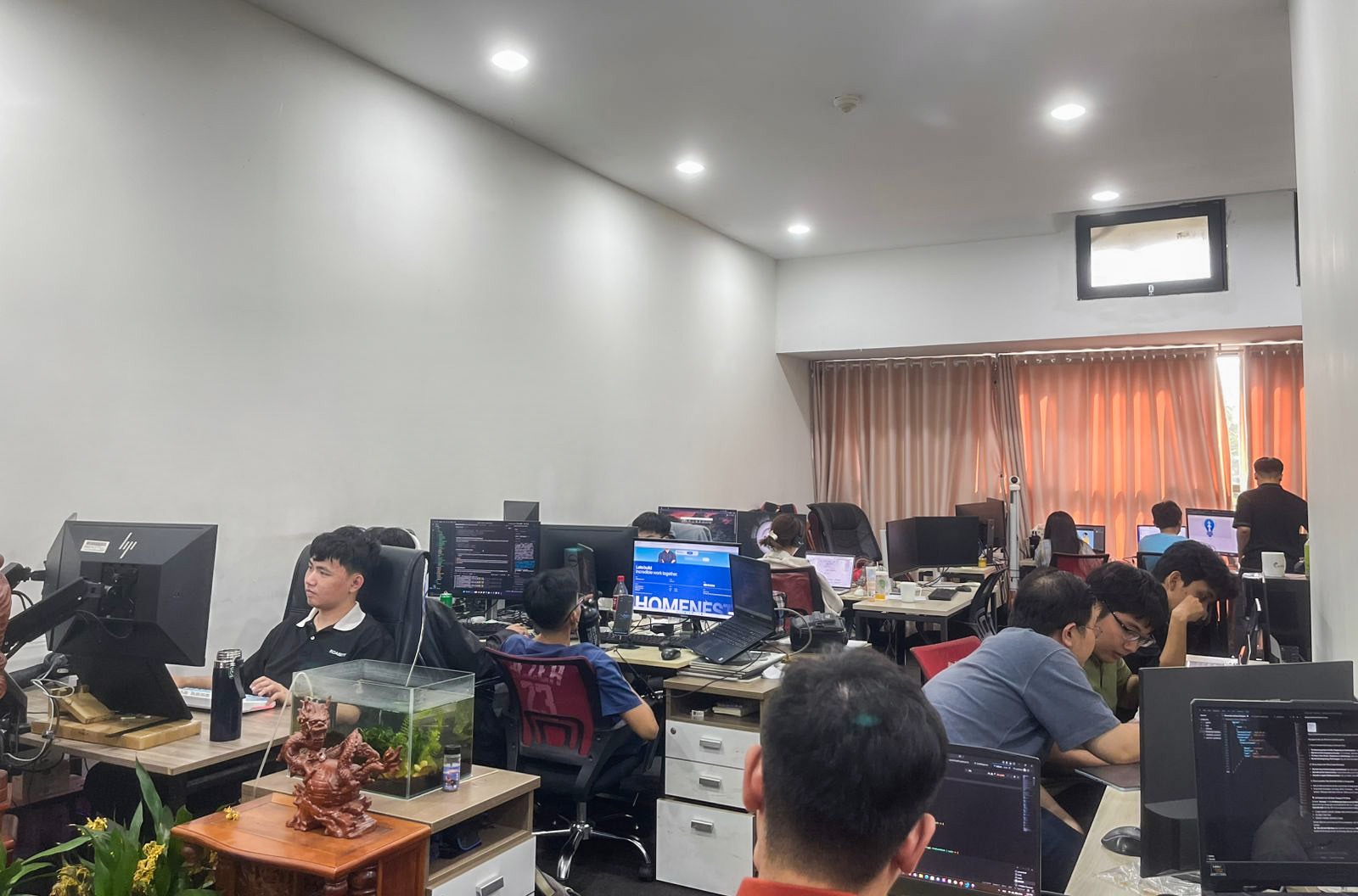
With over a decade of experience, HomeNest Software delivers a strong combination of competitive pricing, high engineering standards, and consistent delivery performance positioning itself as a trusted offshore development partner for Singapore companies.
What Sets HomeNest Software Apart
- Vietnam based cost advantage with enterprise grade quality:
By leveraging Vietnam’s competitive rate structure, HomeNest Software delivers high quality engineering shaped by more than 10 years of experience serving 250+ global clients. - Strong mid to senior engineering talent:
Our team includes 100+ experienced developers, cloud engineers, AI/ML specialists, and DevOps experts ensuring reliable, high quality output at significantly lower costs than Singapore’s local market. - Bilingual project management for seamless collaboration:
English and Japanese proficient Project Managers and Bridge System Engineers (BrSEs) enable clear communication, faster alignment, and efficient cross border coordination. - Stable, long term offshore teams:
Low attrition rates and continuous internal training programs ensure team stability minimizing onboarding overhead and preserving project knowledge over time. - Strong delivery discipline and Agile maturity:
Our teams emphasize clean code, rigorous QA, structured documentation, and predictable sprint execution reducing rework and hidden costs. - Flexible engagement models:
Whether you need a dedicated team, full cycle outsourcing, or a hybrid approach, HomeNest Software offers transparent pricing and scalable team structures tailored to your needs. - Proven cross industry experience:
We have successfully delivered solutions across fintech, healthcare, logistics, retail, manufacturing, and AI development, providing Singapore clients with confidence in both technical and domain expertise.
HomeNest Software combines cost efficiency with operational reliability, making it a strategic partner for Singapore businesses looking to scale development quickly, efficiently, and sustainably.
Conclusion
Offshore development has evolved into a strategic lever for Singapore companies seeking to scale efficiently while managing the rising cost of local engineering talent. By understanding how offshore rates vary across regions, roles, and technology stacks, businesses can make more informed decisions optimizing budgets and selecting the right partners with greater confidence.
Among available destinations, Vietnam stands out as a leading choice offering competitive pricing, a disciplined engineering culture, and strong time zone alignment with Singapore. Backed by a proven track record of delivering high quality solutions, HomeNest Software consistently delivers one of the most compelling cost–quality ratios in the region.
For Singapore companies planning their next digital initiative, partnering with HomeNest Software provides a reliable, scalable, and cost efficient pathway to building high performing engineering teams and accelerating delivery outcomes.
FAQs
What is the average offshore software development rate in 2026?
Offshore rates typically range from USD 15–80/hour, depending on region, role, and expertise. Southeast Asia (especially Vietnam) offers the most competitive range at USD 18–45/hour, while Eastern Europe and Western markets are significantly higher.
How much can Singapore companies save by outsourcing offshore?
Most Singapore companies achieve 40–60% cost savings compared to local hiring. The exact savings depend on team structure, seniority mix, and the offshore destination chosen.
Which country is best for offshore software development from Singapore?
Vietnam is widely considered one of the best options due to its strong cost–quality balance, engineering discipline, and time zone alignment. The Philippines and India are also viable, depending on project type and communication needs.
What factors affect offshore software development pricing?
Key factors include developer seniority, technology stack, project complexity, engagement model, and location. Specialized roles such as AI/ML or DevOps typically command higher rates.
Is offshore development suitable for complex projects?
Yes. With the right partner, offshore teams can handle enterprise systems, AI solutions, cloud platforms, and large scale applications. Success depends on selecting experienced vendors with proven delivery processes.
What are the main risks of offshore outsourcing?
Common risks include unclear requirements, communication gaps, hidden costs, and vendor inconsistency. These can be mitigated through clear documentation, structured processes, and choosing mature, reliable partners.
How do I choose the right offshore development partner?
Evaluate vendors based on:
- Technical expertise and portfolio
- Communication and project management capabilities
- Team stability and experience level
- Transparency in pricing and delivery model
- Experience working with Singapore or similar markets
What engagement model is most cost effective?
A dedicated team model is typically the most cost efficient for long term projects, offering predictable costs and better team continuity. Time & Materials works well for flexible scopes, while fixed price suits clearly defined projects.
How long does it take to build an offshore team?
Depending on requirements, it usually takes 2–6 weeks to assemble and onboard a fully functional offshore team, including alignment on processes, tools, and communication workflows.
Is offshore development secure and compliant with Singapore regulations?
Yes if implemented correctly. Offshore teams can comply with regulations like PDPA through secure environments, access controls, and data handling policies. It’s important to work with vendors that follow international security standards such as ISO 27001 or SOC 2.
Latest Articles
View All
How to Build a Meal Planning App: A Complete Step-by-Step Guide
Building a successful meal planning app goes beyond creating an attractive interface it requires a clear business strategy, personalized user experiences, and scalable technology. By combining essential features like AI-powered meal recommendations, nutrition tracking, grocery list automation, and wearable integration, businesses can deliver lasting value to users while capitalizing on the growing digital health market. Partnering with an experienced mobile app development company ensures your solution is secure, future-ready, and designed to succeed in an increasingly competitive health-tech industry.

How Much Does It Cost to Build a Shopping App Like Temu?
Temu’s meteoric rise to over 900 million global downloads proves the power of combining AI, gamification, and social commerce, but building a similar viral shopping platform requires careful financial and technical planning. Developing an app like Temu typically costs anywhere from $40,000 for a basic Minimum Viable Product (MVP) to over $300,000 for a fully-featured platform. This guide breaks down every cost category, analyzes the core features driving Temu’s success, highlights the best technology stacks, and offers practical strategies to optimize your development budget without compromising on quality.

Criteria For Choosing The Right App Design Agency
UI/UX design is the logical foundation of a system, not merely a visual element. Choosing the wrong partner will directly lead to technical debt, budget overruns, and disruptions in the development process. This article provides a 6-step evaluation framework and a list of operational risks, helping businesses eliminate subjective design advice and accurately assess agency capabilities based on developer handoff standards and practical business performance.

How Does AI in Banking Industry Impact the Future?
Artificial intelligence (AI) has transitioned from a supplementary tool to a core infrastructure of financial data management, optimizing profitability through real-time fraud detection, natural language processing (NLP), and high-speed credit scoring models. “Deploying AI in the financial sector requires more than just algorithmic accuracy, it demands a highly secure cloud architecture and rigorous data governance,” commented Nguyen Tien, co-founder of HomeNest Software. Why read this guide? We skip the theoretical jargon to focus entirely on technical implementation. Whether you’re evaluating a vendor or planning a system overhaul, this article will detail: Operational Efficiency: Automating unstructured data workflows at scale. Risk Architecture: Implementing real-time threat detection and AML compliance. Data ownership: The essential need for 100% ownership of the source code to ensure full algorithm auditability.

How to Make a Banking App like Bank of America?
Developing a mobile banking application like Bank of America extends far beyond basic UI design; it requires engineering a fault-tolerant backend capable of real-time ledger synchronization, biometric authentication, and high-volume data processing under strict regulatory frameworks. Drawing from HomeNest Software’s deep experience in architecting enterprise-grade fintech solutions, this guide strips away theoretical jargon to focus entirely on operational and technical execution. What you will find in this guide: We break down the precise development roadmap, from mapping out microservices and ensuring PCI-DSS compliance to estimating MVP development costs and securing absolute data sovereignty through 100% source code ownership. If you are preparing to build, scale, or audit a financial platform, this blueprint provides the exact framework you need.

Banking App Development Cost
Building a banking application is rarely a simple process; it’s a complex technical challenge requiring a balance between complying with stringent financial regulations, handling large transaction volumes, and a scalable cloud architecture. Miscalculating these technical requirements from the outset often leads to significant technical debt and budget overruns. Based on HomeNest Software’s practical experience in designing enterprise-grade fintech solutions, this guide bypasses generic estimates to provide a realistic analysis of banking application development costs. What you’ll find in this guide: We analyze the true cost factors, from technology selection and API integration to the hidden costs of regulatory compliance and security infrastructure. Whether you’re launching a minimum viable product or expanding an existing financial platform, this analysis provides the precise operational data you need to plan your budget effectively.