
Top 6 Programming Languages for Custom Software Development
Scope of Work

The IT industry has undergone unprecedented changes in recent years, with the demand for custom software development reaching an all time high. The global pandemic in 2020 acted as a major catalyst, accelerating digital transformation across industries worldwide.
As businesses race to build new digital products, the need for diverse programming languages has grown significantly. The popularity of each language largely depends on the type of applications being developed and the specific requirements of users.
Rather than simply following trends, it’s more important to understand which technologies truly deliver value in real world projects. In this article, we’ll explore the top 6 programming languages widely favored for custom software development today.
Top 6 Programming Languages for Custom Software Development
Based on insights from multiple global statistics, the ranking and popularity of programming languages continue to evolve. Below are six standout languages widely used in custom software development today:
1. Python
Python is known for its clean, readable syntax often compared to plain English making it beginner friendly yet powerful. According to the PYPL Index, Python ranked #1 in December 2020, with an impressive growth of 18–19% over the past five years.
It is widely used in cutting edge fields such as machine learning, artificial intelligence, and data science, as well as web and custom application development.
Pros:
-
Easy to learn, read, and write
-
Boosts developer productivity
-
Open source and free (OSI license)
-
Extensive standard library
-
Cross platform compatibility
-
Strong community support
Read more: How To Hire Mobile App Developers In Vietnam?
2. C#
C# is a general purpose, object oriented programming language developed by Microsoft, primarily for the .NET framework. It has consistently ranked #5 on GitHub’s language rankings in recent years.
C# is commonly used for Windows applications, game development, and server side systems, supported by a rich ecosystem of libraries.
Pros:
-
Fast compilation and updates
-
Component oriented structure
-
Seamless integration with .NET
-
Multi paradigm flexibility
-
Suitable for a wide range of applications
3. JavaScript
JavaScript has remained the most popular programming language for 8 consecutive years, according to the Stack Overflow Developer Survey 2020.
While primarily used in browsers, JavaScript also powers scalable backend systems via Node.js, supporting platforms like Linux, macOS, and Windows. Major platforms such as Facebook, Twitter, Gmail, and YouTube rely heavily on JavaScript for dynamic user experiences.
Pros:
-
Fast execution (client side)
-
Easy to learn and widely adopted
-
Strong ecosystem and interoperability
-
Enables rich, interactive interfaces
-
Continuous browser support updates
4. PHP
PHP (Hypertext Preprocessor) is a widely used server side scripting language, originally created by Rasmus Lerdorf in 1995. According to the PYPL Index, PHP ranks among the top 5 most popular programming languages globally.
It is especially popular for web development, offering flexibility and ease of use.
Pros:
-
Open source and free
-
Platform independent
-
Easy to learn and implement
-
Strong library support
-
Efficient code management
-
Integrates well with other technologies
5. Ruby
Developed in Japan, Ruby is a high level, object oriented scripting language known for its simplicity and productivity. It is widely used in both frontend and backend development, particularly with Ruby on Rails.
Major platforms such as Twitter, Airbnb, Bloomberg, and Shopify have leveraged Ruby in their development.
Pros:
-
Simple and intuitive syntax
-
Strong community support
-
Open source and free
-
High developer productivity
-
User friendly development experience
6. C / C++
C and C++ are foundational programming languages widely used for system level programming, including operating systems, kernel development, and performance critical applications. C++ extends C with object oriented features and is heavily used in game development, GUI, and desktop applications.
Top tech companies like Adobe, Oracle, Microsoft, and Nvidia actively hire developers skilled in these languages.
Pros:
-
Platform independent
-
Multi paradigm capabilities
-
High performance and efficiency
-
Strong scalability
-
Mature and well established standards
Understanding these programming languages and their strengths can help businesses choose the right technology stack for building scalable and high performing custom software solutions.
Read more: Top IT Outsourcing Companies in Vietnam
HomeNest Software – Home to 100+ Skilled Developers
At HomeNest Software, we take pride in being a hub for over 100 talented developers with diverse expertise across modern technologies. Our team is proficient in a wide range of programming languages and frameworks, including Ruby on Rails, PHP, .NET, Python, C/C++, JavaScript, C#, ASP.NET, Angular, Node.js, and React enabling us to deliver scalable and high performance software solutions.
With nearly a decade of growth and recognition in the IT industry, HomeNest Software has consistently ranked among the top software development companies in Vietnam. Our strong technical foundation and global project experience allow us to support businesses across various industries.
Looking to bring your idea to life? Get a free consultation and quote by sharing your project details with us we’ll get back to you shortly.

Contact Information:
- Address: The Sun Avenue, 28 Mai Chi Tho Street, Binh Trung Ward, Ho Chi Minh City
- Hotline: +84 898 994 298 ( WhatsApp )
- Website: homenest.software
FAQs
Why choose HomeNest Software for custom software development?
HomeNest Software offers a team of 100+ experienced developers, strong technical expertise, and a proven track record in delivering high quality software solutions for global clients.
What technologies does HomeNest Software specialize in?
The team works with a wide range of technologies, including Python, .NET, PHP, JavaScript, C#, C/C++, Ruby on Rails, and modern frameworks like React, Angular, and Node.js.
Does HomeNest Software support international clients?
Yes. HomeNest Software has experience working with clients worldwide, ensuring smooth communication, project management, and delivery across different time zones.
Can HomeNest Software handle large scale projects?
Absolutely. With a large team and scalable development capabilities, HomeNest can manage projects of various sizes from startups to enterprise level systems.
Does HomeNest Software provide post development support?
Yes. The company offers ongoing maintenance, updates, and technical support to ensure long term performance and scalability.
How do I get a quote from HomeNest Software?
You can submit your project details through the contact form. The team will review your requirements and provide a free consultation and estimate.
What industries does HomeNest Software serve?
HomeNest Software works across multiple industries, including fintech, healthcare, e commerce, manufacturing, and more.
How does HomeNest ensure project quality?
By following Agile practices, rigorous testing processes, and continuous communication, HomeNest ensures high quality, reliable software delivery.
Latest Articles
View All
Criteria For Choosing The Right App Design Agency
UI/UX design is the logical foundation of a system, not merely a visual element. Choosing the wrong partner will directly lead to technical debt, budget overruns, and disruptions in the development process. This article provides a 6-step evaluation framework and a list of operational risks, helping businesses eliminate subjective design advice and accurately assess agency capabilities based on developer handoff standards and practical business performance.

How Does AI in Banking Industry Impact the Future?
Artificial intelligence (AI) has transitioned from a supplementary tool to a core infrastructure of financial data management, optimizing profitability through real-time fraud detection, natural language processing (NLP), and high-speed credit scoring models. “Deploying AI in the financial sector requires more than just algorithmic accuracy, it demands a highly secure cloud architecture and rigorous data governance,” commented Nguyen Tien, co-founder of HomeNest Software. Why read this guide? We skip the theoretical jargon to focus entirely on technical implementation. Whether you’re evaluating a vendor or planning a system overhaul, this article will detail: Operational Efficiency: Automating unstructured data workflows at scale. Risk Architecture: Implementing real-time threat detection and AML compliance. Data ownership: The essential need for 100% ownership of the source code to ensure full algorithm auditability.
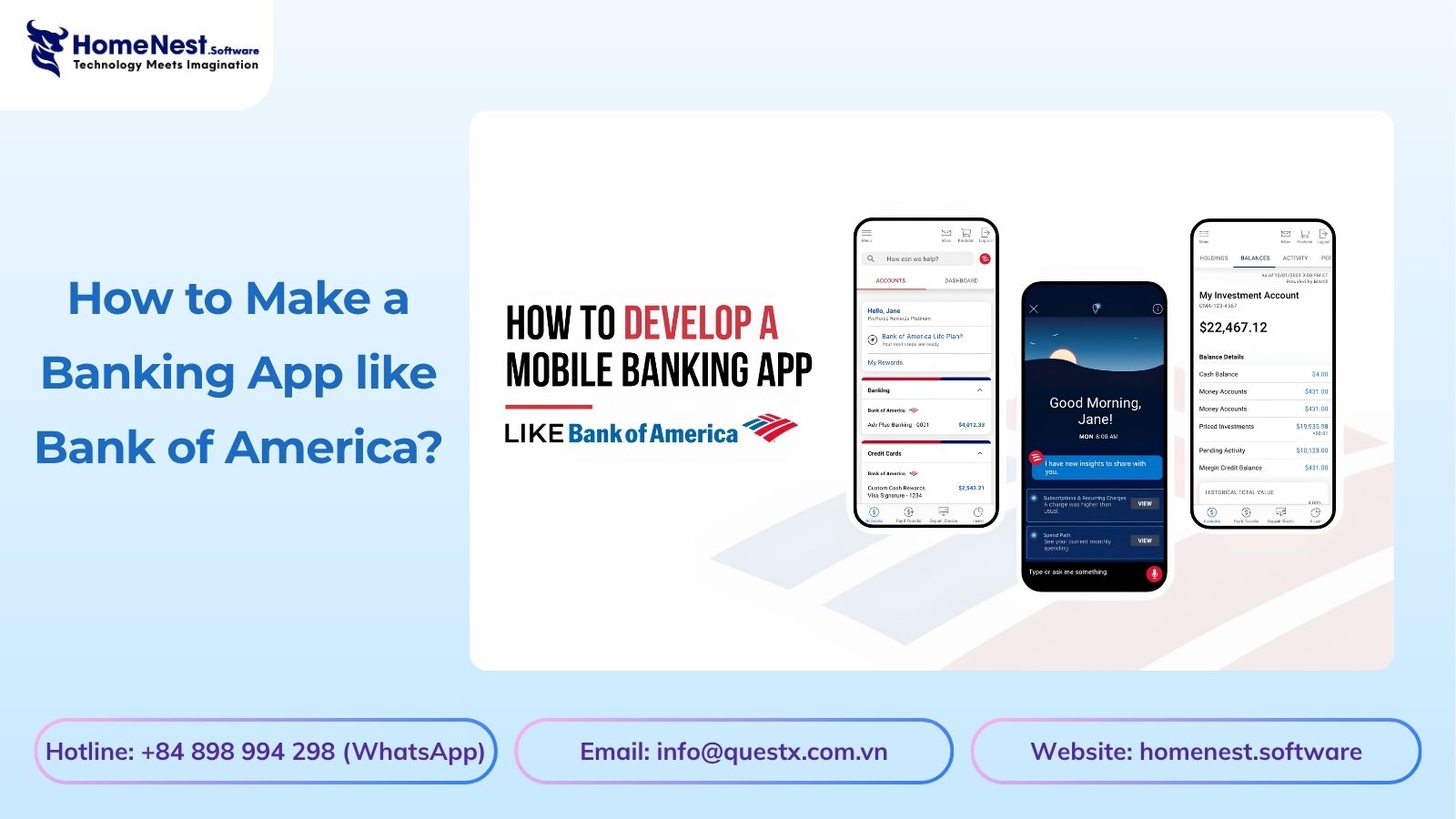
How to Make a Banking App like Bank of America?
Developing a mobile banking application like Bank of America extends far beyond basic UI design; it requires engineering a fault-tolerant backend capable of real-time ledger synchronization, biometric authentication, and high-volume data processing under strict regulatory frameworks. Drawing from HomeNest Software’s deep experience in architecting enterprise-grade fintech solutions, this guide strips away theoretical jargon to focus entirely on operational and technical execution. What you will find in this guide: We break down the precise development roadmap, from mapping out microservices and ensuring PCI-DSS compliance to estimating MVP development costs and securing absolute data sovereignty through 100% source code ownership. If you are preparing to build, scale, or audit a financial platform, this blueprint provides the exact framework you need.
Banking App Development Cost
Building a banking application is rarely a simple process; it’s a complex technical challenge requiring a balance between complying with stringent financial regulations, handling large transaction volumes, and a scalable cloud architecture. Miscalculating these technical requirements from the outset often leads to significant technical debt and budget overruns. Based on HomeNest Software’s practical experience in designing enterprise-grade fintech solutions, this guide bypasses generic estimates to provide a realistic analysis of banking application development costs. What you’ll find in this guide: We analyze the true cost factors, from technology selection and API integration to the hidden costs of regulatory compliance and security infrastructure. Whether you’re launching a minimum viable product or expanding an existing financial platform, this analysis provides the precise operational data you need to plan your budget effectively.
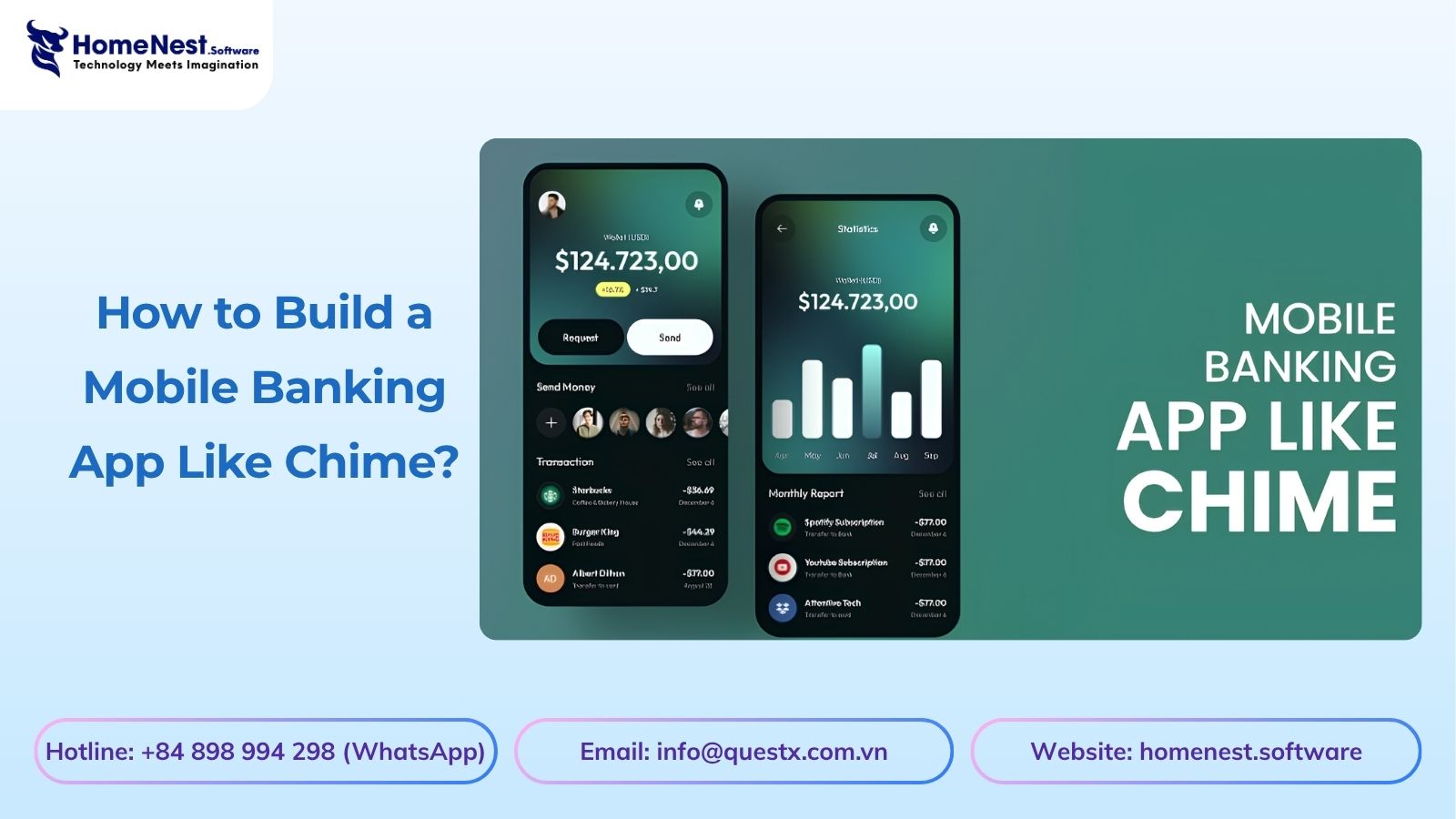
How to Build a Mobile Banking App Like Chime?
Building a mobile banking app like Chime is not just about features, it is about delivering a secure, scalable, and user-centric financial experience. From planning the right architecture to optimizing mobile banking app development cost, every decision directly impacts your product’s success. Leveraging Fintech app development services, starting with MVP app development, and scaling through on-demand app development solutions allows businesses to reduce risk and accelerate time to market. To stay competitive, combining Android app development services and iOS app development solutions ensures wider reach, while continuous updates through maintenance software development services keep your app secure and future-ready.

How to Build a Banking App Like Barclays: A Complete Entrepreneur’s Guide
Building a banking app like Barclays requires more than just development. It demands a strong product vision, secure architecture, and a clear monetization strategy. From optimizing cost and selecting the right tech stack to ensuring compliance and scalability, every decision impacts long-term success. Partnering with an experienced team like HomeNest Software helps accelerate development, reduce risks, and deliver a high-quality fintech product that can compete in today’s fast-evolving digital banking landscape.