
Enterprise Mobile App Development in Singapore: Technical Requirements for Secure, Scalable Systems
This guide specifies the technical, financial, and operational requirements for deploying enterprise mobile applications in Singapore. It details exact standards for API-first architecture, PDPA compliance, total cost of ownership (TCO) calculation, and risk management using a hybrid delivery model.
Scope of Work

Organizations in Singapore require mobile applications to manage remote workforces, meet data protection regulations, and synchronize supply chain data. In this context, a mobile application functions directly as a core component of enterprise IT infrastructure rather than a standalone tool.
Developing enterprise mobile applications requires strict risk management. A poorly architected system causes data inconsistencies, system downtime, and security vulnerabilities. This document specifies the technical, financial, and operational requirements for deploying enterprise-grade mobile systems.
What Is Enterprise Mobile App Development?
Enterprise mobile app development refers to the design, development, and ongoing management of mobile applications built specifically for large organizations and complex operational environments. Unlike basic consumer apps or short term MVPs, enterprise applications are engineered to support mission critical workflows, accommodate multiple user roles, and integrate seamlessly with existing enterprise systems.
These applications play a central role in enabling digital transformation connecting employees, partners, and customers while ensuring data consistency, operational efficiency, and regulatory compliance.
Enterprise Mobile App Trends & Market Outlook (2026)
The enterprise mobile app development market is entering a phase of sustained, high growth expansion as organizations accelerate digital transformation initiatives. Globally, the market is expected to increase from USD 110.99 billion in 2024 to USD 125.39 billion in 2025, reflecting a 13.0% CAGR. This growth is driven by rising smartphone penetration, the maturity of cloud ecosystems, advancements in mobile network infrastructure, the adoption of enterprise mobility management (EMM), and increasing demand for process automation.
By 2026, enterprise mobile applications will no longer be viewed as supplementary tools they are becoming core operational platforms. Businesses are leveraging mobile apps to run mission critical workflows, support distributed and remote teams, enable real time access to business data, and enhance overall operational visibility. The role of mobile is shifting from extending web functionality to powering end to end enterprise processes.
One of the most significant trends shaping this evolution is the move toward cloud native and API first architectures. Enterprises are prioritizing mobile solutions that can scale efficiently, integrate seamlessly with systems such as ERP and CRM, and adapt quickly to changing business requirements. As a result, traditional monolithic architectures are increasingly being replaced by more modular, flexible approaches better suited for long term enterprise scalability and innovation.
Functional Differences Between Enterprise and Consumer Applications
Applying consumer application development methods to internal enterprise systems causes structural failures. Consumer applications are built for rapid user acquisition and simple single-user functions. Enterprise systems are built to execute complex business logic.
Enterprise application engineering requires specific structural differences:
- Process Execution over Usage Time: The primary function is to complete multi-step business processes, such as procurement approvals or field service reporting, efficiently. Maximizing user session time is not the objective.
- System Dependencies: Enterprise applications must constantly exchange data with existing legacy infrastructure, Enterprise Resource Planning (ERP) systems, and specialized modules like IoT sensor networks or AI-driven analytics tools, without causing data conflicts.
- Controlled Deployments: Rapid, automated updates disrupt an enterprise environment. Deployments require isolated staging environments and user acceptance testing (UAT) to ensure continuous operation of supply chains and financial reporting.
Core Technical Requirements for Singapore Enterprises
Technical leaders must implement three specific system requirements to ensure long-term stability.
Cloud-Native Architecture and API-First Integration
A monolithic application structure limits future updates. The system architecture must separate functions into independent microservices. This allows individual components to scale independently as data processing requirements increase. Furthermore, an API-first design provides standard protocols for the mobile application to communicate securely with existing on-premises software and newly integrated platforms, such as blockchain-based traceability systems.
PDPA Compliance and Access Control
Under Singapore law, data protection dictates the initial system design. Engineers must implement multi-factor authentication (MFA) and strict role-based access control (RBAC). Data must be encrypted at rest on the device and in transit between the device and servers. The system must also automatically generate comprehensive audit logs to record specific user actions, which are mandatory for compliance reporting.
Offline Operability and Data Synchronization
Continuous internet access is not guaranteed for logistics, field sales, and manufacturing staff. The application requires local database storage on the device to allow staff to input data without a network connection. The application must run background synchronization protocols to securely transfer this data to the central server immediately upon network reconnection, using conflict-resolution rules for version control.
5 Types of Enterprise Mobile Applications
Enterprise mobile applications are designed to address diverse business functions across departments and operational layers. In Singapore, organizations typically deploy a combination of application types depending on their industry, workflows, and digital maturity.
Internal Workforce & Operations Apps
These applications focus on improving employee productivity and streamlining internal processes. Common use cases include workforce management, task coordination, internal communication, reporting, and operational tracking.
Customer Facing Enterprise Apps
Designed to enhance customer engagement, these apps provide secure access to services such as self service portals, account management, booking systems, loyalty programs, and personalized user experiences.
Sales & Field Service Apps
Built for mobile teams, these applications enable sales representatives and field staff to access real time data, manage schedules, operate offline, and integrate directly with CRM systems improving efficiency and responsiveness in the field.
Partner & Vendor Collaboration Apps
These apps facilitate seamless collaboration with external stakeholders such as partners, suppliers, and distributors. They typically include role based access control, shared data environments, and workflow coordination tools.
Industry Specific Enterprise Apps
Custom built for sectors like fintech, healthcare, education, logistics, and manufacturing, these applications are tailored to meet strict regulatory requirements and complex operational needs unique to each industry.
You can also view the Lover’s Lawn project, a landscape project that HomeNest Software has completed. Additionally, you can see many other outstanding projects from our team.
While each type serves a distinct business function, all enterprise mobile applications share core requirements scalability, security, seamless integration, and long term reliability to effectively support and sustain enterprise operations.
Benefits of Enterprise Mobile App Development
Investing in enterprise mobile applications delivers measurable value across operations, productivity, and long term business growth. Below are seven core benefits organizations can expect:
Increased Employee Productivity and Efficiency
Enterprise apps provide employees with secure, mobile access to tools, data, and workflows anytime, anywhere. This reduces dependency on manual processes and accelerates approvals, often resulting in productivity improvements of up to 20–30%.
Faster Collaboration and Real Time Communication
With integrated messaging, notifications, and workflow updates, teams can collaborate instantly across departments and locations reducing delays and improving responsiveness.
Streamlined Operations Through Automation
By replacing manual processes, spreadsheets, and fragmented systems, enterprise apps enable fully digitized workflows. Tasks such as approvals, reporting, and data capture become faster, more consistent, and less error prone.
Real Time Data Access and Smarter Decision Making
When connected to systems like ERP, CRM, and analytics platforms, enterprise apps provide real time visibility into operations and KPIs empowering leaders to make faster, data driven decisions.
Enhanced Customer and Stakeholder Engagement
Customer facing enterprise apps enable secure self service, personalized experiences, and faster support. This leads to higher satisfaction, stronger engagement, and improved retention especially in service driven industries.
Long Term Cost Efficiency and Stronger ROI
While initial development requires investment, enterprise apps reduce long term costs by minimizing manual work, consolidating systems, and improving operational efficiency often delivering clear ROI within a few years.
Scalability and Future Ready Infrastructure
Built on scalable, cloud enabled architectures, enterprise mobile apps can evolve with business needs supporting new users, features, and integrations over time while maintaining performance and reliability.
Overall, enterprise mobile app development enables organizations to operate more efficiently, respond faster to market demands, and build a scalable digital foundation for sustained growth.
Must Have Features of Enterprise Mobile Apps in 2026
By 2026, enterprise mobile applications are no longer optional tools they are secure, scalable, and mission critical platforms that support core business operations.
To meet modern enterprise demands, the following features are considered essential:
Enterprise Grade Security
Robust security must be embedded from the ground up, including strong authentication mechanisms, role based access control (RBAC), end to end encryption, and comprehensive audit logging to ensure data protection and regulatory compliance.
Seamless System Integration
Modern enterprise apps must support API driven integration with systems such as ERP, CRM, HRM, and legacy platforms ensuring consistent data flow and fully connected business processes.
Scalable, High Performance Architecture
Cloud native, scalable architectures are critical to handle increasing user loads, growing data volumes, and continuous feature expansion without compromising performance.
Offline Access with Secure Synchronization
For field operations and distributed teams, offline functionality is essential. Apps must allow users to operate without connectivity and securely synchronize data once the connection is restored.
Role Based User Experience
Interfaces and workflows should be tailored to specific user roles, ensuring both usability and operational efficiency while maintaining a consistent experience across the organization.
Workflow Automation and Real Time Notifications
Automation of approvals, task routing, and business processes combined with real time alerts helps accelerate decision making and reduce operational delays.
Analytics and Performance Monitoring
Built in analytics dashboards and monitoring tools provide visibility into user behavior, system performance, and operational metrics supporting continuous optimization.
Together, these capabilities ensure enterprise mobile applications remain reliable, compliant, and adaptable, enabling organizations to meet evolving business requirements and sustain long term growth.
Key Architecture & Security Considerations for Enterprise Mobile Apps
Building an enterprise mobile application goes far beyond feature selection. Long term success depends on making the right architectural and security decisions from the outset ensuring the system is scalable, secure, and capable of evolving with business needs.
Scalable Enterprise Mobile App Architecture
A well designed architecture enables the application to grow alongside the organization without requiring costly rework or major system overhauls.
Modern enterprise mobile apps increasingly adopt:
Cloud native and microservices architectures
These approaches allow individual components to scale independently, accelerate deployment cycles, and simplify maintenance compared to traditional monolithic systems.
API first design
An API driven approach ensures seamless communication between the mobile app and backend services, while also enabling future integrations without disrupting existing functionality.
Load balancing and performance optimization
Essential for applications serving large user bases, multiple departments, or concurrent workflows ensuring consistent performance under varying demand.
A scalable architecture helps prevent performance bottlenecks, minimizes downtime, and supports continuous product evolution.
Security & Compliance (PDPA Centric)
Security is a core pillar of enterprise mobile development especially in Singapore, where compliance with PDPA and industry specific regulations is mandatory.
Key security considerations include:
Robust authentication and authorization
Implementing multi factor authentication (MFA), single sign on (SSO), and role based access control (RBAC) ensures users only access appropriate data and functionalities.
Data encryption
Encrypting data both at rest and in transit protects sensitive business and personal information from unauthorized access and breaches.
Audit trails and monitoring
Comprehensive logging of user activity supports compliance audits, incident tracking, and forensic analysis.
Secure coding and vulnerability testing
Regular penetration testing, code reviews, and adherence to secure development standards reduce the risk of vulnerabilities.
Embedding security and compliance at the architectural level not only reduces legal and operational risks but also builds trust with users, partners, and regulators.
Integration with Enterprise Systems
Enterprise mobile applications must operate as part of a broader digital ecosystem rather than in isolation. Seamless integration is critical to delivering real business value.
Key integration considerations include:
Connectivity with core enterprise systems
Integration with ERP, CRM, HRM, financial platforms, and legacy systems ensures consistent data flow and eliminates silos or manual processes.
Middleware and API gateways
These layers facilitate secure, scalable communication between mobile apps and complex backend infrastructures.
Real time and offline synchronization
Ensures users can access accurate, up to date information both online and offline particularly important for field operations and distributed teams.
Effective integration design leads to streamlined workflows, improved data accuracy, higher user adoption, and a more cohesive enterprise technology ecosystem.
Structured Development and Deployment Process
Predictable software delivery requires a phased process to identify technical limitations before coding begins.
- Feasibility and Compliance Audit: Technical teams document the existing IT infrastructure, define hardware constraints, and list the specific regulatory compliance standards the application must meet.
- Role-Based Interface Design: Business analysts specify exact functions for every user type, ensuring the application interface corresponds exactly to the actual operational hierarchy.
- Iterative Engineering: Software engineers build the database architecture and integration pipelines first. User-facing features are developed in subsequent, controlled segments.
- Quality Assurance and Phased Rollout: Testing includes automated load testing and manual security penetration testing. Deployment is executed department by department to measure system stability under actual operational loads.
Calculating Total Cost of Ownership (TCO)
Evaluating development costs based only on the initial build results in budget deficits. Financial planning must calculate the Total Cost of Ownership (TCO) over a three to five-year period.
The initial capital expenditure for development in Singapore corresponds directly to system complexity:
- Targeted Internal Workflows (Single User Role): SGD 60,000 to SGD 120,000.
- Multi-Role Systems with Standard Integrations: SGD 120,000 to SGD 200,000.
- High-Compliance Platforms (Custom Legacy Integrations): SGD 200,000 to SGD 500,000+.
Organizations must also allocate continuous operational expenditure (OpEx). This includes server hosting, third-party API licensing, scheduled penetration testing, operating system compatibility updates, and ongoing code maintenance.
How To Optimize Development Costs
Start with an MVP and scale iteratively
Launching with a minimum viable product helps validate assumptions early and reduces initial investment before expanding features.
Adopt a hybrid delivery model
Combining local product strategy with offshore engineering can significantly reduce costs while maintaining enterprise level quality and oversight.
Prioritize core functionalities
Focusing on essential workflows first minimizes scope creep and ensures faster time to value.
Leverage modular architecture
A modular, scalable design allows incremental expansion and reduces long term technical debt.
A clear understanding of cost drivers combined with a structured development approach enables enterprises to optimize investment while building scalable, future ready mobile solutions.
Common Challenges in Enterprise Mobile App Development & How to Avoid Them
Enterprise mobile app projects often encounter predictable challenges due to their scale, complexity, and long term strategic impact. Identifying these risks early allows organizations to reduce failure rates and deliver more sustainable, high value solutions.
Unclear Requirements and Scope Creep
Why it happens: Multiple stakeholders, shifting priorities, and lack of alignment between business and IT teams.
How to avoid it: Conduct a thorough discovery phase, define a clear scope upfront, and implement structured change management to control requirement changes.
Legacy System Integration Complexity
Why it happens: Many legacy systems were not designed for mobile environments or modern API based connectivity.
How to avoid it: Perform early technical feasibility assessments and adopt API first or phased integration strategies to minimize disruption.
Security and Compliance Risks
Why it happens: Security is often treated as an afterthought, or regulatory requirements are not fully understood.
How to avoid it: Integrate security and PDPA compliance into the architecture and design stages from the beginning.
Low User Adoption
Why it happens: Applications fail to align with real user workflows or lack usability.
How to avoid it: Involve end users early, design role based experiences, and validate through usability testing and feedback loops.
Performance and Scalability Issues
Why it happens: The system is not designed to handle enterprise level workloads or future growth.
How to avoid it: Architect for scalability from day one and conduct performance testing under realistic usage conditions.
Underestimated Maintenance and Support
Why it happens: Too much focus on initial delivery, with insufficient planning for long term operations.
How to avoid it: Allocate budget and resources for ongoing maintenance, monitoring, updates, and continuous feature enhancements.
Addressing these challenges proactively ensures enterprise mobile applications remain reliable, scalable, and aligned with long term business objectives.
Partner with HomeNest Software for Enterprise Mobile App Development in Singapore
HomeNest Software provides custom enterprise software development designed to resolve specific operational requirements. We engineer secure, scalable mobile platforms that connect directly to your core business databases and advanced digital transformation tools.
Operating on a hybrid delivery model, we provide organizations in Singapore with localized project management and cost-efficient engineering execution. From initial legacy system audits to post-deployment server maintenance, we prioritize system stability, exact data security, and verifiable operational output.
Why Enterprises Choose HomeNest Software

Enterprise focused expertise
We specialize in building complex, multi role mobile applications with deep legacy system integrations going beyond simple consumer apps or short term MVPs.
Security and compliance by design
Our teams embed security, data protection, and regulatory requirements such as PDPA into every stage of development ensuring enterprise grade protection from the ground up.
Hybrid Singapore delivery model
We combine local consulting, governance, and stakeholder alignment with highly skilled offshore engineering teams delivering cost efficiency without compromising quality.
Strong architecture and integration capabilities
Our solutions are built on scalable, API driven architectures that integrate seamlessly with ERP, CRM, legacy platforms, and third party systems.
Long term partnership approach
Beyond initial delivery, we provide ongoing maintenance, scaling, and continuous improvement ensuring your application evolves alongside your business.
Partner with HomeNest Software to build secure, scalable mobile applications tailored to your enterprise needs. Contact us today to explore the right development strategy and delivery model for your organization.
Contact Information:
- Address: The Sun Avenue, 28 Mai Chi Tho Street, Binh Trung Ward, Ho Chi Minh City
- Hotline (WhatsApp): +84 898 994 298
- Email: info@questx.com.vn
Conclusion
Enterprise mobile app development has become a critical capability for organizations in Singapore aiming to improve efficiency, strengthen security, and modernize operations. As digital ecosystems grow more complex, the need for scalable architectures, robust compliance, seamless integrations, and long term maintainability continues to increase.
Success depends on making the right strategic decisions from selecting the appropriate technology stack and development process to choosing a reliable delivery partner. By understanding market trends, addressing common challenges proactively, and adopting a structured approach, enterprises can transform mobile applications into powerful drivers of productivity and business growth.
Whether your goal is to streamline internal workflows, empower distributed teams, or deliver secure customer facing services, a well executed enterprise mobile app provides a sustainable competitive advantage.
FAQs
What is enterprise mobile app development?
Enterprise mobile app development involves building mobile applications tailored for large organizations to support internal operations, customer services, and complex workflows with high scalability and security.
How is an enterprise app different from a consumer app?
Enterprise apps focus on business operations, integrations, and compliance, while consumer apps prioritize user experience, speed to market, and mass adoption.
How much does enterprise mobile app development cost in Singapore?
Costs typically range from SGD 60,000 to SGD 500,000+, depending on complexity, integrations, security requirements, and scale.
How long does it take to develop an enterprise mobile app?
Timelines usually range from 3 to 9+ months, depending on project scope, system integrations, and enterprise requirements.
What are the key stages of enterprise app development?
The process includes discovery, technical feasibility, UX/UI and architecture design, development and testing, deployment, and continuous improvement.
What technology stack is best for enterprise mobile apps?
There is no one size fits all stack. The best choice depends on scalability needs, integration requirements, security policies, and whether native, cross platform, or hybrid development is preferred.
Why is architecture important in enterprise apps?
A scalable, well designed architecture ensures the app can handle large workloads, integrate with systems, and evolve without major rework.
What security requirements should enterprise apps meet?
They should include encryption, MFA, RBAC, secure APIs, audit logs, and compliance with regulations such as PDPA.
Can enterprise mobile apps integrate with existing systems?
Yes. They are typically designed to integrate with ERP, CRM, HRM, payment systems, and legacy platforms using APIs and middleware.
What are common challenges in enterprise mobile app development?
Challenges include unclear requirements, legacy system integration, security risks, low user adoption, scalability issues, and underestimating maintenance.
How can enterprises reduce development costs?
By starting with an MVP, prioritizing core features, using a hybrid delivery model, and adopting scalable, modular architecture.
What is a hybrid delivery model?
It combines local consulting and governance with offshore engineering teams to balance cost efficiency and enterprise level quality.
How do I choose the right development partner?
Look for enterprise experience, strong security and compliance expertise, structured delivery processes, integration capabilities, and long term support.
What happens after the app is launched?
Ongoing maintenance includes monitoring, bug fixes, performance optimization, security updates, and continuous feature enhancements.
Is enterprise mobile app development worth the investment?
Yes. It improves operational efficiency, enables better decision making, enhances customer engagement, and supports long term digital transformation.
Which industries benefit most from enterprise mobile apps?
Fintech, healthcare, logistics, manufacturing, education, and government sectors benefit the most due to their need for secure, scalable, and integrated systems.
Can enterprise mobile apps scale with business growth?
Yes. When built with scalable architectures, they can support increasing users, data, and functionality over time.
Latest Articles
View All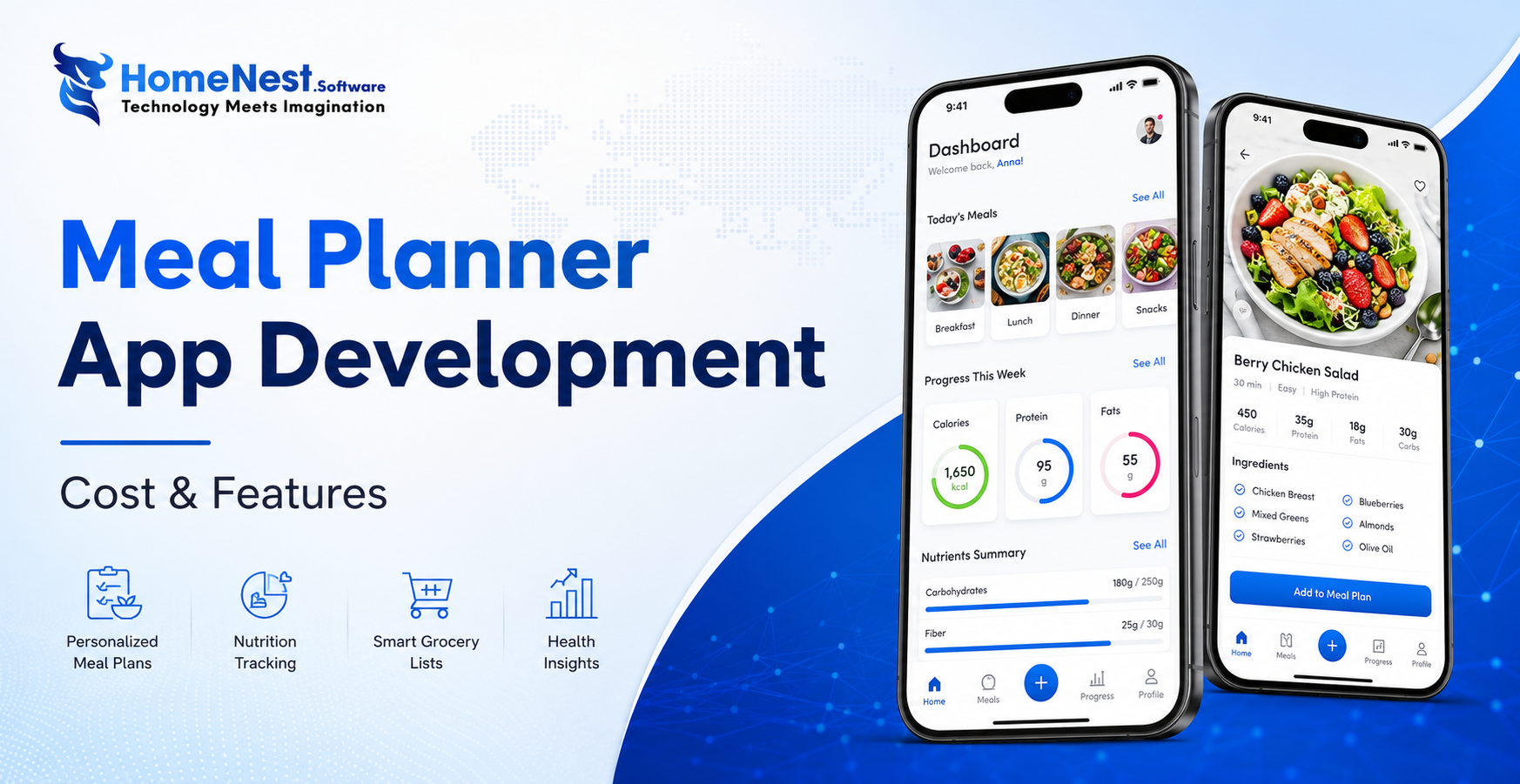
How to Build a Meal Planning App: A Complete Step-by-Step Guide
Building a successful meal planning app goes beyond creating an attractive interface it requires a clear business strategy, personalized user experiences, and scalable technology. By combining essential features like AI-powered meal recommendations, nutrition tracking, grocery list automation, and wearable integration, businesses can deliver lasting value to users while capitalizing on the growing digital health market. Partnering with an experienced mobile app development company ensures your solution is secure, future-ready, and designed to succeed in an increasingly competitive health-tech industry.
How Much Does It Cost to Build a Shopping App Like Temu?
Temu’s meteoric rise to over 900 million global downloads proves the power of combining AI, gamification, and social commerce, but building a similar viral shopping platform requires careful financial and technical planning. Developing an app like Temu typically costs anywhere from $40,000 for a basic Minimum Viable Product (MVP) to over $300,000 for a fully-featured platform. This guide breaks down every cost category, analyzes the core features driving Temu’s success, highlights the best technology stacks, and offers practical strategies to optimize your development budget without compromising on quality.

Criteria For Choosing The Right App Design Agency
UI/UX design is the logical foundation of a system, not merely a visual element. Choosing the wrong partner will directly lead to technical debt, budget overruns, and disruptions in the development process. This article provides a 6-step evaluation framework and a list of operational risks, helping businesses eliminate subjective design advice and accurately assess agency capabilities based on developer handoff standards and practical business performance.
How Does AI in Banking Industry Impact the Future?
Artificial intelligence (AI) has transitioned from a supplementary tool to a core infrastructure of financial data management, optimizing profitability through real-time fraud detection, natural language processing (NLP), and high-speed credit scoring models. “Deploying AI in the financial sector requires more than just algorithmic accuracy, it demands a highly secure cloud architecture and rigorous data governance,” commented Nguyen Tien, co-founder of HomeNest Software. Why read this guide? We skip the theoretical jargon to focus entirely on technical implementation. Whether you’re evaluating a vendor or planning a system overhaul, this article will detail: Operational Efficiency: Automating unstructured data workflows at scale. Risk Architecture: Implementing real-time threat detection and AML compliance. Data ownership: The essential need for 100% ownership of the source code to ensure full algorithm auditability.
How to Make a Banking App like Bank of America?
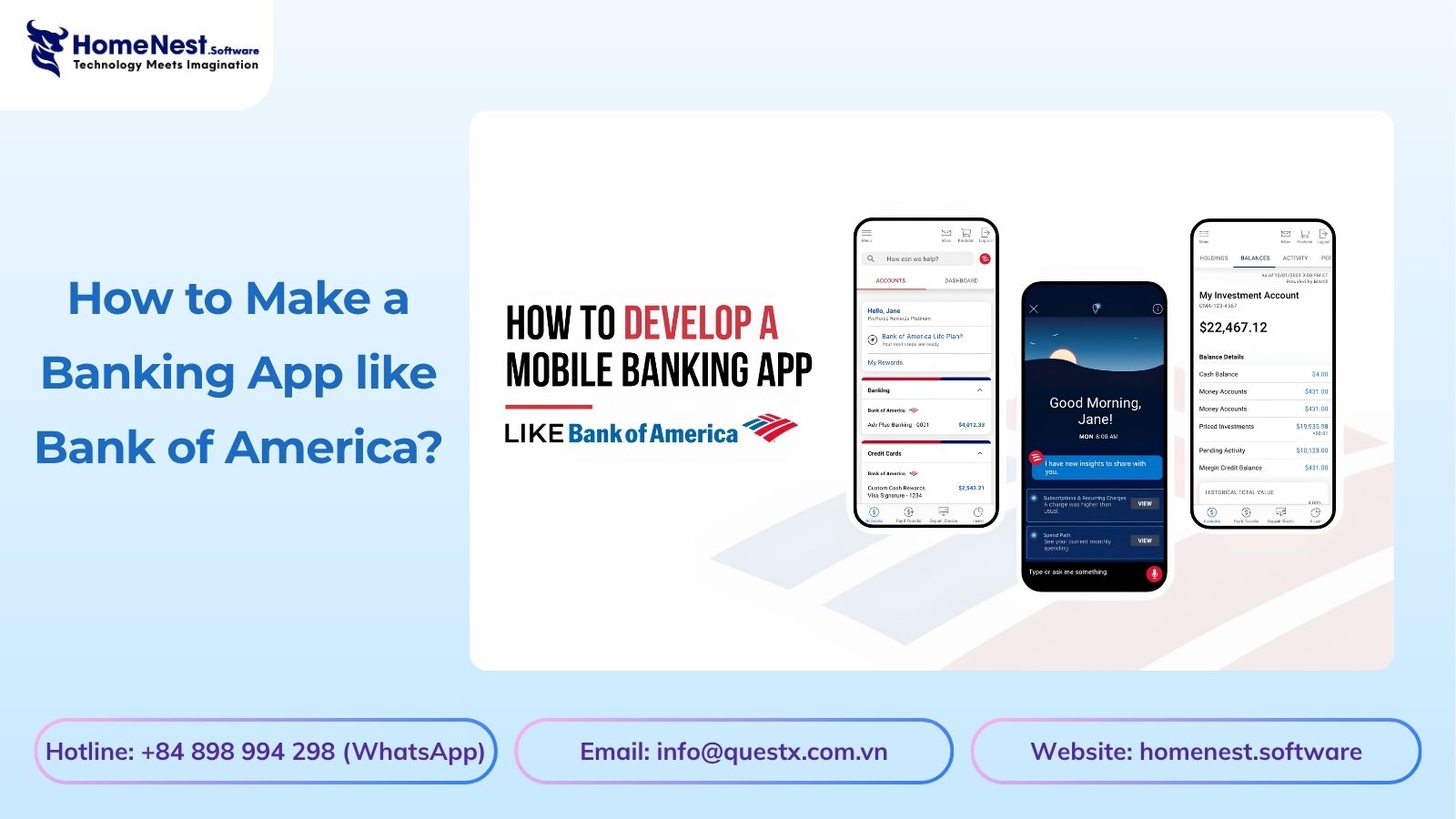
Developing a mobile banking application like Bank of America extends far beyond basic UI design; it requires engineering a fault-tolerant backend capable of real-time ledger synchronization, biometric authentication, and high-volume data processing under strict regulatory frameworks. Drawing from HomeNest Software’s deep experience in architecting enterprise-grade fintech solutions, this guide strips away theoretical jargon to focus entirely on operational and technical execution. What you will find in this guide: We break down the precise development roadmap, from mapping out microservices and ensuring PCI-DSS compliance to estimating MVP development costs and securing absolute data sovereignty through 100% source code ownership. If you are preparing to build, scale, or audit a financial platform, this blueprint provides the exact framework you need.
Banking App Development Cost
Building a banking application is rarely a simple process; it’s a complex technical challenge requiring a balance between complying with stringent financial regulations, handling large transaction volumes, and a scalable cloud architecture. Miscalculating these technical requirements from the outset often leads to significant technical debt and budget overruns. Based on HomeNest Software’s practical experience in designing enterprise-grade fintech solutions, this guide bypasses generic estimates to provide a realistic analysis of banking application development costs. What you’ll find in this guide: We analyze the true cost factors, from technology selection and API integration to the hidden costs of regulatory compliance and security infrastructure. Whether you’re launching a minimum viable product or expanding an existing financial platform, this analysis provides the precise operational data you need to plan your budget effectively.