
Outsourcing AI And Machine Learning: A Decision-Maker’s Practical Guide
Outsourcing AI is not just a service delivery model—it’s a strategic enabler. Successful companies are not those that outsource the most, but those that define scope intelligently, retain control over critical components, and design for knowledge transfer from day one. Use outsourcing to validate ideas, access scarce expertise, and move faster, while keeping the goal of in-house ownership over time. True ROI comes not just from deploying an AI feature, but from building a repeatable, scalable capability that your organization can independently leverage.
Scope of Work
AI development outsourcing is the practice of collaborating with an external team to design, build, train, deploy, and maintain machine learning models and AI driven features. Unlike traditional software outsourcing, it involves more experimental workflows, is highly data dependent, and requires continuous model iteration—making vendor selection, scope definition, and technical management significantly more complex.
If you are a CTO under pressure to develop AI capabilities without having in house ML experts, you are not alone. Hiring senior Machine Learning engineers can take 4 to 6 months, during which your competitive advantage may continue to shrink. This guide will walk you through the entire decision making process.
- When is outsourcing the right choice?
- Should you outsource or keep it in house?
- How do you evaluate and choose the right vendor?
- How can you structure the engagement effectively?
- And how do you measure success after delivery?
In reality, the success or failure of AI initiatives doesn’t depend solely on the vendor’s capabilities—it also heavily depends on how well the engagement is defined, structured, and managed from the very beginning.
Why?

AI software outsourcing differs from traditional software outsourcing in several fundamental ways. Applying conventional development processes to AI projects is one of the most common reasons for failure.
AI projects are inherently experimental
In traditional software delivery models, you define requirements and expect deterministic outputs—features are built according to exact specifications. AI does not work this way. A machine learning model may fail, achieve lower than target accuracy, or perform well in testing but break under real world conditions. These outcomes are not failures but inherent characteristics of machine learning systems. Your contracts, timelines, and success criteria must reflect this uncertainty.
Data is the main bottleneck
In software outsourcing, source code is the primary product to be delivered. However, in the artificial intelligence (AI) software family, data quality is a limiting factor. Data scientists typically spend around 40% of their time preparing and cleaning data. In modeling software, this percentage increases due to non attribute data and incomplete schema documentation. Cheap material will progress slowly regardless of technical capabilities.
The talent market is extremely scarce
While traditional software outsourcing provides access to global technical talent, AI outsourcing goes a step further—it offers access to highly specialized and scarce expertise. Skills in areas such as computer vision, natural language processing (NLP), or reinforcement learning are difficult to hire locally and often require months of recruitment. For many companies, outsourcing is the only practical way to access this level of expertise.
AI models require continuous lifecycle management
Traditional software outsourcing typically ends at delivery and deployment. However, AI systems require ongoing monitoring and improvement. Due to data drift and concept drift, model performance can degrade over time. Without continuous retraining, evaluation, and system maintenance, even a well built model will eventually fail in a production environment.
When should you outsource AI development?
Outsourcing AI development is most effective in several specific scenarios: when you need to validate a use case before committing internal resources; when AI is a supporting feature rather than your core product; when you require specialized expertise without hiring full time staff; or when timelines are too tight to support internal recruitment.
1. Validate before committing
If you are exploring use cases such as predictive analytics, personalization, or virtual assistants, a proof of concept (PoC) can answer feasibility questions within 8–12 weeks. This approach minimizes upfront investment and replaces assumptions with real performance data.
2. AI as an augmentation layer
When AI is not your core product but a supporting capability—such as recommendations, dynamic pricing, fraud detection, or chatbots—outsourcing allows you to move faster without restructuring your technical organization. Your internal team focuses on the core platform, while the external team builds and integrates the machine learning layer. Clear interface boundaries are critical here.
3. Access to specialized ML expertise
Highly specialized skills such as computer vision, natural language processing, large language models (LLMs), or robotic process automation (RPA) are difficult to hire and often unnecessary as permanent roles. Teams with prior production experience can deliver faster and with less risk compared to generalists learning on the job.
4. Fixed deadlines you cannot miss
When deadlines are non negotiable due to competitive pressure, board commitments, or regulatory requirements, outsourcing becomes the most practical option. It allows you to bypass lengthy hiring cycles and accelerate execution.
Read more: Types of IT Outsourcing: Onshore, Offshore, Nearshore
When should you build AI in house?
Outsourcing is not always the right choice. Keeping AI development in house is preferable in the following cases:
AI is your core product or competitive advantage
If machine learning capabilities are what differentiate your business, outsourcing core model development can lead to long term dependency and reduced strategic control.
Your data is highly sensitive
In regulated environments or when working with proprietary datasets, data sharing constraints may make outsourcing impractical—even with strict governance processes, NDAs, or security protocols in place.
You need tight iteration cycles with product teams
If your ML workflows require rapid iteration, close alignment with product decisions, and frequent changes, external teams may introduce communication overhead that slows down execution.
You have talent but lack capacity
If your organization already has machine learning expertise but is constrained by limited resources, models such as staff augmentation or contract hiring are often more effective than fully outsourcing the entire project.
The key is alignment: outsource when it accelerates execution without compromising control, and keep development in house when AI is central to your long term strategy.
What should you outsource, and what should you keep in house?
The most common failure in AI outsourcing is not choosing the wrong vendor, but poorly defining the scope of work. If you outsource too much, your team won’t be able to maintain or evolve the system. If you outsource too little, you lose the speed and expertise advantages you were aiming for.
Recommended division of responsibilities
| Component | Outsource? | Rationale |
|---|---|---|
| Data pipeline engineering | Yes | Infrastructure heavy work that can be effectively handled by external teams. |
| Model training and experimentation | Yes | Requires ML expertise and experience with iterative processes. |
| MLOps setup | Yes | Involves complex tooling and deployment workflows. |
| Proof of Concept (PoC) | Yes | Faster validation with external expertise. |
| Data labeling and annotation | Yes | Labor intensive and easily scalable remotely. |
| Problem definition and success metrics | No | Requires deep business and product knowledge. |
| Data access and governance | No | remain internal to ensure security and compliance. |
| Model evaluation and acceptance | No | A business decision, not purely technical. |
| Production integration | No | Closely tied to your internal architecture. |
| Monitoring and retraining | Yes | Gradually transition ownership to internal teams. |
Be careful with the “Transfer Trap.”
A common failure scenario: an external team provides a model that works well in a Jupyter notebook, but your internal team cannot reproduce the results, understand the technical decisions behind feature engineering, or troubleshoot performance issues in a production environment.
The solution is simple: transfer design knowledge from day one.
- Make sure the vendor works within your repositories and tools.
- Continuously document decisions and processes.
- Include pair programming or hands on observation during the final product refinement stages.
A strong partner does not create dependency; instead, they proactively reduce it over time.
A real world example
Consider a mid stage B2B SaaS company adding predictive analytics to its platform:
- Outsourced work: data pipelines, model development, and MLOps setup.
- In house work: feature definition, experiment design (A/B testing), product implementation, and final acceptance criteria.
The external team works directly within the company’s GitHub repositories and integrates with the company’s CI/CD processes. After about 16 weeks, the model is deployed into production, and the internal team can retrain and maintain it on their own.
This is a picture of well planned AI outsourcing: clear ownership boundaries, structured collaboration, and a proactive roadmap toward internal capability.
How to Evaluate and Select an AI Software Outsourcing Partner
Choosing the right AI partner requires a rigorous assessment across three dimensions: technical depth, process maturity, and contractual clarity. An immediate red flag: any vendor that guarantees a specific model accuracy before analyzing your data.
1. Technical Due Diligence
Don’t rely solely on polished case studies. Dig deeper:
- MLOps architecture: Request diagrams and detailed documentation of their processes, including how they track experiments, manage model versions, and validate data.
- Data handling capabilities: Reputable vendors can explain how they deal with incomplete, inconsistent, or constantly changing data—not just idealized datasets.
- Data engineering vs. modeling: Many teams can build models on clean data; very few can design robust data pipelines capable of handling real world complexity.
- Production history: Ask directly:
- How many models have you deployed that are still running in production?
- How do you monitor and maintain model performance over time?
The goal is to verify that they build reliable, production ready systems, not just visually impressive prototypes for demos.
2. Assessing Business Operations and Processes
- Communication and transparency: Request sample progress reports from previous projects. Reputable vendors typically report on model performance, data quality metrics, and experiment results—not just completed tasks.
- Team stability: Clarify who will actually be working on your project and their time commitment. Frequent personnel changes lead to repeated onboarding and loss of overall context. You need a stable team with clearly identified members, not a constantly rotating workforce.
- Intellectual property and data governance: Ensure contracts clearly define ownership of models, derivative data, and source code. Verify their security practices, including:
- Encryption (both in transit and at rest)
- Access control and audit logs
- Data storage locations and regulatory compliance (e.g., GDPR)
- Certifications such as ISO 27001
If these terms are not clearly documented, they are unlikely to be enforceable.
3. Warning Signs to Watch For
- Guaranteed accuracy claims: Promises of high metrics like “95% accuracy” without reviewing your data indicate inexperience or overpromising.
- Lack of transparency about team members: Be cautious if the vendor avoids disclosing who will actually do the work.
- Lack of real world production experience: A track record limited to research projects or PoCs (Proof of Concept) without operational systems is a significant risk.
- Rigid fixed price contracts: AI projects require flexibility. Strictly fixed scopes often lead to misalignment when real data and changing requirements arise.
A strong AI software outsourcing partner demonstrates not only technical competence but also operational maturity, transparency, and practical understanding of the risks involved in machine learning projects.
Building an Interaction Structure for Success
The most effective AI outsourcing projects typically follow a phased approach, with clear decision milestones between each phase to manage risk and avoid wasted investment.
Phase 1: Discovery & Proof of Concept (6–12 weeks, time & materials)
This is the most critical and cost effective phase. The objectives are to:
- Precisely define the problem.
- Assess the quality and readiness of the data.
- Build a working experimental model.
Answer a single question: “Is this worth pursuing?”
Any vendor that moves straight into a large scale development contract without going through a discovery phase should be approached with caution.
Phase 2: Development (Milestone Based or Dedicated Team)
Once feasibility is confirmed, move into a structured deployment phase:
- Milestone based model: Suitable when deliverables can be clearly defined (e.g., a model trained on data resembling production data, end to end processes during the testing phase).
- Dedicated team model: More appropriate for continuously evolving requirements or exploratory research work.
Avoid tying milestones to fixed accuracy targets. Instead, anchor them around process milestones (pipeline readiness, data validation) and delivery milestones (model performance under defined conditions).
Phase 3: Transition & Handover (4–8 weeks)
Allocate 15–20% of total project time to this phase. It includes:
- Comprehensive documentation
- Knowledge transfer sessions
- Pair programming with internal engineers
- A supervised handover period where your team operates the system
Skipping this phase is a common failure point leading to systems that run in production but cannot be maintained internally.
Go / No Go Decision Points
Introduce explicit checkpoints after each phase:
- After PoC → Does the result justify further investment?
- After initial production ready model → Is there measurable business value?
- After staging deployment → Is the system operationally ready?
These checkpoints allow you to continue, pivot, or stop reducing exposure to sunk cost bias.
Protecting Your Intellectual Property
Your contract must clearly define ownership of:
- Trained AI models
- Derived datasets
- Custom code and pipelines
- Testing and evaluation scripts
Be cautious with clauses around “vendor proprietary tools,” which can be broadly defined and may overlap with deliverables you’ve paid for.
Also clarify pre existing IP: vendors may use their own frameworks, components, or pretrained assets. Define what is:
- Vendor owned
- Client owned
- Shared or licensed
Finally, ensure data governance is contractually enforced, including:
- Encryption (in transit and at rest)
- Access controls
- Data residency requirements
- Data retention and deletion policies post engagement
A well structured engagement doesn’t just improve delivery it reduces risk, preserves control, and ensures your team can operate independently after the vendor exits.
Managing the Relationship Day to Day
Effective AI outsourcing isn’t just about choosing the right partner it’s about how you manage the engagement daily. The difference between smooth delivery and ongoing friction typically comes down to four practices:
Embed, Don’t Delegate
Assign an internal technical lead to stay actively involved. This person should join standups, review pull requests, and challenge technical decisions when needed. They don’t need deep ML expertise, but they must have enough technical judgment to spot issues early. Think of this role as your safeguard against misalignment and the “handoff trap.”
Standardize Shared Tooling from Day One
Your vendor should operate within your ecosystem your repositories, CI/CD pipeline, and experiment tracking tools. If they work in isolated environments and deliver code in batches, you’re creating future integration pain. Shared tooling ensures continuity and eliminates friction when transitioning ownership.
Run Weekly Model Performance Reviews
In addition to sprint reviews, establish a dedicated cadence to evaluate:
- Data quality metrics
- Model performance across key segments
- Infrastructure and compute costs
- Upcoming experiments and iteration plans
- Integration and deployment issues
This is where you detect data drift, bias, and pipeline failures early long before they impact production.
Resolve Data Access Early
The most common bottleneck in outsourced AI projects is not the vendor it’s delayed data access, security approvals, and governance processes on the client side. Align on data permissions, compliance requirements, and access protocols before the engagement begins to avoid unnecessary delays.
Strong day to day management ensures the engagement stays aligned, transparent, and scalable turning outsourcing from a risk into a controlled execution advantage.
Measuring ROI from AI Development Outsourcing
Evaluate ROI across multiple dimensions not just cost. A narrow cost comparison misses the real value AI outsourcing can deliver.
Time to Value vs. In House Development
The primary advantage of outsourcing is speed. If it enables you to launch an AI feature six months earlier, quantify the impact:
- Incremental revenue from earlier market entry
- Competitive advantage gained
- Avoided hiring and ramp up costs
Outsourcing may not always be cheaper per hour but it is almost always faster to first delivery.
Model Performance in Business Terms
Technical metrics alone don’t justify investment. Translate outcomes into business impact:
- Instead of “93% accuracy,” frame it as
→ “Reduced false positives by 40%, saving 200 support hours per month.”
Organizations that measure AI performance in business terms are significantly more likely to scale successfully.
Knowledge Transfer and Internal Capability
A successful engagement builds internal capability not dependency. After delivery, your team should be able to:
- Retrain the model independently
- Diagnose and fix performance issues
- Extend the system for new use cases
Validate this explicitly before handover e.g., have your engineers perform supervised retraining and debugging exercises while the vendor is still engaged.
Total Cost of Ownership (TCO)
Initial development is only part of the cost typically 30–40% of first year spend. A complete ROI analysis must include:
- Ongoing monitoring and maintenance
- Periodic retraining cycles
- Infrastructure costs (compute, storage, model serving)
- Internal resources required to operate the system
A robust ROI framework ensures you’re not just delivering a working model but building a sustainable, scalable AI capability aligned with business outcomes.
Common Pitfalls in AI Outsourcing (and How to Avoid Them)
AI outsourcing failures are rarely random they follow repeatable patterns. Recognizing them early gives you clear guardrails for success.
Starting Without Production Ready Data
If your training data is incomplete, poorly labeled, or not representative of real world conditions, the project will stall in data preparation rather than model development.
How to Avoid This:
Conduct a data readiness assessment before starting the project. If the data is not ready, begin with a data strategy phase rather than building a model. This is one of the most costly mistakes—but entirely preventable.
Treat the PoC as a Production System
Proof of concept (PoC) projects are often intentionally simplified—they rely on hard coded logic, ignore edge cases, and lack scalability or monitoring. Deploying a PoC directly into production results in unreliable systems and erodes user trust.
How to avoid this:
Allocate separate budget and time to harden the system for production, including error handling, scalability, and monitoring infrastructure.
Scope creep from the “Just one more feature” mindset
Initial success often leads to additional requests: “Can it do X as well?” Each request may seem small, but cumulatively they cause delays and inconsistent product delivery.
How to avoid this:
Clearly define the project scope from the start and enforce governance.
Ignoring MLOps Until the Final Stage
Deployment, monitoring, version control, and retraining are not optional—they are core to production ready AI. Treating MLOps as an afterthought creates an expensive gap between model development and real world deployment.
How to avoid this:
Ensure MLOps is integrated into the system from the very beginning. Experienced vendors typically embed it into the initial architecture rather than adding it as an after the fact feature.
No Exit Strategy
What happens if the relationship with the vendor ends due to cost, performance, or external factors? Without full ownership and internal understanding, you become dependent.
How to avoid this:
Plan for independence early:
- Ensure full ownership of source code and models.
- Maintain comprehensive documentation.
- Keep at least one internal engineer capable of operating the system.
AI outsourcing is successful when risks are anticipated and managed proactively. Most issues that arise are not technical—they stem from structural gaps and can be prevented if properly addressed from the start.
Building Long Term AI Capability After Outsourcing
The most effective AI outsourcing projects are designed with a clear end goal. The objective is not long term dependency but accelerating deployment while building internal capabilities that your organization can maintain.
A phased transition model works well:
- Phase 1: Fully outsource the initial project to accelerate progress.
- Phase 2: Hire your first ML engineer during the collaboration.
- Phase 3: Move to a co development model, where your internal team works alongside the vendor.
- Phase 4: Achieve full internal ownership in the next cycle.
This approach ensures that knowledge transfer happens in real time, rather than as a last minute handoff.
Your first ML engineer will be significantly more effective if they inherit a well structured system with fully documented data pipelines, experiment tracking, and deployment processes—rather than starting from scratch.
When done correctly, outsourcing not only delivers AI features but also establishes the technical and operational foundation for your company’s long term AI capability.
If you’re looking to implement artificial intelligence (AI) initiatives, you can learn more about AI development and how HomeNest Software supports providing comprehensive, scalable, and production ready solutions.
Outsourcing AI And Machine Learning: A Decision Maker’s Practical Guide
Frequently Asked Questions: Outsourcing Artificial Intelligence and Machine Learning Projects
What is AI development outsourcing?
AI development outsourcing involves collaborating with an external team to design, build, train, deploy, and maintain machine learning models or AI based features for your business.
When should a company outsource AI development services?
Outsourcing is ideal when you need to speed up time to market, lack in house machine learning experts, require specialized skills, or want to validate use cases before investing in a full internal team.
Which parts of an AI project should be outsourced?
Commonly outsourced components include data pipelines, model development, MLOps setup, and proof of concept work. Core aspects such as problem definition, data governance, and production integration are typically best handled in house.
Is outsourcing AI services more cost effective than hiring internal staff?
Not always on an hourly basis. However, outsourcing often delivers better ROI by accelerating progress, avoiding recruitment delays, and reducing long term fixed costs for specialized positions.
How to choose the right AI software outsourcing partner?
Evaluate providers based on technical expertise (MLOps, production experience), process maturity (communication, reporting), and contract clarity (intellectual property rights, data security). Avoid vendors who guarantee results without understanding your data.
What are the biggest risks in outsourcing AI services?
Key risks include poor data quality, unclear scope, lack of MLOps planning, insufficient knowledge transfer, and vendor dependency. These risks can be mitigated by defining scope, structured management, and proper knowledge transfer.
How long does a typical outsourced AI project take?
A typical project includes a proof of concept (PoC) phase lasting 6–12 weeks, followed by development phases depending on complexity. Readiness for production may take several months.
Can externally developed AI models be maintained in house later?
Yes, if processes are properly structured. With complete documentation, architectural handover, and standard tools, internal teams can handle retraining, monitoring, and further development.
Should AI be developed in house or outsourced long term?
If AI is a core competitive advantage, it should be brought in house. Outsourcing should only be used to accelerate initial progress and build internal capabilities over time.
How can HomeNest Software support AI outsourcing?
HomeNest Software helps businesses define the scope of innovative AI architectures, provides professional engineering teams, develops production ready AI systems, and ensures architectural handover and long term maintainability.
Latest Articles
View All
Criteria For Choosing The Right App Design Agency
UI/UX design is the logical foundation of a system, not merely a visual element. Choosing the wrong partner will directly lead to technical debt, budget overruns, and disruptions in the development process. This article provides a 6-step evaluation framework and a list of operational risks, helping businesses eliminate subjective design advice and accurately assess agency capabilities based on developer handoff standards and practical business performance.
How Does AI in Banking Industry Impact the Future?
Artificial intelligence (AI) has transitioned from a supplementary tool to a core infrastructure of financial data management, optimizing profitability through real-time fraud detection, natural language processing (NLP), and high-speed credit scoring models. “Deploying AI in the financial sector requires more than just algorithmic accuracy, it demands a highly secure cloud architecture and rigorous data governance,” commented Nguyen Tien, co-founder of HomeNest Software. Why read this guide? We skip the theoretical jargon to focus entirely on technical implementation. Whether you’re evaluating a vendor or planning a system overhaul, this article will detail: Operational Efficiency: Automating unstructured data workflows at scale. Risk Architecture: Implementing real-time threat detection and AML compliance. Data ownership: The essential need for 100% ownership of the source code to ensure full algorithm auditability.
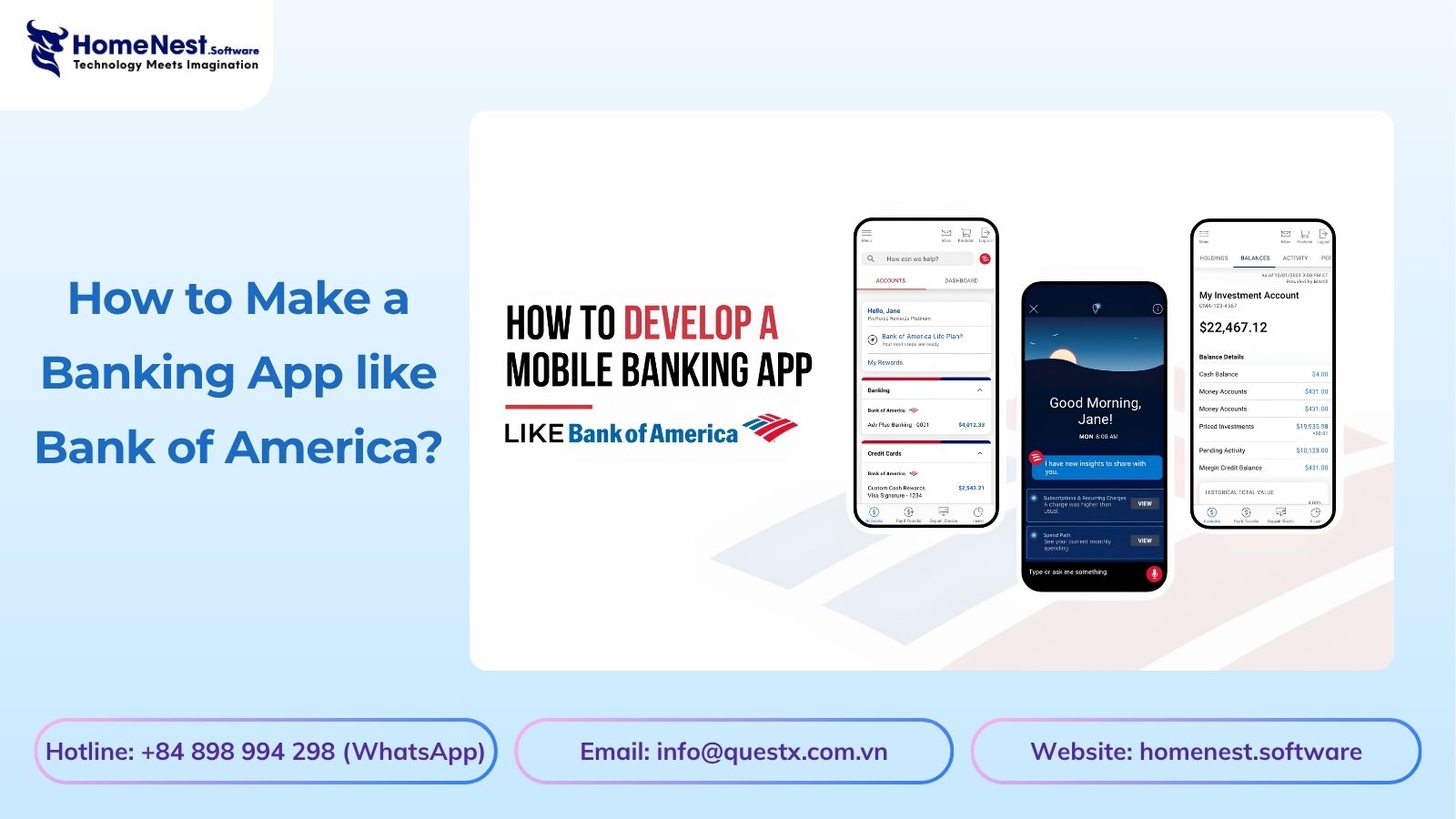
How to Make a Banking App like Bank of America?
Developing a mobile banking application like Bank of America extends far beyond basic UI design; it requires engineering a fault-tolerant backend capable of real-time ledger synchronization, biometric authentication, and high-volume data processing under strict regulatory frameworks. Drawing from HomeNest Software’s deep experience in architecting enterprise-grade fintech solutions, this guide strips away theoretical jargon to focus entirely on operational and technical execution. What you will find in this guide: We break down the precise development roadmap, from mapping out microservices and ensuring PCI-DSS compliance to estimating MVP development costs and securing absolute data sovereignty through 100% source code ownership. If you are preparing to build, scale, or audit a financial platform, this blueprint provides the exact framework you need.
Banking App Development Cost
Building a banking application is rarely a simple process; it’s a complex technical challenge requiring a balance between complying with stringent financial regulations, handling large transaction volumes, and a scalable cloud architecture. Miscalculating these technical requirements from the outset often leads to significant technical debt and budget overruns. Based on HomeNest Software’s practical experience in designing enterprise-grade fintech solutions, this guide bypasses generic estimates to provide a realistic analysis of banking application development costs. What you’ll find in this guide: We analyze the true cost factors, from technology selection and API integration to the hidden costs of regulatory compliance and security infrastructure. Whether you’re launching a minimum viable product or expanding an existing financial platform, this analysis provides the precise operational data you need to plan your budget effectively.
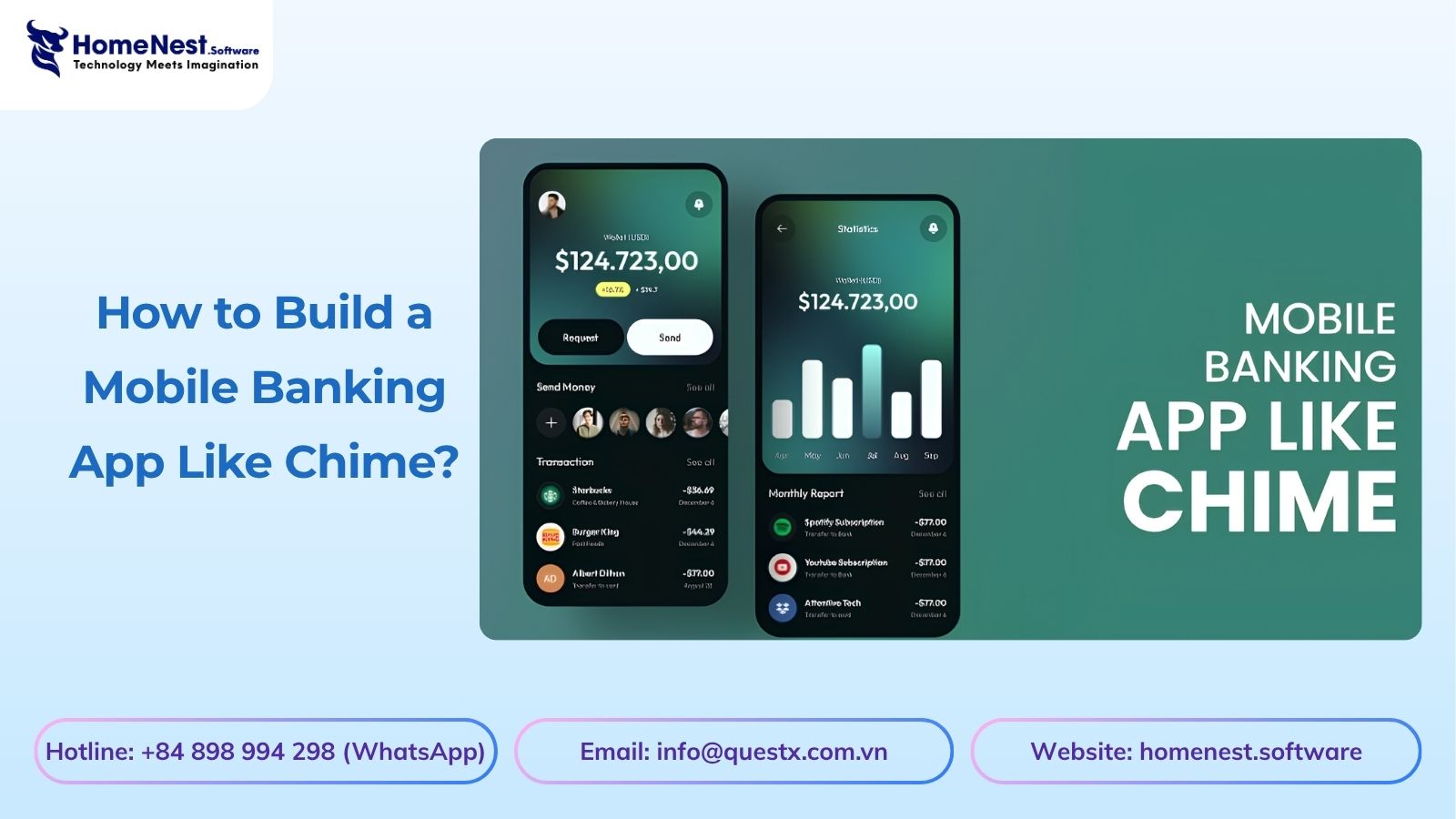
How to Build a Mobile Banking App Like Chime?
Building a mobile banking app like Chime is not just about features, it is about delivering a secure, scalable, and user-centric financial experience. From planning the right architecture to optimizing mobile banking app development cost, every decision directly impacts your product’s success. Leveraging Fintech app development services, starting with MVP app development, and scaling through on-demand app development solutions allows businesses to reduce risk and accelerate time to market. To stay competitive, combining Android app development services and iOS app development solutions ensures wider reach, while continuous updates through maintenance software development services keep your app secure and future-ready.

How to Build a Banking App Like Barclays: A Complete Entrepreneur’s Guide
Building a banking app like Barclays requires more than just development. It demands a strong product vision, secure architecture, and a clear monetization strategy. From optimizing cost and selecting the right tech stack to ensuring compliance and scalability, every decision impacts long-term success. Partnering with an experienced team like HomeNest Software helps accelerate development, reduce risks, and deliver a high-quality fintech product that can compete in today’s fast-evolving digital banking landscape.