
What is TypeScript? A Reliable Programming Solution for Long-Term Application Development
Scope of Work
TypeScript is becoming the top choice for modern programmers due to its scalability, intelligent error checking, and optimized development efficiency. This language not only inherits the power of JavaScript but also brings a safer, clearer, and more professional programming experience.
So, what makes TypeScript increasingly popular and an essential “weapon” for programmers today?
What is TypeScript?
TypeScript is an open-source programming language introduced by Microsoft in 2012. It is built upon the foundation of JavaScript while adding powerful features such as static typing, classes, and Object-Oriented Programming (OOP).
Unlike JavaScript, TypeScript code cannot run directly in a browser. Instead, it needs to be compiled into regular JavaScript code through the TypeScript compiler (tsc). Once compiled, the TypeScript program can function normally in any environment that supports JavaScript.
Practical Applications of TypeScript

TypeScript inherits the full power of JavaScript and extends it with modern features, making the software development process safer, clearer, and easier to maintain. More than just a powerful programming tool, TypeScript brings significant practical value to building large-scale projects, especially in professional development environments.
1. Static Type Checking – Increasing Code Safety
TypeScript allows for fixed data type declarations for variables, functions, and objects, helping to detect syntax or data type errors early in the coding phase. This enables developers to address mistakes sooner, prevent runtime errors, and ensure application stability.
2. Support for Object-Oriented Programming (OOP)
The language offers genuine object-oriented programming capabilities through concepts like classes, inheritance, and access modifiers (public, private, protected). This results in code with a tight structure, making it easier to extend and reuse.
3. Efficient Code Organization with Modules
TypeScript enables the division of source code into separate modules, making it simpler to manage, reuse, and facilitate team collaboration on large projects. This organizational approach is particularly useful when developing complex systems or when multiple members are involved.
4. Integration of Modern ES6 Features
As an extension of JavaScript, TypeScript is fully compatible with new ECMAScript 6 (ES6) features such as arrow functions, template strings, and destructuring. This allows developers to leverage modern syntax while ensuring project stability.
5. Increased Development Speed and Efficiency
With features like code suggestion (IntelliSense), autocomplete, and error warnings during input, TypeScript helps developers write code faster, more accurately, and minimizes errors throughout the development process.
6. Easy Maintenance and Scalability
Clear data types and a tight organizational structure make the source code easy to read and understand, facilitating future application maintenance or extension – a critical factor in projects with a long lifecycle.
7. Full Compatibility with JavaScript
As a “superset” of JavaScript, TypeScript can be used side-by-side with existing JavaScript code without needing a complete overhaul. This allows projects to flexibly transition to TypeScript, saving time and cost.
8. Strong Ecosystem and Development Community
Developed by Microsoft and supported by a global developer community, TypeScript is continuously updated and improved. The vibrant community makes it easy for users to find resources, libraries, and receive support during their work.
Advantages and Disadvantages of TypeScript
Advantages
- Early Error Detection: Helps identify errors during the coding process rather than at runtime.
- Easy-to-Read and MaTypeScript is increasingly popular among modern programmers because of its scalability, smart error checking, and efficient development. This language not only inherits JavaScript’s power but also provides a safer, clearer, and more professional programming experience. Integrable Source Code: The use of explicit data types makes the code easier to understand and helps prevent logic errors.
- Good Support for Large Projects: Clear structure, easy to refactor and scale.
- Full Compatibility with JavaScript: After compilation, it can run on any browser or platform that supports JavaScript.
- Powerful Tooling Ecosystem: TypeScript is well-supported in IDEs, providing effective syntax suggestions, auto-completion, and error detection.
Disadvantages
- Requires Compilation Time: Must be converted to JavaScript before execution, which slightly slows down the process.
- Requires Additional Knowledge: Beginners need a solid understanding of JavaScript before learning TypeScript.
- Dependency on Definition Files: Some third-party libraries may lack type definition files, posing challenges during integration.
TypeScript Data Type Structure
TypeScript utilizes a flexible type system that allows for the definition and checking of data types throughout the entire program. This system includes:
- Basic Types (number, string, boolean, array, etc.): Ensure values adhere to the correct format.
- Interfaces: Define data structures, helping to clearly describe the required properties and methods.
- Generics: Allow writing code that can work with various data types while maintaining type safety.
- Special Types (any, void, null, undefined): Provide flexibility when dealing with cases where the type is unknown or not applicable.
- Advanced Types (Union, Intersection, Tuple, Type alias): Support the representation of complex data types and flexible combinations.
Thanks to this system, TypeScript helps to minimize syntax errors, increase the predictability of program behavior, and ensure consistency throughout the source code.
Object-Oriented Programming in TypeScript
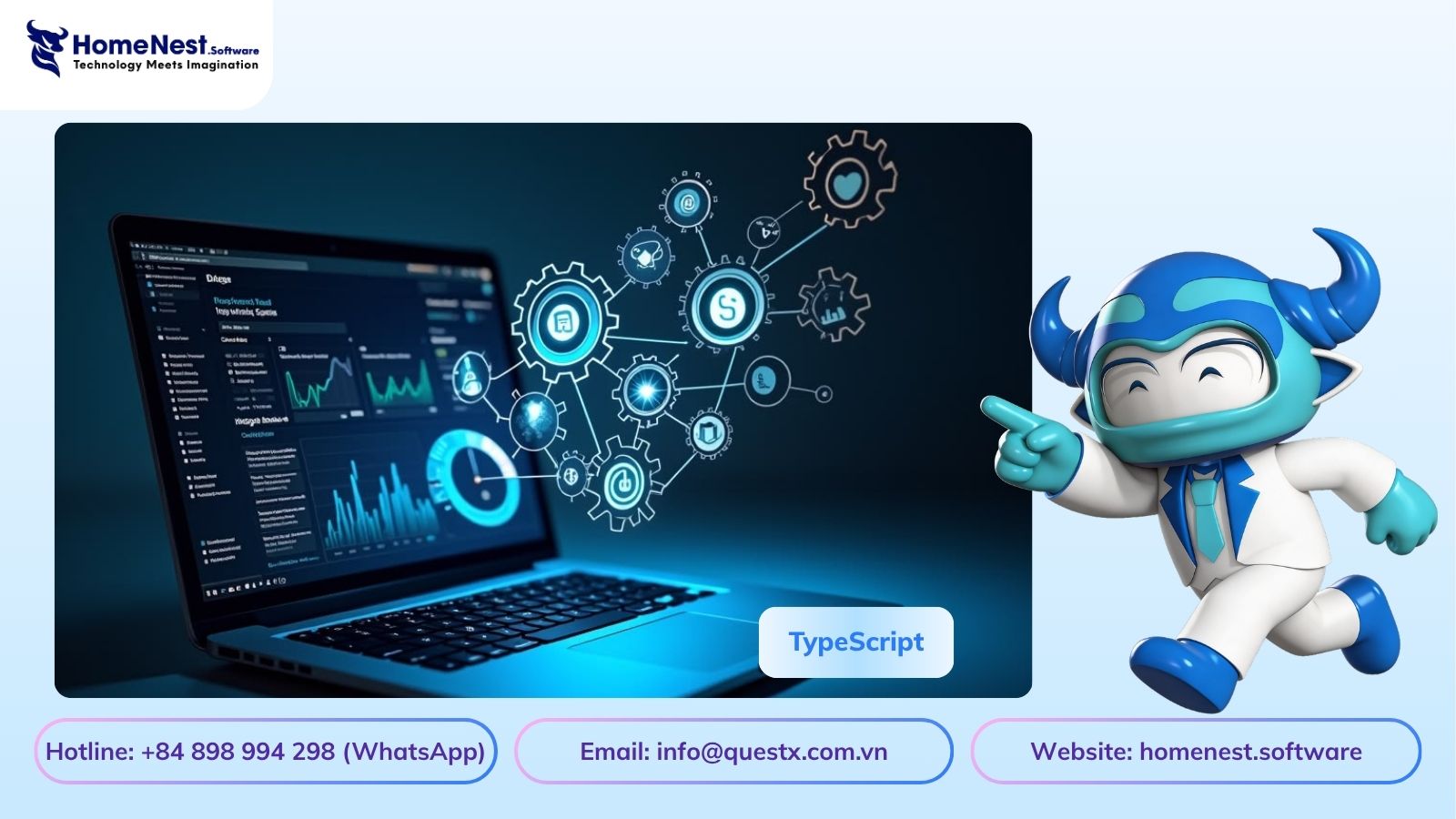
TypeScript supports the OOP (Object-Oriented Programming) model, which allows developers to build applications using an “object” structure, comprising properties and methods.
The fundamental concepts of OOP in TypeScript include:
- Class: Defines the blueprint for an object, encompassing data and behavior.
- Access Modifiers:
- public – Accessible from anywhere.
- private – Accessible only within the class.
- protected – Accessible within the class and its derived (inherited) classes.
- Inheritance: Allows one class to extend the functionality of another class.
- Abstract Class: An abstract class defines a general behavioral framework that must be implemented by its subclasses.
- Interface: Helps to define the shape (structure) of an object without requiring detailed implementation.
As a result, TypeScript provides capabilities for code reusability, easy extensibility, and enhanced organization in software projects.
The Relationship Between TypeScript and JavaScript
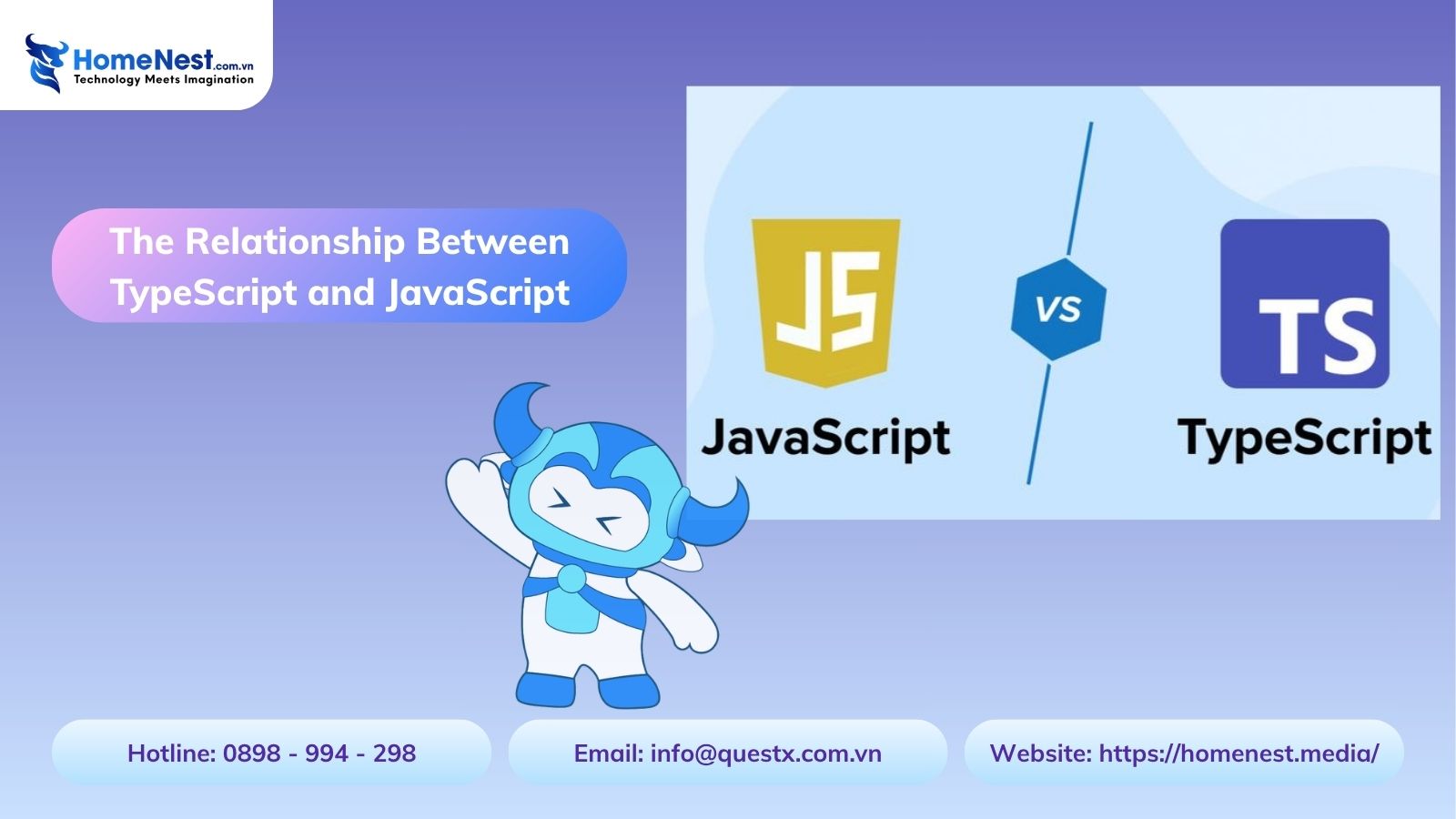
TypeScript can be seen as an “enhanced version” of JavaScript. Every program written in JavaScript is valid in TypeScript, but the reverse is not true, because TypeScript includes its own specific syntax.
Mechanism of Operation
To run in a browser, TypeScript code must be compiled into JavaScript. During this process, the compiler will:
- Analyze and check the syntax.
- Verify data types.
- Convert the TypeScript code into equivalent JavaScript code.
Compatibility
- It is possible to combine TypeScript and JavaScript within the same project.
- The type system helps to minimize errors when migrating from JavaScript to TypeScript.
- The compiled code runs on all platforms that support JavaScript.
TypeScript vs. JavaScript Comparison
| Criteria | TypeScript | JavaScript |
| Developer | Microsoft | Brendan Eich (Netscape) |
| Data Typing | Static typing | Dynamic typing |
| Tooling Support | Strong IDE support with type checking | Primarily debuggers and DevTools |
| Syntax | The extension of JavaScript includes classes and interfaces | Flexible, simple |
| Project Suitability | Suitable for large projects, team collaboration | Good for small projects, more flexible |
| Learning Curve | Requires a JavaScript foundation | Easy access for beginners |
Learn more: TypeScript vs JavaScript
Conclusion
TypeScript is a significant leap forward for JavaScript, making the source code safer, clearer, and easier to maintain thanks to its powerful type system and Object-Oriented Programming capabilities. Due to these benefits, TypeScript is increasingly favored in modern software projects, especially large-scale systems requiring high reliability.
Experience the stability and performance of TypeScript firsthand. Contact HomeNest Software today for expert Web Application Development services designed to elevate your business
If you are looking to apply TypeScript to optimize your processes and enhance software development efficiency, Contact Us Now – HomeNest Software. We will partner with you to create breakthrough solutions in the digital age.
HomeNest Software – A Foundation for Sustainable Growth for Vietnamese Businesses.

Contact Information:
- Address: The Sun Avenue, 28 Mai Chi Tho Street, Binh Trung Ward, Ho Chi Minh City
- Hotline: +84 898 994 298 ( WhatsApp )
- Website: Homenest Software
Frequently Asked Questions (FAQ)
1. Is TypeScript more difficult to learn than JavaScript?
No. If you are already familiar with JavaScript, learning TypeScript is quite easy. TypeScript only adds syntax and typing rules, which ultimately make the code more robust and less prone to errors.
2. Will TypeScript completely replace JavaScript?
No. TypeScript is compiled into JavaScript, so it does not replace but rather extends the capabilities of JavaScript, leading to more efficient software development.
3. Should small projects use TypeScript?
Absolutely. Although TypeScript maximizes its potential in large projects, it still helps detect errors early and improves code quality even in smaller ones.
4. Can TypeScript run directly in the browser?
No. TypeScript code needs to be compiled into JavaScript before it can be executed in a web browser or a Node.js environment.
5. Can TypeScript be used with frameworks like React, Angular, or Vue?
Yes. TypeScript is highly compatible with popular frameworks such as React, Angular, Vue, and Next.js, making the development process more stable and easier to maintain.
6. Why are many tech companies switching to TypeScript?
Because TypeScript helps reduce errors, increase development speed, and makes projects easier to manage and scale, it is particularly suitable for large development teams and large-scale systems.
What is TypeScript? A Reliable Programming Solution for Long-Term Application Development
Latest Articles
View All
Criteria For Choosing The Right App Design Agency
UI/UX design is the logical foundation of a system, not merely a visual element. Choosing the wrong partner will directly lead to technical debt, budget overruns, and disruptions in the development process. This article provides a 6-step evaluation framework and a list of operational risks, helping businesses eliminate subjective design advice and accurately assess agency capabilities based on developer handoff standards and practical business performance.

How Does AI in Banking Industry Impact the Future?
Artificial intelligence (AI) has transitioned from a supplementary tool to a core infrastructure of financial data management, optimizing profitability through real-time fraud detection, natural language processing (NLP), and high-speed credit scoring models. “Deploying AI in the financial sector requires more than just algorithmic accuracy, it demands a highly secure cloud architecture and rigorous data governance,” commented Nguyen Tien, co-founder of HomeNest Software. Why read this guide? We skip the theoretical jargon to focus entirely on technical implementation. Whether you’re evaluating a vendor or planning a system overhaul, this article will detail: Operational Efficiency: Automating unstructured data workflows at scale. Risk Architecture: Implementing real-time threat detection and AML compliance. Data ownership: The essential need for 100% ownership of the source code to ensure full algorithm auditability.

How to Make a Banking App like Bank of America?
Developing a mobile banking application like Bank of America extends far beyond basic UI design; it requires engineering a fault-tolerant backend capable of real-time ledger synchronization, biometric authentication, and high-volume data processing under strict regulatory frameworks. Drawing from HomeNest Software’s deep experience in architecting enterprise-grade fintech solutions, this guide strips away theoretical jargon to focus entirely on operational and technical execution. What you will find in this guide: We break down the precise development roadmap, from mapping out microservices and ensuring PCI-DSS compliance to estimating MVP development costs and securing absolute data sovereignty through 100% source code ownership. If you are preparing to build, scale, or audit a financial platform, this blueprint provides the exact framework you need.
Banking App Development Cost
Building a banking application is rarely a simple process; it’s a complex technical challenge requiring a balance between complying with stringent financial regulations, handling large transaction volumes, and a scalable cloud architecture. Miscalculating these technical requirements from the outset often leads to significant technical debt and budget overruns. Based on HomeNest Software’s practical experience in designing enterprise-grade fintech solutions, this guide bypasses generic estimates to provide a realistic analysis of banking application development costs. What you’ll find in this guide: We analyze the true cost factors, from technology selection and API integration to the hidden costs of regulatory compliance and security infrastructure. Whether you’re launching a minimum viable product or expanding an existing financial platform, this analysis provides the precise operational data you need to plan your budget effectively.

How to Build a Mobile Banking App Like Chime?
Building a mobile banking app like Chime is not just about features, it is about delivering a secure, scalable, and user-centric financial experience. From planning the right architecture to optimizing mobile banking app development cost, every decision directly impacts your product’s success. Leveraging Fintech app development services, starting with MVP app development, and scaling through on-demand app development solutions allows businesses to reduce risk and accelerate time to market. To stay competitive, combining Android app development services and iOS app development solutions ensures wider reach, while continuous updates through maintenance software development services keep your app secure and future-ready.

How to Build a Banking App Like Barclays: A Complete Entrepreneur’s Guide
Building a banking app like Barclays requires more than just development. It demands a strong product vision, secure architecture, and a clear monetization strategy. From optimizing cost and selecting the right tech stack to ensuring compliance and scalability, every decision impacts long-term success. Partnering with an experienced team like HomeNest Software helps accelerate development, reduce risks, and deliver a high-quality fintech product that can compete in today’s fast-evolving digital banking landscape.