
How Much Does Taxi Booking App Development Cost?
Building a taxi booking app requires more than just development it demands the right business model, a scalable architecture, and a well-balanced feature set aligned with your budget. By carefully managing cost drivers such as features, platform choice, and team structure, and partnering with an experienced provider like HomeNest Software, businesses can launch a high-performance, competitive platform while maximizing long-term ROI.
Scope of Work

The rapid growth of on demand services has reshaped multiple industries and the taxi sector is no exception. The ability to book a ride within seconds has fundamentally changed how people move, setting new expectations for speed, convenience, and reliability. Platforms like Uber and Bolt have redefined industry standards, driving global demand for similar ride hailing solutions. As a result, more entrepreneurs, startups, and enterprises are actively exploring opportunities to launch their own platforms.
However, one critical question arises at the outset: “How much does it cost to develop a taxi booking app?” The answer depends on multiple factors including feature scope, technology stack, UI/UX design, and the expertise of your chosen development partner.
In this guide, we break down everything you need to know from core features and technical architecture to development and hiring costs so you can accurately estimate your investment and plan your ride hailing app with confidence.
Taxi Booking App Business Models
Choosing the right business model is a critical decision when launching a taxi booking platform. It directly impacts how your app operates, generates revenue, scales over time, and ultimately determines your development and operational costs. Below are the most widely adopted and proven business models in the ride hailing industry:
1. Aggregator Model
This is the model used by leading platforms like Uber, Bolt, Lyft, and Ola.
How It Works:
The platform connects independent drivers with passengers, acting as an intermediary without owning vehicles.
Revenue Streams:
- Commission per ride (typically 15–30%)
- Surge pricing and service fees
Advantages:
- Highly scalable with minimal asset ownership
- Faster market entry and expansion
2. Ownership Model (Traditional Taxi Business)
This model is ideal for companies that own and operate their own fleet of vehicles.
How It Works:
The business manages vehicles, hires drivers, and uses the app for booking, dispatching, and payment processing.
Revenue Streams:
- Direct income from rides
Advantages:
- Full control over service quality and customer experience
- Strong brand consistency
3. Hybrid Model
A combination of aggregator and ownership approaches, offering greater operational flexibility.
How It Works:
The company operates its own fleet while also allowing independent drivers to join the platform.
Revenue Streams:
- Earnings from owned vehicles
- Commission from third party drivers
Advantages:
- Balanced control and scalability
- Diversified revenue streams
4. Franchise Model
This model enables expansion through local partners operating under your brand.
How It Works:
You provide the technology platform and brand, while franchise partners manage operations in specific regions.
Revenue Streams:
- Franchise fees
- Ongoing royalties or revenue share
Advantages:
- Rapid geographic expansion
- Lower operational and capital investment
5. Corporate Partnership Model
This model focuses on B2B opportunities by offering transportation solutions to organizations.
How It Works:
Businesses, hotels, or enterprises use your platform for employee transport, client pickups, or event logistics.
Revenue Streams:
- Subscription plans
- Long term corporate contracts
Advantages:
- Predictable and stable revenue
- Strong long term business relationships
There is no one size fits all model. The right choice depends on your market strategy, operational capacity, and growth vision. A well aligned business model not only optimizes costs but also sets the foundation for long term scalability and competitive advantage.
How Much Does It Cost to Develop a Taxi App?
The cost of developing a taxi booking app can vary widely depending on multiple factors such as feature complexity, platform selection, and overall system architecture. On average, building an app similar to Uber, Ola, or Lyft typically ranges from $5,000 to $15,000+.
In general, the more advanced features and integrations you include such as real time tracking, AI based matching, or analytics dashboards the higher the development cost.
Estimated Cost by App Complexity
| App Type | Estimated Cost |
|---|---|
| Basic App | $5,000 – $8,000 |
| Intermediate App | $10,000 – $15,000 |
| Advanced App | $15,000+ |
What Drives the Cost?
Several key factors influence the overall budget:
- Feature Set: Core vs advanced functionalities
- Platform Choice: Android, iOS, or cross platform
- UI/UX Design: Level of customization and user experience quality
- Backend Infrastructure: Scalability, APIs, and real time processing
- Third Party Integrations: Maps, payments, notifications
- Security & Compliance: Data protection and payment standards
Taxi app development costs are not fixed they scale with your product vision. Starting with a lean MVP can help reduce initial investment, while a fully featured platform requires higher upfront costs but delivers greater long term scalability and competitive advantage.
Factors Determining the Development Cost of a Taxi Booking App
When planning to build a taxi booking app, understanding the key cost drivers is essential. The overall investment can vary significantly depending on the scope, technology, and resources involved. Below are the most critical factors that influence the total cost:
1. Type of Taxi Booking Application
The business model you choose aggregator, fleet based, or hybrid plays a significant role in cost estimation. For example, a fleet based or bike focused service may increase the bike taxi app development cost due to additional operational and feature requirements.
2. Features and Functionality
The scope of features directly affects the budget. Basic functionalities such as ride booking, GPS tracking, and payments are relatively affordable, while advanced capabilities like AI based routing, dynamic pricing, and analytics dashboards require higher investment.
3. Platform Choice (iOS, Android, or Both)
Developing for a single platform reduces cost, but launching on both iOS and Android expands your reach. Cross platform frameworks can help balance cost and performance efficiently.
4. UI/UX Design
A clean and simple interface is faster to build, while a highly customized and interactive design increases both development time and cost. However, better UX often leads to higher user retention.
5. Backend Development
A scalable backend is essential to handle ride matching, payments, notifications, and real time data. Investing in a strong architecture early helps avoid costly rework later.
6. Development Team and Location
Hiring costs vary by region and expertise. Working with a dedicated development team for hire can be a cost effective way to access skilled professionals while maintaining flexibility and speed.
7. Third Party Integrations
Integrating services like maps, payment gateways, and messaging systems adds both development effort and ongoing costs but is necessary for a complete solution.
8. Admin Panel Development
An admin dashboard is required to manage users, drivers, operations, and analytics. The more advanced the control features, the higher the development cost.
9. Security and Compliance
Ensuring data protection and compliance with standards like GDPR or PCI DSS requires additional resources but is critical for building trust and avoiding legal risks.
10. Maintenance and Updates
Post launch support including updates, bug fixes, and performance optimization is an ongoing cost that should be planned from the beginning.
Taxi app development cost is not fixed it depends on your product vision, feature depth, and execution strategy. By prioritizing core features and scaling gradually, businesses can optimize investment while building a sustainable and competitive platform.
Features of Your Taxi Booking App
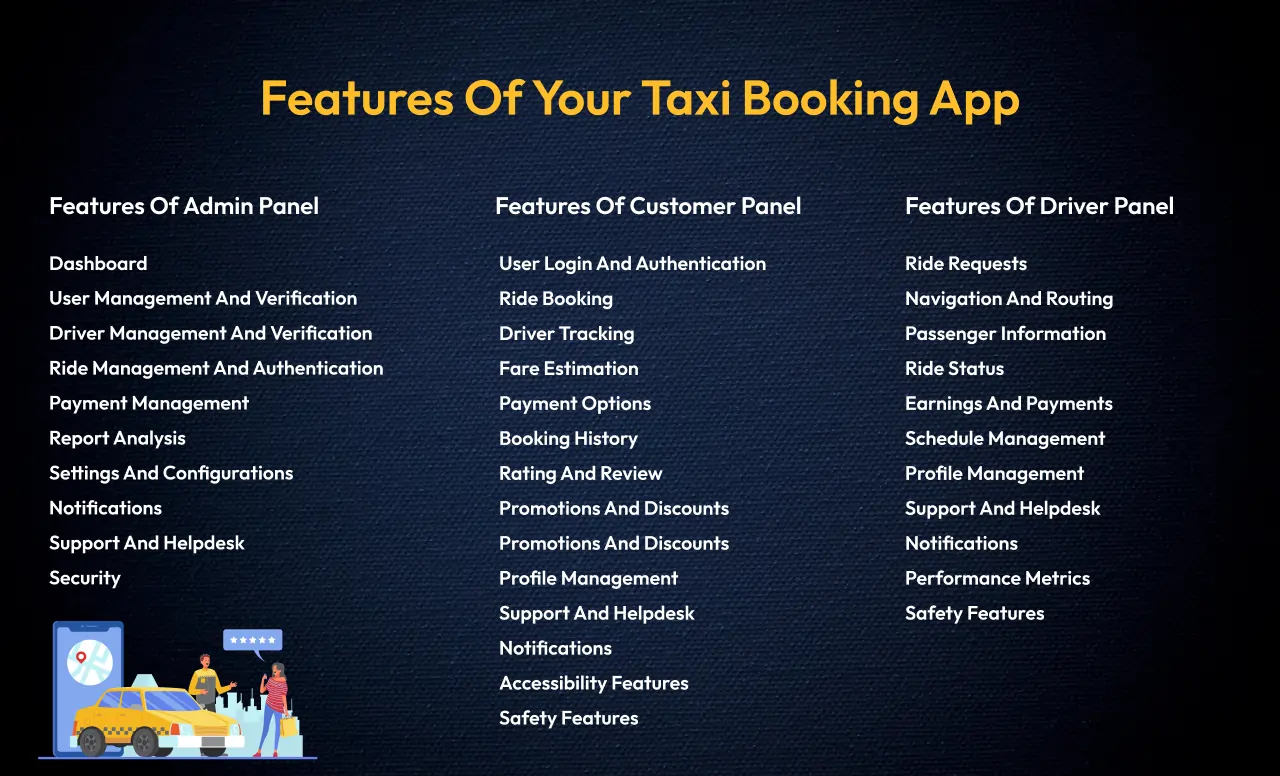
The feature set of your taxi booking application plays a critical role in determining both development cost and overall user experience. Depending on how you distribute functionality across the admin, customer, and driver panels, the complexity and therefore the cost can vary significantly.
For example, you may prioritize a powerful admin dashboard with advanced analytics, or focus on enhancing the driver panel to optimize ride efficiency. The final cost depends on the depth and sophistication of features implemented in each module.
Admin Panel Features
The admin panel acts as the control center of the platform, enabling full operational oversight:
- Dashboard: Real time overview of platform activity and performance
- User Management & Verification: Manage and verify customer accounts
- Driver Management & Verification: Onboard, monitor, and approve drivers
- Ride Management: Track and manage all ongoing and completed rides
- Payment Management: Handle transactions, commissions, and payouts
- Reports & Analytics: Generate insights on revenue, usage, and trends
- Settings & Configuration: Customize platform rules and parameters
- Notifications Management: Control system alerts and announcements
- Support & Helpdesk: Resolve user and driver issues efficiently
- Security Controls: Monitor and enforce platform safety and data protection
Customer (User) Panel Features
The customer app is the primary interface and must deliver a seamless, intuitive experience:
- User Login & Authentication: Secure onboarding and access
- Ride Booking: Easy trip scheduling with pickup and drop off selection
- Driver Tracking: Real time tracking of assigned drivers
- Fare Estimation: Transparent pricing before booking
- Multiple Payment Options: Cards, wallets, and cash support
- Booking History: Access to past trips and receipts
- Ratings & Reviews: Feedback system for service quality
- Promotions & Discounts: Offers to boost engagement and retention
- Profile Management: Manage personal information and preferences
- Support & Helpdesk: In app assistance for issues
- Push Notifications: Updates on ride status and offers
- Accessibility Features: Inclusive design for diverse users
- Safety Features: SOS button, trip sharing, and verification
Driver Panel Features
The driver app ensures efficient ride management and earnings tracking:
- Ride Requests: Receive and accept/reject trip requests
- Navigation & Routing: GPS based directions for optimal routes
- Passenger Information: Access trip and rider details
- Ride Status Updates: Manage trip stages (accepted, ongoing, completed)
- Earnings & Payments: Track income and payout history
- Ratings & Reviews: Feedback from passengers
- Schedule Management: Control availability and working hours
- Profile Management: Update driver details and documents
- Support & Helpdesk: Assistance for operational issues
- Notifications: Alerts for new rides and updates
- Performance Metrics: Insights into trips, ratings, and efficiency
- Safety Features: Emergency support and trip monitoring
The overall cost of building a taxi booking app depends heavily on how extensive and advanced these features are across each panel. A lean feature set reduces initial investment, while a fully integrated, feature rich platform increases cost but delivers stronger scalability and competitive advantage.
Engagement Models for Taxi Booking App Development Teams
The way you engage with your development team has a direct impact on both cost and project outcomes. Each engagement model offers different levels of control, flexibility, and scalability making it important to choose the one that aligns with your project scope and budget.
Managed Development Team
With a managed team model, you work with a dedicated group of developers who function similarly to an in house team.
- Direct communication and ongoing collaboration
- Ability to provide feedback and guide development in real time
- Option to use your own infrastructure for enhanced security
- Typically engaged on a project basis until deployment
Best for: End to end product development where you need consistency, control, and long term collaboration.
Hourly Based Hiring
This model is ideal when your project scope is flexible or still evolving.
- Pay only for the actual hours worked
- Suitable for feature enhancements, iterations, or uncertain requirements
- Developers can work on your infrastructure or their own, depending on project needs
Best for: Projects requiring continuous adjustments, small upgrades, or experimentation.
Freelance Developers
Freelancers can be a cost effective option for specific, short term tasks.
- Ideal for minor updates, bug fixes, or isolated features
- Lower upfront cost compared to full teams
- Limited scalability and coordination for large, complex projects
Best for: Small enhancements or post launch maintenance rather than full scale development.
Your chosen engagement model significantly influences development cost, timeline, and quality. A managed team offers stability and scalability, hourly hiring provides flexibility, and freelancers suit smaller tasks. Selecting the right model ensures efficient resource utilization and better project outcomes.
Final Thoughts
Investing in taxi booking application development in Vietnam presents significant opportunities but it also comes with technical, operational, and strategic challenges. On average, development costs range from $5,000 to $15,000+, depending on feature complexity, platform scope, and overall requirements. For a more accurate estimate, it’s best to consult with an experienced development partner who can assess your needs and provide a tailored roadmap.
Choosing the right technology partner is critical. Beyond development, a strong partner will help you optimize your app for app stores, improve visibility, and drive early user adoption key factors for gaining initial traction in a competitive market.
With deep expertise in Mobile App Development and Enterprise Software Development, HomeNest Software delivers end to end solutions from concept and development to launch and optimization ensuring maximum ROI and long term scalability.
Ready to bring your idea to life? Connect with HomeNest Software and turn your vision into a high performance, market ready application.
Frequently Asked Questions (FAQs)
What is a taxi booking app?
A taxi booking app is a mobile platform that connects passengers with drivers, allowing users to book rides, track trips in real time, and make payments digitally.
How much does it cost to develop a taxi booking app?
The cost typically ranges from $5,000 to $15,000+, depending on features, platform choice, and development complexity. Advanced, enterprise level apps may cost significantly more.
How long does it take to build a taxi app?
An MVP can take 2–4 months, while a full featured, scalable application may require 4–8+ months, depending on scope and team size.
What are the essential features of a taxi booking app?
Core features include ride booking, real time tracking, driver matching, payment integration, push notifications, ratings and reviews, and an admin dashboard.
Which business model is best for a taxi app?
Popular models include aggregator, fleet ownership, hybrid, franchise, and corporate partnerships. The best choice depends on your target market and operational capacity.
Should I build for Android, iOS, or both?
For maximum reach, most businesses choose both platforms. Cross platform frameworks can help reduce cost and development time.
What factors affect taxi app development cost?
Key factors include feature complexity, UI/UX design, backend infrastructure, platform choice, third party integrations, security requirements, and the development team’s location.
How do taxi booking apps generate revenue?
Revenue streams include ride commissions, surge pricing, subscription plans, advertising, and partnerships with businesses or enterprises.
Is it better to hire a dedicated team or freelancers?
A dedicated development team for hire is ideal for full scale projects, offering better coordination and scalability, while freelancers are more suitable for small tasks or updates.
Why choose HomeNest Software for taxi app development?
HomeNest Software provides end to end solutions across Mobile App Development and Enterprise Software Development, helping businesses build scalable, secure, and high performance taxi booking platforms tailored to their goals.
Latest Articles
View All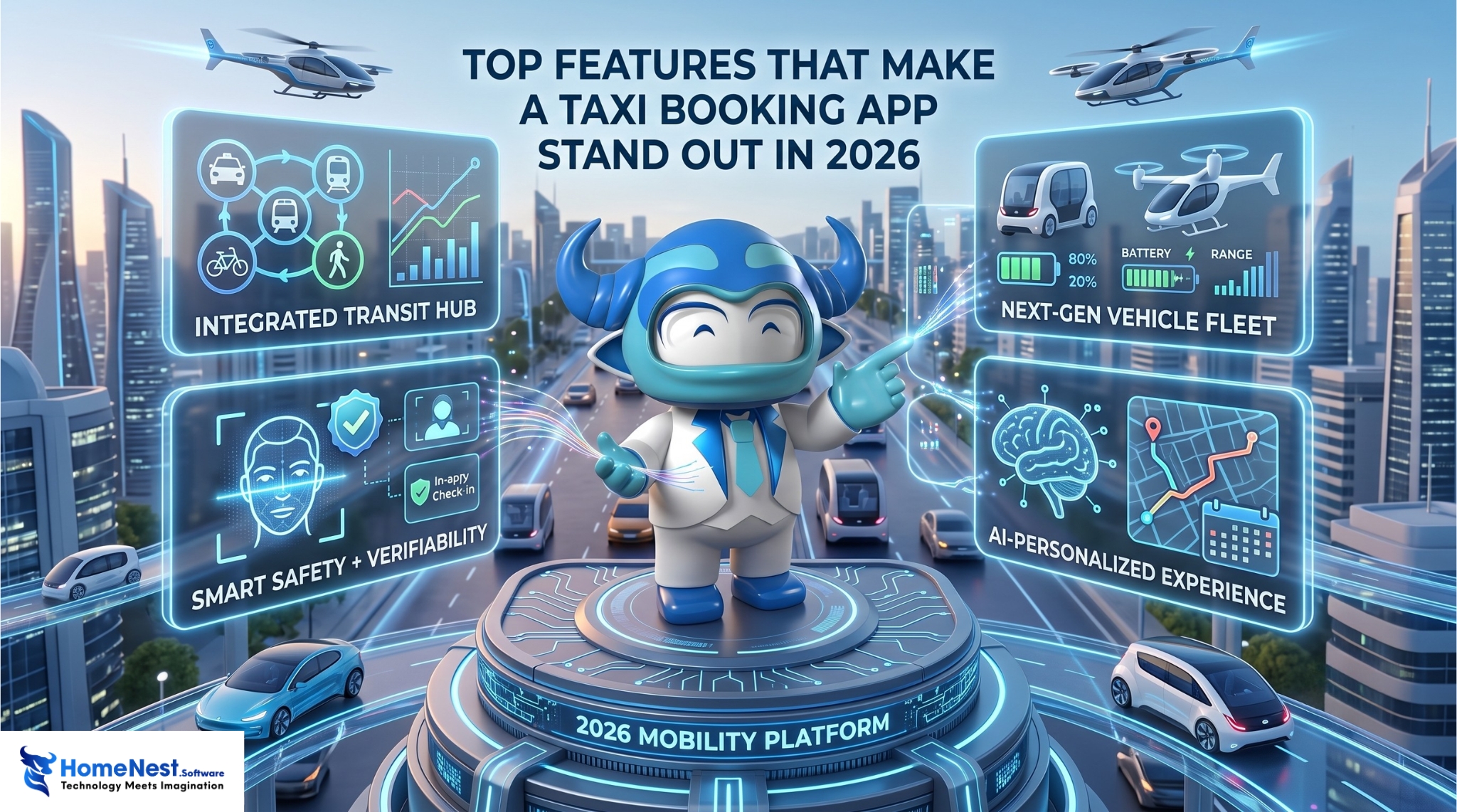
Top Features That Make A Taxi Booking App Stand Out In 2026
Building a standout taxi booking app in 2026 requires a forward-looking tech strategy. From AI-driven personalized booking and real-time IoT telematics to scalable cloud-native engineering, HomeNest Software highlights the essential features and technical recommendations needed to boost user retention, optimize fleet operations, and dominate the modern mobility market.
How Much Does It Cost To Develop A Food Delivery App Like Zomato?
Discover the complete cost breakdown and technical roadmap to build a Zomato-like food delivery app with HomeNest Software. This guide explores budget tiers, the essential 4-panel architecture (Customer, Merchant, Driver, Admin), modern tech stack recommendations, and proven monetization strategies. Learn how HomeNest Software transforms your digital platform vision into a scalable, high-yielding business asset!

GitHub vs GitLab – Architecture and Selection Guide
Managing source code requires stable infrastructure. Automating software releases requires reliable pipelines. Tool sprawl creates operational complexity. Engineering teams face friction when using fragmented DevOps tools. Selecting between GitHub and GitLab shapes long term development efficiency.

The True Cost of an Employee: A Complete Breakdown for Employers
This article reveals that the true cost of an employee is typically 25% to 40% higher than their base salary due to hidden expenses like taxes, benefits, workspace, and recruiting. To address this, the guide provides a detailed 7-step framework to accurately calculate total employer costs, alongside actionable strategies to optimize budgets and improve retention without reducing pay.
Essential Tips To Develop A Music Streaming App
Discover expert tips to develop a successful music streaming app with HomeNest Software. This guide covers essential features, legal licensing, and scalable technology stacks. Learn how to build a robust, cross-platform application with AI personalization to stand out in the 2026 competitive audio market.

How to Build a Language Learning App Like Cake
Discover how to build a successful language learning app like Cake with this comprehensive guide from HomeNest Software. We explore market research, essential MVP features, advanced AI integrations, tech stack selection, and estimated development costs. Partner with HomeNest Software to create a scalable, gamified, and highly engaging educational platform tailored to your business goals. Start your app development journey with us today.